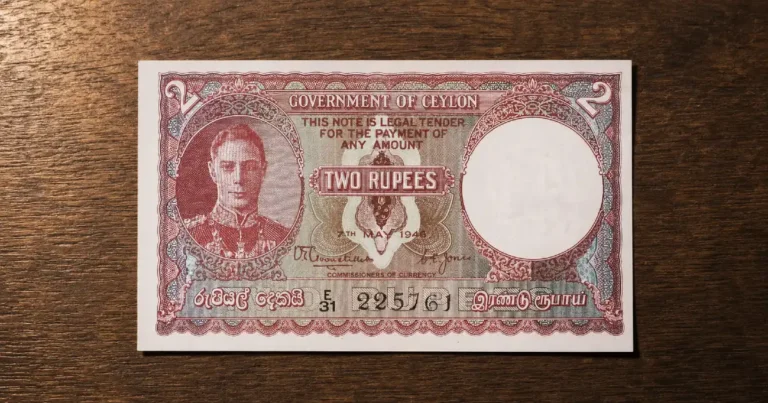
King George VI (KGVI) Burma overprint banknotes represent the final chapter of British administration paper currency in Burma. Released in consecutive phases starting in May 1945, these provisional series resolved a catastrophic monetary crisis by instantly stabilizing a newly liberated colony while it was still an active war zone. To achieve this, re-entering British authorities modified unissued vaults of King George VI Government of India and Reserve Bank of India banknotes with localized overprints. This strategic move transformed standard Indian currency into dedicated KGVI Burma overprint banknotes, establishing an immediate, legally binding network that successfully steered Burma from Axis occupation toward full independence.
The provisional money supply was split across two distinct issuing eras: the initial Military Administration of Burma overprint banknotes placed into circulation from May 1945, and the subsequent civilian-led Burma Currency Board overprint banknotes introduced during the transitional months of 1947. Utilizing existing, high-security British India banknotes allowed the treasury to partition the currency supply overnight, ensuring that cash blocks remained geographically locked within Burma’s borders. Officially cataloged in the Burma chapter under Pick numbers Pick 25 through Pick 33 in the Standard Catalog of World Paper Money and references BNB B503 through BNB B604 in The Banknote Book, these issues are highly prized cornerstones of British Commonwealth numismatics.
Today, collectors study KGVI Burma overprint banknotes with an intense focus on underlying base note attributions, signature variations, and precise prefix configurations. Because the authorities used pre-war and wartime Indian note bases, the series contains critical combinations of signatures, serial number ink colors, and prefix range that serve as the primary line of defense against forgeries. This comprehensive reference guide provides an exhaustive technical analysis of both overprint eras, documenting their historical genesis, exact catalog numbering alignments, and diagnostic authentication protocols.
Liberation and Monetary Mobilization in 1945
The origins of the post-occupation KGVI Burma overprint banknotes lie in the intense, late-war campaigns of early 1945. As Allied forces successfully broke through Japanese defensive lines along the Irrawaddy River and advanced rapidly toward Rangoon, they faced an economic landscape that was completely fractured.
The Collapse of Japanese Occupation Currency
During the three years of Axis occupation, the puppet administration had flooded the domestic marketplace with unbacked, un-serialized Japanese Invasion Money (JIM). Concurrently, the puppet regime established the Burma State Bank banknotes system to further exploit local resources. As the Japanese army faced imminent military defeat, public confidence in this occupation scrip evaporated instantly. Hyperinflation tore through local markets, turning the occupation currency into worthless paper overnight. Merchants refused to accept the notes, barter systems emerged, and the domestic trade network ground to a complete halt.
The Urgent Mandate for Currency Stabilization
When Allied forces liberated major trading hubs, the re-entering authorities faced an immediate crisis — they needed Military Administration of Burma overprint banknotes in circulation from day one. Leaving the local population with no stable currency risked triggering severe civil unrest, which would undermine the entire ongoing military mobilization.
Military Administration to Burma Currency Board
The British solved this challenge using a two-stage provisional strategy. First, beginning in May 1945 while the Pacific war was still actively raging, the military government placed the first Military Administration of Burma overprint banknotes into active circulation across liberated towns. Once the region stabilized and military units handed over governance to a reconstructed civilian leadership, the monetary mantle was passed to the Burma Currency Board overprint banknotes in 1947, forming the second and final phase of the KGVI provisional currency program. Together, these two temporary overprint issues successfully held the country’s economy together, acting as a crucial monetary bridge that lasted until the historic declaration of the independent Union of Burma in January 1948.
Historical Genesis and Restoration Logistics
The physical logistics behind the 1945 monetary restoration reveal how closely linked military planning was with currency security. The British could not wait until a custom, sovereign banknote series could be designed and engraved; they required millions of physical notes packed into crates, ready to move forward behind the advancing front lines.
The Return of Allied Forces and the May 1945 Proclamation
Following the formal activation of the military government under senior Allied commands, a historic monetary proclamation was issued in May 1945. This decree instantly demonetized all Japanese occupation scrip, rendering it illegal to possess or trade.
Why the Treasury Re-Introduced Modified Indian Currency Notes
The fastest, most secure method to supply the liberation forces with cash was to tap into the massive reserves of unissued banknotes resting inside the vaults of the Government of India. These notes, once overprinted, would become trusted KGVI Burma overprint banknotes already familiar to banking officials, recognized by the local population, and built using complex intaglio security plates that were nearly impossible for local counterfeiters to replicate.
However, the treasury encountered a massive financial problem: if they injected standard, unmodified Indian banknotes into Burma, those same notes could easily drift back into the Indian mainland via unchecked post-war trade or black-market networks. This uncontrolled flow would create severe accounting chaos for the Reserve Bank of India. To prevent this capital flight, the notes had to be permanently partitioned. The solution was an aggressive, mandatory overprinting program that legally restricted the currency’s geographic jurisdiction solely to the borders of Burma.
The Mechanics of Overprinting at the India Security Press in Nasik
To execute this program, the authorities turned to the India Security Press located at Nasik. Selected unissued sheets of King George VI Indian currency notes were routed away from regular packaging lines and sent into secondary letterpress printing grids.
Using heavy metal type justification frames, the press operators applied the intense text stamps directly onto the finished paper sheets. Because this process was handled as a secondary pass over pre-printed and serialized notes, minute positioning shifts of the overprint type block can be observed, making the study of type alignment a highly engaging field for advanced specialists.
Base Note Portrait Specifications and Typographic Variations
Before analyzing individual denominations, collectors must master the precise typographic layouts, stamp configurations, and design traits that define these two consecutive overprint eras.
King George VI Portrait Typologies: Side-Face vs. Front-Face Designs
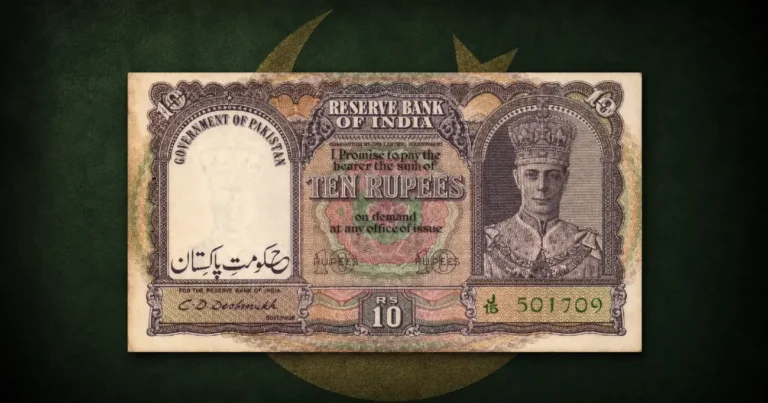
The foundational paper assets utilized for this entire post-occupation program belonged to the classic King George VI Government of India and Reserve Bank of India series. For the 1, 5, and 100 Rupee values, the design featured the iconic side-face portrait of the King, showing his profile facing strictly to the left. The 10 Rupees value stood out as a sharp visual exception, utilizing a magnificent front-face portrait where the monarch looks directly forward at the viewer.
Denomination Specific Overprint Layouts, Lines, and Stamp Colors
Unlike the pre-war 1937 provisional issues, which applied a uniform consistent single-line overprint, the Military Administration of Burma overprint banknotes display considerably less consistency. The line arrangement, positioning, and ink color vary significantly from denomination to denomination
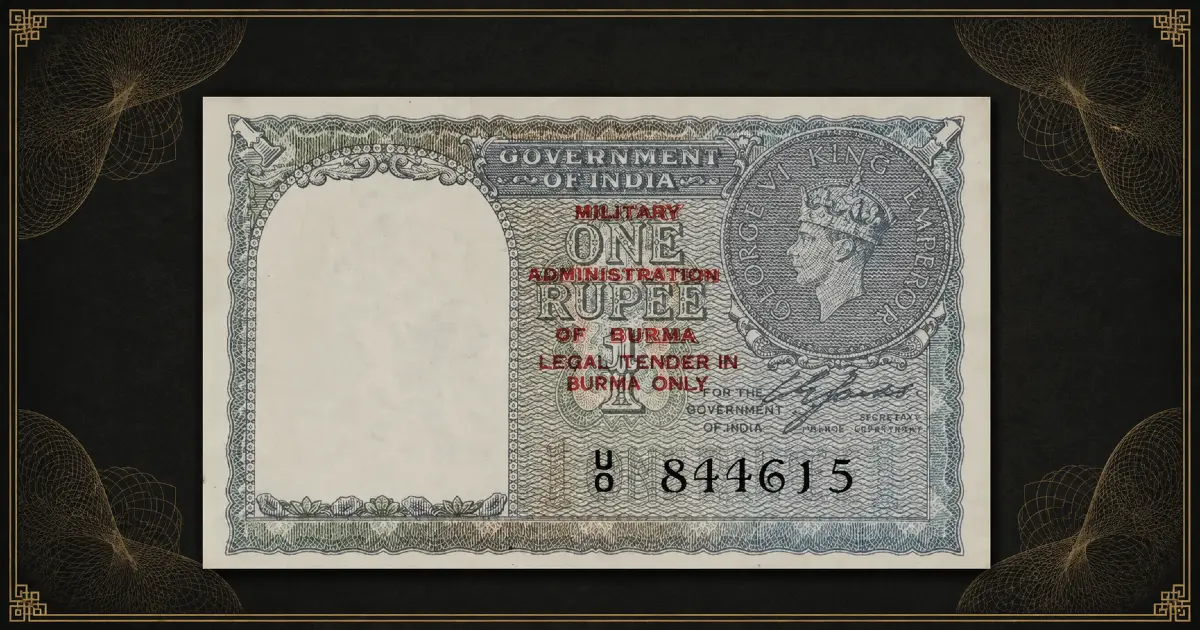
- 1 Rupee Note: Five-line red overprint block struck centrally across the note. The first three lines read “MILITARY / ADMINISTRATION / OF BURMA” followed by a shared two-line “LEGAL TENDER IN / BURMA ONLY” block.
- 5 Rupees Note: Dark blue or black overprint elements: “MILITARY ADMINISTRATION OF BURMA” across the upper design area, and a two-line “LEGAL TENDER IN / BURMA ONLY” block within the central text panel.
- 10 Rupees Note: Red overprint in English struck in the lower design area. The first two lines read “MILITARY ADMINISTRATION / OF BURMA” for Pick 28 followed by a shared two-line “LEGAL TENDER IN / BURMA ONLY” block. Uniquely among the series, this denomination carries an additional Burmese script overprint struck directly above the “TEN RUPEES” denomination text and Burmese numeral on left and right of “10” at the bottom because the underlying Indian base note omitted Burmese language from its reverse multilingual panel.
- 100 Rupees Note: Two separate red overprint elements struck across the obverse face. The upper two-line block reads “MILITARY ADMINISTRATION / OF BURMA” positioned across the upper design area directly below “RESERVE BANK OF INDIA”. A second two-line block reading “LEGAL TENDER IN / BURMA ONLY” is struck separately within the central promise text panel.
When production transitioned to the civilian Burma Currency Board overprint banknotes in 1947, the overprint line frameworks and colors remained nearly identical to the military issues. The only fundamental modification was the physical change of the text within the type justification frame, replacing the words MILITARY ADMINISTRATION OF BURMA with BURMA CURRENCY BOARD.
The Absence of Reverse Overprints: A Key Crossover Distinction
A critical technical distinction must be noted by advanced collectors who are cross-referencing their collections with earlier colonial issues: unlike the pre-war King George V provisional series, no overprint text was applied to the back of these King George VI notes. The reverse remained completely untouched, preserving the pure, original Indian intaglio back designs. This architectural difference provides a powerful visual contrast when linking your post-occupation collection back to the pre-war KGV Burma overprint banknotes article.
Military Administration of Burma Overprint Banknotes
The initial emergency currency series placed into circulation in May 1945 consisted of four circulating denominations of KGVI Burma overprint banknotes. This family is defined by the explicit typography of the Military Administration of Burma overprint.
Master Military Administration of Burma Banknote Cross-Reference Matrix
| Denomination | Burma Pick Number | Base Note India Pick | Banknote Book Burma | Base Note India BNB |
|---|---|---|---|---|
| 1 Rupee | Pick 25a | Pick P25a | BNB B503a | BNB B151a |
| 1 Rupee | Pick 25b | Pick P25d | BNB B503b | BNB B151d |
| 5 Rupees | Pick 26a | Pick 18a | BNB B504a | BNB B202a |
| 5 Rupees | Pick 26b | Pick 18b | BNB B504b | BNB B202b |
| 10 Rupees | Pick 28 | Pick 24 | BNB B506 | BNB B208 |
| 100 Rupees | Pick 29a | Pick 20d | BNB B507a | BNB B204a2 |
| 100 Rupees | Pick 29b | Pick 20e | BNB B507b | BNB B204b2 |
1 Rupee Military Administration of Burma Banknote (Pick 25a / Pick 25b)
The low-value entry of the Military Administration of Burma overprint banknotes, designed to flood local markets with small-change security paper.
- Dimensions: 101 x 63 mm
- Primary Color: Blue-gray
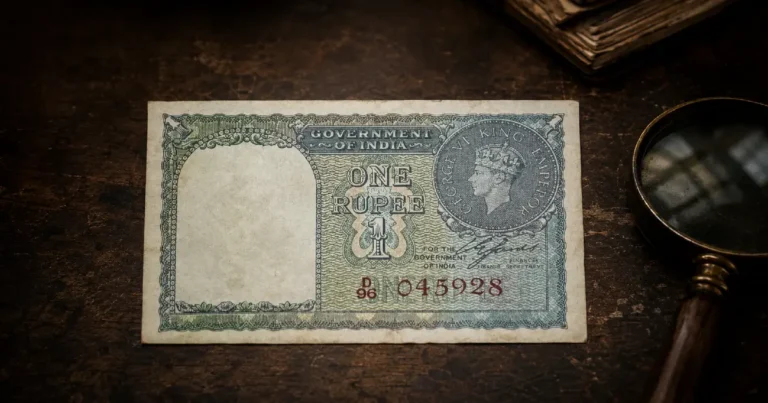
- Obverse Design: Indian 1-rupee silver coin with King George VI facing left
- Reserve Design: Reverse of Indian 1-rupee silver coin dated 1940; language panel
- Variety 1 (Pick 25a / BNB B503a): Black serial number printed without any inset letter
- Prefixes: T/99, U/0, and U/1
- Variety 2 (Pick 25b / BNB B503b): Green serial number incorporating A inset letter
- Prefixes:
- C/86 to C/99
- D/0 to D/71
- E/42 to E/99
- F/0 to F/61
- Prefixes:
5 Rupees Military Administration of Burma Banknote (Pick 26a / Pick 26b)
A vital commercial note heavily distributed throughout urban retail networks and military centers.
- Dimensions: 127 x 73 mm
- Primary Colors: Brown, violet, and green
- Obverse Design: King George VI facing left
- Reserve Design: Language panel
- Variety 1 (Pick 26a / BNB B504a): Signature of J.B. Taylor
- Prefixes: J/62 to J/65
- Variety 2 (Pick 26b / BNB B504b): Signature of C.D. Deshmukh
- Prefixes:
- N/20 to N/31
- N/75 to N/80
- P/11 to P/48
- Prefixes:
10 Rupees Military Administration of Burma Banknote (Pick 28 / BNB B506)
The 10 Rupees Military Administration of Burma banknote was the primary transactional note for merchant clearings, featuring the prominent front-face portrait of KGVI.
- Dimensions: 145 x 80 mm
- Primary Colors: Violet, olive green, and brown
- Obverse Design: King George VI facing front
- Reserve Design: Language panel; sail boat
- Production Details: Issued as a single variety featuring the signature of C.D. Deshmukh.
- Prefixes:
- C/0 to C/10
- C/79 to C/90
- D/56 to D/75
100 Rupees Military Administration of Burma Banknote (Pick 29a / Pick 29b)
The 100 Rupees Military Administration of Burma banknote was the highest circulating value of the military era, printed exclusively using the Calcutta Circle base stocks.
- Dimensions: 170 x 107 mm
- Primary Colors: Green, pink, and orange
- Obverse Design: King George VI facing left
- Reserve Design: Language panel; Bengal tiger
- Variety 1 (Pick 29a / BNB B507a): Signature of J.B. Taylor
- Prefixes:
- A/62 (serials 900001 to 1000000)
- A/73 (serials 000001 to 200000)
- Prefixes:
- Variety 2 (Pick 29b / BNB B507b): Signature of C.D. Deshmukh
- Prefixes:
- A/89 (700001 to 1000000)
- A/98 (000001 to 100000)
- B/7 (600001 to 1000000)
- B/16 (000001 to 700000)
- B/23 (700001 to 1000000)
- B/47 (000001 to 100000)
- Prefixes:
The Unissued 10 Rupees Specimen (Pick 27)
The 1945 military restoration series include the unissued 10 Rupees overprint note cataloged as Burma Pick 27. Prepared using the earlier Indian base note (India Pick 19 / BNB B203) which featured the left-facing side-face profile portrait of King George VI, this note was fully overprinted at Nasik but never released into general circulation. It is known today only in specimen form.
Modern research indicates that the likely reason this 10 Rupees note was abandoned was that the underlying Indian side-face base note had been widely and deceptively counterfeited by Japanese intelligence teams during the war. To destabilize the British Indian economy, Axis printing facilities had flooded the border regions with high-quality counterfeits of this specific note type.
Realizing that overprinting a compromised base note would leave the military currency highly vulnerable to immediate disruption, the authorities canceled the release and moved production exclusively to the front-face portrait base note (Pick 28).
Burma Currency Board Overprint Banknotes
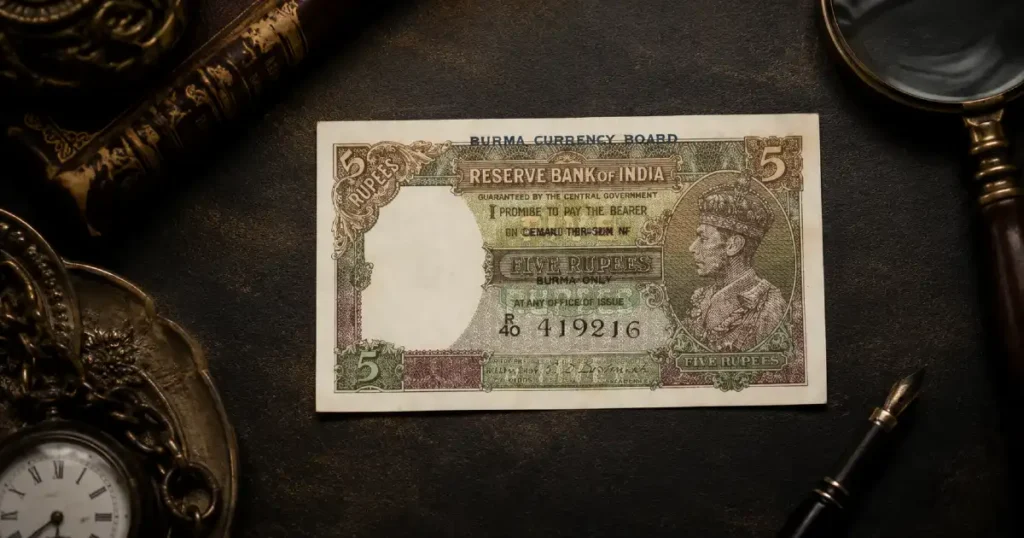
In 1947, as military administration dissolved and the colony prepared for full civilian rule, the responsibility for the money supply shifted to the newly created civilian authority based out of London. This family is characterized by the explicit typography of the Burma Currency Board overprint banknotes, distinguishable from the military issues by the replacement of the military text block with the civilian board designation.
The London Accord and the Shift to Civilian Control
Following negotiations in London, the civilian board assumed full control over the local money supply. This body was tasked with a final transition: winding down the use of KGVI Burma overprint banknotes while preparing the country’s first post-war definitive banknotes. To maintain stability during this brief interim year, they ordered a final run of Burma Currency Board overprint banknotes using the remaining stocks at Nasik, creating four clean, highly collectible Burma Currency Board overprint banknotes.
Master Burma Currency Board Banknote Cross-Reference Matrix
| Denomination | Burma Pick Number | Base Note India Pick | Banknote Book Burma | Base Note India BNB |
|---|---|---|---|---|
| 1 Rupee | Pick 30 | Pick P25d | BNB B601 | BNB B151d |
| 5 Rupees | Pick 31 | Pick 18b | BNB B602 | BNB B202b |
| 10 Rupees | Pick 32 | Pick 24 | BNB B603 | BNB B208 |
| 100 Rupees | Pick 33 | Pick 20e | BNB B604 | BNB B204b2 |
1 Rupee Burma Currency Board Banknote (Pick 30 / BNB B601)
- Dimensions: 101 x 63 mm
- Primary Color: Blue-gray
- Obverse Design: Indian 1-rupee silver coin with King George VI facing left
- Reserve Design: Reverse of Indian 1-rupee silver coin dated 1940; language panel
- Production Details: Green serial number incorporating A inset letter
- Prefixes:
- K/27 to K/66
- Q/17 to Q/36
5 Rupees Burma Currency Board Banknote (Pick 31 / BNB B602)
- Dimensions: 127 x 73 mm
- Primary Colors: Brown, violet, and green
- Obverse Design: King George VI facing left
- Reserve Design: Language panel
- Production Details: Signature of C.D. Deshmukh
- Prefixes: R/24 to R/41
10 Rupees Burma Currency Board Banknote (Pick 32 / BNB B603)
- Dimensions: 145 x 80 mm
- Primary Colors: Violet, olive green, and brown
- Obverse Design: King George VI facing front
- Reserve Design: Language panel; sail boat
- Production Details: Signature of C.D. Deshmukh
- Prefixes:
- G/31 to G/42
- H/73 to H/82
- J/43 to J/50
100 Rupees Burma Currency Board Banknote (Pick 33 / BNB B604)
- Dimensions: 170 x 107 mm
- Primary Colors: Green, pink, and orange
- Obverse Design: King George VI facing left
- Reserve Design: Language panel; Bengal tiger
- Production Details: Printed using the Calcutta Circle and featuring the signature of C.D. Deshmukh
- Prefixes:
- B/47 (serial numbers 600001 to 1000000)
- B/52 (full run)
- B/53 (serial numbers 000001 to 800000)
Advanced Collecting Varieties and Specialized Crossover Themes
Beyond standard denomination types, KGVI Burma overprint banknotes host several highly specialized collecting niches that enjoy immense popularity among advanced specialists.
Completing the Prefix Runs and Collecting Key Boundary Blocks
A highly popular collecting strategy among specialists involves assembling complete prefix runs across the entire timeline of the overprint issues. For example, the 5 Rupees overprints present a beautiful, multi-era challenge requiring the collection of prefixes J, N, P, and R across both the military and civilian issues. Similarly, the 10 Rupee notes require tracking prefixes C, D, G, H, and J to build a complete authority sequence.
Advanced specialists also fiercely compete for boundary blocks, which include the very first and absolute last prefix runs of an overprint production run. These boundary pieces provide concrete material evidence of the exact operational brackets used by the presses at Nasik.
Collectible Archival Annotations and Ledger Notations
Among the more overlooked collecting areas within British Burma numismatics are notes carrying original handwritten annotations from colonial treasury officials. Bank tellers and government accountants routinely recorded ink notes, cross-references, and inventory figures directly onto the notes as part of routine auditing procedures.
Rather than reducing a note’s interest, these handwritten markings elevate it into a primary historical document. Each annotation is a direct trace of how that specific note moved through government or banking hands during Burma’s turbulent return to British administration.
Localized Town Stamps, Bank Seals, and Treasury Markings
An equally rewarding collecting area involves notes bearing town stamps, bank seals, or official treasury handstamps applied during circulation. Each ink strike ties a note to a specific geographic location, creating a direct connection to the town or institution that once handled it. For collectors drawn to historical narrative, a note carrying a clear, readable town or treasury stamp tells a story that a crisp uncirculated example simply cannot — placing that specific piece of paper within a real place, at a defining moment in Burma’s history.
“Burma Note Payment Refused” Stamps
Following the steady stabilization of the local economy, the Military Administration notes were officially demonetized on 1 June 1950, followed by the complete demonetization of the Currency Board notes on 28 December 1952. This withdrawal triggered a unique financial crisis. Because standard, non-overprinted Government of India banknotes remained completely legal tender in India until their eventual demonetization deadline on 27 October 1957, illicit syndicates and desperate cash holders attempted to remove the Burma overprints.
To combat this widespread fraud, the Reserve Bank of India enacted strict counter-measures. Bank tellers carefully scrutinized all incoming KGVI cash; when a washed or scraped note was detected, it was instantly stamped with a large, bold ink strike reading BURMA NOTE PAYMENT REFUSED.
To combat this widespread fraud, the Reserve Bank of India enacted strict counter-measures. Bank tellers carefully scrutinized all incoming KGVI cash; when a washed or scraped note was detected, it was instantly stamped with a large, bold ink strike reading BURMA NOTE PAYMENT REFUSED. Today, genuine “Payment Refused” stamps are collected as artifacts in their own right. However, their appeal has also attracted modern fakes bearing counterfeit handstamps. Always verify that the underlying note falls strictly within the confirmed Burma prefix ranges detailed in this guide before finalizing any acquisition.
Forensic Forgery Diagnostics and Technical Authentication
To safeguard a collection against significant financial loss, numismatists must understand the historical and economic forces that shaped the forgery landscape surrounding KGVI Burma overprint banknotes. Because these banknotes were modified from genuine Government of India sheets, counterfeiters cannot be exposed by analyzing the paper fabric or watermarks alone. Instead, authentication requires a highly disciplined forensic approach that separates fraudulent pieces into two distinct historical categories.
Identifying Contemporary Circulation Forgeries
Contemporary circulation forgeries were manufactured during the actual period of use to cheat local merchants, pay for black-market goods, or facilitate underground trade. This phenomenon almost exclusively targeted the high-value 100 Rupees overprint banknotes.
The vast majority of these period fabrications are characterized by low-quality printings. Intriguingly, contemporary counterfeiters were highly meticulous regarding operational data; they almost always copied the exact, authentic serial number prefix ranges of the genuine overprint notes to pass basic screenings. While most surviving contemporary pieces are crude, select high-quality examples are known to exist, requiring close under-magnification ink audits to detect.
Identifying Modern Numismatic Forgeries
Modern forgeries are fabrications created decades after the notes left active circulation, engineered explicitly to cheat collectors in the numismatic investment market. This threat primarily targets the 1 Rupee overprint series, driven heavily by market dynamics during the 1980s and 1990s. During those decades, the market price for an authentic Burma 1 Rupee note soared, while the common, non-overprinted Indian 1 Rupee base note remained incredibly cheap and readily available in large quantities. This massive value gap led to a significant influx of modern fakes entering the market in the mid-1990s.
Fortunately, modern forgeries can be easily exposed through two definitive tests:
- Prefix Allocation Auditing: Modern counterfeiters routinely apply fake overprint stamps to common Indian base notes that fall completely outside the recorded Burma prefix parameters. Any banknote sitting on an unrecorded prefix string must be immediately rejected.
- The Serial Number Inset Letter Trap: The Serial Number Inset Letter Trap: Counterfeiters producing fake 1 Rupee overprints consistently added an inset A to their black serial number forgeries — having mostly encountered genuine Burma examples with an inset A, they assumed all notes carried one. This assumption was wrong. Genuine black serial number examples were issued without any inset letter. The moment an inset A appears on a black serial number note, the forgery is immediately exposed.
Why Advanced Collectors Preserved and Catalog Reference Forgeries
Ultimately, far from dismissing these deceptive pieces, advanced numismatists often deliberately seek out and catalog both contemporary and modern forgeries, transforming them from market liabilities into invaluable reference specimens for ongoing research, comparative authentication, and historical study.
Conclusion and Legacy: The Monetary Bridge to Independence
Though born out of absolute economic necessity, the King George VI overprint banknotes of 1945–1947 represent a major triumph of colonial monetary engineering. They successfully prevented a hyperinflationary collapse during the chaos of liberation, giving the region a stable medium of exchange that allowed the physical infrastructure of the country to be safely rebuilt.
These KGVI Burma overprint banknotes served as the vital bridge that guided the economy through the dissolution of military governance and the final transition into civilian administrative control. For any numismatist building a complete reference library of British Burma, these provisional overprints stand as absolute keystones, preserving the rich, tumultuous history of a country on the verge of independence.
To trace how this monetary timeline began before the outbreak of World War II, see our definitive guide to the pre-war RBI Peacock Series banknotes. Alternatively, to see the artistic peak of sovereign Burmese paper money that replaced these temporary overprints following full decolonization, continue to our comprehensive study on the post-independence Government of Burma and Union of Burma banknotes.