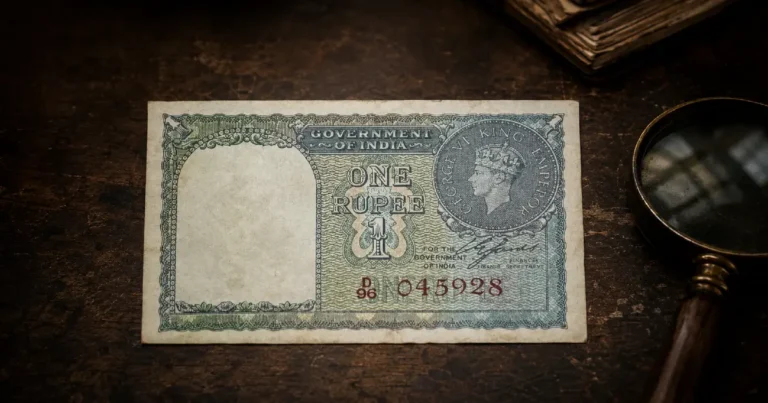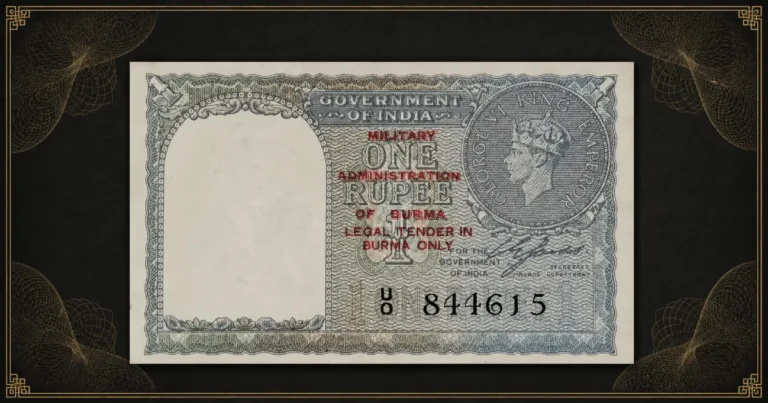
Pakistan King George VI banknotes are among the most important transitional issues in South Asian paper money. They were introduced after the partition of British India, when the new Dominion of Pakistan urgently needed a functioning currency system before it could establish its own central bank and permanent national banknote series.
Collectors often call these notes Pakistan overprint banknotes, and that phrase remains widely used in the market. However, genuine examples are more accurately described as Pakistan inscribed banknotes because the English and Urdu “Government of Pakistan” text was incorporated into the printing plates, not added later as a simple surface overprint. This distinction is important for authentication, especially because many false Pakistan overprints have appeared on genuine Indian King George VI base notes. The 1948 Pakistan provisional series was issued in five denominations: 1 rupee, 2 rupees, 5 rupees, 10 rupees, and 100 rupees.
For collectors, Pakistan King George VI banknotes are important because they belong to the first stage of Pakistan’s monetary history. They also connect British India, early Pakistan, and post-partition currency administration in one compact series. Their value is driven by historical significance, denomination, condition, prefix range, and authenticity. Because genuine Pakistan notes are usually worth more than ordinary Indian base notes, careful authentication is essential.
This guide explains the historical background, legal framework, denominations, catalogue references, authorized prefixes, inscription types, counterfeit risks, and authentication methods for Pakistan King George VI banknotes.
Table of Contents
What Are Pakistan King George VI Banknotes?
Pakistan King George VI banknotes are provisional currency notes prepared for Pakistan after independence in 1947 and introduced in 1948. They used existing British India note designs featuring King George VI, but with Pakistan inscriptions added to identify them for circulation in the new country.
The five denominations are: 1 Rupee, 2 Rupees, 5 Rupees, 10 Rupees, and 100 Rupees. The 1 rupee note was issued by the Government of India. The 2, 5, 10, and 100 rupee notes were issued by the Reserve Bank of India. All five were modified with English and Urdu Government of Pakistan inscriptions.
In collector language, these notes are often called Pakistan overprint banknotes. That name is understandable because they look like Indian notes with Pakistan text added. Technically, however, genuine examples were not ordinary overprints. The Pakistan inscriptions were incorporated into the printing plates used for production. For this reason, advanced collectors and cataloguers often use the more accurate term Pakistan inscribed banknotes or amended plates provisional issue.
These notes were a temporary solution. Pakistan did not yet have a fully operational central bank, domestic note printing system, or permanent national banknote series at independence. The Reserve Bank of India therefore continued to act as Pakistan’s temporary monetary authority under special legal arrangements.
The notes are best understood as 1948 Pakistan provisional issues. They are neither ordinary Indian banknotes nor fully independent Pakistani designs. They belong to the short transition between British India currency and the later banknotes issued by the State Bank of Pakistan. Circulating from 1948 and demonetized on 1 January 1952, the series had an active life of less than four years.
Partition and Currency Shortage
The partition of British India created two new dominions: Pakistan and India. Pakistan came into existence on 14 August 1947, followed by Indian independence on 15 August 1947. Pakistan was formed from two geographically separated regions: West Pakistan and East Pakistan, the latter largely created from East Bengal (present-day Bangladesh).
The plan for partition was announced on 3 June 1947. This left only a little over two months before independence. Such a short transition period created immediate administrative challenges, including the need to provide a reliable supply of currency.
Before partition, British India had a unified monetary system. Banknotes were issued by the Government of India and the Reserve Bank of India. Pakistan did not yet have its own central bank, domestic security printing facility, currency issue department, or ready national banknote designs.
Without emergency arrangements, Pakistan would have faced a serious currency shortage. Trade, salaries, banking, taxation, government payments, and daily commerce all required a stable supply of notes. The practical solution was to allow Indian notes to continue circulating temporarily and then introduce modified Indian notes carrying Government of Pakistan inscriptions.
This emergency monetary situation explains why Pakistan King George VI banknotes were created. They were created because independence arrived faster than the administrative machinery needed to support a separate currency system.
Pakistan Monetary System and Reserve Bank Order
The legal foundation for the 1948 Pakistan provisional issues was the Pakistan (Monetary System and Reserve Bank) Order, 1947. This order allowed the Reserve Bank of India to continue as the common currency authority for India and Pakistan during the transitional period.
Under this arrangement, notes issued by the Reserve Bank of India and the Government of India remained legal tender in Pakistan for a limited time. The order also allowed notes to be inscribed with “Government of Pakistan” in English and Urdu, so that they could be placed into circulation for Pakistan.
The original arrangement allowed the Reserve Bank of India to continue as Pakistan’s monetary authority until 30 September 1948. However, the political and economic relationship between India and Pakistan became increasingly difficult after partition. Issues connected to financial assets, refugee movement, administrative separation, and monetary independence created pressure for Pakistan to establish its own central bank sooner. The arrangement was shortened. The Reserve Bank ceased to act as Pakistan’s monetary authority on 30 June 1948. The State Bank of Pakistan began operations on 1 July 1948.
This short timeline gives Pakistan King George VI banknotes their historical importance. They belong to the brief period when Pakistan was politically independent but still relied on Indian monetary infrastructure for note issue and currency supply.
Why Pakistan Used Indian Base Notes
Pakistan used modified Indian base notes because it had no practical alternative in the immediate aftermath of partition. A complete currency system requires secure paper, printing plates, special inks, serial numbering, note inspection, legal authority, banking coordination, and controlled distribution. These could not be created instantly.
No Domestic Security Printing Facility
Pakistan did not yet have a domestic banknote printing works capable of producing a complete national currency series. Security printing requires specialized machinery, secure paper, watermark control, engraving, plate preparation, numbering systems, and strict accounting procedures.
Short Transition Period
The partition plan was announced on 3 June 1947, and Pakistan became independent on 14 August 1947. This left too little time to design, approve, print, and distribute a completely new series.
Need for Monetary Continuity
A sudden shortage of currency would have disrupted commerce and administration. Using familiar Indian note designs helped maintain public confidence and allowed trade and banking to continue.
Temporary Reserve Bank of India Authority
Because the Reserve Bank of India temporarily remained responsible for Pakistan’s monetary system, modified RBI and Government of India notes were a practical transitional solution.
For collectors, these circumstances explain why Pakistan overprint banknotes retain Indian design elements, Indian signatures, and Indian base note references while still forming part of Pakistan’s first currency history.
Pakistan Overprint Banknotes vs Pakistan Inscribed Banknotes
Collectors and dealers widely use the phrase Pakistan overprint banknotes. It is useful for search and market recognition. However, collectors should understand the technical difference between the popular name and the actual production method.
A true overprint is normally added after a banknote has already been printed. It may be applied by a separate printing pass, handstamp, surcharge, or later surface-printing process. This is different from the Pakistan King George VI notes.
The genuine Pakistan issues were plate-inscribed. The English “GOVERNMENT OF PAKISTAN” text and the Urdu “Hakumat-e-Pakistan” (حکومتِ پاکستان) inscription were incorporated into the printing plates. They were not simply stamped onto finished Indian notes.
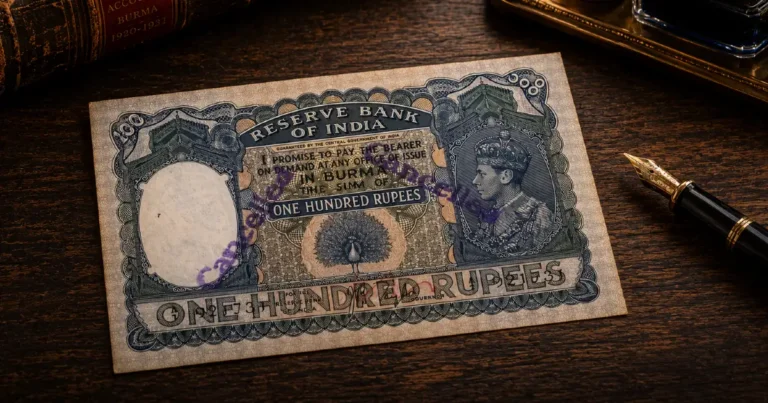
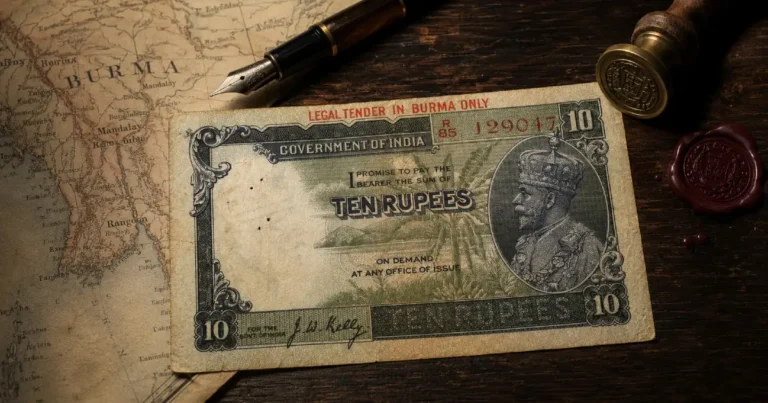
This difference can be compared with the King George VI Burma issues. Burma notes were genuine overprint issues, while Pakistan notes were plate-inscribed provisional issues. For a related comparison, see our guide to KGVI Burma overprint banknotes.
The distinction matters because many fake Pakistan overprints are made by taking genuine Indian King George VI notes and adding imitation Pakistan text. The base note may be authentic, but the Pakistan inscription may be false. This is the main authentication risk in the series.
Main Design Features
Pakistan King George VI banknotes retained the general appearance of their Indian base notes. The Government of Pakistan inscription in the watermark area is the key identifying feature.
King George VI Portrait Types
The 1 rupee, 2 rupees, and 100 rupees notes show King George VI in side profile facing left. This was the classic side-face portrait style used on several British India issues.
The 5 rupee and 10 rupee notes show a front-facing portrait of King George VI. These two denominations are visually distinct from the side-face values.
English and Urdu Inscriptions
Each genuine note carries two Government of Pakistan inscriptions in the watermark area:
- “GOVERNMENT OF PAKISTAN” in English
- “Hakumat-e-Pakistan” in Urdu
The English inscription appears toward the upper part of the watermark panel. The Urdu inscription appears toward the lower part. Together, they identify the note as intended for Pakistan.
Signatures
The 1 rupee note carries the signature of C. E. Jones, Finance Secretary to the Government of India.
The 2, 5, 10, and 100 rupee notes carry the signature of C. D. Deshmukh, Governor of the Reserve Bank of India.
This is important because, although these are early Pakistan issues, they still carry Indian official signatures due to the transitional monetary arrangement.
Inscription Colors
The inscription color varies by denomination:
- 1 Rupee: greenish-gray
- 2 Rupees: lilac
- 5 Rupees: green
- 10 Rupees: violet
- 100 Rupees: green
Wrong inscription color is a warning sign, especially when combined with poor print quality or an invalid prefix.
Cross-Reference Table
The following table compares the Pakistan references with the Indian base note references. This is useful because genuine Pakistan King George VI banknotes are directly connected to specific Government of India and Reserve Bank of India base note types.
| Denomination | Pakistan Pick Number | Base Note India Pick | Banknote Book Pakistan | Base Note India BNB |
|---|---|---|---|---|
| 1 Rupee | Pick 1 | Pick 25 | B101 | B151d |
| 2 Rupees | Pick 1A | Pick 17b | B102 | B201b |
| 5 Rupees | Pick 2 | Pick 23a | B103 | B207a |
| 10 Rupees | Pick 3 | Pick 24 | B104 | B208 |
| 100 Rupees | Pick 3A | Pick 20k | B105 | B204b6 |
This cross-reference is important when checking suspected Pakistan overprint banknotes. Because genuine Pakistan notes are worth more than many Indian base notes, altered examples are sometimes created by adding fake Pakistan inscriptions to genuine Indian notes. The base note may be correct for India, but the Pakistan attribution may still be false.
The following denomination sections use a consistent reference format for collectors. Each entry summarizes the catalogue references, design layout, production details, inscription color, and authorized prefix range
Pakistan King George VI 1 Rupee Note
The 1 rupee note is the lowest denomination in the Pakistan King George VI banknotes series. It was based on the Government of India 1 rupee note and carries the side-face portrait of King George VI.
- Catalog Classifications: Pick 1 / BNB B101
- Base Note: India Pick 25d / BNB B151d
- Dimensions: 101 x 63 mm
- Primary Color: Blue-gray
- Obverse Design: King George VI facing left; “GOVERNMENT OF PAKISTAN” in greenish-gray inscription inside left watermark area
- Reverse Design: 1 rupee coin dated 1940; multilingual language panel
- Signature: C.E. Jones
- Serial Number Typology: Green serial number incorporating A inset letter
- Prefixes:
- Q/37 – Q/99
- R/0 – R/6
- R/76 – R/99
- S/0 – S/55
Pakistan King George VI 2 Rupees Note
The 2 rupees note was based on the Reserve Bank of India 2 rupees King George VI issue. It carries the side-face portrait of the king and the Pakistan inscription in the watermark area.
- Catalog Classifications: Pick 1A / BNB B102
- Base Note: India Pick 17b / BNB B201b
- Dimensions: 114 x 63 mm
- Primary Color: Lilac
- Obverse Design: King George VI facing left; Government of Pakistan lilac inscription in the watermark area
- Reverse Design: Reserve Bank of India tiger and palm tree emblem; language panel
- Signature: C.D. Deshmukh
- Serial Number Typology: Black serial numbers
- Prefixes:
- G/27 – G/36
- G/53 – G/67
Pakistan King George VI 5 Rupees Note
The 5 rupees note is one of the front-facing portrait denominations. It was based on the Reserve Bank of India 5 rupees King George VI note and carries the Government of Pakistan inscription in green.
- Catalog Classifications: Pick 2 / BNB B103
- Base Note: India Pick 23a / BNB B207a
- Dimensions: 126 x 73 mm
- Primary Color: Green
- Obverse Design: King George VI facing front; “GOVERNMENT OF PAKISTAN” in green inscription inside left watermark area
- Reverse Design: Three antelopes; language panel
- Signature: C.D. Deshmukh
- Serial Number Typology: Black serial numbers
- Prefixes:
- A/42 – A/80
- B/65 – B/88
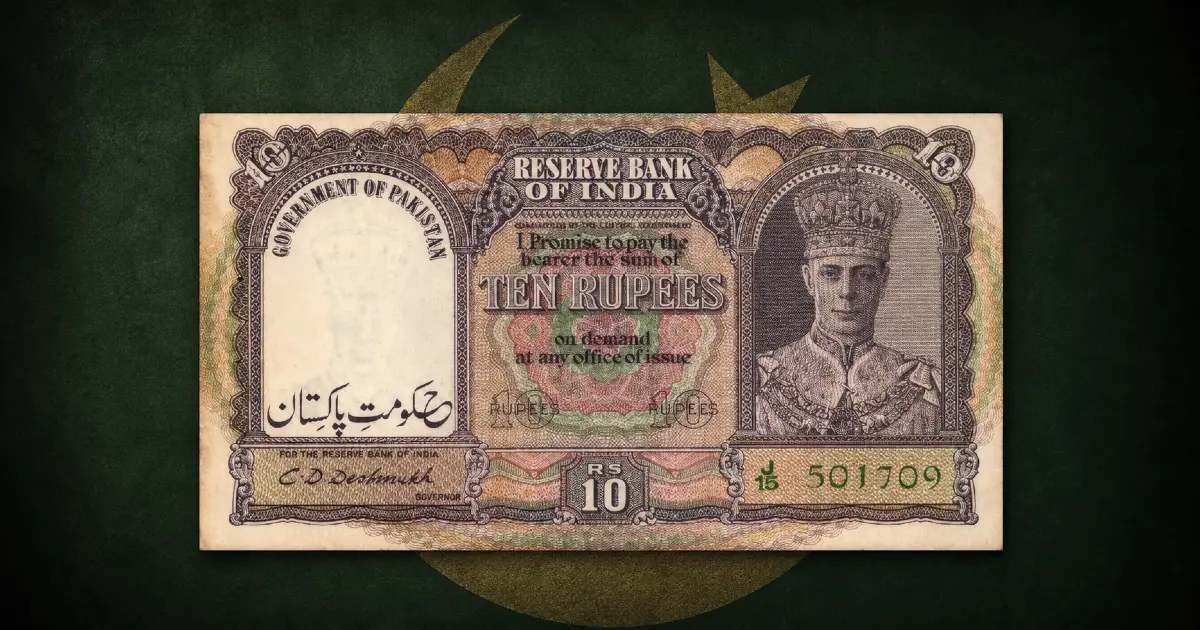
Pakistan King George VI 10 Rupees Note
The 10 rupees note is another front-facing portrait denomination. It was based on the Reserve Bank of India 10 rupees King George VI note and is one of the most studied denominations in the Pakistan provisional series.
- Catalog Classifications: Pick 3 / BNB B104
- Base Note: India Pick 24 / BNB B208
- Dimensions: 145 x 80 mm
- Primary Colors: Violet, brown, olive green, orange, and blue
- Obverse Design: King George VI facing front; Government of Pakistan violet inscription in the watermark area
- Reverse Design: Language panel; sailboat
- Signature: C.D. Deshmukh
- Serial Number Typology: Green serial numbers
- Prefixes:
- H/48 – H/72
- H/83 – H/99
- J/0 – J/42
- J/50 – J/58
Important Historical Prefix Context: The specific 10 Rupee prefix sequences running from H/73 to H/82 and J/43 to J/50 are entirely missing from the Pakistan issue sequence. These intermediate ranges were sent directly to Rangoon, where they were overprinted with “BURMA CURRENCY BOARD” for exclusive use in Burma.
Pakistan King George VI 100 Rupees Note
The 100 rupees note is the highest denomination in the Pakistan King George VI banknotes series. It was based on the Reserve Bank of India 100 rupees King George VI note Karachi circle of issue and carries the side-face portrait of the monarch.
- Catalog Classifications: Pick 3A / BNB B105
- Base Note: India Pick 20k / BNB B204b6
- Dimensions: 170 x 107 mm
- Primary Colors: Green, violet, and orange
- Obverse Design: King George VI facing left; Government of Pakistan violet inscription in the watermark area
- Reverse Design: Language panel; roaring Bengal tiger
- Signature: C.D. Deshmukh
- Serial Number Typology: Black serial numbers
- Prefixes:
- B/54 – B/59
- B/60 (serial numbers 000001 – 700000)
Counterfeit Pakistan Overprint Banknotes
Counterfeit Pakistan overprint banknotes have become a serious problem because genuine Pakistan King George VI issues are more expensive than the ordinary Indian base notes. This price difference creates an incentive to alter Indian notes by adding false Government of Pakistan inscriptions.
A typical fake begins with a genuine Indian King George VI note. The note may have correct paper, serial numbers, portrait, watermark, and signature. The problem is the added Pakistan text.
Prefix Outside the Pakistan Range
This is the easiest first check. If the prefix is not listed for the Pakistan issue, the note should be rejected as a genuine Pakistan provisional note.
Poor Inscription Quality
False inscriptions often show weak letters, uneven printing pressure, blurred edges, inconsistent ink, or poor alignment. Genuine plate inscriptions should look controlled and consistent.
Wrong Inscription Color
Each denomination has an expected inscription color. A wrong shade or obviously modern ink tone is a warning sign.
Surface-Printed Appearance
A fake overprint may appear to sit on the surface of the note. Under magnification, the ink may look different from the surrounding printed elements.
Misalignment in the Watermark Area
The official text placement is consistent. If the English or Urdu text is too high, too low, tilted, or awkwardly spaced, caution is needed.
Pakistan Notes Payment Refused Stamps
Some Pakistan King George VI banknotes are found with stamps reading “PAKISTAN NOTES PAYMENT REFUSED.” These pieces relate to the complicated currency situation after partition and the later withdrawal of Pakistan’s provisional notes.
After the Pakistan-inscribed notes were demonetized, some individuals attempted to pass altered notes through Indian banking channels. Since ordinary Indian King George VI notes remained valid in India until 1957, there was an incentive to remove or obscure the Pakistan inscriptions from demonetized Pakistan notes.
Indian banking authorities could detect these attempts by checking the prefix ranges and examining the watermark area. When a note was identified as a Pakistan issue or an altered Pakistan note, payment could be refused and the note stamped accordingly.
For collectors, these stamped notes are interesting historical artifacts. They show how the separation of India and Pakistan created practical banking and currency problems long after independence.
A “Pakistan Notes Payment Refused” stamp may add historical interest, but the note should still be evaluated for authenticity, denomination, condition, and stamp quality.
Demonetization of Pakistan King George VI Notes
Pakistan King George VI banknotes were temporary issues. They were never intended to remain Pakistan’s permanent national currency.
After the establishment of the State Bank of Pakistan, the country moved toward its own permanent currency issues. The provisional King George VI notes were eventually withdrawn.
All five denominations in the series were demonetized on 1 January 1952.
This short official life adds to their collector appeal. They represent a clearly defined emergency period between the monetary system of British India and the independent currency system of Pakistan.
Conclusion: Pakistan King George VI Banknotes
Pakistan King George VI banknotes are a historically important group of early independence-era paper money. They show how Pakistan managed its first currency needs after partition by using modified Government of India and Reserve Bank of India notes while preparing for its own central banking system.
Although collectors often call them Pakistan overprint banknotes, genuine examples are more accurately described as Pakistan inscribed banknotes or KGVI Amended Plates Provisional Issue because the English and Urdu Government of Pakistan text was incorporated into the printing plates. This distinction is central to authentication because many false Pakistan overprints have been made by adding imitation text to genuine Indian base notes.
The 1, 2, 5, 10, and 100 rupees denominations together form one of the most significant 1948 Pakistan provisional issues. They are important to collectors of Pakistan, British India, South Asian independence issues, King George VI paper money, and transitional Commonwealth currency.
For collectors, the key checks are denomination, base note type, prefix range, inscription color, inscription quality, and paper condition. A correct prefix is essential, but it should be combined with close inspection of the English and Urdu text. Higher-value examples, especially the 100 rupee banknotes, should be authenticated carefully.
A genuine Pakistan King George VI note is more than a collectible banknote. It is a document of partition, emergency monetary planning, and the first stage of Pakistan’s independent currency history.