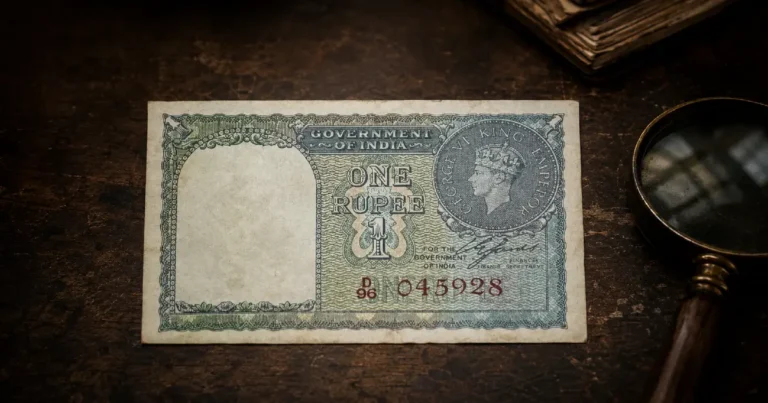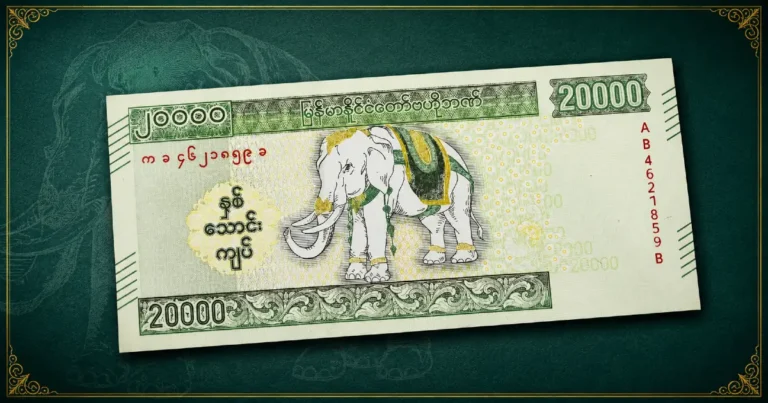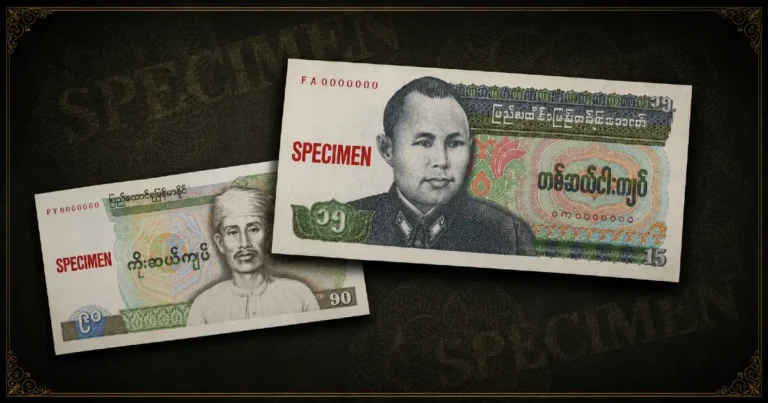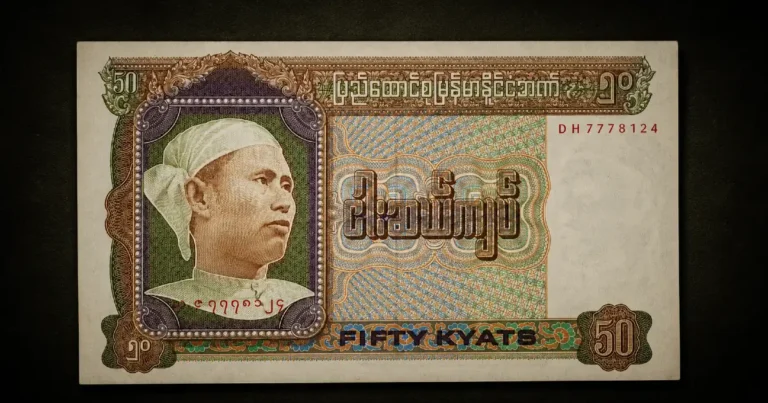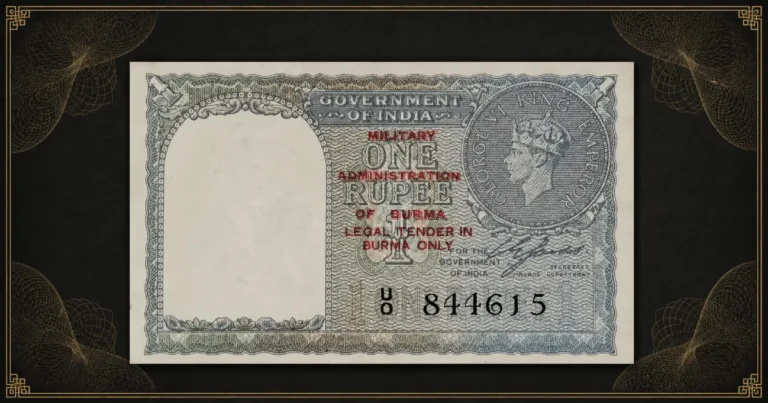
The study of independent paper currency in Southeast Asia finds its most complex and artistically rich chapter within the initial series of the Government of Burma and the Union Bank of Burma banknotes. Issued following the formal conclusion of British colonial administration on 4 January 1948, Burma’s financial planners faced an immediate mandate: replace the temporary British Burma overprint series with a standalone currency worthy of an independent nation.
The result was a family of notes that numismatists collectively study under the framework of the classic Peacock and Chinthe designs—some of the most artistically accomplished security printing produced in post-colonial Southeast Asia. These historic Union of Burma banknotes trace a clear progression across three distinct series released between 1948 and 1953. While the primary engraved design elements remained deliberately consistent to build public confidence, the issuing authority names, executive signatures, and denomination definitions changed significantly across the era.
Specialists divide this period into two administrative frameworks: the initial Government of Burma banknotes spanning 1948 to 1950, and the subsequent Union Bank of Burma banknotes issued across parallel Rupee and Kyat series throughout 1953. Officially cataloged across Pick 34 through Pick 45 in the Standard Catalog of World Paper Money and BNB B701 through BNB B808 in The Banknote Book, these issues are globally prized for their intricate engraving, historical depth, and complex variety paths. Understanding the nuances of these Union Bank of Burma banknotes requires an examination of both their security architecture and the political transitions that dictated their production.
Table of Contents
Sovereign Decolonization and the Core Series
The emergence of the independent Union of Burma banknotes was driven by an immediate requirement to project a distinct national identity while preserving absolute stability in everyday commerce. The entering independent government could not risk a radical, jarring aesthetic upheaval that might alienate local populations or confuse merchants, yet they remained determined to purge all symbols of foreign imperial authority from their financial documents.
The Proclamation of the Independent Union of Burma on 4 January 1948
On 4 January 1948, the sovereign republic of the Union of Burma was formally proclaimed, closing a long chapter of colonial oversight. The physical infrastructure of the nation was heavily impacted by the widespread conflicts of World War II, leaving its financial ledger structures equally fractured. The immediate priority of the newly established independent republic was to assert absolute fiscal sovereignty by preparing a definitive family of banknotes capable of commanding authority across domestic and regional marketplaces.
Visual Continuity Across the Initial Post-Colonial Runs
To secure this financial foundation without causing public concern, treasury planners deployed an intentional strategy of design continuity. Over a five-year period, the state released three successive banknote series. Despite moving the entire economy away from the colonial Rupee and into the decimalized Kyat, the visual layouts of these early Government of Burma banknotes and Union Bank of Burma banknotes remained remarkably identical. This consistency ensured that everyday citizens could easily identify, authenticate, and trust the national currency, regardless of shifting legislative backgrounds.
The Monetary Evolution from Rupee to Decimalized Kyat
The baseline economic structure under which these early independent Burma banknotes circulated was highly dynamic. The initial 1948 Government of Burma banknotes maintained the traditional Rupee denomination format inherited from previous regional systems. However, by 1952, the Chamber of Deputies passed extensive banking laws designed to establish a standalone, decimalized currency network. On 1 July 1952, the national monetary unit was officially transformed from the Rupee to the Kyat, which was partitioned into one hundred pyas. This transition set the stage for the definitive central bank updates that followed the release of the final Union Bank of Burma banknotes in 1953.
Institutional Evolution and Central Banking Architecture
The administrative journey of these classic Burma banknotes reflects the systematic transfer of currency management from foreign oversight directly into native hands at Rangoon.
1948 Government of Burma Banknotes
Immediately following the declaration of the independent republic, the country’s currency distribution was temporarily managed by a provisional treasury board labeled the Government of Burma. Because a fully functioning native central bank was still under active organization, this transitional body took immediate responsibility for the money supply. Operating under immediate legislative mandates, they released the first family of sovereign banknotes in the 1, 5, 10, and 100 Rupees values to fulfill essential daily cash requirements between 1948 and 1950.
The Union Bank of Burma Act of 1947 and its February 1948 Activation
While the government treasury was organizing the distribution of the early 1948 issues, a permanent central banking authority was finalized. The Union Bank of Burma Act of 1947 was officially activated on 3 February 1948, shortly after independence day. In its initial phase, the UBB functioned primarily by absorbing the financial duties previously handled by the Rangoon branch of the Reserve Bank of India, while broad currency reserves were temporarily managed through a currency board in London. This act marked the legal birth of the framework that would eventually control all future Union Bank of Burma banknotes.
The July 1952 Reform: Securing Full National Note Issue Prerogative
This temporary split-management arrangement was dissolved by the passage of a new Union Bank of Burma Act, which cleared the Chamber of Deputies on 17 March 1952. When this act went into full effect on 1 July 1952, the central bank officially took over all sovereign currency responsibilities from the London board. This historic expansion of power enabled the bank to modernize the master plates, allowing them to release the definitive Union Bank of Burma banknotes of 1953.
Production Standards, Watermarks, and Engraving Mechanics
To insulate the new sovereign currency from international fraud, the authorities entered into an elite production contract with the world’s most respected security print masters.
The Security Printing Partnership with Thomas De La Rue & Company
Every single entry within the catalog of independent Union Bank of Burma banknotes was manufactured in Great Britain by the legendary security printing house Thomas De La Rue & Company, Limited (London). De La Rue utilized advanced, high-pressure intaglio printing methods that gave the paper a distinct, raised textural quality. The flawless detail of their steel-plate line work provided an incredible safety standard for the young republic, embedding intricate geometric borders and complex safety fields into each layout.
Obverse Master Plate Designs
The front faces of these early independent Burma banknotes are anchored by two highly celebrated Burmese cultural and national symbols: the Chinthe and the Dancing Peacock. Understanding their exact placement is essential for proper variety classification:
- 1 Rupee / 1 Kyat Notes: Feature the elegant dancing peacock motif positioned on the right side of the front layout.
- 5 Rupees / 5 Kyats Notes: Feature a large, intricately detailed rendering of a squatting Chinthe lion facing left.
- 10 Rupees / 10 Kyats Notes: Showcase the dancing peacock emblem located cleanly on the right side of the front design.
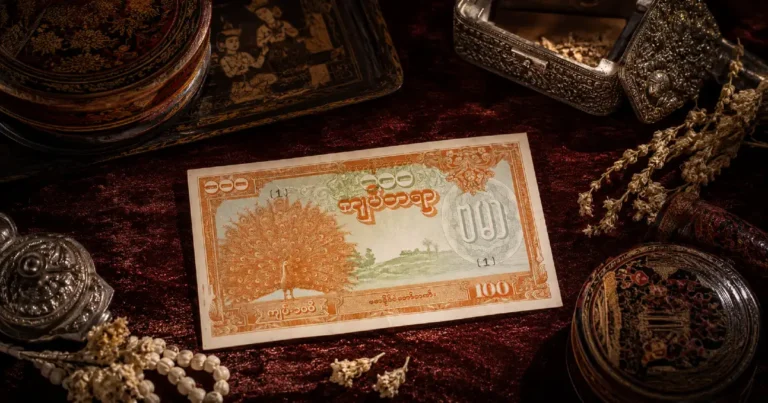
- 100 Rupees / 100 Kyats Notes: Represent the artistic peak of the series, featuring a massive dancing peacock positioned at the center of the front layout, flanked on the right margin by a proud Chinthe lion facing to the left.
Reverse Vignettes and National Iconographies
The back plates of these early Government of Burma and Union Bank of Burma banknotes celebrate the daily routines, commercial industries, and natural landscapes of the country. These designs change distinctly based on the note’s denomination:
- 1 Rupee / 1 Kyat Issues: Depict a scenic view featuring traditional boats with sails navigating regional waterways past distant mountain peaks.
- 5 Rupees / 5 Kyats Issues: Capture a beautiful interior workspace showing a woman weaving cloth at a traditional indoor loom alongside a spinner with a spinning wheel.
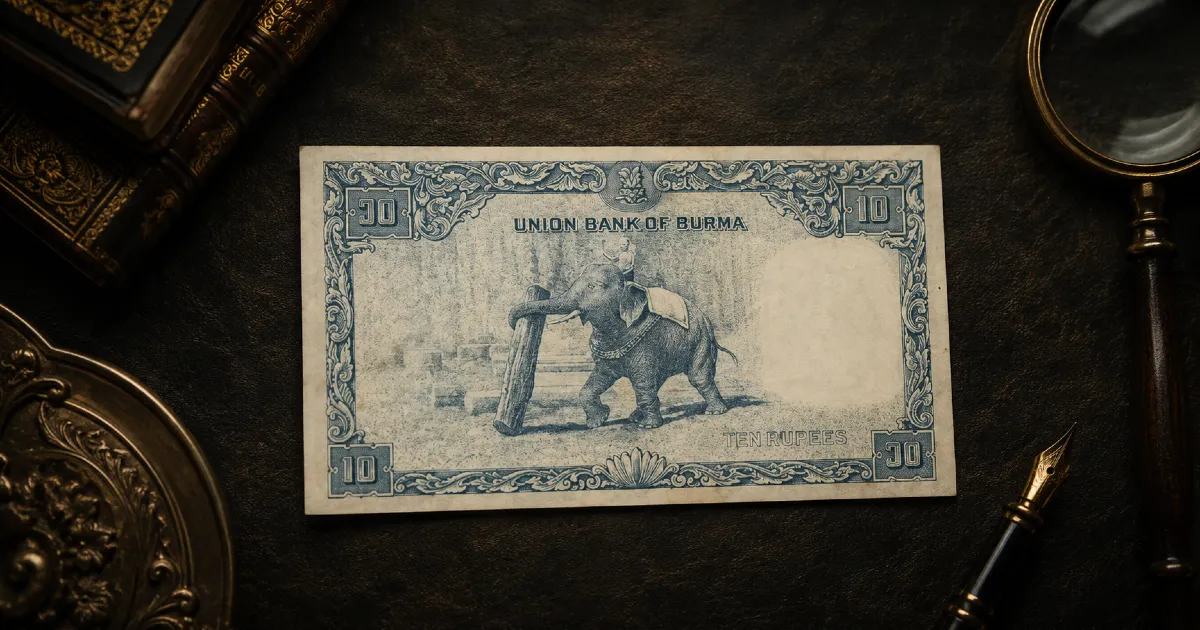
- 10 Rupees / 10 Kyats Issues: Document a vital regional trade activity, showing a mahout riding an elephant lifting a heavy piece of wood with its trunk.
- 100 Rupees / 100 Kyats Issues: Display an extensive rural landscape scene featuring a man guiding a pair of oxen through a flooded agricultural paddy field.
Security Threads and Multi-Tonal Peacock Watermarks
The underlying paper security frameworks built into these early Burma banknotes evolved systematically depending on the face value. The low-value 1 Rupee and 1 Kyat issues were manufactured entirely without an internal security thread. In contrast, every single higher denomination note—including the 5, 10, and 100 values across all series—was built with a solid security thread running vertically through the paper fibers. Additionally, to prevent counterfeiting, all variations of these notes include a beautiful, multi-tonal Peacock watermark window that glows clearly under translucent light.
The Government of Burma Rupee Series (1948-1950)
The Government of Burma banknotes entered active commercial channels in phases beginning in 1948. The 1 Rupee was introduced in February 1948, followed by the 5 Rupees in August 1948, the 10 Rupees in December 1949, and the 100 Rupees in January 1950. These notes are identified by their reliance on the traditional Rupee unit, with Burmese text printed on the obverse and English text on the reverse. Every note carries a 6-digit serial number and an alphanumeric prefix starting at 1A and advancing alphabetically.
The Richard Valentine Nind Hopkins and Maung Kaung Signature Combinations
To authorize this initial series, the front plates displayed a distinct, dual-signature configuration at the lower border. The left side features the hand-signed English script signature of Richard Valentine Nind Hopkins (printed as Chairman), balanced on the right by the Burmese script signature of Maung Kaung (printed as Board Member).
Master 1948 Government of Burma Banknotes Reference Matrix
| Denomination | Burma Pick Number | Banknote Book Burma |
|---|---|---|
| 1 Rupee | Pick 34 | BNB B701 |
| 5 Rupees | Pick 35 | BNB B702 |
| 10 Rupees | Pick 36 | BNB B703 |
| 100 Rupees | Pick 37 | BNB B704 |
1 Rupee Note (Pick 34 / BNB B701)
- Dimensions: 108 x 66 mm
- Primary colors: Gray, green, and pink
- Legend: GOVERNMENT OF BURMA below the upper border
- Documented Prefixes: 1A through 8M
5 Rupees Note (Pick 35 / BNB B702)
- Dimensions: 126 x 73 mm
- Primary color: Brown
- Legend: GOVERNMENT OF BURMA at the lower border
- Documented Prefixes: 1A through 2Z
10 Rupees Note (Pick 36 / BNB B703)
- Dimensions: 145 x 82 mm
- Primary colors: Blue, green, violet, and yellow
- Legend: GOVERNMENT OF THE UNION OF BURMA below the upper border
- Documented Prefixes: 1A through 3C
100 Rupees Note (Pick 37 / BNB B704)
- Dimensions: 171 x 106 mm
- Primary color: Green
- Legend: GOVERNMENT OF THE UNION OF BURMA below the upper border
- Date on the Note: This note displays the printed date line: RANGOON, 1st January 1948. Although Burma’s independence was ultimately declared at 4:20 AM on 4 January 1948 — a moment chosen by state astrologers as spiritually auspicious — the banknote date reflects the original planned independence date, making it a small but fascinating footnote in the country’s history.
- Documented Prefixes: 1A, 1B, 1C, 1D
The Union Bank of Burma Rupee Series (1953)
The second era of these independent Union Bank of Burma banknotes debuted on 20 January 1953. Released under the authority of the newly empowered central bank, this brief Rupee series of Union Bank of Burma banknotes was required to supply major trade channels while the final minting frameworks for national decimalization were locked down.
Managing Director U San Lin and the Central Bank Plate Updates
To signal the final departure of the London-based colonial currency board, the old Hopkins/Kaung signature block was permanently removed from the De La Rue printing plates. It was replaced by a clean, single-signature window positioned at the lower center of the obverse face, carrying the handwritten Burmese script signature of Managing Director U San Lin. While the back legal legends were changed to read UNION BANK OF BURMA, these brief notes preserved the old Rupee value definitions.
Master Union Bank of Burma 1953 Rupee Matrix
| Denomination | Burma Pick Number | Banknote Book Burma |
|---|---|---|
| 1 Rupee | Pick 38 | BNB B801 |
| 5 Rupees | Pick 39 | BNB B802 |
| 10 Rupees | Pick 40 | BNB B803 |
| 100 Rupees | Pick 41 | BNB B804 |
1 Rupee Note (Pick 38 / BNB B801)
- Dimensions: 108 x 66 mm
- Primary colors: Gray, green, and pink
- Legend: UNION BANK OF BURMA below the upper border
- Documented Prefixes: 1A through 2W
5 Rupees Note (Pick 39 / BNB B802)
- Dimensions: 126 x 73 mm
- Primary color: Brown
- Legend: UNION BANK OF BURMA at the lower border
- Documented Prefixes: 1A through 1U
10 Rupees Note (Pick 40 / BNB B803)
- Dimensions: 145 x 82 mm
- Primary colors: Blue, green, violet, and yellow
- Legend: UNION BANK OF BURMA below the upper border
- Documented Prefixes: 1A through 1Q
100 Rupees Note (Pick 41 / BNB B804)
- Dimensions: 171 x 106 mm
- Primary color: Green
- Legend: GOVERNMENT OF THE UNION OF BURMA below the upper border
- Documented Prefixes: 1A, 1B
The Union Bank of Burma Kyat Series (1953)
On 1 July 1952, the national monetary unit was officially transformed from the Rupee to the Kyat, subdivided into one hundred pyas. Because banknote production requires significant lead time, the 1953 Rupee series had already been prepared and was released alongside the transition. The Kyat series followed promptly, completing the permanent retirement of the colonial Rupee unit from Burma’s currency system.
Implementing the National Currency Transition
To produce the new Kyat denominations, the Union Bank of Burma commissioned a fresh set of plates from Thomas De La Rue. The new notes retained the exact same color palettes, security papers, threads, and physical dimensions as the parallel Rupee issues — ensuring continuity and public familiarity. The only fundamental change was textual: all Rupee denomination inscriptions in both English and Burmese were replaced with the new Kyat values.
Master Union Bank of Burma 1953 Kyat Matrix
| Denomination | Burma Pick Number | Banknote Book Burma |
|---|---|---|
| 1 Kyat | Pick 42 | BNB B805 |
| 5 Kyats | Pick 43 | BNB B806 |
| 10 Kyats | Pick 44 | BNB B807 |
| 100 Kyats | Pick 45 | BNB B808 |
1 Kyat Note (Pick 42 / BNB B805)
- Dimensions: 108 x 66 mm
- Primary colors: Gray, green, and pink
- Legend: UNION BANK OF BURMA below the upper border
- Documented Prefixes: 1A through 13Q
5 Kyats Note (Pick 43 / BNB B806)
- Dimensions: 126 x 73 mm
- Primary color: Brown
- Legend: UNION BANK OF BURMA at the lower border
- Documented Prefixes: 1A through 3G
10 Kyats Note (Pick 44 / BNB B807)
- Dimensions: 145 x 82 mm
- Primary colors: Blue, green, violet, and yellow
- Legend: UNION BANK OF BURMA below the upper border
- Documented Prefixes: 1A through 6A
100 Kyats Note (Pick 45 / BNB B808)
- Dimensions: 171 x 106 mm
- Primary color: Green
- Legend: GOVERNMENT OF THE UNION OF BURMA below the upper border
- Documented Prefixes: 1A through 1G
Advanced Specialized Collecting
Because the primary visual engraving designs across these twelve notes are so uniform, advanced collectors focus heavily on specialized production varieties to build elite catalog sets of early Government of Burma and Union Bank of Burma banknotes.
Serial Number Alphabetic Mechanics: Tracking the 1A Prefix Progressions
Thomas De La Rue utilized a highly rigid, mathematical system for tracking print sequences during this era. Every standard circulating banknote features a 6-digit serial number paired with an alphanumeric prefix block, with each variety beginning strictly at prefix 1A.
The progression follows an important pattern that differs from many other colonial and post-colonial series. The trailing letter advances first—so after 1A comes 1B, 1C, 1D, and so on through the full alphabet to 1Z. Only once the letter cycle is exhausted does the leading number increment, moving to 2A and beginning the letter sequence again. This means 2A does not follow 1A directly.
Specimen Varieties: Red DLR Ovals vs. Diagonal Perforations
To supply international central banks and internal archives with reference examples, De La Rue prepared highly distinct Specimen varieties that were never permitted to enter commercial circulation. These specialized indicators are mapped comprehensively in our Specimen Banknote Guide:
- Red DLR Oval Overprints: These specimens feature a vivid red, horizontal or diagonal Thomas De La Rue oval security stamp applied directly to the face or back of the note body, paired with matching horizontal or diagonal red text reading SPECIMEN or SPECIMEN NO # inside the lower margin. They are universally anchored by an all-zero serial number array (000000).
- Diagonal SPECIMEN or CANCELLED Perforations: A parallel archive variety features a bold text block reading SPECIMEN or CANCELLED punched directly into the paper body via clean, microscopic diagonal pinhole perforations. These also display a uniform all-zero serial number configuration without prefix allocations.
Un-Serialized Remainder Notes: Identifying Blank Sheet Stock
An additional advanced variety highly sought after by specialists is the Remainder note. These pieces represent fully printed, authentic De La Rue sheet stock that successfully underwent all primary and secondary intaglio text press runs, but were pulled from production lines before receiving final numerical serialization or prefix application. Displaying completely blank, white serial number windows and no serial text, these remainders offer a fascinating look at the un-serialized material state of the currency before final central bank validation.
The Permanent Legacy of the 1948 – 1953 Designs
The early families of 1948 Government of Burma banknotes and 1953 Union Bank of Burma banknotes stand as a triumphant chapter of sovereign monetary engineering and artistic design. By maintaining absolute visual symmetry across three separate series, economic planners successfully protected domestic trade while guiding the country through massive structural transitions. These notes saw the final departure of London’s colonial currency board, the rise of a sovereign central bank, and the permanent birth of the decimalized Kyat system that continues to guide the nation. For the modern numismatist, capturing these twelve classic variations represents the ultimate tribute to the foundational architecture of independent Burmese paper money history.
To explore how the nation’s currency eventually moved away from these traditional allegorical icons to honor the political architects of the revolution, continue to our master catalog covering the definitive Aung San Burma Banknotes series. Alternatively, to trace the preceding monetary history under British administration, read our study on the KGVI Burma Overprint Banknotes.