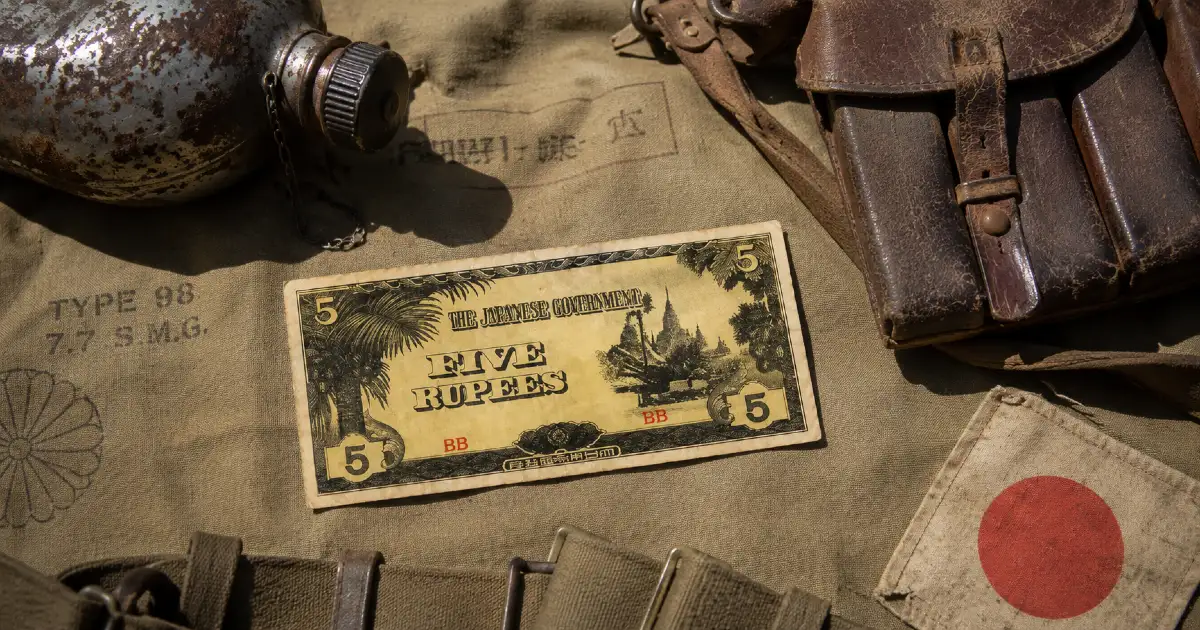
Japanese Invasion Money Burma, commonly known as Burma JIM notes, is one of the most fascinating and widely collected areas of World War II paper money. Issued by the Japanese military administration following the invasion of Burma in 1942, these occupation banknotes replaced the British-controlled monetary system and became the principal currency used throughout much of the country during the war.
Officially designated as Foreign Denomination Military Certificates, the notes were first distributed through the Yokohama Specie Bank and later through the Southern Development Bank. Although denominated in rupees and cents, they were fundamentally different from earlier British Burma banknotes, lacking signatures, serial numbers, and many of the security features normally associated with government-issued currency.
Today, Burma JIM notes are instantly recognizable for their wartime origins, distinctive prefix system, and the famous Ananda Temple design found on several denominations. The series ranges from 1 cent to 100 rupees and includes numerous prefix varieties, watermark differences, and paper types that continue to attract specialist collectors. In addition, the existence of Allied-produced OSS and SOE counterfeits has made Japanese Invasion Money Burma an important field of study for both numismatists and military historians.
This collector’s guide explores the complete Burma JIM series, including its historical background, production, design features, Pick catalog references, Banknote Book references, prefix varieties, wartime counterfeits, and lasting legacy within the field of Japanese occupation currency. Whether you are a beginning collector or an advanced specialist seeking to build a complete prefix collection, Burma JIM notes offer one of the most accessible and historically significant areas of Asian paper money collecting.
Table of Contents
Historical Background
The deployment of Japanese Invasion Money Burma occurred during one of the most turbulent periods in Southeast Asian history. As Japanese forces advanced rapidly through the country during World War II, existing colonial institutions collapsed, and the monetary framework that had operated under British administration was systematically dismantled.
The Japanese Invasion of Burma
The Empire of Japan invaded Burma in January 1942 as part of its wider campaign across Southeast Asia. Rangoon fell on 8 March 1942, and Japanese forces continued their rapid advance through the country, capturing Mandalay on 21 May 1942 and effectively ending British control over much of Burma.
The military campaign had a profound impact on the country’s economy, banking system, and currency circulation. To review the official military records regarding the speed of the 1942 colonial evacuation, collectors can reference the wartime archives preserved in The National Archives (UK). While existing colonial issues remained in use temporarily, the Japanese authorities soon sought to establish an entirely new monetary system under their direct command.
Collapse of the Colonial Monetary System
Prior to the invasion, Burma’s currency system consisted primarily of Reserve Bank of India-issued banknotes, earlier overprint issues, and various Government of India notes. The orderly circulation of the previous Burma Peacock banknotes collapsed entirely due to aggressive scorched-earth treasury policies enacted during the British retreat.
The collapse of British administration disrupted the normal supply of currency and severed Burma’s connection with the institutions responsible for issuing and managing its pre-war banknotes. As Japanese forces consolidated control, a replacement currency became a strategic necessity to support military operations and civilian commerce.
Introduction of Japanese Invasion Money Burma
To replace the vanishing British-controlled currency, the Japanese military administration introduced occupation banknotes known officially as Foreign Denomination Military Certificates. These notes circulated alongside existing currency before eventually becoming the dominant paper money issue in Japanese-occupied Burma.
Today, these notes are collectively known as Japanese Invasion Money Burma, or simply JIM Burma. These terms are widely used by collectors and researchers to distinguish the occupation currency from the emergency 1937 KGV provisional overprints and the later sovereign issues of the Burma State Bank.
Burma Under Japanese Administration
In August 1942, the Japanese established the Burmese Executive Administration to govern the occupied territory. While some Burmese continued to support the British war effort, others cooperated with Japan in the hope that occupation would eventually lead to independence.
Among those who initially worked alongside the Japanese was General Aung San, who would later become one of the most important figures in modern Burmese history. During this period, Japanese Invasion Money became the principal currency used throughout much of occupied Burma and remained in circulation until the final years of the war.
Production and Issue Details
Japanese Invasion Money was issued to support the wartime economy of occupied Burma and other territories under Japanese control. Unlike pre-war Burma banknotes, which were issued by the Reserve Bank of India, JIM notes were military currency created to facilitate trade, pay troops, and finance the Japanese occupation administration.
Although commonly referred to as Japanese occupation currency, the notes were officially designated as Foreign Denomination Military Certificates.
Foreign Denomination Military Certificates
The official title of the notes was Foreign Denomination Military Certificates. Rather than creating a separate currency name, the Japanese authorities issued notes denominated in existing local units such as rupees and cents to ease their acceptance among the population.
The notes bear Japanese text identifying them as issues of the Greater Japan Imperial Government, reflecting their status as military occupation currency rather than conventional banknotes issued by a central bank.
The Yokohama Specie Bank
The earliest Burma JIM notes were distributed through the Yokohama Specie Bank, one of Japan’s most important financial institutions during the war.
Acting on behalf of the Japanese military administration, the bank served as a fiscal agent responsible for introducing the occupation currency into circulation following the collapse of the British-controlled monetary system.
The Southern Development Bank
Responsibility for distribution later shifted to the Southern Development Bank (Nampo Kaihatsu Kinko), an institution created to support Japanese economic administration throughout occupied Southeast Asia.
Together, the Southern Development Bank and the Yokohama Specie Bank acted as the financial conduits through which Japanese military currency entered circulation across Burma.
Printing by the Greater Japan Imperial Government
Although distributed through Japanese-controlled financial institutions, the notes were printed in Japan by the Ministry of Finance Printing Bureau in Tokyo.
The printer’s designation, “Greater Japan Imperial Government” (府政國帝本日大), appears on the notes and identifies the issuing authority behind the occupation currency. After printing, the notes were transported to Burma and other occupied territories for circulation.
Wartime Circulation in Burma
Burma JIM notes entered active circulation in March 1942, rapidly displacing the remnants of the British colonial monetary framework. Initial distributions focused heavily on the foundational 1/4 Rupee to 10 Rupee notes, with the hyperinflationary 100 Rupee denomination introduced much later, in 1945, as supply lines buckled.
To provide small change for everyday marketplace transactions, the Japanese administration decimalized the system in October 1942, augmenting the currency supply with lower-value fractional cent issues. Throughout the occupation period, Japanese Invasion Money Burma circulated extensively across the country, serving as the compulsory medium of exchange for both civilians and military personnel.
Design and Security Features
Japanese Invasion Money was designed for rapid wartime production rather than long-term monetary stability. As a result, Burma JIM notes are generally simpler than the British Burma banknotes they replaced and lack many of the security features commonly found on pre-war currency.
Despite their relatively simple appearance, the notes possess several distinctive characteristics that make them immediately recognizable to collectors today.
The Ananda Temple Design
The most recognizable design element of the Burma JIM series is the depiction of the Ananda Temple in Bagan. This famous Buddhist monument appears on the higher-denomination notes and has become one of the defining symbols of Japanese occupation currency in Burma. For an in-depth architectural look at this historic site, collectors can reference the field studies maintained by the UNESCO World Heritage Centre.
The use of the Ananda Temple gave the notes a distinctly Burmese appearance while allowing the Japanese authorities to employ a familiar local landmark on the occupation currency. The Ananda Temple appears on the 1/2 Rupee denomination and continues through the higher values, including the 1 Rupee, 5 Rupees, 10 Rupees, and 100 Rupees notes.
Denominations Without the Ananda Temple
Not all issues of Japanese Invasion Money Burma feature the Ananda Temple. The 1 cent, 5 cents, 10 cents, and 1/4 Rupee denominations use simpler designs without the famous pagoda vignette.
Prefix Letters and Series System
One of the most distinctive features of JIM Burma notes is their series system. Every genuine note begins with the letter B, followed by either a second letter or a fractional prefix format. The earliest notes use a two-character series such as BA, BB, BC, and so forth. After the available combinations were exhausted, the system expanded to fractional prefixes such as B/AA, B/AB, and B/AC.
Unlike most conventional banknotes, Burma JIM notes do not carry serial numbers. The prefix system, therefore, serves as the primary method of identifying printings and varieties.
Watermarks and Paper Types
Watermarks vary by denomination and issue. Some notes were produced with traditional watermarks, while later wartime printings were manufactured on paper without watermarks.
Several denominations also exist on paper containing silk fibers, reflecting wartime changes in paper production and security measures.
These differences are important to collectors because they create recognized varieties within the series.
No Signature, Date, or Serial Number
Unlike British Burma banknotes, Burma JIM notes do not bear a signature, date, or serial number.
The absence of these features reflects their status as military occupation currency rather than banknotes issued by a central bank. Instead, identification relies on denomination, prefix, watermark, paper type, and catalog references.
Printing Characteristics
Burma JIM notes were printed using relatively simple designs intended for efficient wartime production. The notes rely heavily on coloured printing, ornamental borders, and engraved central motifs rather than the complex security devices found on many contemporary banknotes.
As wartime conditions deteriorated, production methods evolved and paper quality varied between issues. These manufacturing differences provide valuable clues for collectors studying varieties and authenticating notes today.
The Complete Burma JIM Series
Japanese Invasion Money Burma was issued in nine denominations ranging from 1 cent to 100 rupees and circulated throughout Burma during the Japanese occupation. Today, the series is collected for its wartime history, distinctive prefix system, and numerous paper and watermark varieties.
The notes are catalogued as Pick 9–17 in the Standard Catalog of World Paper Money and B301–B309 in The Banknote Book.
| Denomination | Description | Pick Number | Banknote Book |
|---|---|---|---|
| 1 Cent | 2-character series (eg. BA) | Pick 9a | B301a |
| 1 Cent | Fractional series (eg. B/AA) | Pick 9b | B301b |
| 5 Cents | 2-character series | Pick 10a | B302a |
| 5 Cents | Fractional series | Pick 10b | B302b |
| 10 Cents | 2-character series | Pick 11a | B303a |
| 10 Cents | Fractional series | Pick 11b | B303b |
| 1/4 Rupee | Single issue | Pick 12 | B304 |
| 1/2 Rupee | Single issue | Pick 13 | B305 |
| 1 Rupee | 63 mm character spacing | Pick 14a | B306a |
| 1 Rupee | 70 mm character spacing | Pick 14b | B306b |
| 5 Rupees | Single issue | Pick 15 | B307 |
| 10 Rupees | Watermarked paper | Pick 16a | B308a |
| 10 Rupees | Silk-fiber paper, no watermark | Pick 16b | B308b |
| 100 Rupees | Watermarked paper | Pick 17a | B309a |
| 100 Rupees | Silk-fiber paper, no watermark | Pick 17b | B309b |
1 Cent Note (Pick 9 a-b / BNB B301 a-b)
The lowest denomination of the Japanese military currency array. Unlike their higher-value counterpart notes, the cent issues rely on highly simplified, purely geometric borders without localized scenic elements.
- Dimensions: 95 x 46 mm
- Primary Colors: Red and blue
- Watermark: None
- Block Structures:
- (a) 2-characters (BA – BV)
- (b) Fractional series (B/AA – B/EX)
5 Cents Note (Pick 10 a-b / BNB B302 a-b)
A mid-range fractional issue bridging the 1 Cent and 10 Cent denominations.
- Dimensions: 100 x 48 mm
- Primary Colors: Purple and green
- Watermark: None
- Block Structures:
- (a) 2-characters (BA – BV)
- (b) Fractional series (B/AA – B/BX)
10 Cents Note (Pick 11 a-b / BNB B303 a-b)
The highest of the three fractional cent denominations.
- Dimensions: 106 x 51 mm
- Primary Color: Brown
- Watermark: None
- Block Structures:
- (a) 2-characters (BA – BZ)
- (b) Fractional series (B/AA – B/AR)
1/4 Rupee Note (Pick 12 / BNB B304)
The 1/4 Rupee note was the smallest rupee denomination issued during the occupation. It bridges the operational gap between the lower cent issues and the larger circulating notes.
- Dimensions: 107 x 51 mm
- Primary Colors: Blue and orange
- Watermark: None
- Block Structures: 2-characters (BA – BV)
1/2 Rupee Note (Pick 13 / BNB B305)
The 1/2 Rupee note introduced the Ananda Temple design that would become the defining focal motif of the larger Burma JIM denominations.
- Dimensions: 120 x 58 mm
- Primary Color: Olive green
- Watermark: Quatrefoil pattern
- Block Structures: 2-characters (BA – BD)
1 Rupee Note (Pick 14 a–b / BNB B306 a–b)
The 1 Rupee denomination is best known for its character spacing varieties, which are among the most studied features of the JIM Burma series.
- Dimensions: 141 x 67 mm
- Primary Colors: Dark green and pink
- Watermark: Quatrefoil pattern
- Block Structures:
- (a) BA – BD prefixes (63 mm narrow space between block letters)
- (b) BD prefix variant (70 mm wide space between block letters)
5 Rupees Note (Pick 15 / BNB B307)
The 5 Rupees denomination is one of the most recognizable Burma JIM notes and remains a popular entry point for collectors of Japanese occupation currency.
- Dimensions: 150 x 72 mm
- Primary Colors: Purple and yellow
- Watermark: Kiri flower
- Block Structures: 2-characters (BA – BB)
10 Rupees Note (Pick 16 a–b / BNB B308 a–b)
The 10 Rupees note exists in two major varieties that reflect critical wartime changes in paper production and security measures.
- Dimensions: 161 x 77 mm
- Primary Colors: Red and light green
- Watermark:
- (a) Standard watermarked paper (Quatrefoil pattern)
- (b) Manufactured on plain silk-fiber paper without a watermark
- Block Structures:
- (a) BA block prefix featuring 7.5 mm wide block letters
- (b) BA block prefix featuring 6.75 mm compressed block letters
100 Rupees Note (Pick 17 a–b / BNB B309 a–b)
The 100 Rupees denomination was the highest value issued within the Burma JIM series and represents the final stage of occupation currency production.
- Dimensions: 169 x 81 mm
- Primary Colors: Dark green and purple
- Watermark:
- (a) Standard watermarked paper (Quatrefoil pattern)
- (b) Manufactured on plain silk-fiber paper without a watermark
- Block Structures:
- (a) BA block prefix featuring 7.25 mm wide block letters
- (b) BA block prefix featuring 6.75 mm compressed block letters
Prefix Varieties and Collecting Notes
One of the defining characteristics of Burma JIM notes is their series system. Unlike most government-issued banknotes, which rely on serial numbers for identification, Japanese Invasion Money uses a combination of letter prefixes, fractional series, spacing varieties, and paper differences to distinguish individual printings.
As a result, many advanced collectors focus on varieties rather than simply acquiring one example of each denomination.
Understanding the B Prefix System
All genuine Burma JIM notes begin with the letter “B”, making the prefix system one of the most recognizable features of the series.
Because the notes do not carry serial numbers, these prefixes serve as the primary method of distinguishing different printings.
Two-Character Series
The original issues were printed using a two-character series format beginning with BA. The second letter advanced alphabetically as production increased.
Examples include BA, BB, BC, BD, and so forth through the documented ranges for each denomination.
Fractional Series
After the available two-character combinations were exhausted, the Japanese authorities introduced a fractional prefix system.
Examples include B/AA, B/AB, B/AC, B/AD, and so forth. This system significantly expanded the number of available series combinations and allowed wartime production to continue without introducing serial numbers.
Character Spacing and Character Width
The 1 Rupee BD series can be distinguished based on spacing between block letters.
While the 10 Rupees and 100 Rupees JIM notes can be distinguished based on the width of the letters BA.
Although subtle, these differences are sufficient to justify separate catalog listings and remain an important area of study for specialists.
Watermark and Paper Varieties
The 10 Rupees and 100 Rupees notes are known in both watermarked and non-watermarked forms. Later issues were produced on paper containing silk fibers but without a watermark, reflecting changing wartime production requirements.
These varieties are catalogued separately and are essential for collectors seeking to assemble a complete set of Burma JIM notes.
Notes with Chop Marks
Some surviving Burma JIM notes bear chop marks, merchant marks, banking stamps, or other circulation markings applied during the occupation period.
These markings provide evidence of a note’s circulation history and can sometimes be linked to specific regions, businesses, or financial institutions. Chop-marked notes represent an interesting specialist area within Japanese occupation currency.
Building a Complete Prefix Collection
Because many Burma JIM notes remain affordable, some advanced collectors pursue complete prefix collections rather than stopping at a single example of each denomination.
This approach requires careful study of catalog references, prefix ranges, spacing varieties, watermark types, and paper differences. Completing such a collection can be considerably more challenging than assembling a basic denomination set and remains one of the most rewarding areas of Burma JIM collecting.
Allied Counterfeits and Wartime Propaganda
One of the most fascinating aspects of Burma JIM notes is that some of the best-known counterfeits were not produced by criminals but by Allied intelligence agencies during World War II. These notes were created as part of a broader effort to disrupt the Japanese occupation economy and undermine confidence in military currency.
Today, Allied counterfeits form an important area of study for collectors of Japanese occupation currency and wartime propaganda.
OSS Counterfeit Operations
The American Office of Strategic Services (OSS), the predecessor of the modern Central Intelligence Agency (CIA), produced counterfeit Burma JIM notes as part of its economic warfare program against Japan.
Large quantities of counterfeit notes were printed and distributed to resistance groups operating behind Japanese lines. The objective was to introduce additional currency into circulation and place pressure on the occupation economy.
Among the denominations targeted by the OSS were the 1 Rupee and 10 Rupees notes, both of which circulated widely throughout occupied Burma.
SOE Counterfeit Operations
The British Special Operations Executive (SOE) also participated in counterfeit currency operations in Burma. Working from facilities in India, the SOE produced high-quality reproductions of Japanese military currency for use by Allied-supported guerrilla forces.
These notes were distributed through various resistance networks, including the Kachin Levies and other groups operating against Japanese forces in northern Burma.
Unlike ordinary forgeries intended for profit, these counterfeits were created as weapons of economic warfare.
Counterfeit 10 Rupees Notes
The 10 Rupees denomination is particularly important because both genuine notes and Allied-produced counterfeits are encountered by collectors.
Millions of counterfeit 10 Rupees notes were reportedly produced by the OSS and SOE during the war, although many were intended to circulate alongside genuine occupation currency.
One of the most useful diagnostics for the 10 Rupees denomination is found on the reverse of the note in the design beneath the letter “T”. All genuine 10 Rupees notes display either a long line or a short line in the design. These variations are associated with legitimate wartime printings.
Notes lacking this line entirely are counterfeit examples produced by the American OSS.
British SOE counterfeits can be more difficult to identify. Although they typically retain the short-line design, they often lack both the watermark and the silk fibers found on genuine notes. In some cases, specialists have also identified subtle differences in the background cross-hatching surrounding the Ananda Temple vignette.
Legacy of Japanese Invasion Money
Japanese Invasion Money occupies a unique place in Burma’s monetary history. Unlike the banknotes that preceded and followed it, JIM was neither issued by the Reserve Bank of India nor by a Burmese central bank. Instead, it represented a wartime occupation currency imposed by the Japanese military administration during one of the most turbulent periods in the country’s history.
Today, Burma JIM notes remain among the most widely collected Japanese occupation issues and provide an important record of how currency was used as both an economic and political tool during World War II.
The End of Japanese Military Currency
As Allied forces gradually regained control of Burma during 1944 and 1945, the Japanese occupation administration began to collapse. The military currency system that had supported the occupation lost its authority, and Japanese Invasion Money ceased to function as Burma’s principal medium of exchange.
Following the end of Japanese rule, occupation currency was withdrawn and replaced by new monetary arrangements under British administration.
Transition to Burma State Bank Notes
During the later stages of the occupation, the Japanese authorities established the Burma State Bank to oversee domestic financial operations. This institution issued an entirely separate currency family—including the definitive Peacock Kyat notes and the legendary Dr. Ba Maw 100 Kyat note.
This monetary shift marked an entirely new phase in Burma’s wartime paper money history. To follow the chronological evolution of this puppet-regime currency system, continue to our comprehensive guide detailing the specialized Burma State Bank banknotes.
Why Collectors Study Burma JIM Notes
Burma JIM notes appeal to a wide range of collectors, including specialists in Japanese occupation currency, World War II history, Burma banknotes, and military finance.
The combination of wartime history, numerous prefix varieties, paper differences, and Allied counterfeits provides collectors with many avenues for research beyond simply assembling a denomination set.
Their affordability also makes the series accessible to new collectors while still offering significant depth for advanced specialists.
Japanese Occupation Currency in World Numismatics
Japanese Invasion Money was issued across a vast area of Asia and the Pacific during World War II, including Burma, Malaya, the Philippines, the Netherlands East Indies, and Oceania.
Among these issues, Burma JIM notes are particularly notable for their Ananda Temple design, extensive prefix varieties, and the documented involvement of Allied intelligence agencies in producing counterfeit examples.
As a result, they remain an important and well-studied component of both World War II numismatics and the broader history of occupation currency.