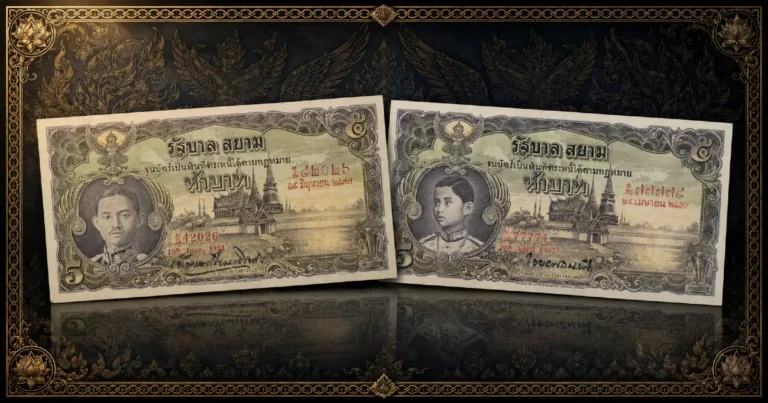
The release of the Thailand Series 4 Banknotes represents one of the most complex, politically descriptive, and visually striking eras in the history of Southeast Asian paper currency. Entering circulation in the late 1930s, this series captures a nation rapidly reshaping its identity on both the domestic and international stages. Following the historic templates established by the preceding Thailand Series 3 Banknotes, the Thai Series 4 paper money firmly consolidated a portrait-centric currency tradition. This era elevated the young King Ananda Mahidol (King Rama 8) to the obverse of the notes while introducing a sweeping graphic standardization across its reverse designs.
What sets this series apart for serious numismatists is its dual identity. The production of the Thailand Series 4 Banknotes was split across two dramatically different manufacturing environments, turning it into the first bank note series in Thai history to feature multiple printers. Initial standard printings were executed by the master engravers of Thomas De La Rue & Company Limited (TDLR) in London. However, the unexpected outbreak of World War II severed international supply chains, forcing domestic presses to step in under heavy pressure.
Additionally, the London-printed phase records a historic terminology evolution, capturing an official country name change from Siam to Thailand right across the faces of the currency. For currency specialists diving into Siam paper money history, this intersection of high-art British security engraving, local emergency improvisation, and semantic text variations makes Thai Series 4 paper money an exhaustive, endlessly rewarding landscape for study.
Table of Contents
One Series, Two Producers: The First Multiple-Printer Arrangement
The Thailand Series 4 Banknotes are primarily distinguished by their two different printers, a direct consequence of the global geopolitical situation during World War II. Initially, the banknotes were produced by the British firm Thomas De La Rue & Company (TDLR) in London, continuing a long-standing relationship with the Thai government. These notes, including denominations of 1, 5, 10, 20, and 1,000 Baht, are widely celebrated for their high-quality intaglio printing, superior paper, and intricate designs.
However, the war severely disrupted this arrangement. After Thailand signed a mutual offensive-defensive alliance pact with Japan on 21 December 1941, and subsequently declared war on Britain on 25 January 1942, it became impossible to continue obtaining banknotes from TDLR. This sudden break forced the Thai government to look for alternative solutions. An order was placed for banknotes from Japan, but severe difficulties with wartime transportation combined with the steadily increasing demand for banknotes by the Japanese military stationed in Thailand ultimately made that option unviable.
This necessity for self-reliance led to the production of the second type of Series 4 notes, which were printed domestically by the Royal Thai Survey Department (RTSD). Materials for these notes had to be completely sourced from local elements under extreme constraints. The paper was manufactured by the Thai Paper Mill in Kanchanaburi Province, and printing ink had to be coercively purchased from private local entities.
The resulting denominations—1, 10, 20, and 100 Baht—were produced under emergency wartime conditions, featuring noticeably cruder engravings on inferior, highly brittle paper stock. This dual-printer arrangement marks the Thailand Series 4 banknotes as a major milestone, being the first series in Thai history to have more than one producer.
Portrait of the King: Continuing the Visual Lineage
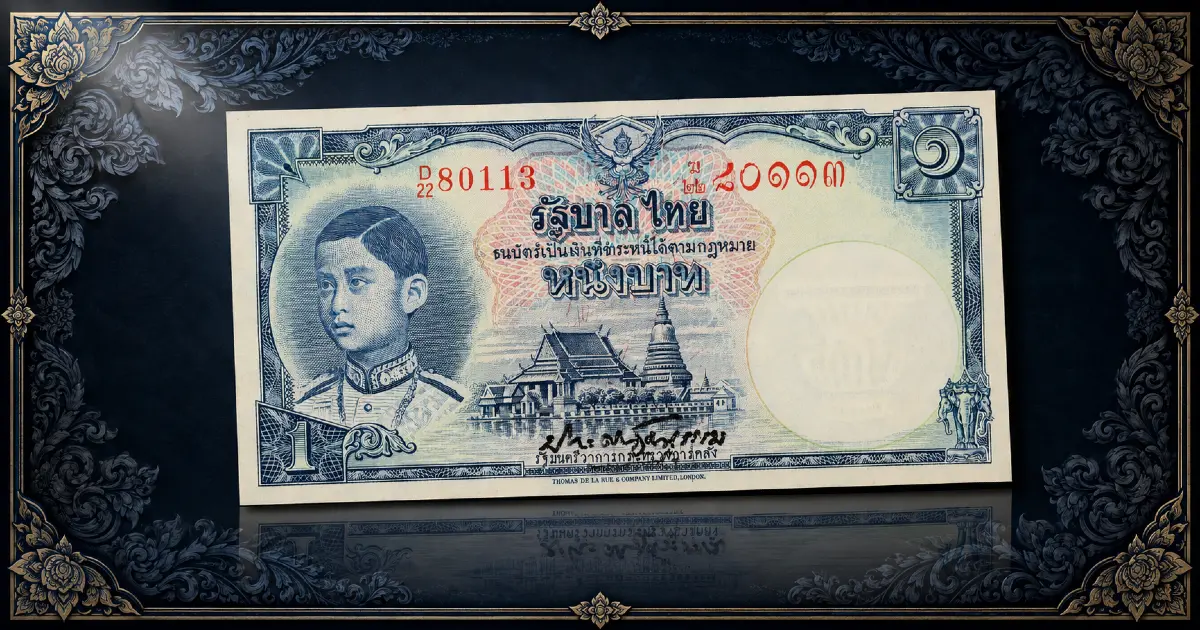
The obverse of all Thailand Series 4 banknotes features a portrait of King Ananda Mahidol (Rama 8) wearing a formal military uniform. This choice maintained a visual lineage established by the late-era Thailand Series 3 Banknotes, which had first introduced monarchical portraiture onto the state’s paper currency.
King Ananda Mahidol had officially ascended the throne as a young boy on 2 March 1935 following the abdication of his uncle, King Prajadhipok (Rama 7). While the young monarch pursued his formal education in Lausanne, Switzerland, a deeply nationalistic government led by Prime Minister Plaek Phibunsongkhram took administrative control in Bangkok. The presence of his portrait across all printer variations provided a vital symbol of national legitimacy and continuous royal lineage, even as production shifted from London to local emergency presses.
Geopolitical Transformations and the Issuer Title Change
Beyond the change in printers, the London-produced De La Rue issues record a historic terminology evolution across the face of the currency. As part of the government’s cultural campaign to project a modernized, fiercely independent state, the official name of the country was changed from “Siam” to “Thailand” via a major decree. This political shift split the TDLR-printed notes into two clear, highly collectible variety classes based on the title text at the upper front area:
Phase 1: The “Government of Siam” Issues (1938–1939)
The opening wave of Thai Series 4 notes carried the traditional legal moniker “Government of Siam” at the upper center front. These pieces exhibit the classic pre-war De La Rue style, combining intricate pastel security underprints with heavy, crisp intaglio portrait lines.
Phase 2: The “Government of Thailand” Heading Change (1940–1946)
Following the name change, Thomas De La Rue altered the core printing plates to read “Government of Thailand”. This created direct design parallels across denominations: the layouts and primary motifs remained identical, but the semantic swap fundamentally updated the state identity embedded in the currency. It is highly notable that no 20 Baht note was ever put into regular circulation under this De La Rue “Thailand” header phase.
Technical Specifications and Serial Tracking Logic
The serialization rules governing the Thailand Series 4 banknotes carry forward the logical tracking methods used in previous decades:
- Serial Number Formats: Every standard circulating note features a clean, 5-digit serial number paired with a fractional alphanumeric prefix block.
- The TDLR Prefix Chain: On the Thomas De La Rue prints, the “Government of Thailand” prefix numbering begins exactly where the old “Government of Siam” prefix range ends. For example, on the 10 Baht note, the “Government of Siam” printing block concluded at prefix fraction N/15. When the heading was changed to “Government of Thailand,” the TDLR press started the new run immediately at prefix N/16.
- The RTSD Prefix Reset: Conversely, when the local Royal Thai Survey Department stepped in to print emergency notes, they completely ignored the ongoing London prefix sequence. For their emergency runs, the prefix numbering started completely over again at N/1.
- Denomination Identifiers: The alphabetical numerator codes correspond to specific denominations: K was assigned to the 5 Baht notes, N to the 10 Baht notes, P to the 20 Baht notes, S to the 100 Baht notes, and T to the 1,000 Baht notes.
Watermark Framework and Security Variations
Standard De La Rue issues incorporate a specialized security watermark displaying the Constitution on a pedestal (alternatively described as the constitution on a decorated tray or phan). To explore how this powerful political icon became a mainstay of national currency design, read our comprehensive article on the Constitution of Thailand on Banknotes.
While the local emergency RTSD printings maintained this watermark layout, it is rendered with a far cloudier, rougher definition due to domestic paper constraints. Furthermore, a highly unique variation exists exclusively on the emergency 10 Baht note (Pick 40 / BNB B106) printed under the signature of Direk Chainam or Vijitr Luritanon. On these specific varieties, the standard pedestal watermark was replaced by a design consisting of wavy lines running through the paper along with a printed constitution on phan symbol, making it one of the most famous security paper anomalies of the war.
Enshrining the Ananta Samakhom Throne Hall
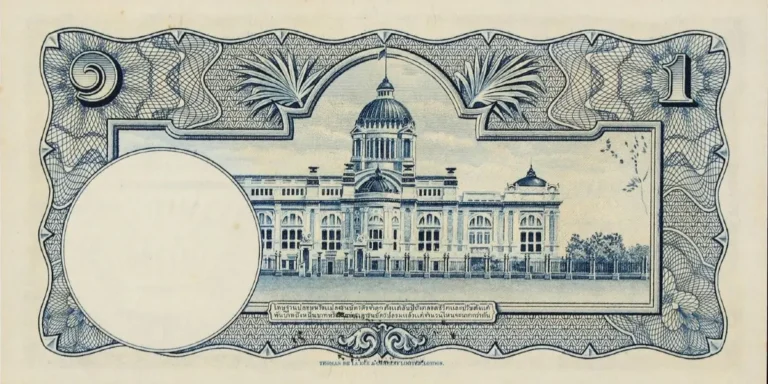
Like its predecessors — Series 2 with its royal ploughing ceremony and Series 3 with the Phra Samut Chedi temple — Series 4 maintained a single, unified reverse design across all denominations. What distinguished Thai Series 4 notes was the subject chosen: the Ananta Samakhom Throne Hall, rendered in razor-sharp intaglio engraving on the De La Rue London plates and displayed from a frontal perspective that accentuates its grand neoclassical dome, flanking arches, and symmetrical facades.
The choice was deliberate. Repurposed as Siam’s first official parliament building following the 1932 Revolution, the Throne Hall carried immediate constitutional symbolism — its placement on every denomination from the 1 Baht to the 1,000 Baht note was a daily projection of the new political order into public hands. On the later RTSD domestic printings, the reverse design was replicated via flat lithography, losing some of De La Rue’s fine lines but preserving the architectural silhouette intact.
For a full exploration of this building’s numismatic journey across series, printers, and reigns, see our dedicated article on the Ananta Samakhom on Thai Banknotes.
Pridi Banomyong: A Name of Two Titles
For variety specialists, the presence of two different signatories on the Thailand Series 4 banknotes—Pradit Manudham and Pridi Banomyong—is a unique and highly collectible feature, as they refer to the exact same individual. This rare occurrence adds a fascinating layer to the series, making it a key focus for numismatists.
Born Pridi Banomyong on 11 May 1900, he was a highly accomplished scholar who earned a PhD in law and a diploma in economics from Sciences Po in Paris. Upon his return to Siam in 1927 to work for the Ministry of Justice, he was granted the royal title Luang Praditmanudham. He used this title when signing official documents as the Minister of Finance, and he was also a key leader of the 1932 Siamese Revolution.
However, he officially renounced his royal title in 1942, after which he signed banknotes under his birth name, Pridi Banomyong. This profound bureaucratic and personal transformation explains the distinct name variation found on the currency faces of this era, forcing collectors to track both name layouts to achieve a complete variety set.
Master Reference Matrix — Pick & BNB Numbers
To provide variety specialists and type set collectors with a clear, structured overview of the entire series as documented in specialized catalog indexes, the following reference matrix maps out the standard circulating issues, unissued configurations, standard Pick numbers, and Banknote Book (BNB) classifications.
| Denomination | Printer | Issuer Title | Pick Number | Banknote Book |
|---|---|---|---|---|
| 1 Baht | TDLR | Siam | Pick 22 | Siam B244 |
| 1 Baht | TDLR | Thailand | Pick 31 | Thailand B101 |
| 1 Baht | RTSD | Thailand | Pick 39 | Thailand B105 |
| 5 Baht | TDLR | Siam | Pick 32 | Siam B245 |
| 5 Baht | TDLR | Thailand | Pick 33 | Thailand B102 |
| 10 Baht | TDLR | Siam | Pick 34 | Siam B246 |
| 10 Baht | TDLR | Thailand | Pick 35 | Thailand B103 |
| 10 Baht | RTSD | Thailand | Pick 40 | Thailand B106 |
| 20 Baht | TDLR | Siam | Pick 36 | Siam B247 |
| 20 Baht | RTSD | Thailand | Pick 41 | Thailand B107 |
| 100 Baht (Unissued) | TDLR | Siam | Unlisted | Siam B248 |
| 100 Baht | RTSD | Thailand | Pick 42 | Thailand B108 |
| 1,000 Baht | TDLR | Siam | Pick 37 | Siam B249 |
| 1,000 Baht | TDLR | Thailand | Pick 38 | Thailand B104 |
Detailed In-Depth Denomination Profiles
1 Baht Banknote
- Dimensions: 125 x 65 mm
- Primary Colors: Blue and green
- Obverse Design: Portrait of King Rama 8 in military uniform on the left; Royal Garuda emblem at upper center; detailed engraving of Phra Samut Chedi temple and its river pagoda centered; three-headed elephant (Airapote) icon on the lower right margin
De La Rue “Siam” Variety (Pick 22 / B244):
- Variety a: Signature: Chaiyos Sombat. Prefixes: A/1 to A/52. Introduced on 5 December 1938.
- Variety b: Signature: Pradit Manudham. Prefixes: A/53 to B/100.
De La Rue “Thailand” Variety (Pick 31 / B101):
- Variety a: Signature: Pradit Manudham. Serial numbers on the right side: Thai digits. Prefixes: C/1 to D/50. Introduced on 7 March 1940.
- Variety b: Signature: Pridi Panomyong. Western digits in both serial lines. Prefixes: D/51 to D/62. Introduced on 22 May 1946.
Royal Thai Survey Department Issue (Pick 39 / B105):
- Variety a: Signature: Pao Pienlert Boripanyuthakit. Serial numbers on the right side: Thai digits. Prefixes: A/1 – A/40. Introduced on 24 June 1942.
- Variety b: Signature: Pao Pienlert Boripanyuthakit. Western digits in both serial lines. Prefixes: A/41 – C/28.
- Variety c: Signature: Khuang Abhaiwongse. Prefixes: C/29 – C/32.
- Variety d: Signature: Leng Srisomwong. Prefix: C/33.
5 Baht Banknote
- Dimensions: 135 x 76 mm
- Primary Colors: Purple and green
- Obverse Design: King Rama 8 portrait on the left; Royal Garuda emblem at top center; Phra Pathom Chedi temple centered in the foreground frame; Airapote icon on the lower right
De La Rue “Siam” Variety (Pick 32 / B245):
- Variety a: Signature: Pradit Manudham. Prefixes: K/1 – K/25. Introduced on 14 April 1939.
De La Rue “Thailand” Variety (Pick 33 / B102):
- Variety a: Signature: Pradit Manudham. Prefixes: K/26 – K/27. Introduced on 7 March 1940.
10 Baht Banknote
- Dimensions: 147 x 87 mm
- Primary Color: Brown
- Obverse Design: King Rama 8 portrait on the left; Royal Garuda emblem at top center; ramparts and watchtowers of Mahakan Fort in Bangkok; Airapote standing on the lower right frame border
De La Rue “Siam” Variety (Pick 34 / B246):
- Variety a: Signature: Pradit Manudham. Prefixes: N/1 – N/15, entering public circulation on 12 June 1939.
De La Rue “Thailand” Variety (Pick 35 / B103):
- Variety a: Signature: Pradit Manudham. Prefixes: N/16 – N/39, introduced on 7 March 1940.
- Variety b: Signature: Pridi Banomyong. Prefixes: N/48 – N/55.
- Note: Prefixes N/40–N/47 are currently unrecorded in the literature. Whether these represent an unissued printing block, a destroyed run, or simply undiscovered survivors remains unknown. Any example bearing these prefixes would be of numismatic interest.
Royal Thai Survey Department Issue (Pick 40 / B106):
- Variety a: Signature: Pao Pienlert Boripanyuthakit. Prefixes: Block N/1 – N/50, introduced on 24 May 1943.
- Variety b: Signature: Leng Srisomwong. Prefixes: Block N/51 – N/57.
- Variety c: Signature: Direk Chainam. Prefixes: Block N/58 – N/82, introduced on 5 April 1945.
- Variety d: Signature: Vijitr Luritanon. Prefixes: N/83 – N/86.
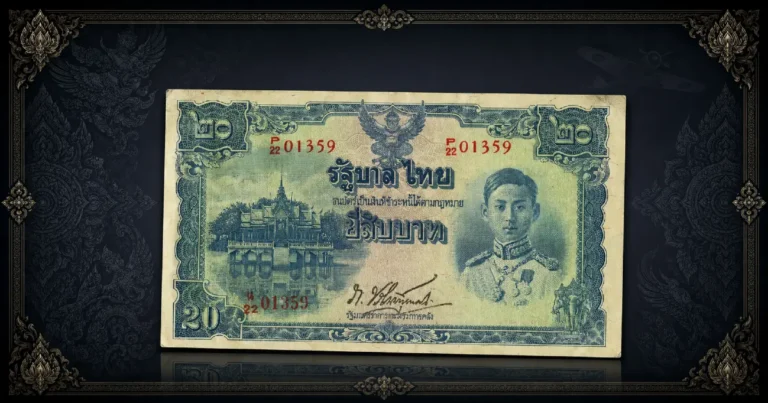
20 Baht Banknote
- Dimensions: 147 x 87 mm
- Primary Colors: Green and orange
- Obverse Design: King Rama 8 portrait on the left; Royal Garuda emblem at top center; spires and overlapping eaves of both the Dusidabhirom Pavilion and the Chakri Maha Prasat Pavilion; Airapote guarding the lower right field
De La Rue “Siam” Variety (Pick 36 / B247):
- Variety a: Signature: Pradit Manudham. Prefixes: P/1 – P/15. Introduced on 29 December 1939.
Royal Thai Survey Department Issue (Pick 41 / B107):
- Variety a: Signature: Pao Pienlert Boripanyuthakit. Prefixes: Block P/1 – P/84. Introduced on 17 February 1943.
- Variety b: Signature: Khuang Abhaiwongse. Prefixes: P/83 (overlapping with Variety a).
- Variety c: Signature: Leng Srisomwong. Prefixes: P/84 – P/88 (P/84 overlaps with Variety a).
100 Baht Banknote
- Dimensions: 147 x 87 mm
- Primary Colors: Blue and orange
- Obverse Design: King Rama 8 portrait on the left; Royal Garuda emblem at top left; Wat Arun (Temple of the Dawn); Airapote elephant standing on the lower right corner border
Unissued De La Rue “Siam” Variety (Pick NL / B248):
- The Unadopted Design: Prepared by London engravers carrying the traditional headline text.
Royal Thai Survey Department Emergency Issue (Pick 42 / B108):
- Variety a: Signature: Khuang Abhaiwongse. Prefixes: S/1 – S/6. Introduced on 27 December 1944.
- Variety b: Signature: Leng Srisomwong. Prefix: S/6 (overlapping with Variety a).
1,000 Baht Banknote
- Dimensions: 195 x 105 mm
- Primary Color: Red
- Obverse Design: Large format layout featuring the portrait of King Rama 8 on the left; Royal Garuda emblem at top center; Wat Arun along the banks of the Chao Phraya River; Airapote icon on the lower right border
De La Rue “Siam” Variety (Pick 37 / B249):
- Variety a: Signature: Pradit Manudham. Prefixes: Serial tracking structure s/n T/1 00001 – T/1 20000. Introduced on 9 January 1939.
De La Rue “Thailand” Variety (Pick 38 / B104):
- Variety a: Signature: Pradit Manudham. Prefixes: Serial tracking structure s/n T/1 20001 – T/1 40000. Introduced on 7 March 1940.
Variety Checklist — Signatures & Prefixes
The following comprehensive variety matrix acts as a definitive checklist for serious collectors to map out signature codes, title changes, printer details, and prefix allocations.
| Denomination | Printer Source | Issuer Title | Signature | Prefixes |
|---|---|---|---|---|
| 1 Baht | TDLR | Siam | Chaiyos Sombat | A/1 – A/52 |
| 1 Baht | TDLR | Siam | Pradit Manudham | A/53 – B/100 |
| 1 Baht | TDLR | Thailand | Pradit Manudham | C/1 – D/50 |
| 1 Baht | TDLR | Thailand | Pridi Banomyong | D/51 – D/62 |
| 1 Baht | RTSD | Thailand | Pao Pienlert (Thai s/n on right) | A/1 – A/40 |
| 1 Baht | RTSD | Thailand | Pao Pienlert (Western s/n on right) | A/41 – C/28 |
| 1 Baht | RTSD | Thailand | Khuang Abhaiwongse | C/29 – C/32 |
| 1 Baht | RTSD | Thailand | Leng Srisomwong | C/33 |
| 5 Baht | TDLR | Siam | Pradit Manudham | K/1 – K/25 |
| 5 Baht | TDLR | Thailand | Pradit Manudham | K/26 – K/27 |
| 10 Baht | TDLR | Siam | Pradit Manudham | N/1 – N/15 |
| 10 Baht | TDLR | Thailand | Pradit Manudham | N/16 – N/39 |
| 10 Baht | TDLR | Thailand | Pridi Banomyong | N/48 – N/55 |
| 10 Baht | RTSD | Thailand | Pao Pienlert | N/1 – N/50 |
| 10 Baht | RTSD | Thailand | Leng Srisomwong | N/51 – N/57 |
| 10 Baht | RTSD | Thailand | Direk Chainam (Wavy Lines Wmk) | N/58 – N/82 |
| 10 Baht | RTSD | Thailand | Vijitr Luritanon (Wavy Lines Wmk) | N/83 – N/86 |
| 20 Baht | TDLR | Siam | Pradit Manudham | P/1 – P/15 |
| 20 Baht | RTSD | Thailand | Pao Pienlert | P/1 – P/84 |
| 20 Baht | RTSD | Thailand | Khuang Abhaiwongse | P/83 |
| 20 Baht | RTSD | Thailand | Leng Srisomwong | P/84 – P/88 |
| 100 Baht | RTSD | Thailand | Khuang Abhaiwongse | S/1 – S/6 |
| 100 Baht | RTSD | Thailand | Leng Srisomwong | S/6 |
| 1,000 Baht | TDLR | Siam | Pradit Manudham | T/1 00001 – T/1 20000 |
| 1,000 Baht | TDLR | Thailand | Pradit Manudham | T/1 20001 – T/1 40000 |
Archival Legacy and the Underground Movement
While standard commercial operations dictate the parameters of regular print varieties, the Thailand Series 4 banknotes also house an incredible secret chapter tied to clandestine intelligence operations. Following the Japanese occupation of Thailand during the war, a patriotic underground resistance group known as the Seri Thai (Free Thai Movement) formed to oppose Axis control.
Operating in total secrecy, this network coordinated closely with Allied intelligence groups to prepare for the liberation of the kingdom. To facilitate these highly dangerous operations, specialized currency blocks based closely on the Thailand Series 4 banknotes blueprints were produced under extraordinary conditions. For an in-depth exploration of the secret printing operations, specific diagnostic features, and the heroic history behind these clandestine resistance artifacts, read our dedicated guide on Seri Thai Banknotes.
A Captivating Chapter in Wartime Numismatics
The Thailand Series 4 banknotes remain an undeniable masterpiece of historical and technical currency design. They perfectly chart a nation walking a thin geopolitical tightrope—captured beautifully by the transition from the elegant London engravings of “Government of Siam” and “Government of Thailand” to the rustic, resilient local print runs executed under intense wartime duress. They stand as a physical record of the exact moment when global conflict forced a historic shift in production, turning this run of Thai Series 4 paper money into a vital bridge toward future issues, such as the fascinating Thailand Series 5 Banknotes, which would subsequently be printed in Japan to meet the kingdom’s soaring currency demands.
For the modern collector, assembling a comprehensive variety type set of Thai Series 4 notes requires balancing an appreciation for pristine British security intaglio work with an eye for the fascinating ink and paper variations of local emergency print runs. Each note functions as a magnificent paper monument, preserving the enduring architectural silhouette of the Ananta Samakhom Throne Hall across an era of intense global disruption.