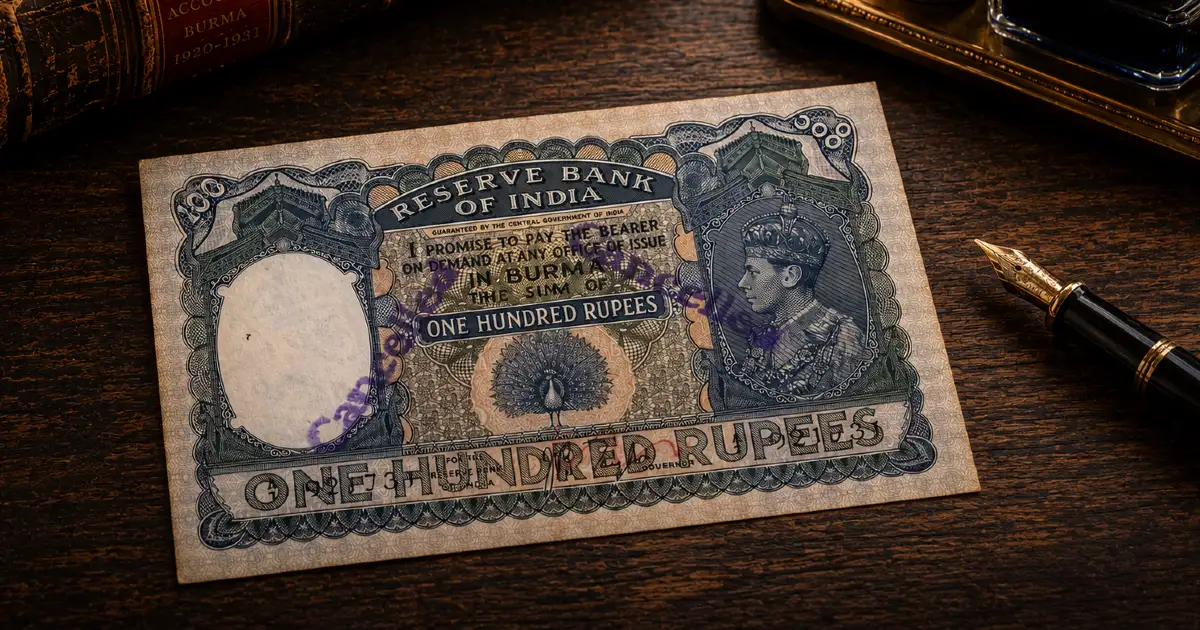
Burma Peacock banknotes are among the most important and recognizable issues in Southeast Asian paper money history. Introduced by the Reserve Bank of India (RBI) between 1938 and 1939, these King George VI Burma banknotes represented the first permanent, definitive currency series created specifically for Burma following its administrative separation from British India.
Unlike the earlier emergency provisional overprint notes, the Burma Peacock Series was designed from the ground up for exclusive circulation within the colony. The notes beautifully integrated the portrait of King George VI with the iconic dancing peacock motif—a classic symbol deeply associated with sovereign Burmese history and cultural identity. Today, Burma Peacock banknotes are actively collected not only by specialists in British Burma paper money but also by collectors of Indian banknotes due to their direct administrative connection with the Reserve Bank of India.
The series consisted of five core denominations ranging from 5 Rupees to 10,000 Rupees and remained the bedrock of Burma’s monetary system until the massive structural disruptions caused by World War II. Among worldwide numismatists, the family is celebrated for its intricate engraving quality, challenging high-denomination rarities, and undeniable significance as Burma’s premier definitive paper money milestone. This comprehensive guide explores the complete series, tracking its historical background, technical security parameters, prefix ranges, rarity factors, and lasting legacy.
Table of Contents
The First Permanent Banknotes of Burma
The introduction of the Burma Peacock Series marked a major turning point in the country’s paper money timeline. While prior currency choices served as temporary fiscal buffers, this new King George VI series established a distinct visual sovereignty for the colony while maintaining strict monetary stability during a complex period of political transition.
From the KGV Overprints to the Peacock Series
When Burma separated from British India on 1 April 1937, existing King George V Government of India banknotes were modified with a localized print stamp to establish a transitional currency layout. For a comprehensive historical breakdown of those early emergency provisions, see our detailed guide on the 1937 KGV provisional overprints.
Following this stopgap phase, the Reserve Bank of India finalized a dedicated, permanent series of banknotes for Burma. Entering circulation between 1938 and 1939, these new issues systematically replaced the provisional overprints and provided the colony with its very first long-term, custom-tailored banknote installation.
The Reserve Bank of India’s Role
Responsibility for local currency administration and reserve distribution remained tied directly to the Reserve Bank of India post-1937. The RBI managed the issue parameters of the new banknotes, ensuring absolute financial continuity. As a result, Burma Peacock banknotes occupy an unusual crossover position in world numismatics: although printed specifically for Burma, they were issued under the stamp of the Reserve Bank of India, making them highly collectible crossover items for both Indian and Burmese banknote specialists. For the full currency story from colonial Burma through to modern Myanmar, see our complete history of Burma banknotes.
The Peacock as a Sovereign Symbol
The defining hallmark of the new series was the integration of the dancing peacock, a motif deeply intertwined with Burmese history and regional culture. Long before British annexation, the peacock served as the supreme royal emblem on the silver coinage of the Konbaung Dynasty under King Mindon. Its prominent placement on the new banknotes helped differentiate the series from standard domestic Indian notes, giving Burma its own unmistakable currency identity that remains highly celebrated by modern collectors.
Production and Issue Details
The Burma Peacock Series was engineered from scratch under the auspices of the Reserve Bank of India to provide a secure, standardized monetary framework. The notes remained denominated in rupees and circulated throughout the colony during the final peaceful years of British administration before the onset of World War II.
Issuer and Printing Authority
Although designated for exclusive use within Burma, the series was issued under the authority of the Reserve Bank of India and executed by the India Security Press in Nasik. Consequently, the notes share standard paper textures, geometric line-work styles, and high intaglio production characteristics with contemporary home-market RBI banknotes, while cleanly preserving their distinct Burmese design accents.
Introduction Timeline by Denomination
The five denominations of the Peacock Series were introduced over a staggered 14-month window to ensure banking systems could smoothly transition out of older overprinted notes:
- 5 Rupees: May 1938
- 10 Rupees: June 1938
- 100 Rupees: May 1939
- 1,000 Rupees: July 1939
- 10,000 Rupees: May 1939
Circulation Realities Within Burma
By the beginning of 1942, Burma’s active currency environment had become incredibly complex, featuring a parallel mix of definitive Peacock issues, older overprints, and standard non-overprinted Government of India notes. The lower denominations bore the brunt of daily domestic market commerce, while the massive high-value rupee notes were utilized almost exclusively by commercial banks, major timber/rice corporations, and high-level British colonial treasury clearings.
Design and Security Features
The series successfully introduced a bold visual identity for Burma while retaining the meticulous security standards expected of pre-war colonial currency production.
King George VI Portrait
All denominations feature a sharp obverse portrait of King George VI dressed in formal state robes. The inclusion of the new monarch’s portrait clearly distinguishes these 1938 definitive issues from the earlier provisional overprint notes, which relied entirely on older King George V security bases.
Multi-Linguistic Script
Unlike standard home-market Indian banknotes, the Burma Peacock Series does not feature a multi-language panel on the reverse. Instead, the denomination is rendered in three specific languages: English, Burmese, and Shan. This makes the Peacock family historically significant as the only banknote series in global numismatics to incorporate Shan script.
RBI Governor Signature & Security Arrays
Every note in this series bears the single signature of J.B. Taylor (Sir James Braid Taylor), the second Governor of the Reserve Bank of India. The notes do not carry printed calendar dates or embedded security threads; protection against forgery relied on intricate hand-engraved intaglio frames, complex geometric guilloches, and a clear, high-contrast watermark of King George VI embedded into the security paper stock.
The Complete Burma Peacock Series
The series maps to Pick numbers 4 through 8 in the Standard Catalog of World Paper Money and references B201 through B205 in The Banknote Book.
5 Rupees Peacock Banknote (Pick 4 / BNB B201)
The 5 Rupees note served as the workhorse low-value denomination of daily Burmese marketplace trade.
- Dimensions: 127 x 73 mm
- Primary Colors: Violet and green
- Obverse Design: Portrait of King George VI paired with a profile peacock layout
- Reverse Design: A majestic Asian elephant working in a tropical forest
- Documented Prefixes: A/0 through A/36
10 Rupees Peacock Banknote (Pick 5 / BNB B202)
The mid-tier denomination of the series, heavily favored in commercial retail environments across Rangoon and Mandalay.
- Dimensions: 146 x 84 mm
- Primary Colors: Green, violet, blue, and orange
- Obverse Design: Portrait of King George VI set alongside a traditional Burmese bullock cart
- Reverse Design: A native Burmese sailboat (laung-zat) navigating coastal waters
- Documented Prefixes:: A/0 through A/50
100 Rupees Peacock Banknote (Pick 6 / BNB B203)
A high-value merchant note representing a substantial amount of financial capital before the war.
- Dimensions: 171 x 108 mm
- Primary Colors: Blue, green, and orange
- Obverse Design: Portrait of King George VI accompanied by a prominent central peacock vignette
- Reverse Design: An Asian elephant logging teak trees in the Burmese jungle
- Documented Prefixes: A/0, A/1 (full runs); A/2 (serials up to 500000 only)
1,000 Rupees Peacock Banknote (Pick 7 / BNB B204)
An exceptionally rare high-denomination note reserved for institutional banking clearings and colonial treasury payments.
- Dimensions: 202 x 126 mm
- Primary Color: Brown
- Obverse Design: Detailed profile portrait of King George VI within an ornamental frame
- Reverse Design: A dynamic wildlife vignette featuring a tiger paired with a profile peacock panel
- Documented Prefix: A/0 (Tracked serial ranges extend to at least 200000)
10,000 Rupees Peacock Banknote (Pick 8 / BNB B205)
The absolute pinnacle of British Burma numismatics. Used strictly for massive inter-bank institutional clearings, surviving examples are legendary rarities.
- Dimensions: 202 x 126 mm
- Primary Color: Violet
- Obverse Design: Portrait of King George VI surrounded by heavy geometric borders
- Reverse Design: A scenic rendering of a Burmese waterfall framed next to a profile peacock panel
- Documented Prefix: A/0 (Total printing volumes remain unrecorded)
Rarity and Survival
Although these banknotes formed the backbone of pre-war colonial commerce, authentic surviving examples are incredibly scarce today—frequently proving much harder to locate than contemporary home-market Indian banknotes.
Wartime Evacuation and Wholesale Destruction
The outbreak of World War II shattered the circulation timeline of the Peacock Series. During the rapid Japanese advance into Burma in early 1942, British military administrations enacted strict scorched-earth treasury policies. Vast quantities of cash reserves locked inside bank vaults and government offices were systematically burned or defaced to prevent them from falling into enemy hands.
The frantic evacuation forced private individuals to abandon or bury their personal paper currency savings, exposing paper stocks to severe tropical degradation. Consequently, a vast majority of surviving Peacock notes are heavily circulated, down-graded examples that survived the conflict through pure chance.
Authentication and Collecting Notes
Due to the intense value commanding high-denomination pre-war colonial paper assets, collectors must apply disciplined authentication metrics when examining raw specimens.
Detecting Wartime Counterfeit Contexts
A prominent area of specialized research involves wartime espionage counterfeits produced during the conflict. To destabilize British colonial finance along the border, the Japanese military executed sophisticated counterfeiting operations that actively targeted both home-market Indian currency and the definitive Burma Peacock banknotes, especially the 10 Rupee notes.
While these Japanese-produced Burma counterfeits can appear highly convincing at first glance, the overall engraving quality is slightly inferior to genuine issues. One of the easiest diagnostic features can be found directly within the bullock cart vignette on the obverse, where the engraved human figures lack the sharpness, clean line-work, and fine detail seen on authentic examples. Collectors carefully study these plate variations and line crispness to protect their investments from these historically significant wartime fabrications.
Collectible Archival Annotations and Ledger Notations
A highly sophisticated, yet frequently overlooked, niche in British Burma numismatics involves notes featuring contemporary archival annotations. Because these pre-war assets were meticulously tracked, bank tellers and colonial treasury officials regularly applied handwritten ink notes, accounting cross-references, or manuscript inventory balances directly onto the paper borders.
Far from being detriments or “graffiti,” these authentic accounting notations transform a standard note into an active primary historical document. They provide irreplaceable material evidence of exactly how an individual note was processed, indexed, and audited within corporate or government vaults during the late colonial era.
Localized Town Stamps and Treasury Markings
Another incredibly rich collecting field centers on Peacock banknotes bearing localized town stamps, bank seals, or official colonial treasury handstamps.
The ink strikes provide an undeniable geographic fingerprint, allowing researchers to accurately chart the exact physical path a banknote traveled through Burma’s banking network before the 1942 evacuation. For collectors looking for a deep historical connection, acquiring a note with a distinct, readable treasury or town stamps adds a profound layer of storytelling that a pristine, uncirculated note simply cannot replicate.
Collecting Crossover Appeal
Because the series was administered directly under the Reserve Bank of India, these banknotes enjoy a powerful crossover demand, targeted simultaneously by Indian currency specialists and British Burma collectors. For significant acquisitions, utilizing third-party grading and encapsulation services like PMG (Paper Money Guaranty) provides essential assurance regarding paper preservation, authenticity, and grade accuracy. Read our banknote grading scale to understand what grades mean for value and preservation.
Legacy of the Peacock Series
The Burma Peacock Series represents the final fully developed, peaceful monetary chapter of the pre-war colonial era. It gracefully bridged the gap between basic colonial Indian currency designs and a distinct, localized aesthetic identity for Burma. By successfully embedding the dancing peacock motif and pioneering the use of Shan script, the series proved that a modern circulating currency framework could honor local heritage while preserving strict structural stability. Browse our collection of rare Burma banknotes from the colonial era available to collectors.
Conclusion: A Timeline Severed by Invasion
Ultimately, the 1938 definitive installation remains a poignant “what-if” in Asian numismatics, its lifespan cut short by the chaos of World War II. Assembling a complete set across all five denominations stands as an elite milestone of numismatic achievement.
To explore how the local economy structurally transformed after the British retreat forced the withdrawal of these notes, continue on to our next historical guide mapping the emergence of the wartime Japanese Invasion Money Burma and the subsequent issues of the sovereign Burma State Bank banknotes.