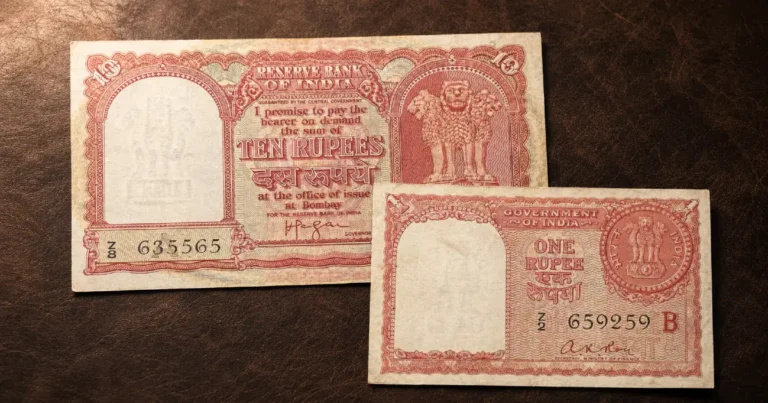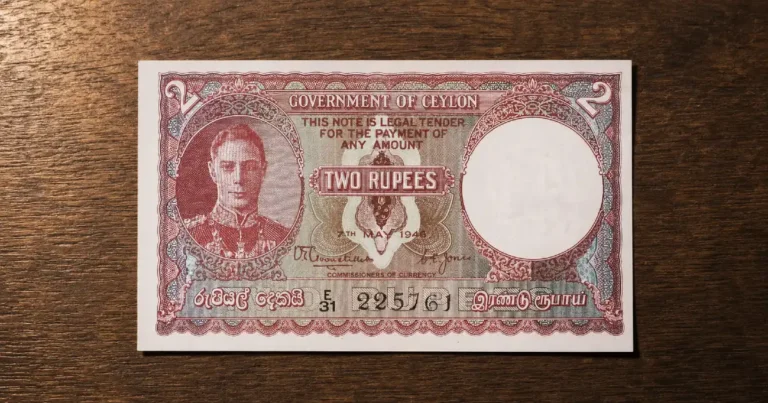
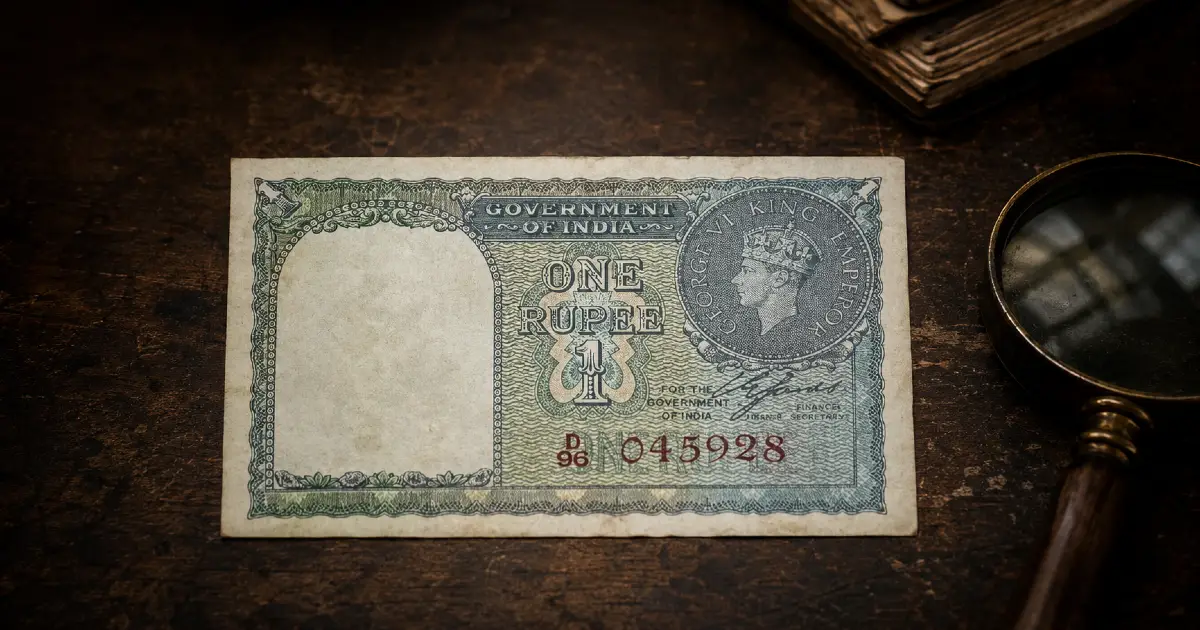
The King George VI 1 Rupee banknote is one of the most important low-denomination paper money issues of British India and the wider Asian wartime currency network. Issued by the Government of India from 1944, it connects several major collecting fields: wartime silver scarcity, Government of India paper money, the monetary recovery of Burma after Japanese occupation, and the transitional currency arrangements of newly independent India and Pakistan.
For collectors, the series rewards close study. Varieties are distinguished by serial number color, inset letter, prefix range, overprint, and territorial inscription. The main types span British India base issues, a Dominion of India transitional note, Military Administration of Burma overprints, Burma Currency Board notes, and the Government of Pakistan engraved plate issue. Each variety carries distinct catalog classifications and known prefix ranges that form the basis of authentication and specialist collecting.
This guide covers the historical background, legal status, design features, and all major varieties of the King George VI 1 Rupee banknote, with full catalog references and prefix data.
Table of Contents
Historical Background of the King George VI 1 Rupee Banknote
The King George VI 1 Rupee banknote was not the first paper rupee issued by the Government of India. A 1 Rupee note featuring King George V was introduced in 1917 as a direct response to silver shortages caused by World War I. A second King George V 1 Rupee variety was issued in 1940, reflecting wartime monetary pressures as the Second World War began to impact India’s economy. The King George VI 1 Rupee banknote, introduced in 1944, continued this established pattern.
Before these paper issues became necessary, the silver rupee had been the standard medium of exchange across British India. The public trusted its intrinsic metal content, and silver coins circulated widely through urban markets, rural trade, and regional commerce. As the Second World War intensified, that trust became a monetary problem. Rising silver prices and wartime uncertainty prompted widespread hoarding, removing large quantities of silver coins from circulation and disrupting everyday trade.
The Government of India responded first by reducing the silver content of rupee coins. Earlier King George VI rupee coins, particularly those of 1938 and 1939, had been struck in high-purity silver; later wartime issues contained progressively less. This measure conserved silver but did not stop hoarding, as people continued to set aside older, higher-purity pieces. A paper substitute was unavoidable.
By 1944, the King George VI 1 Rupee banknote was in circulation. Its small size, simple format, and direct Government of India authority made it practical for mass distribution across markets, transport networks, military supply channels, and regional trade routes. The institutional infrastructure established by the two King George V issues meant the framework for producing and distributing a paper rupee was already in place.
Legal Status of the King George VI 1 Rupee Banknote
The King George VI 1 Rupee banknote occupies a unique legal position in Indian paper money. Under the Reserve Bank of India Act, 1934, the minimum denomination the Reserve Bank was authorized to issue was five rupees, later reduced to two rupees. The 1 Rupee denomination fell below this threshold, which is why it was issued directly by the Government of India rather than the Reserve Bank of India.
This distinction has several important consequences for collectors. The note does not carry the signature of the RBI Governor. It does not include the conventional central bank promise-to-pay clause found on higher-denomination banknotes. Instead, it was signed by C.E. Jones, Secretary to the Finance Department, and its legal identity was tied directly to the rupee coin rather than to the banknote framework of the Reserve Bank.
The reverse of the note reinforces this connection: it carries an engraved representation of the reverse of the 1940 Indian 1 Rupee coin, even though the note itself was introduced in 1944. This design choice was deliberate, visually linking the paper issue to the circulating coin it was intended to supplement.
The 1 Rupee note therefore sits at the intersection of coinage and paper money collecting — legally a coin substitute, physically a banknote, and administratively outside the Reserve Bank framework entirely.
Design Features of the King George VI 1 Rupee Banknote
The design of the King George VI 1 Rupee banknote reflects its legal status as a paper substitute for the rupee coin. Size, obverse and reverse layout, and security features were all kept functional rather than elaborate, while still incorporating the identification points collectors rely on for variety attribution.
Size and General Appearance
The note measures approximately 101 x 63 mm. The main color is blue-gray with underprint elements.
Obverse Design
The obverse carries “Government of India” at the top, with a portrait of King George VI in the upper right reproduced from the obverse of the Indian 1-rupee coin. The denomination “One Rupee” is placed prominently in the center. Ornamental borders and geometric security backgrounds surround the main text.
Serial number color, inset letter, overprint, and territorial inscription — the primary variety identification points — are all located on the obverse.
Reverse Design
The reverse features an engraved representation of the reverse of the 1940 Indian 1 Rupee coin. This was a deliberate design decision connecting the paper note to the coin it supplemented. A multilingual denomination panel in seven scripts reflects India’s linguistic diversity. The absence of Burmese script reflects Burma’s administrative separation from British India before this issue.
Security Features
The note was printed on security paper with a watermark portrait of King George VI. It does not incorporate a security thread, which was reserved for higher-value denominations. For a broader look at how Asian banknotes have used watermarks, threads, and other security features across denominations and eras, see our dedicated guide. Authentication relies on the natural watermark, fine engraving, serial numbering, and controlled print quality. A genuine watermark should appear within the paper structure when held to light, not as a surface impression.
King George VI 1 Rupee Banknote Signature
All major varieties of the King George VI 1 Rupee banknote carry the signature of C.E. Jones, Secretary to the Finance Department. Because the note was a Government of India issue rather than a Reserve Bank issue, it did not use the RBI Governor signature system.
The C.E. Jones signature therefore appears across British India base issues, Dominion of India transitional notes, Burma overprints, and Pakistan transitional issues. Because every variety in the series carries the same signature, it cannot be used to distinguish between them. Serial number color, inset letter, prefix range, and overprint or territorial inscription must all be examined together instead.
British India King George VI 1 Rupee Banknote Issues
The British India issues form the foundation of the series. Three varieties are recognized, distinguished by serial number color and the presence or absence of an inset letter.
Black Serial Number, No Inset
- Catalog Classifications: Pick 25a / BNB B151a
- Issuer: Government of India
- Obverse Design: King George VI portrait upper right; “Government of India” at top.
- Serial Number: Black serial number, no inset letter
- Prefixes: A/0 – Z/99 (excluding I and O)
The earliest and most broadly distributed British India variety, and the base note used for the first Military Administration of Burma overprint. It is the standard entry point for collectors building a King George VI 1 Rupee set.
Black Serial Number, Inset A
- Catalog Classifications: Pick 25c / BNB B151c
- Issuer: Government of India
- Obverse Design: King George VI portrait upper right; “Government of India” at top.
- Serial Number: Black serial number incorporating A inset letter
- Prefix: W
The inset letter A distinguishes this variety from Pick 25a. The restricted prefix range — a single W block — makes it less commonly encountered than the no-inset issue.
Green Serial Number, Inset A
- Catalog Classifications: Pick 25d / BNB B151d
- Issuer: Government of India
- Obverse Design: King George VI portrait upper right; “Government of India” at top.
- Serial Number: Green serial number incorporating A inset letter
- Prefixes: A/0 – W/99 (excluding I and O)
The green serial number issue is particularly significant because the same base note stock underlies the Burma overprint varieties and the Pakistan transitional issue.
Dominion of India King George VI 1 Rupee
Following Indian independence in August 1947, the Government of India continued issuing 1 Rupee notes on the King George VI design format during the transitional period. The Dominion of India issue is identified by its red serial numbers, distinguishing it from all British India base varieties.
Red Serial Number, No Inset
- Catalog Classifications: Pick 25b / BNB B151b
- Issuer: Government of India
- Obverse Design: King George VI portrait upper right; “Government of India” at top.
- Serial Number: Red serial number, no inset letter
- Known Prefixes: D/90 – D/99; E/0 – E/10
The narrow confirmed prefix range makes this one of the scarcer varieties in the series. The red serial number is the most immediate visual identifier. This note bridges the colonial and post-colonial monetary periods — the design remains unchanged from the wartime British India issues, but the issue context belongs to independent India.
Burma Overprints on the King George VI 1 Rupee Note
The Burma overprint issues are among the most historically significant and specialized varieties in the King George VI 1 Rupee series. For a detailed treatment of the Burma monetary context, overprint typography, and the full range of Burma currency board issues, see the KGVI Burma Overprint Banknotes guide.
Burma had been separated administratively from British India in 1937. When British control returned following Japanese occupation, existing Government of India 1 Rupee note stock was adapted for Burma circulation through overprinting, limiting legal tender status to Burma.
Military Administration of Burma — Black Serial Number
- Catalog Classifications: Burma Pick 25a / BNB B501a
- Base Note: India Pick 25a / BNB B151a
- Issuer: Military Administration of Burma
- Obverse Design: King George VI portrait upper right; red five-line overprint reading “MILITARY / ADMINISTRATION / OF BURMA / LEGAL TENDER IN / BURMA ONLY”
- Serial Number: Black serial number, no inset letter
- Prefixes: T/99; U/0; U/1
The rarest variety in the King George VI 1 Rupee series. The confirmed prefix range covers only three complete blocks, making genuine examples extremely difficult to source in any grade. Because of its scarcity and value, this variety is a primary target for false overprints. Prefix verification against the known range is the essential first authentication step.
Military Administration of Burma — Green Serial Number, Inset A
- Catalog Classifications: Burma Pick 25b / BNB B501b
- Base Note: India Pick 25d / BNB B151d
- Issuer: Military Administration of Burma
- Obverse Design: King George VI portrait upper right; red five-line overprint reading “MILITARY / ADMINISTRATION / OF BURMA / LEGAL TENDER IN / BURMA ONLY”
- Serial Number: Green serial number incorporating A inset letter
- Prefixes:
- C/86 – C/99
- D/0 – D/71
- E/42 – E/99
- F/0 – F/61
More obtainable than BNB B501a but still a specialized note. The red overprint on a green serial number base makes visual identification straightforward; however, authenticity depends entirely on prefix range confirmation and period-consistent overprint ink. Notes outside the listed prefix ranges should be treated as forged overprints.
Burma Currency Board — Green Serial Number, Inset A
- Catalog Classifications: Pick 30 / BNB B601
- Base Note: India Pick 25d / BNB B151d
- Issuer: Burma Currency Board
- Obverse Design: King George VI portrait upper right; red five-line overprint reading “BURMA / CURRENCY / BOARD / LEGAL TENDER IN / BURMA ONLY”
- Serial Number: Green serial number incorporating A inset letter
- Prefixes:
- K/27 – K/66
- Q/17 – Q/36
The Burma Currency Board issue reflects a later stage of Burma’s monetary reconstruction, representing a move from military administration toward formal currency governance. The overprint wording distinguishes it immediately from the Military Administration varieties. As with all Burma overprints, prefix range verification is mandatory — notes with overprints falling outside the recorded ranges are counterfeit overprints.
Pakistan Issue of the King George VI 1 Rupee Note
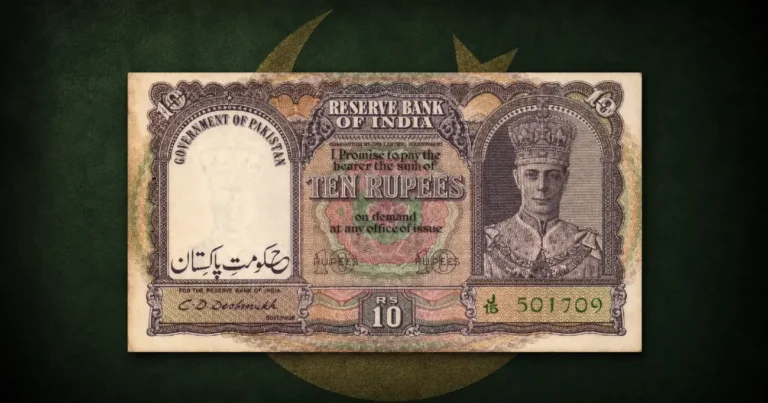
At partition in August 1947, Pakistan required immediate currency but lacked the domestic security printing capacity to produce all denominations independently. The Government of Pakistan 1 Rupee note was produced by modifying the existing King George VI 1 Rupee printing plate, making it the earliest paper money issue of Pakistan. For a full treatment of Pakistan’s transitional currency arrangements, see the Pakistan King George VI Banknotes guide.
Government of Pakistan — Green Serial Number, Inset A
- Catalog Classifications: Pick 1 / BNB B101
- Base Note: India Pick 25d / BNB B151d
- Issuer: Government of Pakistan
- Obverse Design: King George VI facing left; “GOVERNMENT OF PAKISTAN” in greenish-gray inscription inside left watermark area, with Urdu equivalent.
- Serial Number: Green serial number incorporating A inset letter
- Prefixes:
- Q/37 – Q/99
- R/0 – R/6
- R/76 – R/99
- S/0 – S/55
Unlike the Burma issues, which used surface overprints applied to existing notes, the Pakistan issue incorporated the territorial inscription directly into the printing plate. “Government of Pakistan” and its Urdu equivalent appear as part of the original printed design, not as a later addition. Authentication therefore requires examining whether the inscription is fully integrated into the printing rather than sitting above it as a surface stamp. Prefix range verification remains essential: the Q, R, and S prefix blocks recorded for this variety are specific and non-contiguous, and notes presenting outside these ranges are forgery overprints.
King George VI 1 Rupee Banknote Variety Checklist
| Issuer | Serial Color | Inset | Prefix Range | Catalog Reference |
|---|---|---|---|---|
| Government of India | Black | None | A/0–Z/99 (excl. I, O) | India Pick 25a / BNB B151a |
| Government of India | Black | A | W | India Pick 25c / BNB B151c |
| Government of India | Green | A | A/0–W/99 (excl. I, O) | India Pick 25d / BNB B151d |
| Government of India | Red | None | D/90–D/99; E/0–E/10 | India Pick 25b / BNB B151b |
| Mil. Admin. of Burma | Black | None | T/99; U/0; U/1 | Burma Pick 25a / BNB B501a |
| Mil. Admin. of Burma | Green | A | C/86–C/99; D/0–D/71; E/42–E/99; F/0–F/61 | Burma Pick 25b / BNB B501b |
| Burma Currency Board | Green | A | K/27–K/66; Q/17–Q/36 | Burma Pick 30 / BNB B601 |
| Government of Pakistan | Green | A | Q/37–Q/99; R/0–R/6; R/76–R/99; S/0–S/55 | Pakistan Pick 1 / BNB B101 |
How to Identify a King George VI 1 Rupee Banknote
Because many varieties share the same base design, correct identification depends on examining four features in sequence.
Overprint or territorial inscription is the first filter. No overprint or inscription indicates a British India or Dominion of India issue. A red overprint reading “Military Administration of Burma / Legal Tender in Burma Only” indicates the black or green serial number Burma overprint (Burma P25a or P25b). A red overprint reading “Burma Currency Board / Legal Tender in Burma Only” indicates the Burma Currency Board issue (Burma P30). A greenish-gray inscription integrated into the plate design indicates the Government of Pakistan issue (Pakistan BNB P1).
Serial number color narrows the field within each group. Black serial numbers indicate the British India no-inset issue (India P25a), the British India inset A issue (India P25c), or the rarest Burma overprint (Burma P25a). Green serial numbers cover the largest group: the British India green issue (India P25d), both the Burma Currency Board and Military Administration of Burma green overprints (Burma P25b and P30), and the Government of Pakistan issue (Pakistan P1). Red serial numbers identify only the Dominion of India issue (India P25b).
Inset letter narrows the field further. All green serial number issues carry inset A. India P25c carries inset A on a black serial number base.
Prefix range is the definitive authentication control. Every variety has a recorded prefix range. A note that does not fall within the known range for its apparent type must be treated as suspect regardless of how the overprint or inscription appears
Payment Refused Stamps on King George VI 1 Rupee Notes
Some King George VI 1 Rupee notes are found with “Payment Refused” stamps. These stamps were applied by treasury officials or bank clerks when notes were presented for payment after territorial currency arrangements had ended.
The scenario involves notes from Burma or Pakistan prefix ranges where overprints or inscriptions had been removed or tampered with in an attempt to pass them as standard India notes. Officials identifying a prefix belonging to a Burma or Pakistan issue — particularly if the overprint appeared altered or absent — could reject the note and apply the stamp.
Payment Refused notes are collectible as documentary evidence of post-war and post-partition currency control. A genuine stamp should be consistent with the note’s prefix range. Fake Payment Refused stamps do appear on the market, typically applied to common notes to suggest an altered Burma or Pakistan variety.
Persian Gulf Circulation of the King George VI 1 Rupee Banknote
Standard Government of India 1 Rupee notes circulated in Persian Gulf trade centers before the introduction of dedicated Gulf currency arrangements. The economies of Kuwait, Bahrain, Qatar, Oman, and the Trucial States were closely connected with Indian commercial centers, and Indian rupees served as a practical trading currency across this network. These notes carry no special Gulf markings, but their circulation history is relevant for collectors interested in the broader context of Indian Ocean monetary networks and the eventual introduction of the Gulf Rupee in 1959.
Collecting Strategy for the King George VI 1 Rupee Banknote
The series supports several collecting approaches depending on depth of interest and available budget.
A basic type collection requires a single British India example — India Pick 25a or Pick 25d being the most accessible — representing the standard wartime Government of India paper rupee.
A variety collection covers all four British India and Dominion of India types (Pick 25a through 25d), distinguishing the series by serial number color and inset.
A regional transition collection adds the Burma and Pakistan issues, tracing how a single base note design was adapted across multiple territories and political transitions. The Military Administration of Burma black serial number variety (Burma Pick 25a) is the most difficult piece in the entire series.
A complete specialized set extends to Payment Refused examples and deliberate prefix range studies documenting specific blocks. This is specialist territory requiring deep familiarity with the recorded prefix data and access to specialist literature.
The Legacy of the King George VI 1 Rupee Banknote
The King George VI 1 Rupee banknote is the third chapter in a recurring Government of India monetary response to wartime silver scarcity — preceded by the two King George V issues, and shaped by the same legal framework that kept the 1 Rupee denomination outside the Reserve Bank of India structure entirely. That legal distinctiveness, combined with a design that tied the paper note directly to the 1940 rupee coin, gives it a unique position in Indian paper money that no higher-denomination note occupies.
For variety specialists, the series is unusually rich for a single denomination. Eight catalogued varieties span four issuing authorities across three territories, with prefix ranges that function as the primary authentication control and as a record of how note stock moved across British India, Burma, and Pakistan during one of the most politically turbulent decades in South Asian and South East Asian history. The Burma overprints document emergency monetary recovery; the Pakistan engraved plate issue documents the financial mechanics of partition.
A common British India example remains accessible and affordable. The Dominion of India red serial number issue demands more effort to source in collectable grade. The Burma and Pakistan varieties require authentication expertise and familiarity with the recorded prefix data. At the extreme end, Burma Pick 25a — three prefix blocks — represents one of the most demanding pieces in Indian paper money collecting.
The series as a whole is a compact study in how a single base note design was adapted, overprinted, and re-inscribed to serve the monetary needs of multiple territories across a decade of war and independence.