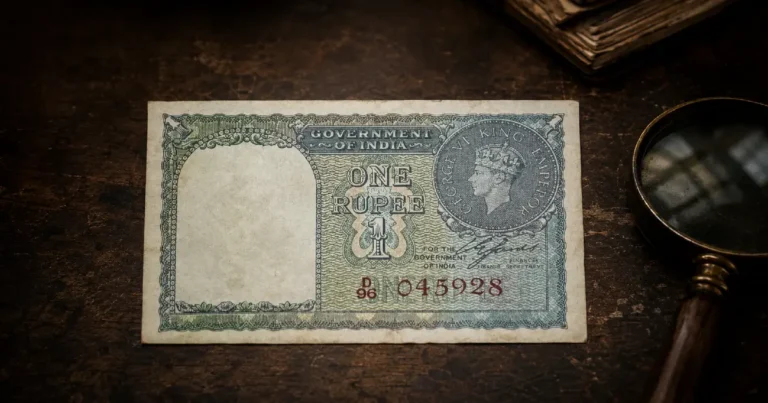
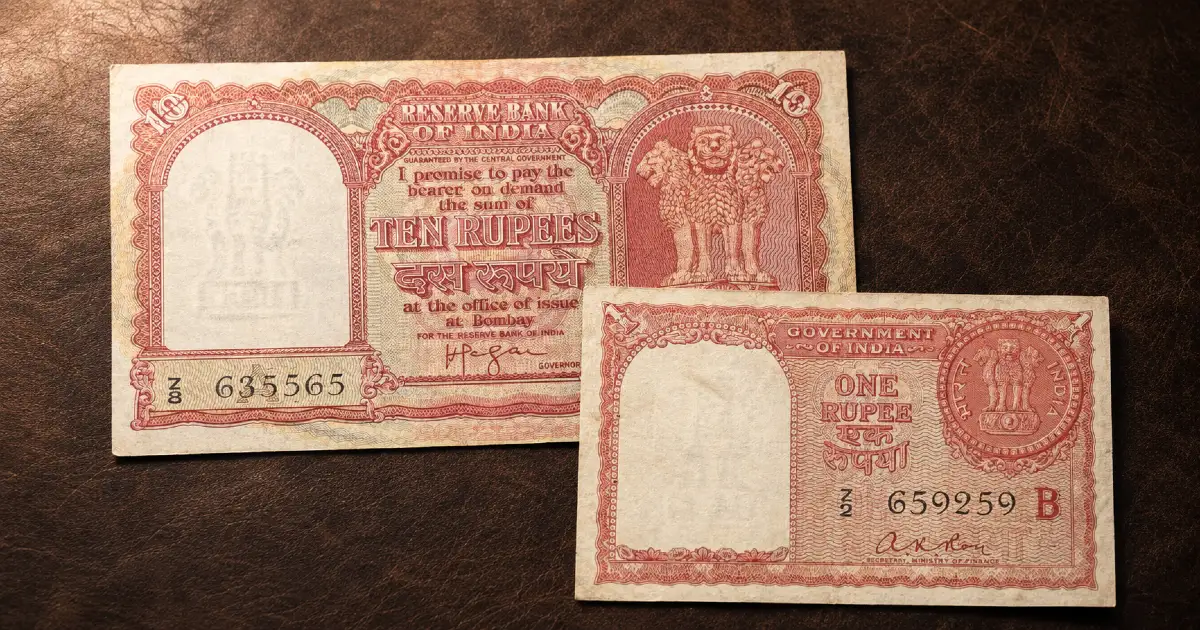
The Gulf Rupee was a special external currency series introduced by the Reserve Bank of India in 1959 for circulation in Bahrain, Kuwait, Muscat and Oman, Qatar, and the Trucial States — territories that later became part of the United Arab Emirates. Based on India’s Ashoka Pillar banknote designs but printed in denomination-specific colors and assigned distinctive “Z” prefix serial numbers, the notes were legally separate from domestic Indian currency and carried no legal tender status within India. The series comprised four denominations — 1 Rupee, 5 Rupees, 10 Rupees, and 100 Rupees — and remained in circulation until each Gulf territory introduced its own national currency between 1961 and 1973.
Table of Contents
Gulf Rupee: Definition and Overview
The Gulf Rupee circulated at par with the Indian Rupee — 1 Gulf Rupee equalled 1 Indian Rupee — but the two were legally distinct instruments. Gulf Rupee notes carried no legal tender status in India, and ordinary Indian Rupee notes were not valid substitutes for the Gulf issue. This parity-with-separation structure is what makes the series numismatically distinct: the notes are closely related in design to their Indian Ashoka Pillar counterparts but occupy a separate catalogue category with their own Pick and BNB references.
The series included four main denominations:
- 1 Rupee
- 5 Rupees
- 10 Rupees
- 100 Rupees
The RBI based these notes on India’s contemporary Ashoka Pillar series designs, printing them in different colors and assigning special ‘Z’ prefix serial numbers. These features allowed banks, officials, and merchants to distinguish Gulf Rupee notes from ordinary Indian currency.
Why Indian Currency Was Used in the Persian Gulf
Indian currency was widely used in the Persian Gulf long before the formal introduction of the Persian Gulf banknotes. This was the result of centuries of trade, migration, banking relationships, and political links between India and the Gulf region.
Trade Between India and the Gulf
Centuries of maritime trade across the Arabian Sea established Indian currency as a familiar and trusted medium in Gulf commercial centers. Indian merchant communities in Bahrain, Kuwait, Muscat, and Dubai conducted trade, banking, and remittance activity in Indian Rupees, embedding the currency into local financial practice well before formal monetary arrangements existed.
British Administration and Monetary Links
The use of Indian currency in the Gulf was also supported by British political and administrative arrangements. Several Gulf territories were under British protection or influence, and the British administration in the Gulf was historically connected to British India.
Before Indian independence, the Government of India and later the Reserve Bank of India played an important role in issuing currency used across British India and related trade areas. Because the Gulf’s commercial and administrative systems were closely linked with India, Indian currency naturally became part of the region’s monetary system.
Even after India became independent in 1947, Indian Rupee notes continued to circulate in several Gulf territories. This arrangement would generate the foreign exchange pressures that made the Gulf Rupee a monetary policy necessity a decade later.
Why the Gulf Rupee Was Introduced in 1959
India introduced the Gulf Rupee to resolve a monetary problem created by the continued use of ordinary Indian Rupees in the Persian Gulf. By the 1950s, India needed to protect its domestic currency and foreign exchange reserves while still allowing Gulf trade to continue using a familiar rupee-based system.
Gold Smuggling and Currency Controls
After independence, India maintained strict controls on foreign exchange, imports, and gold. These controls created a price difference between gold inside India and gold available through overseas markets.
This price differential drove gold arbitrage across the Arabian Sea. Traders exploited the spread between controlled Indian gold prices and open Gulf market rates, with Indian Rupee banknotes serving as the settlement instrument on both ends of the transaction. The resulting pressure on India’s foreign exchange reserves made the domestic-external currency separation a monetary policy priority.
Separating Domestic and External Rupee Circulation
India introduced the Gulf Rupee specifically to separate domestic rupee circulation from the external rupees used across Persian Gulf territories. This allowed the Gulf to continue using a rupee-based currency while preventing those special external notes from being used inside India.
The Reserve Bank of India issued the Persian Gulf banknotes exclusively for external use. They were visually different from domestic Indian notes because of their special colors and “Z” prefix serial numbers. This made them easier to identify and helped banks and authorities distinguish external Gulf currency from ordinary Indian currency.
The separation allowed India to maintain monetary control without disrupting the rupee-based trade system Gulf merchants and banks had relied on for decades.
Legal Basis of the Gulf Rupee
The Gulf Rupee rested on a specific legislative provision. Section 28A of the Reserve Bank of India Act, 1934 authorized the Reserve Bank and the Government of India to issue banknotes and one-rupee notes exclusively for external circulation — a legal mechanism that kept the Gulf issue structurally separate from domestic Indian currency law.
The Reserve Bank of India issued the 5, 10, and 100 Rupee denominations. The Government of India issued the 1 Rupee note, following the established Indian practice of assigning that denomination to the Finance Ministry.
Why Gulf Rupee Notes Were Not Legal Tender in India
Gulf Rupee notes carried no legal tender status within India, which prevented them from re-entering domestic monetary circulation and undermining India’s exchange controls.
Design Features of Gulf Rupee Notes
Gulf Rupee notes were not completely new designs. They were based on India’s Ashoka Pillar series, but they included clear identifying features that separated them from regular Indian notes.
Ashoka Pillar Series Base Designs
The Gulf Rupee used designs derived from contemporary Indian Ashoka Pillar banknotes. These designs featured the Lion Capital of Ashoka, geometric security patterns, denomination panels, signatures, watermarks, and reverse designs already familiar from Indian currency.
This approach made practical sense. Using existing Indian designs allowed the notes to be produced efficiently while maintaining high security standards. At the same time, the notes were modified enough to make them recognizable as special external issues.
Gulf Rupee Color Schemes
One of the easiest ways to identify a Persian Gulf banknote is by its color. Each denomination used a color scheme different from its ordinary Indian counterpart.
The 1 Rupee Gulf issue was printed in red rather than the gray-blue used for the domestic Indian base note. The 5 Rupees Gulf issue was printed in orange rather than green. The 10 Rupees note used a red-orange tone instead of violet, and the 100 Rupees Gulf issue was green rather than blue.
These color differences helped banks, merchants, and collectors distinguish Gulf Rupee notes from regular Indian currency.
The “Z” Prefix Serial Number
The most important identifying feature of Gulf Rupee notes is the “Z” prefix in the serial number.
Genuine Persian Gulf Rupee notes carry serial numbers beginning with “Z”, followed by a fractional prefix such as Z/0, Z/1, or similar ranges depending on the denomination. This “Z” prefix was used to identify the notes as special external issues for the Persian Gulf.
Collectors should not confuse the “Z” prefix with replacement notes or star notes. In the Persian Gulf series, the “Z” prefix is a dedicated identifying feature of the issue.
Bombay Office of Issue Text
Another important feature of the 5, 10, and 100 Rupees Gulf Rupee notes is the promise clause on the obverse. Unlike ordinary Indian Reserve Bank of India notes, which usually state that the note is payable “at any office of issue,” the external rupee notes specify payment “at the office of issue at Bombay.”
This wording reflects the special external status of the Persian Gulf paper money. The notes were issued for circulation outside India and were linked administratively to Bombay, which served as the relevant office of issue for these Persian Gulf currency notes. For collectors, this text is a useful confirmation feature when comparing the Persian Gulf issue with their ordinary Indian base note equivalents.
Gulf Rupee Denominations and Catalogue References
The Gulf Rupee series consisted of four principal denominations: 1 Rupee, 5 Rupees, 10 Rupees, and 100 Rupees. Each denomination corresponds to a specific Indian base note design and has its own Pick and Banknote Book references.
These catalogue references are important for collectors because Persian Gulf Rupee notes are closely related to Indian Ashoka Pillar series notes. The design similarities can cause confusion, especially for new collectors, so the catalogue number, color, and serial prefix should always be checked together.
| Denomination | Gulf Pick Number | Base Note India Pick | Gulf BNB Number | Base Note India BNB | Primary Gulf Color | Base Note Color |
|---|---|---|---|---|---|---|
| 1 Rupee | Pick R1 | Pick 75 | BR101 | B156 | Red | Gray-Blue |
| 5 Rupees | Pick R2 | Pick 35 | BR201 | B217 | Orange | Green |
| 10 Rupees | Pick R3 | Pick 39 | BR202 | B221 | Red-orange | Violet |
| 100 Rupees | Pick R4 | Pick 43 | BR203 | B225 | Green | Blue |
1 Rupee Gulf Rupee Note
The Government of India issued the 1 Rupee Persian Gulf note. It was based on the Indian 1 Rupee Ashoka Pillar design but printed in a distinctive red color for external Gulf circulation.
- Catalog Classifications: Pick R1 / BNB BR101
- Base Note Equivalent: India Pick P75 / BNB B156
- Dimensions: 101 x 64 mm
- Primary Color: Red
- Obverse Design: Lion Capital of Ashoka pillar on the right side
- Reverse Design: Indian 1 Rupee coin dated 1957; multilingual language panel
- Signature: A. K. Roy (Secretary, Ministry of Finance)
- Security Features: No security thread (consistent with all Government of India 1 Rupee notes of this period); Ashoka Pillar watermark
- Serial Number Typology: Black serial numbers, inset B
- Prefixes: Z/0 – Z/29
5 Rupees Gulf Rupee Note
The Reserve Bank of India issued the 5 Rupees Persian Gulf banknote. The orange color scheme makes the Gulf Rupee 5 Rupees immediately distinguishable from the green domestic equivalent.
- Catalog Classifications: Pick R2 / BNB BR201
- Base Note Equivalent: India Pick P35 / BNB B217
- Dimensions: 128 x 73 mm
- Primary Color: Orange
- Obverse Design: Lion Capital of Ashoka pillar on the right side
- Reverse Design: Multilingual language panel; six antelopes running across an open field
- Signature: H. V. V. Iyengar (Governor, RBI)
- Security Features: Solid security thread; Ashoka Pillar watermark
- Serial Number Typology: Black serial number, with no background inset letter
- Prefixes: Z/0 – Z/16
10 Rupees Gulf Rupee Note
The 10 Rupees Persian Gulf paper money was also issued by the Reserve Bank of India. It used the domestic Indian 10 Rupees Ashoka Pillar design but was printed in a distinctive red-orange scheme.
- Catalog Classifications: Pick R3 / BNB BR202
- Base Note Equivalent: India Pick P39 / BNB B221
- Dimensions: 145 x 80 mm
- Primary Color: Red-orange
- Obverse Design: Lion Capital of Ashoka pillar on the right side
- Reverse Design: Multilingual language panel; Dhow boat sailing along a coastline
- Signature: H. V. V. Iyengar (Governor, RBI)
- Security Features: Solid security thread; Ashoka Pillar watermark
- Serial Number Typology: Black serial number, with no background inset letter
- Prefixes: Z/0 – Z/25
100 Rupees Gulf Rupee Note
The 100 Rupees Persian Gulf Rupee currency note is the highest denomination in the series. It was issued by the Reserve Bank of India based on the domestic Indian 100 Rupees Ashoka Pillar note, but with a green color scheme instead of the domestic blue version.
- Catalog Classifications: Pick R4 / BNB BR203
- Base Note Equivalent: India Pick P43 / BNB B225
- Dimensions: 170 x 107 mm
- Primary Color: Green
- Obverse Design: Lion Capital of Ashoka pillar featured on the right
- Reverse Design: Multilingual language panel; two tusker elephants inside a dense tropical forest
- Signature: H. V. V. Iyengar (Governor, RBI)
- Security Features: Solid security thread; Ashoka Pillar watermark
- Serial Number Typology: Red serial number, with no background inset letter
- Prefixes: Z/0 – Z/5
Withdrawal of the Gulf Rupee
The Gulf Rupee served as a transitional currency during a period when Gulf territories were establishing independent monetary systems. As these territories introduced their own currencies, the Persian Gulf issue was gradually withdrawn from circulation.
This withdrawal did not happen all at once. Different Gulf states and territories replaced the Gulf Rupee at different times, depending on their political and monetary development.
Kuwait and the Kuwaiti Dinar
Kuwait was the first major Gulf state to replace the external rupee issue. In 1961, it introduced the Kuwaiti Dinar as its national currency, with a fixed transition rate of 1 Dinar = 13⅓ Rupees.
Bahrain and the Bahraini Dinar
Bahrain introduced the Bahraini Dinar in 1965, replacing the rupee-based currency used in local circulation. The exchange rate was set at 1 Dinar = 10 Rupees.
Qatar, Dubai, and the Qatar-Dubai Riyal
Following the 36.5% devaluation of the Indian Rupee on 6 June 1966, Qatar and Dubai discontinued the Gulf Rupee. Saudi Riyals circulated informally during the transition before the Qatar and Dubai Riyal was introduced in September 1966, at a fixed rate of 1 Riyal = 10 Rupees.
Muscat and Oman and the Rial
Muscat and Oman continued using the rupee-based system longer than several other Gulf territories. The transition took place in 1970 with the introduction of the Rial, at an exchange rate of 1 Rial = 21 Rupees.
Trucial States and the UAE Dirham
The Trucial States were among the territories where the special Indian external notes had circulated. After the formation of the United Arab Emirates in 1971, the UAE introduced the Dirham in 1973, replacing the earlier rupee-based system at a rate of 1 Dirham = 10 Rupees.
Collecting Gulf Rupee Notes Today
The Gulf Rupee occupies a distinct position in both Indian and Persian Gulf monetary history — a sovereign external currency issued to manage trade continuity and exchange controls simultaneously, and withdrawn within fourteen years as Gulf states established independent monetary systems.
For collectors, the series is precisely defined. Four denominations exist: 1 Rupee (Pick R1 / BNB BR101), 5 Rupees (Pick R2 / BNB BR201), 10 Rupees (Pick R3 / BNB BR202), and 100 Rupees (Pick R4 / BNB BR203). Authentication rests on three criteria verified together: the denomination-specific color scheme, the “Z” prefix serial number, and — on the 5, 10, and 100 Rupees notes — the promise clause reading “at the office of issue at Bombay” rather than “at any office of issue.” No single criterion is sufficient in isolation.
Scarcity follows the serial prefix ranges. The 100 Rupees note, with prefixes running only from Z/0 to Z/5, represents the narrowest printed range in the series and attracts the most serious collector attention. The 1 Rupee note, with prefixes from Z/0 to Z/29, is the most broadly distributed. Condition assessment should apply standard numismatic grading criteria, with particular attention to corner integrity and the legibility of the “Z” prefix, which functions as the primary authentication reference in any context.
The Gulf Rupee is collected across three overlapping fields: Indian banknotes, Persian Gulf currency, and world paper money. Its short circulation window, finite prefix ranges, and clear documentary record make it a well-supported area for both new and advanced collectors.