The paper currency issued during the final years of the Socialist Republic of the Union of Burma represents one of the most eccentric, politically charged sequences in global numismatics. Between 1985 and 1987, the domestic financial landscape was completely upended by the sudden introduction of Burma odd denomination banknotes. These unusual currency values lacked any modern precedent, presenting denominations driven purely by the personal numerological beliefs of the ruling military chairman, General Ne Win, rather than standard economic logic.
Completely abandoning the base-10 decimal structures found across virtually all other modern monetary systems, this final national family encompasses five specific values: the 15, 35, 45, 75, and 90 Kyats notes. Produced domestically under the legal framework of the Union of Burma Bank, each note carried deliberate astrological weight. No other modern issuing authority has ever deployed an entire national currency family based around irregular values of this nature.
For currency specialists, studying Burma odd denomination banknotes demands an examination that cuts across political history, economic policy, and security printing mechanics. The human cost of forcing these unusual values into circulation was severe — two separate demonetization events wiped out the savings of millions of ordinary citizens, directly fueling the political upheavals of 1988 that permanently reshaped the nation.
The series is cataloged across Pick 62 through Pick 66 in major world references and sections BNB B1007 through BNB B1011 in The Banknote Book, documenting a rapid and turbulent institutional shift that would prove to be Burma’s final currency chapter — and one of the most extraordinary episodes in the history of Southeast Asian paper money.
Table of Contents
General Ne Win’s Mystical Numerology Series
The sudden emergence of Burma odd denomination banknotes onto the commercial market was not driven by standard inflationary math or retail convenience. Instead, it was the direct consequence of absolute state decisions dictated by the personal spiritual beliefs of the nation’s ruling chairman, General Ne Win.
Astrology, Numerology, and the Union of Burma Bank Mandates
Throughout his decades of control, General Ne Win maintained an absolute obsession with numerology and astrology—the mystical belief that specific numbers hold a cosmic relationship with physical events and political longevity. Ne Win routinely consulted state astrologers before enacting sweeping national laws. In the mid-1985 calendar year, the central banking authorities were quietly ordered to format upcoming banknote plates around numbers that aligned with Ne Win’s personal numerological calculations. While the official Union of Burma Bank press releases remained completely silent on why these unusual values were chosen, they were intentionally deployed to channel auspicious spiritual energy to the regime.
The numerological fingerprint is visible across the denomination choices. The 75 Kyats note is widely believed to commemorate Ne Win’s 75th birthday — various publications place his birth year at either 1910 or 1911. The 45 and 90 Kyats denominations are both multiples of nine, a number considered supremely auspicious within his personal framework. The 90 Kyats note carries an additional dimension: Ne Win’s astrologers are said to have identified 90 as the apex of his destined lifespan, and the denomination was partly issued as a numerological anchor for that longevity. He outlived the currency, the regime, and the republic — dying in 2002 at 91 or 92. The reasoning behind the 15 and 35 Kyats values remains officially unexplained.
The Political and Economic Shocks of Sudden Demonetization
The human cost behind the introduction of these Burma odd denomination banknotes was severe, unfolding across two separate demonetization events.
The first, on 3 November 1985, demonetized the 20, 50, and 100 Kyats notes of the earlier issues — though crucially, citizens were granted a grace period to exchange their holdings for new notes. Eight days later, the 75 Kyats note was issued as the first entry in the new odd denomination series.
The second event was far more destructive. On 5 September 1987, the government abruptly demonetized the 25 Kyats note of the earlier Union of Burma Bank series alongside the 35 Kyats and 75 Kyats notes of the new odd denomination banknotes — with no prior warning and no exchange pathway whatsoever. In a largely cash-dependent society where most ordinary families, students, and merchants kept their savings in physical banknotes rather than in banks, the decree rendered those savings instantly worthless. This economic shock directly destabilized public trust and fueled the widespread student protests that set the stage for major national transformations.
Defining “Odd and Unusual” within Southeast Asian Numismatics
Within the broader theater of Southeast Asian bank note history, currency is almost universally partitioned into standard base-10 sequences (such as 1, 5, 10, 20, 50, and 100 units) — odd denomination banknotes of this nature represent an extreme rarity in modern monetary history, and no issuing authority deployed them quite as aggressively as Burma did here.
The 1985–1987 Burmese issues completely shattered this framework. Introducing independent values like the 15, 35, and 75 Kyats notes created an incredibly awkward transacting environment where everyday buyers had to mentally calculate mathematically complex combinations just to settle basic marketplace bills. This bizarre operational environment cements this series as one of the most uniquely irregular monetary experiments ever captured on paper — and a defining entry in the catalog of Burma unusual banknotes.
Shared Designs and Frameworks of the Odd Denomination Series
Despite the unusual numerical values printed across their faces, these final national banknotes utilized top-tier security engineering standards to insulate the state against widespread forgery.
Issuer Typography
The obverse carries the issuing authority name in Burmese script — ပြည်ထောင်စုမြန်မာနိုင်ငံဘဏ် (Union of Burma Bank) — positioned at the top right or top left. The English designation “Union of Burma Bank” appears on the reverse at the top center or bottom center.
Intaglio Standards of Security Printing Wazi (SPW)
Every single entry within the catalog of Burma odd denomination banknotes was manufactured domestically at the government’s high-security complex, Security Printing Wazi (SPW) — the sole facility trusted to produce these odd denomination banknotes under strict state control. Operating under technical design assistance from the specialized German firm, Giesecke & Devrient (G&D), the Wazi facility utilized high-pressure intaglio printing presses.
Micro-Text Security Threads and Paper Specifications
To prevent advanced photolithographic counterfeiting operations, the paper stock chosen for these runs incorporated sophisticated defense layers directly into the paper pulp:
- Solid Security Threads: Every denomination within this series—from the low-value 15 Kyats up to the flagship 90 Kyats note—was manufactured with a solid vertical security thread embedded into the fibers.
- Burmese Micro-Text: On all denominations, these solid security threads were subtly printed with microscopic Burmese text strings that read clearly under magnification.
- Distinct Watermark Profiles: The underlying paper stock features crisp watermark configurations that mirror the primary portrait printed on the obverse face of each note, providing a vital double-authentication mechanism.
Prefix Typography and Serialization Tracking
Security Printing Wazi utilized a dual serial number framework displayed in two locations on the obverse. At the top left, a Western two-letter alphabet prefix paired with a 6-digit Western Arabic numeral sequence is printed in red on a white background — clean and immediately legible.
A matching serial combining Burmese script letters and Burmese numerals appears at the bottom right, also in red, but printed directly over the note’s colored guilloche background; in circulated or worn examples this second serial can be difficult to read. In both positions, the prefix and serial number run together on a single unbroken line.
The Early General Aung San Portrait Releases (1985-1986)
The initial multi-note wave of these odd denomination banknotes debuted in consecutive phases between late 1985 and mid-1986. To project immediate cultural legitimacy and maintain public trust, the plates retained the iconic portrait variations of the country’s martyred founding father, General Aung San.
Master 1985-1986 Aung San Portrait Matrix
| Denomination | Burma Pick Number | Banknote Book Reference |
|---|---|---|
| 15 Kyats | Pick 62 | BNB B1007 |
| 35 Kyats | Pick 63 | BNB B1008 |
| 75 Kyats | Pick 65 | BNB B1010 |
15 Kyats Note (Pick 62 / BNB B1007)
- Dimensions: 149 x 71 mm
- Primary Colors: Blue-gray and green
- Obverse Design: General Aung San wearing military uniform
- Reverse Design: Traditional folklore, featuring a detailed engraving of a Zawgyi — the legendary Burmese alchemist who harnesses supernatural abilities to attain immortality, awaiting the arrival of the future Buddha
35 Kyats Note (Pick 63 / BNB B1008)
- Dimensions: 155 x 74 mm
- Primary Colors: Brown-violet and purple
- Obverse Design: General Aung San wearing military uniform with a peaked cap flanked by a stylized peacock motif
- Reverse Design: Three iconographic elements: a wood sculpture of Sakka, a standing Nat Thar — the traditional Burmese spirit — holding a delicate lotus bud, and a Hintha, the mythical duck adopted as the enduring symbol of the Mon people
- Demonetized: 5 September 1987
75 Kyats Note (Pick 65 / BNB B1010)
- Numerological Mandate: The denomination is widely believed to commemorate Ne Win’s 75th birthday, as various publications place his birth year at either 1910 or 1911
- Dimensions: 161 x 77 mm
- Primary Colors: Brown and red-orange
- Obverse Design: General Aung San in traditional Burmese national dress with a beautifully wrapped gaungbaung cloth turban
- Reverse Design: Engraving of a Lawkanat—the mythical guardian angel sitting and calmly beating a ceremonial gong, serving as the ultimate national symbol of peace, justice, and absolute prosperity
- Demonetized: 5 September 1987
The Revolutionary Leader & Peasant Revolt Releases (1987)
The final wave of Burma odd denomination banknotes rolled out onto the market throughout 1987. Marking a dramatic departure from previous design philosophies, the central bank completely removed the portrait of General Aung San from these notes, choosing instead to celebrate legendary historical leaders of regional labor and anti-colonial peasant revolts.
The decision to replace Aung San’s portrait with anti-colonial labor figures on these final two notes remains officially unexplained, though it has been suggested that Ne Win sought to signal that Aung San was not the sole architect of independence, but one of several key figures in the broader movement.
Master 1987 Non-Aung San Catalog Matrix
| Denomination | Burma Pick Number | Banknote Book Reference |
|---|---|---|
| 45 Kyats | Pick 64 | BNB B1009 |
| 90 Kyats | Pick 66 | BNB B1011 |
45 Kyats Note (Pick 64 / BNB B1009)
- Numerological Mandate: The denomination reflects Ne Win’s reverence for nine — 45 being a direct multiple — chosen to embed auspicious energy into the note’s very face value.
- Dimensions: 138 x 73.5 mm
- Primary Colors: Blue-gray and blue
- Obverse Design: Pho Hla Gyi (the legendary oilfield worker who led the historic 1938 labor strikes against colonial petroleum companies)
- Reverse Design: A team of primitive oil workers manually operating traditional wooden oil wells amid the arid landscapes of Yenangyaung
90 Kyats Note (Pick 66 / BNB B1011)
- Numerological Mandate: As both a multiple of nine and the age Ne Win’s astrologers marked as his destined lifespan, 90 was the most numerologically loaded value in the entire series. He survived to 91 or 92 — outlasting the note, the bank, and the republic.
- Dimensions: 167 x 80 mm
- Primary Colors: Green, brown, and blue
- Obverse Design: Saya San (the famous monk and medicine man who led the historic 1930 peasant revolt against British tax systems)
- Reverse Design: A man guiding a plow drawn by a pair of oxen; three farmers transplanting rice in a paddy field
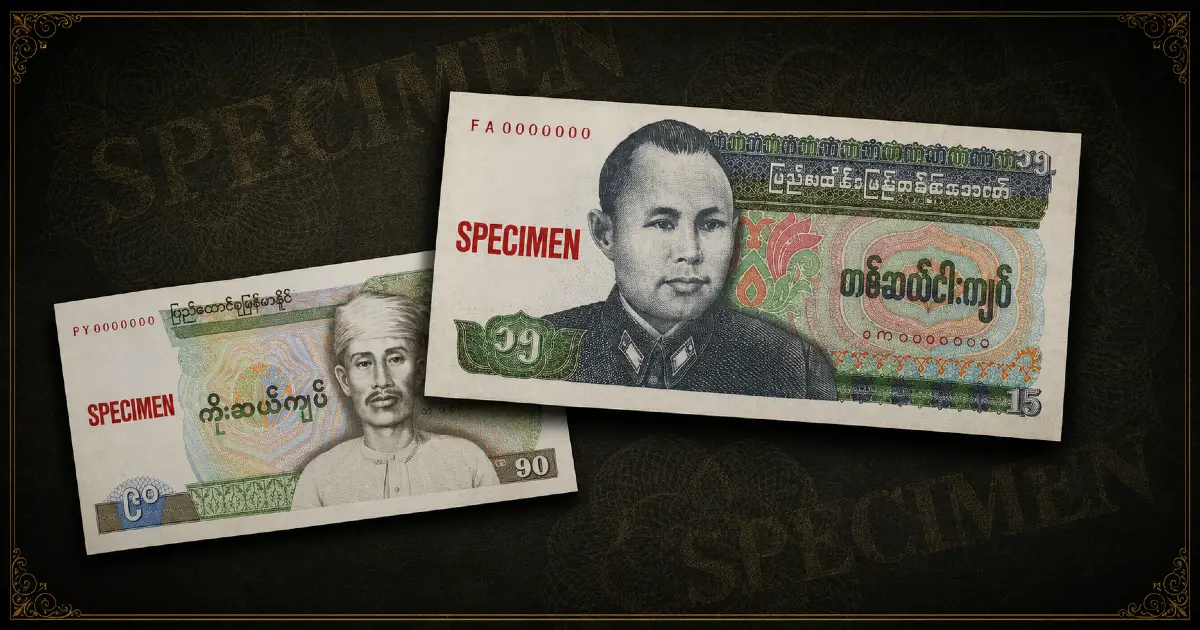
Burma Odd Denomination Banknotes Specimens
Because the 1985–1987 Burma odd denomination banknotes series was characterized by immense political turbulence and sudden demonetization decrees, capturing authentic reference proofs represents the absolute pinnacle of specialized collecting.
Identifying Wazi Diagnostic Specimen Architectures
To provide international central banks and internal design archives with official reference examples, Security Printing Wazi prepared highly regulated Specimen varieties that were strictly barred from public circulation. These ultra-rare archival pieces can be instantly identified by three uniform technical parameters:
- All-Zero Serial Number Array: A genuine specimen completely lacks a standard commercial serialization track, displaying a uniform string of six zeros (000000).
- Red Typography Stamped Overprints: Wazi specimens are easily identified by a bold, horizontal red overprint or highly specialized hollow font block reading SPECIMEN or SPECIMEN / No # struck cleanly across the central face or lower margins.
The full diagnostic framework for identifying specimens — including overprint types and serial conventions — is documented in our Specimen Banknote Guide.
The Final Series of Burma Banknotes
The extraordinary run of Burma odd denomination banknotes issued between 1985 and 1987 stands as the absolute final chapter in the history of Burmese paper currency — and among the most politically charged Burma odd denomination banknotes ever produced by any sovereign authority.
Following the intense political changes and civil demonstrations that erupted across the country in 1988, the military government dissolved the old administrative frameworks. In 1989, the newly formed State Law and Order Restoration Council formally changed the country’s official English name from the “Socialist Republic of the Union of Burma” to the “Union of Myanmar”. This constitutional renaming permanently closed the book on the Burma currency catalog, transitioning all future state currency production into an entirely new era.
To trace how the national money supply systematically evolved following this historic 1989 constitutional renaming, continue to our comprehensive master guide covering the modern Myanmar Banknotes series. Alternatively, to trace the classic portrait era that directly preceded these unusual numerology issues, review our reference guide covering the historic Aung San Burma Banknotes Guide (1958-1979).