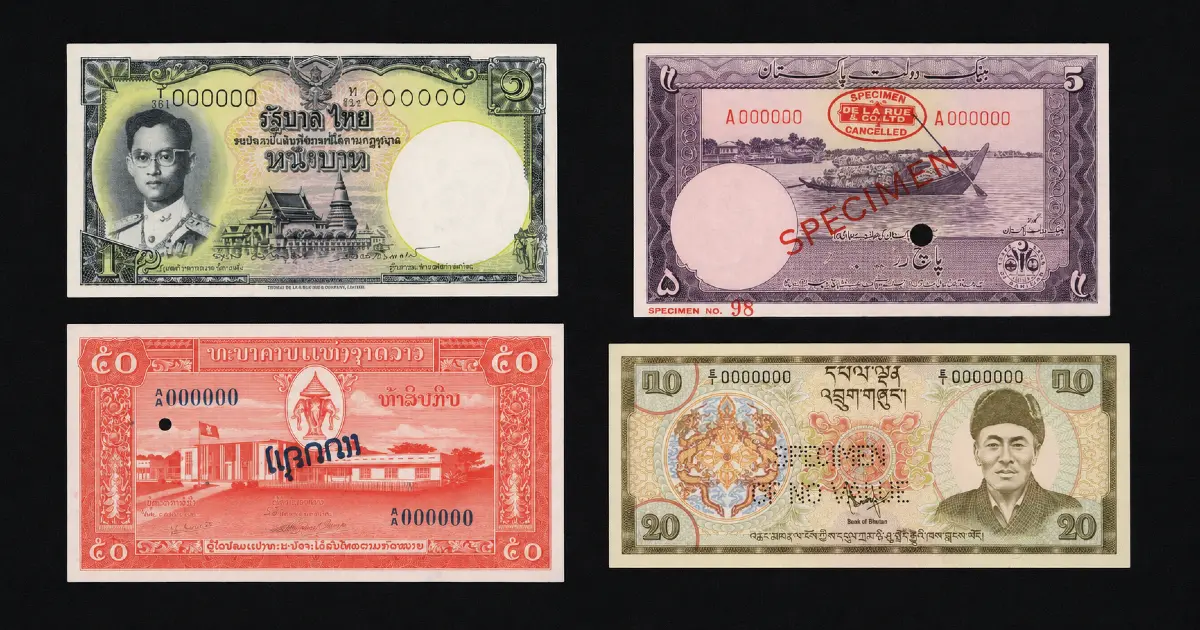
This specimen banknote guide explains one of the most specialized and rewarding areas of paper money collecting. Produced primarily for reference, archival, training, and presentation purposes, specimen notes were never intended for normal circulation. Their limited distribution, historical significance, and close connection to the banknote production process have made them highly desirable among advanced collectors.
For collectors interested in collecting specimen banknotes, understanding how these notes were created and used is essential. Many examples were distributed to central banks, commercial banks, government agencies, and international financial institutions for authentication and verification purposes. Others remained preserved in the archives of leading security printers, providing a unique record of banknote design and production.
Unlike ordinary currency, specimen notes often feature distinctive markings such as overprints, perforations, cancellation punches, or special serial numbers. These characteristics help distinguish them from circulating issues and provide valuable insight into how banknotes were approved, distributed, and monitored by issuing authorities.
Whether you are researching the meaning of a specimen note, evaluating value, or building a specialized collection, this specimen banknote guide covers the key concepts every collector should understand. From identification and authentication to rarity, market demand, and collecting strategies, this resource provides a practical introduction to one of the most fascinating segments of modern notaphily.
This specimen banknote guide is structured to take collectors from foundational definitions through to advanced authentication and collecting strategy.
Table of Contents
What Is a Specimen Banknote?
A specimen banknote is an official reference copy produced by an issuing authority or security printer for archival storage, central bank distribution, staff training, or diplomatic presentation. While they are genuine currency products, specimen notes were never intended for public circulation as legal tender.
To prevent misuse, most examples carry distinctive markings such as SPECIMEN overprints, perforations, cancellation punches, or special serial numbers. These features clearly distinguish them from regular circulating notes.
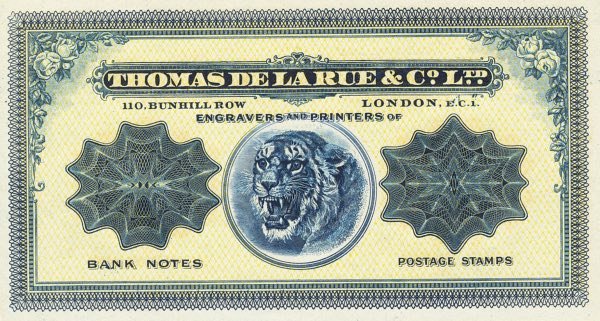
Specimen notes have been produced for more than a century and can be found across a wide range of countries, denominations, and issuing authorities. Many were created by leading security printers such as Thomas De La Rue, Bradbury Wilkinson, Waterlow & Sons, and Giesecke+Devrient. Today, surviving examples are highly sought after by collectors because they often exist in limited quantities and provide a unique record of banknote production history.
What Makes a Banknote a Specimen?
A banknote is generally considered a specimen when it has been officially prepared and marked to indicate that it is a reference copy rather than a circulating issue. The note must originate from the issuing authority, security printer, or an authorized distribution program.
Specimen status is usually identified through one or more distinguishing characteristics, including, SPECIMEN overprints, perforated SPECIMEN markings, punch cancellations, all-zero or control serial numbers, printer archive markings, and official specimen endorsements
These features vary between countries, issuers, and security printers — which is precisely what makes collecting specimen banknotes such a diverse and specialized area of notaphily.
How Specimen Notes Differ from Regular Currency
At first glance, a specimen note may appear identical to the banknotes that circulated among the public. However, specimen notes were created for administrative and reference purposes rather than everyday transactions.
Regular banknotes are produced for circulation and are intended to function as legal tender. Specimen notes, by contrast, were issued in limited quantities to selected recipients and were generally not valid for commercial use. Their purpose was to demonstrate design features, security elements, colors, signatures, and other characteristics of a newly issued banknote.
Because specimen notes were often preserved in archives, institutional collections, or training departments, many survive in exceptional condition. This combination of limited availability, historical significance, and high-grade preservation contributes to their popularity among collectors today.
Uses of Specimen Banknotes
Specimen banknotes were created to serve practical functions within the banking and currency production system. Before a new banknote entered circulation, authorized reference copies were distributed to institutions responsible for handling, verifying, and monitoring the currency. These notes allowed recipients to study the design, signatures, colors, security features, and denomination details without risking the misuse of legal tender.
Although specimen notes were never intended for circulation, they played an important role in the introduction and administration of new banknote issues. Many of the surviving examples found in today’s collections originated from central bank archives, commercial banking records, or security printer reference files — and understanding this provenance chain is foundational to collecting specimen banknotes with confidence.
Central Bank Reference Copies
Central banks often maintained specimen notes as official reference examples of each authorized banknote issue. These notes provided a permanent record of the currency’s design and security features, allowing future verification of genuine issues.
Reference specimens were particularly important when multiple series, denominations, or signature combinations existed. They helped central bank staff identify authentic notes and compare newly issued banknotes against approved production standards.
Distribution to Banks and Government Agencies
When a new banknote was introduced, specimen copies were frequently distributed to commercial banks, treasury departments, customs authorities, and other government agencies. These organizations needed to familiarize their staff with the appearance and security features of the new currency before it entered circulation.
By studying specimen notes, bank employees could more easily recognize genuine banknotes and reduce confusion during the transition to a new issue.
Counterfeit Detection and Staff Training
Specimen notes were widely used as training tools. Bank tellers, cash handlers, law enforcement agencies, and financial institutions relied on them to learn the characteristics of authentic currency.
Because specimen notes displayed the same designs and security features as circulating issues, they provided an effective method for teaching staff how to identify genuine banknotes and detect potential counterfeits.
Security Printer Archives
Major security printers such as Thomas De La Rue, Bradbury Wilkinson, Waterlow & Sons, and Giesecke+Devrient often retained specimen examples in their archives. These records documented completed printing contracts and preserved examples of the company’s work for future reference.
Many of the archival specimens available to collectors today originated from these printer archives. As a result, they offer valuable insight into the history of banknote production and the evolution of security printing technology.
Presentation and Official Distribution
In some cases, specimen notes were prepared for official presentations, exhibitions, diplomatic exchanges, or communication between issuing authorities. These examples allowed governments and financial institutions to showcase new currency designs without distributing legal tender.
Such specimens were usually produced in limited quantities and can be particularly desirable to collectors due to their historical significance and restricted distribution.
How Specimen Notes Are Marked
To prevent specimen notes from being confused with circulating currency, issuing authorities and security printers typically applied distinctive markings that clearly identified them as reference copies. These markings varied between countries, institutions, and printing companies, but their purpose remained the same: to distinguish specimen notes from legal tender intended for public circulation.
Collectors often rely on these identifying characteristics when evaluating specimen notes. Understanding the different marking methods is one of the most practical skills this specimen banknote guide can offer — helping collectors determine authenticity, identify the issuing authority’s practices, and distinguish genuine specimens from altered or fraudulent examples.
SPECIMEN Overprints
One of the most common methods of identification is the use of a SPECIMEN overprint applied directly to the banknote. The word “SPECIMEN” may appear in large letters across the face of the note, diagonally across the design, or in a designated area chosen by the issuing authority.
The style, color, size, and placement of overprints vary considerably between security printers. When collecting specimen banknotes, you will encounter variations ranging from simple black stamps to vibrant, multi-colored security ink scripts.
While the English word is widely recognized, overprints frequently reflect the language of the issuing region. Spanish-speaking nations regularly utilized “MUESTRA,” French-speaking territories applied “SPÉCIMEN,” and Russian-language issuers deployed “ОБРАЗЕЦ” (Obrazets).
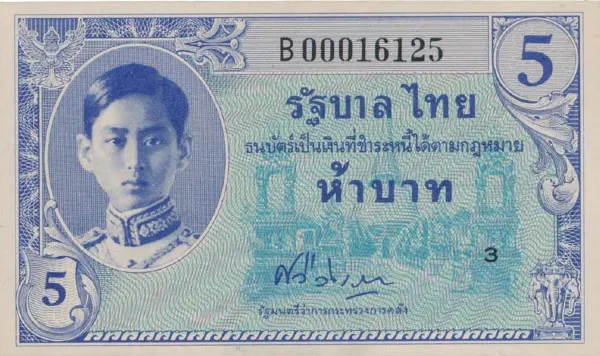
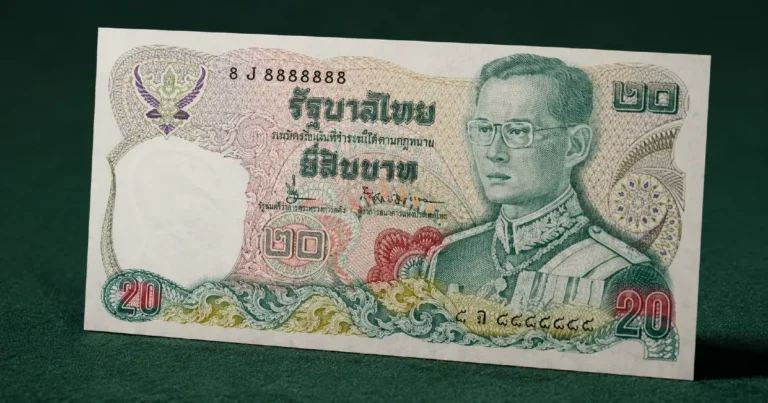
In Asia, practices varied by sovereign identity: the Bank of Thailand uses the native script “ตัวอย่าง” (Tua Yang) and also the English “SPECIMEN” overprint, whereas former British colonial administrations and independent successors—such as Myanmar (Burma) and Sri Lanka (Ceylon)—often retained the English “SPECIMEN” overprint due to their long-standing production contracts with London-based security printers.
Because overprinted specimens are among the most widely collected types, they are also frequently targeted by counterfeiters who add unauthorized overprints to ordinary banknotes. Careful examination of the printing characteristics is therefore essential.
Perforated Specimens
Many specimen notes were identified through perforated lettering punched directly through the paper. These perforations often spell the word “SPECIMEN” and create a permanent cancellation that cannot easily be removed.
Perforated specimens are particularly common among notes produced by major security printers and central banks during the twentieth century. The style and placement of the perforation can sometimes help identify the printer or issuing authority responsible for the note.
Because the perforation process was performed during production, genuine examples usually display clean and consistent alignment.
Punch-Cancelled Specimens
Some specimen notes were marked using cancellation punches rather than overprints or perforations. Circular holes, geometric patterns, or designated punch marks were applied to indicate that the note was not intended for circulation.
Punch cancellations are less common than traditional specimen overprints but can be found on issues from various countries and institutions. In some cases, punch cancellations were used alongside other specimen markings to provide additional security against misuse.
Zero Serial Numbers
Many specimen notes carry distinctive serial numbers that immediately separate them from normal circulating issues. The most recognizable examples feature all-zero serial numbers such as 000000, 0000000, or similar formats.
These numbers were often used because they could not be confused with production serial ranges intended for circulation. However, collectors should note that not all specimen notes use zero serial numbers, and some genuine specimens display control numbers or specially assigned serial sequences instead.
For this reason, serial numbers should be considered alongside other identifying characteristics rather than used as the sole basis for authentication.
Printer Control Numbers
Some specimen notes contain internal reference numbers applied by security printers or issuing authorities. These control numbers assisted with record-keeping, contract management, archival storage, and distribution.
Unlike normal serial numbers, printer control numbers were not intended for circulation tracking. They may appear in unusual locations, follow non-standard numbering formats, or accompany other specimen markings.
For collectors, these numbers can provide valuable clues about a note’s origin, production history, and relationship to printer archives or official reference collections.
Classifications: Types of Specimen Banknotes
Not all specimen notes were produced for the same purpose. While they share the common characteristic of being non-circulating reference copies, specimen notes can be classified according to how they were used, distributed, and preserved. Mastering these distinctions is essential for any collector using this specimen banknote guide to identify the origin and significance of different specimen issues.
Distribution Specimens
Distribution specimens were produced for circulation among central banks, commercial banks, government agencies, and other authorized institutions. Their primary purpose was to familiarize recipients with a new banknote issue before it entered circulation.
These are among the most commonly encountered specimen notes and often display official overprints, perforations, or other identifying markings. Many surviving examples originated from banking archives or institutional collections that were later dispersed to the collecting market.
Archival Specimens
Archival specimens were retained by security printers or issuing authorities as permanent production records. Rather than being distributed externally, these notes remained in archives to document completed printing contracts and preserve examples of the finished product.
Many of the most desirable specimen notes available today originate from archival holdings released by major security printers. Because archival specimens were often carefully stored for decades, they frequently survive in exceptional condition.
Reference Specimens
Reference specimens were maintained by issuing authorities as official examples of authorized banknote designs. These notes served as permanent records and could be consulted whenever questions arose regarding design features, signatures, security elements, or production specifications.
Reference specimens are particularly important for researchers and advanced collectors because they document exactly how a banknote was intended to appear when issued.
Presentation Specimens
Presentation specimens were prepared for official presentations, exhibitions, diplomatic exchanges, and ceremonial purposes. They allowed governments and issuing authorities to showcase new currency designs without distributing legal tender.
Because presentation specimens were often produced in limited quantities and distributed to a small number of recipients, surviving examples can be highly sought after by collectors.
Salesman Samples
Salesman samples were created by security printers to demonstrate their engraving, printing, and security capabilities to prospective clients. Rather than representing an official banknote issue, these samples were used as marketing tools when competing for printing contracts.
Some salesman samples closely resemble actual banknotes, while others incorporate generic designs or modified features. Their connection to major security printers and banknote production history makes them an interesting collecting area in their own right.
Related Forms of Non-Circulating Paper Money
Specimen notes are often grouped alongside other forms of non-circulating paper money, including proofs, essays, and color trials — terms defined in the NumisAsia Banknote Glossary. While these items share similarities and are frequently collected together, they were created for different purposes during the banknote design and production process.
Understanding the distinction between these categories helps collectors accurately identify notes and avoid confusion when evaluating rarity, value, and market demand.
Proof Banknotes
Proof banknotes are trial impressions produced during the engraving and printing process to evaluate the quality of a banknote’s design, engraving, and production. Unlike specimen notes, which were distributed as reference copies after a design was finalized, proofs were created during development and quality-control stages.
Proofs are often printed on special paper, card stock, or uniface formats and may display unfinished design elements. Because they were never intended for circulation, proof banknotes are highly collectible and can be significantly rarer than standard issued notes.
Essays
An essay is a proposed banknote design submitted for consideration before a final design is approved. Essays may include alternative portraits, denominations, colors, security features, or alternative designs that were often modified or rejected before a final version was approved.
Because essays represent ideas rather than finished banknotes, they provide valuable insight into the evolution of currency design. Some essays bear little resemblance to the notes eventually issued, making them particularly interesting to collectors and researchers.
Color Trials
Color trials are experimental printings produced to test color combinations before a final design enters production. They allow issuing authorities and security printers to evaluate the appearance, readability, and security characteristics of different color schemes.
A color trial may use the same design as the issued banknote but feature significantly different colors. In some cases, multiple color combinations were tested before a final version was selected. These experimental printings are often scarce and can be highly desirable among advanced collectors.
Why the Differences Matter
Although specimen notes, proofs, essays, and color trials are all forms of non-circulating paper money, they represent different stages of the production pipeline. For those dedicated to collecting specimen banknotes, understanding these fine line distinctions prevents costly classification errors.
Specimen notes were primarily produced as official reference copies, whereas proofs, essays, and color trials were created during the design and production phases.
For collectors, understanding these distinctions is important because rarity, historical significance, and market value can vary considerably between categories. Correct identification also helps ensure that notes are accurately described when buying, selling, or submitting them for professional grading.
How to Identify and Authenticate Specimen Banknotes
For a broader introduction to authentication principles, see our Banknote Grading & Authentication guide. The steps below focus specifically on the unique characteristics of specimen notes.
Because specimen notes often command substantial premiums over standard circulating issues, they are occasionally targeted by counterfeiters and unscrupulous sellers. In some cases, ordinary banknotes have been altered with fabricated SPECIMEN overprints, artificial perforations, or other markings designed to imitate genuine specimen examples.
For collectors, authentication begins with understanding how authentic specimen notes were produced and distributed. Examining the note’s markings, printing characteristics, provenance, and certification can help determine whether a specimen is genuine.
Examining Overprints and Markings
The first step is to carefully examine any SPECIMEN overprints, perforations, cancellation punches, or control numbers present on the note.
Authentic specimen markings were typically applied during production or official distribution and should appear consistent with known examples. Collectors should look for correct positioning of overprints or perforations, consistent ink application and printing quality, proper alignment with the banknote design, and markings that match documented examples from the issuing authority or security printer
Poorly aligned overprints, unusual fonts, incorrect colors, or inconsistent printing characteristics may indicate later alterations.
Identifying Altered and Fabricated Specimens
One of the most common problems in the marketplace is the creation of artificial specimen notes from ordinary circulation issues.
Examples include added SPECIMEN rubber stamps, modern overprints applied to genuine banknotes, artificial perforations, modified serial numbers, and unauthorized cancellation punches.
Collectors should be particularly cautious when specimen markings appear unusually fresh, inconsistent with known examples, or unsupported by recognized references.
Comparing a note with certified examples and established catalog references can often reveal discrepancies that are not immediately obvious.
Understanding Provenance and Source
Provenance can provide valuable evidence of authenticity. Notes originating from recognized printer archives, established collections, major auction houses, or reputable dealers generally offer a higher level of confidence than examples with undocumented origins.
Many desirable specimen notes entered the collecting market through the release of archival holdings maintained by security printers or issuing authorities. Documentation linking a note to these sources can strengthen confidence in its authenticity.
Professional Grading and Certification
Third-party grading services can provide an additional level of assurance when purchasing higher-value specimen notes.
Organizations such as PMG and PCGS Banknote examine notes for authenticity, alterations, and condition before encapsulating them in tamper-evident holders. Certified examples provide collectors with independent verification and can make buying and selling specimen notes easier.
Collectors should also be aware that PMG and PCGS Banknote labels for specimen notes sometimes include the notation ‘previously mounted.’ This reflects the historical practice of mounting specimen notes in archival presentation albums or institutional reference binders — a common method used by central banks, commercial banks, and security printer archives.
Such mounting typically involved small attachment points at the corners or edges. Notes described as ‘previously mounted’ are genuine specimen issues, and the notation does not indicate damage beyond the mounting evidence itself. This designation is well understood by experienced collectors and does not necessarily diminish historical or collector value.”
Collectors should remember, however, that certification complements research rather than replacing it. Understanding the characteristics of genuine specimen notes remains one of the most important skills in advanced paper money collecting.
Building Confidence Through Research
Successful authentication relies on knowledge. Studying established reference catalogs, comparing certified examples, and becoming familiar with the practices of major issuing authorities and security printers will significantly improve a collector’s ability to recognize genuine specimens. The two most widely consulted references for specimen varieties are the Standard Catalog of World Paper Money (commonly known as the Pick catalog) and The Banknote Book (BNB).
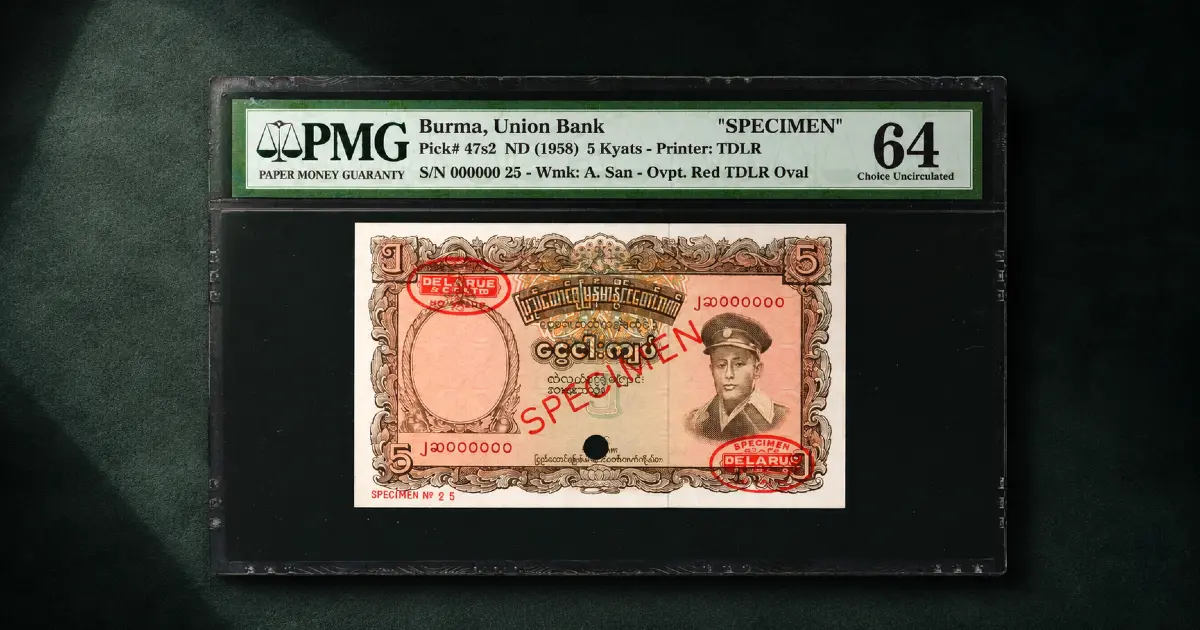
Both systems use an ‘s’ suffix to explicitly designate a specimen issue. The Burma Union Bank 5 Kyats, Pick 47s2 / BNB B810as1, illustrated here is graded PMG 64 Choice Uncirculated — a grade frequently seen on archival specimens that were preserved in institutional holdings rather than handled in circulation. The all-zero serial number (000000), diagonal red SPECIMEN overprint, and De La Rue oval overprint are each characteristic features documented in the catalog description for this specific variety.
The more examples a collector studies, the easier it becomes to identify unusual markings, recognize legitimate production methods, and avoid altered or misrepresented notes.
Market Value and Scarcity
Specimen notes are often more valuable than their circulating counterparts, but not all pieces command significant premiums. As this specimen banknote guide demonstrates, market value depends on a precise matrix of rarity, collector demand, historical significance, condition, and provenance. Discerning these distinctions is essential for any collector using this specimen banknote guide to identify the origin and significance of different specimen issues.
Unlike standard circulation issues, specimen notes were usually produced in limited quantities and distributed only to authorized recipients. This restricted distribution means that many specimen varieties survive in far smaller numbers than the banknotes originally intended for public use.
When evaluating specimen banknote value, collectors should consider not only rarity but also the type of marking, security printer association, and documented provenance.
Factors That Influence Specimen Banknote Value
Several factors can affect the market value of a specimen note:
- Rarity and survival rate
- Country and issuing authority
- Historical significance
- Demand among collectors
- Type of specimen marking
- Security printer association
- Grade and preservation
- Provenance and certification
In general, notes with limited surviving populations and strong collector demand tend to achieve the highest prices.
Rarity and Distribution
The number of specimen notes originally produced can vary significantly between issues. Some banknotes were distributed to hundreds of institutions worldwide, while others were produced only for internal archival use.
Specimens intended for broad distribution are often more readily available to collectors. In contrast, archival specimens, presentation specimens, and limited-release issues may be considerably scarcer.
Because official production figures are rarely published, collectors often rely on auction appearances, grading population reports, and market observations to estimate rarity.
Security Printer and Archival Provenance
Notes originating from the archives of major security printers often attract strong collector interest. Specimens associated with firms such as Thomas De La Rue, Bradbury Wilkinson, Waterlow & Sons, and American Bank Note Company provide a direct connection to the banknote production process.
Documented archival provenance can increase both collector confidence and market appeal, particularly when a specimen can be traced to a recognized archive release or historical collection.
Condition and Third-Party Grading
As with all paper money, condition plays an important role in determining value. Many specimen notes survive in exceptional condition because they were never intended for circulation and were often stored in institutional archives.
Understanding the standard 1–70 grading scale used by PMG and PCGS Banknote is essential for evaluating specimen condition accurately — see our Banknote Grading Scale guide for a full breakdown. Collectors generally place a premium on notes with original paper quality, strong colors, sharp corners, minimal handling, and no repairs or restoration.
Professionally graded examples may attract additional demand because they provide independent verification of authenticity and condition.
Country and Collector Demand
Collector demand varies significantly between countries and issuing authorities. Specimen notes from popular collecting areas such as British India, Burma, Ceylon, Malaya, Hong Kong, and other historically important Asian issuers often command stronger premiums than specimens from less actively collected regions.
For those collecting specimen banknotes from Asian issuing authorities, demand can also increase when a specimen is associated with a short-lived issuer, a notable historical period, or a particularly attractive banknote design.
Are Specimen Notes Rare?
Many specimen notes are genuinely scarce, but rarity should not be assumed simply because a note carries a specimen marking.
Some specimen issues were distributed widely and appear regularly on the market. Others survive in only a handful of known examples. The most desirable specimens typically combine limited availability, strong provenance, historical importance, and sustained collector demand.
For this reason, collectors should evaluate each note individually rather than relying solely on the presence of a SPECIMEN overprint or other identifying mark.
Collecting Specimen Banknotes
Specimen notes offer collectors an opportunity to explore banknote production, security printing, and monetary history from a unique perspective. Because specimens exist for many countries, denominations, and issuing authorities, there is no single correct way to build a collection.
Some collectors focus on a specific country, while others specialize in particular security printers, historical periods, or specimen formats. For those new to collecting specimen banknotes, starting with a focused regional or printer-based collection is often the most rewarding approach.
Whether assembling a modest collection or pursuing rare archival pieces, a clear collecting strategy can help collectors make informed decisions and avoid unnecessary duplication.
Collecting by Country or Region
One of the most popular approaches is to collect specimen notes from a specific country or region. This method allows collectors to follow the evolution of a nation’s currency while studying changes in design, security features, signatures, and issuing authorities.
Collectors interested in Asian paper money often focus on areas such as British India, Burma and Myanmar, Cambodia, Ceylon and Sri Lanka, China, Hong Kong, Laos, Malaya, Nepal, Pakistan, and Thailand.
A country-based collection provides historical context and creates opportunities to compare specimen issues across multiple series and denominations.
Collecting by Issuing Authority
Some collectors concentrate on the output of a particular central bank, government, or monetary authority. This approach highlights changes in currency administration and banknote design over time.
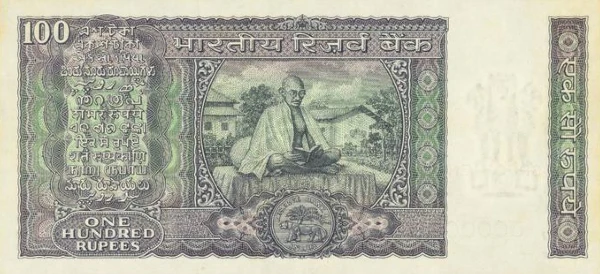
Examples include collecting specimen notes issued by, Reserve Bank of India, Bank of Thailand, Monetary Authority of Singapore, National Bank of Cambodia, and Central Bank of Myanmar.
Such collections often reveal the development of national currency systems and security technologies.
Collecting by Security Printer
Security printers have played a major role in the history of banknote production, and many collectors build collections around a particular printing company.
Popular security printers include Thomas De La Rue (TDLR), Bradbury Wilkinson (BWC), Waterlow & Sons, American Bank Note Company (ABNC), and Giesecke+Devrient.
Because each printer employed distinctive engraving styles, printing techniques, and specimen practices, printer-based collections offer a different perspective on paper money history.
Collecting by Specimen Type
Another approach is to focus on specific categories of specimen notes rather than countries or issuers.
Examples include archival specimens, presentation specimens, distribution specimens, salesman samples, and notes with unusual specimen markings
This strategy allows collectors to compare how different issuing authorities and security printers produced and distributed specimen material.
Building an Advanced Specimen Collection
As collectors gain experience, they often become more selective and focus on rarity, provenance, or historical significance. Advanced collections may include archival releases from major security printers, specimens from short-lived issuing authorities, or examples connected to important historical events.
Maintaining accurate records, researching provenance, and studying auction archives can help collectors identify notable pieces and understand their place within the wider specimen market.
Regardless of collecting strategy, successful specimen collecting is built on knowledge, patience, and careful research. By developing a clear focus and studying genuine examples, collectors pursuing collecting specimen banknotes at an advanced level can assemble collections that are both historically significant and personally rewarding.
Specimen Banknote Guide: Frequently Asked Questions
Start Collecting Specimen Banknotes
Specimen notes occupy a unique position within paper money collecting. Produced as official reference copies rather than circulating currency, they offer collectors a direct connection to the design, production, and distribution of banknotes. Their limited issuance, historical significance, and often exceptional preservation make them one of the most fascinating areas of modern notaphily.
Whether your interest lies in central bank specimens, security printer archives, presentation pieces, or regional specialties, this specimen banknote guide has outlined how collecting specimen notes provides an opportunity to explore aspects of paper money history that are rarely encountered in ordinary circulation issues. By understanding how specimen notes were produced, marked, authenticated, and valued, collectors can make more informed decisions and build collections with confidence.
If you are new to the hobby, exploring our core guide on banknote collecting provides the perfect groundwork before building a specialized specimen collection. This initial resource will help you map out your collecting strategy, understand foundational rarity, and avoid the most common costly mistakes.
🏛️ Expand Your Numismatic Portfolio
Specimen banknotes represent the absolute peak of design scarcity and historical preservation. Because these pieces were held exclusively in institutional vaults and printer archives, they offer modern collectors a rare glimpse into pure, uncirculated design history.
Explore NumisAsia’s curated inventory of Rare Specimen Banknotes — including archival De La Rue issues, Burma specimen banknotes, Thailand specimen banknotes — and find the next centerpiece for your specialized collection.