The paper currency of Burma finds its most historically significant, emotionally resonant, and highly collected sequence within the developmental timeline of Aung San Burma banknotes. As the ultimate founding father of the nation’s independent statehood, General Aung San (famously revered across the country as Bogyoke) represents the unassailable icon of patriotic unity and anti-colonial resistance. Following his tragic martyrdom in July 1947, just months before full sovereignty was realized, his memory was elevated to sacred status. To honor his sacrifice, the central banking authorities eventually chose to replace abstract allegorical patterns with his official portrait, initiating a multi-decade numismatic era defined entirely by these classic Aung San Burma banknotes.
For banknote collectors, tracking these Aung San banknotes offers a profound journey through the economic, political, and cultural shifts of post-independence Burma. Across this era, the production of Aung San Burma banknotes transitioned across three separate state banking administrations and multiple international high-security print facilities. This technical evolution is cataloged extensively under Pick numbers Pick 47 through Pick 61 in global checklists and sections BNB B810 through BNB B1006 in The Banknote Book. By mastering the nuances of shared design configurations, printing plate variations, signature combinations, and watermark formats embedded within these runs, collectors gain a precise lens into the sovereign structural history of the nation itself.
Table of Contents
The Iconography of Bogyoke Aung San
The inclusion of General Aung San’s likeness on the national money supply was not merely an aesthetic selection; it was a calculated piece of political nation-building designed to cement the identity of the young, independent republic.
The Political Purpose of Currency Imagery in the Post-Colonial State
In a newly decolonized state recovering from the structural shocks of World War II and facing immediate internal challenges, currency served as a primary tool for state identity projection. Placing the portrait of the fallen leader on every banknote in active circulation acted as a daily, universal reminder of national unity. Whether a note was handled by a merchant in Rangoon or a farmer in the far northern hills, the face of Bogyoke reinforced the legal legitimacy and cultural sovereignty of the central government.
The Three Core Portraits of Aung San
Across the production history of these independent series, three distinct portrait typologies were engraved onto the master plates, each conveying a specific phase of his identity:
- The Military Commander Profile: Features Aung San dressed in his official military uniform, complete with an open collar overcoat and his characteristic peaked officer’s cap. This portrait presents him as the steadfast revolutionary leader and defender of the land.
- The Open-Necked Civilian Profile: Shows the general in a modest, open-necked civilian dress shirt, projecting an accessible, progressive, and egalitarian citizen identity.
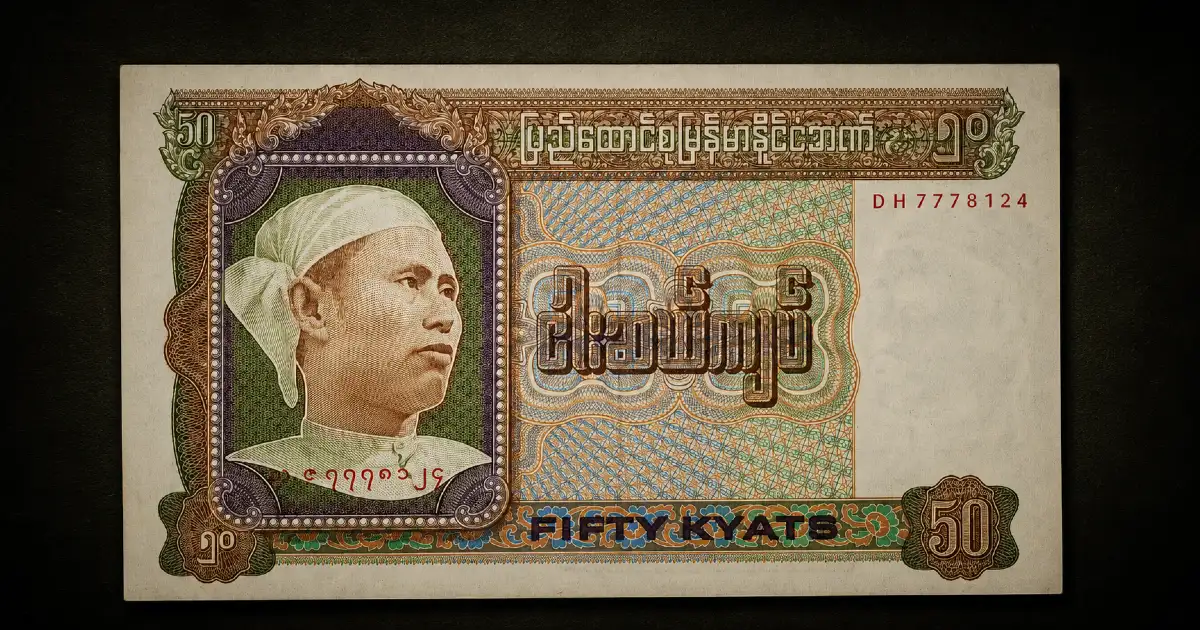
- The Statesman in National Dress: Depicts the general wearing traditional Burmese national dress, anchored by a beautifully wrapped gaungbaung (cloth turban). This final portrait celebrates traditional cultural heritage and state sovereignty.
The Union Bank of Burma 1958 Series (Thomas De La Rue)
The inaugural family of Aung San Burma banknotes debuted in consecutive phases throughout 1958 under the legal authority of the Union Bank of Burma. The initial denominations—consisting of the 1, 5, 10, and 100 Kyats—were officially placed into active circulation on Union Day, 12 February 1958. To further expand commercial velocity, two completely new denominations—the 20 and 50 Kyats notes—were added to the family later that year on 21 August 1958.
Shared Design Framework and Technical Parameters
To maintain strict production uniformity across the entire 1958 family, the central bank implemented a highly standardized set of visual and security parameters:
- Obverse Portrait Layout: Every denomination across this series features an identical portrait of General Aung San wearing his crisp military uniform with a peaked officer cap, positioned prominently on the right field of the plate.
- Security Thread: The 1 Kyat note is the sole exception in this series, issued without a security thread. All remaining denominations incorporate a solid embedded security thread.
- Sovereign Watermark Window: Each note incorporates a matching watermark window displaying General Aung San in full military dress, visible when held to translucent light.
- Prefix Typography: All initial standard circulation runs utilize native Burmese script characters (such as က, လ, ဏ) for their alphanumeric serial prefix coding.
The London Contracts and Intaglio Production Standards
Every note within this 1958 series was manufactured in Great Britain through a high-security contract with Thomas De La Rue. De La Rue utilized deep, high-pressure intaglio steel plate engraving techniques that created fine, raised ink lines across the surfaces.
Master 1958 Union Bank of Burma Banknotes Catalog Matrix
| Denomination | Burma Pick Number | Banknote Book Reference |
|---|---|---|
| 1 Kyat | Pick 46 | BNB B809 |
| 5 Kyats | Pick 47 | BNB B810 |
| 10 Kyats | Pick 48 | BNB B811 |
| 20 Kyats | Pick 49 | BNB B812 |
| 50 Kyats | Pick 50 | BNB B813 |
| 100 Kyats | Pick 51 | BNB B814 |
1 Kyat Aung San Banknote (Pick 46 / BNB B809)
- Dimensions: 124 x 60 mm
- Primary Colors: Gray, green, pink and yellow
- Reverse Motif: Traditional boats with sails
5 Kyats Aung San Banknote (Pick 47 / BNB B810)
- Dimensions: 127 x 72 mm
- Primary Colors: Brown, blue, yellow, and green
- Reverse Motif: Burmese woman working at a traditional wooden weaving loom
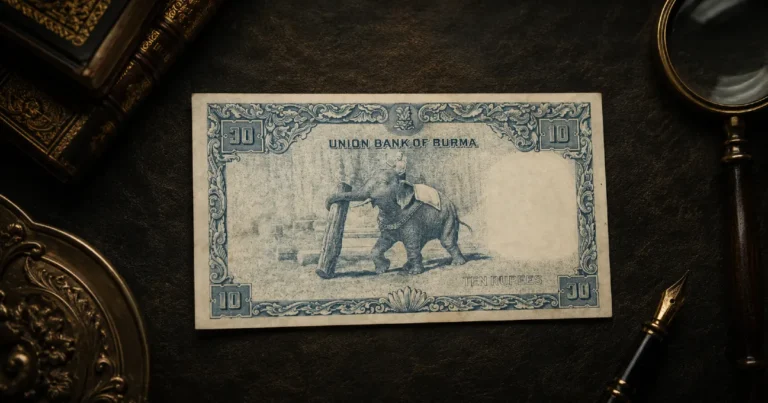
10 Kyats Aung San Banknote (Pick 48 / BNB B811)
- Dimensions: 147 x 82 mm
- Primary Colors: Blue, green, violet, and yellow
- Reverse Motif: A mahout guiding an elephant lifting wood with its trunk
20 Kyats Aung San Banknote (Pick 49 / BNB B812)
- Dimensions: 149 x 86 mm
- Primary Color: Purple
- Reverse Motif: Six Burmese women planting rice in a flooded paddy field
50 Kyats Aung San Banknote (Pick 50 / BNB B813)
- Dimensions: 155 x 90 mm
- Primary Colors: Light brown and yellow
- Reverse Motif: Mandalay Palace and its surrounding moat
100 Kyats Aung San Banknote (Pick 51 / BNB B814)
- Dimensions: 160 x 100 mm
- Primary Colors: Green and pink
- Reverse Motif: A man guiding a pair of oxen through a flooded agricultural paddy field
The People’s Bank of Burma 1965 Series (East Berlin)
Following the political transitions of the early 1962 coup d’état, the revolutionary council enacted wide-reaching socialist policies that fundamentally altered the state’s central banking operations.
Shared Design Framework and Technical Parameters
On 30 April 1965, the state released a heavily modified four-note currency family under the newly consolidated People’s Bank of Burma framework. The series adopted a highly strict, uniform layout to mirror its political changes:
- Obverse Portrait Layout: The traditional military uniform portrait was completely retired. In its place, every single denomination features a youthful General Aung San wearing a modest, open-necked civilian shirt, positioned cleanly at the center of the front plate.
- Reverse Design: All denominations feature the Burmese coat of arms.
- Security Thread Deletion: To simplify paper stock acquisition, all denominations within this 1965 series were manufactured completely without a security thread.
- Watermark Framework: The portrait watermarks were replaced across all notes with a repeating, multi-tonal circular geometric pattern.
The Shift to East Germany Printing
The manufacturing of the Aung San Burma banknotes shifted to the high-security state printing facilities of East Germany located in East Berlin. These Berlin plates relied heavily on soft, multi-colored geometric underprints paired with traditional national symbols like the coat of arms.
Master 1965 People’s Bank of Burma Banknotes Catalog Matrix
| Denomination | Burma Pick Number | Banknote Book Reference |
|---|---|---|
| 1 Kyat | Pick 52 | BNB B901 |
| 5 Kyats | Pick 53 | BNB B902 |
| 10 Kyats | Pick 54 | BNB B903 |
| 20 Kyats | Pick 55 | BNB B904 |
1 Kyat Aung San Banknote (Pick 52 / BNB B901)
- Dimensions: 115 x 66 mm
- Primary Colors: Purple and blue-gray
- Reverse Motif: A fisherman with a net standing on a boat on Inle Lake
5 Kyats Aung San Banknote (Pick 53 / BNB B902)
- Dimensions: 150 x 70 mm
- Primary Color: Green
- Reverse Motif: A farmer wearing a wide hat standing with his ox in an open field
10 Kyats Aung San Banknote (Pick 54 / BNB B903)
- Dimensions: 159 x 81 mm
- Primary Colors: Red-brown and violet
- Reverse Motif: A woman picking cotton inside a plantation
20 Kyats Aung San Banknote (Pick 55 / BNB B904)
- Dimensions: 169 x 90 mm
- Primary Colors: Brown and tan
- Reverse Motif: A farmer riding a tractor across a field
The Union of Burma Bank State-Run Series (1972-1979)
On 30 April 1972, following a comprehensive reorganization of the country’s nationalized banking infrastructure, the primary institution was renamed the Union of Burma Bank — not to be confused with the earlier Union Bank of Burma. This transition marked a historic shift to absolute logistical self-reliance for Burmese banknote production.
Domestic Production and Western Serial Re-alignment
Under the direct technical guidance of the Twenty-Year Long-Term Plan, the government established its own domestic facility named Security Printing Wazi (SPW) around 1972. Operating under the technical direction ofGiesecke & Devrient (G&D), these Aung San banknotes were designed by legendary Burmese master artists U Aye Myint and Major Aung Than.
Shared Technical and Security Specifications
- Dynamic Portrait Variations: Unlike the preceding single-portrait runs, this domestic family utilized completely different portrait stylings on every single note, alternating between his rigid military attire and his older civilian statesman turban dress based on the denomination value.
- Security Thread Restoration: All five denominations within this series incorporate a solid internal security thread running vertically through the note body.
- Watermark Realignment: Wazi restored the highly clear vertical watermark profile of General Aung San across the paper stock of all denominations.
Master 1972-1979 Union of Burma Bank Banknotes Catalog Matrix
| Denomination | Burma Pick Number | Banknote Book Reference |
|---|---|---|
| 1 Kyat | Pick 56 | BNB B1001 |
| 5 Kyats | Pick 57 | BNB B1002 |
| 10 Kyats | Pick 58 | BNB B1003 |
| 25 Kyats | Pick 59 | BNB B1004 |
| 50 Kyats | Pick 60 | BNB B1005 |
| 100 Kyats | Pick 61 | BNB B1006 |
1 Kyat Aung San Banknote (Pick 56 / BNB B1001)
- Dimensions: 124 x 60 mm
- Primary Colors: Green, blue, and brown
- Obverse Design: Aung San in Burma Defense Army uniform with cap
- Reverse Design: Textile spinning wheel
5 Kyats Aung San Banknote (Pick 57 / BNB B1002)
- Dimensions: 136 x 70 mm
- Primary Colors: Blue, purple, orange, and green
- Obverse Design: Aung San in military uniform without a cap
- Reverse Design: Man climbing a palm tree to harvest sweet sap
10 Kyats Aung San Banknote (Pick 58 / BNB B1003)
- Dimensions: 146 x 80 mm
- Primary Colors: Red and violet
- Obverse Design: Aung San in military uniform with peak cap
- Reverse Design: Decorative circular tray supported by a stem of six dancing Kinnara—the legendary half-human, half-bird creatures
25 Kyats Aung San Banknote (Pick 59 / BNB B1004)
- Dimensions: 155 x 90 mm
- Primary Colors: Brown, tan, orange, green, and blue
- Obverse Design: Aung San in military uniform without a cap
- Reverse Design: Pinsa Rupa—a legendary composite animal combining the body of a horse, wings of a bird, head of a dragon, tail of a fish, and the trunk of an elephant
50 Kyats Aung San Banknote (Pick 60 / BNB B1005)
- Dimensions: 166 x 100 mm
- Primary Colors: Brown, violet, green, and blue
- Obverse Design: Aung San wearing formal national dress with gaungbaung (cloth turban)
- Reverse Design: Textile spinning wheel
- Design Profile: Powerful mythological battle scene, showing a giant Galon bird standing astride a captured dragon
100 Kyats Aung San Banknote (Pick 61 / BNB B1006)
- Dimensions: 176 x 110 mm
- Primary Colors: Blue, green, and reddish-orange
- Obverse Design: Aung San wearing formal national dress with gaungbaung (cloth turban)
- Reverse Design: Saung Gauk—the traditional arched 13-string wooden Burmese royal harp
Aung San Burma Banknotes Color Trials and Specimens
Because the primary visual configurations across these three historic banknote eras are deeply intertwined with the sovereign development of Burma, advanced specialists focus heavily on specialized proofing varieties.
The 1958 Series Production Color Trials
During the design approval phases for the inaugural 1958 Aung San banknotes, Thomas De La Rue prepared color trials for each Aung San banknote plate in the 1, 5, and 10 Kyats denominations — the 1 Kyat struck in red, the 5 Kyats in green, and the 10 Kyats in olive green.
Identifying Print House Specimen Architectures
To provide international central banks and internal design vaults with proof references, each print house prepared highly distinct Specimen banknotes that were strictly barred from public circulation:
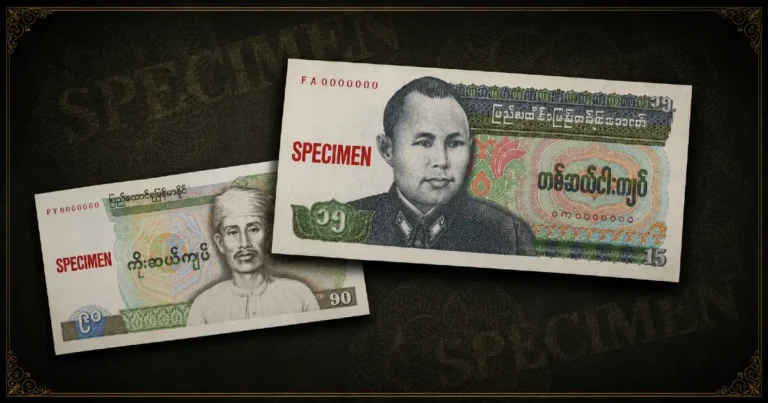
- Thomas De La Rue Specimens: Characterized by an all-zero serial number array (000000), these appear in several distinct forms: diagonal red SPECIMEN overprint paired with a DLR oval stamp; diagonal red SPECIMEN overprint alone; or horizontal CANCELLED perforation. The full range of specimen types and their identifying features is documented in our Specimen Banknote Guide.
- East Berlin Socialist Specimens: Characterized by an all-zero serial number array (000000), these generally appear in two forms: dual diagonal red SPECIMEN overprints on the obverse paired with a single diagonal red SPECIMEN overprint on the reverse; or a single diagonal red SPECIMEN overprint applied uniformly across both faces.
- Wazi Domestic Specimens: These pieces utilize distinct hollow red overprint typography. As documented across the domestic archive guidelines, a genuine Wazi specimen displays a horizontal red hollow text block reading SPECIMEN struck cleanly across the face, anchored uniformly by an all-zero serial number sequence.
The Monetary Legacy of Burma’s Founding Father
The long production span of Aung San Burma banknotes represents a monumental achievement in Southeast Asian numismatics. By using the image of Bogyoke Aung San across three decades of printing, successive administrations successfully used the national money supply to build a unified sense of citizenship. From the classic London intaglio engravings of Thomas De La Rue to the domestic security prints of Wazi, these notes remain vital primary historical documents. For the modern collector, completing this sixteen-note Aung San Burma banknotes from 1958 to 1979 offers an unparalleled connection to the foundational architecture of independent Burma.
To trace the preceding monetary history that led up to this portrait era, see our comprehensive guide to the post-colonial Government & Union Bank of Burma Banknotes (1948-1953). Alternatively, to review the subsequent era of mystical monetary changes, continue to our comprehensive guide on the Burma Odd Denomination and Unusual Banknotes (1985–1987) family.