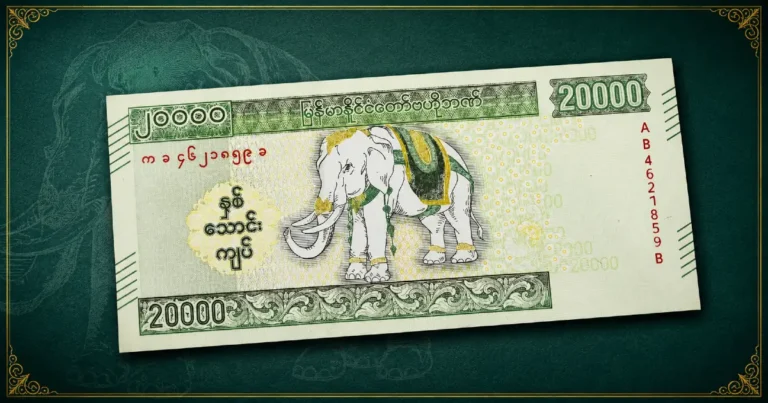
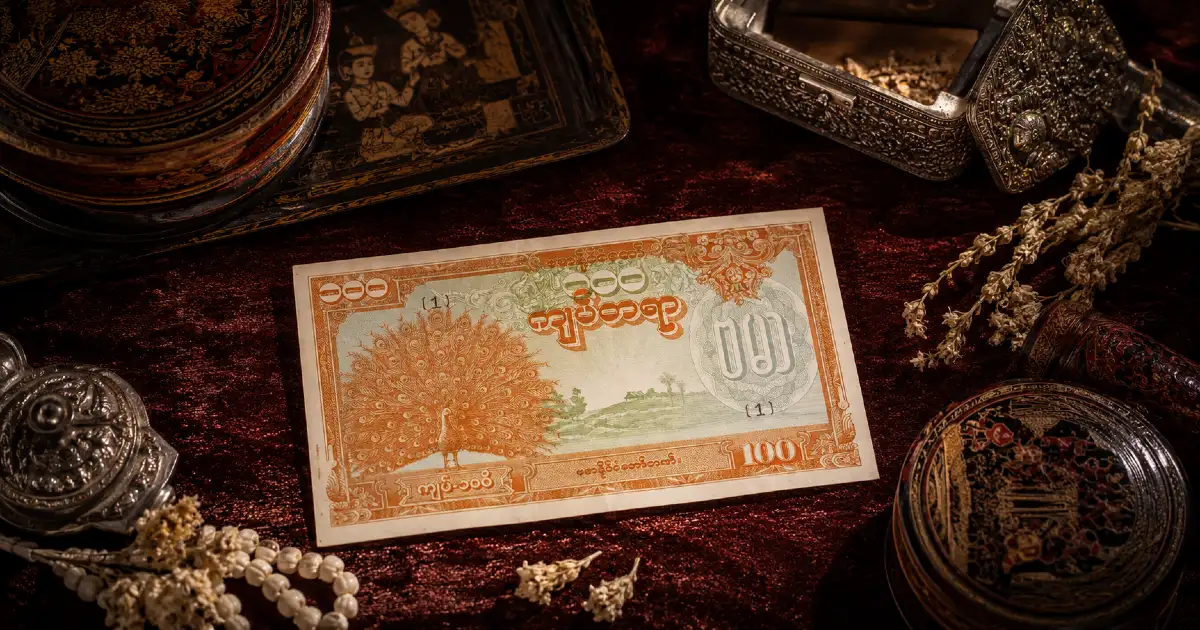
Burma State Bank banknotes represent one of the most important and historically significant chapters in the development of Southeast Asian paper money. Issued during World War II under the Axis-aligned Burma State government or the Puppet State of Burma, these historic pieces marked major milestones in the country’s monetary history, including the first use of the kyat denomination on paper currency, the first Burmese-language watermark, and the first banknotes issued entirely in the native Burmese language without any colonial English text.
The series is best recognized for the circulating Peacock issues of 1944 and the legendary Ba Maw 100 Kyat note of 1945. Together, these banknotes reflect Burma’s complex political and economic environment during the final years of the Japanese occupation. While the Peacock Series functioned as official currency issued by the newly formed central bank, the Ba Maw 100 Kyat note was produced as a localized emergency issue but never entered official circulation, making it one of the most fascinating and discussed rarities in Asian numismatics.
For specialized collectors, Burma State Bank banknotes occupy a unique transitional position between the earlier military-issued Japanese Invasion Money (JIM) series and the post-war currencies of British Burma. The notes are notable for their powerful national iconography, featuring the iconic dancing peacock, Mandalay Palace, traditional Burmese script, and references to the country’s royal heritage.
Today, both the circulating Peacock Series and the unissued Ba Maw 100 Kyat note are highly sought after by collectors of World War II paper money, Japanese occupation currency, and sovereign Asian banknote series. This comprehensive collector’s guide explores their history, production metrics, catalog references, known block numbers, varieties, and lasting significance within the numismatic timeline.
Table of Contents
Historical Background
The creation and deployment of Burma State Bank banknotes were closely tied to the shifting geopolitical and economic sands of the Japanese occupation of Burma during World War II. As Japanese forces systematically dismantled the pre-war British colonial administration, new institutional frameworks were established to support a puppet government and create the illusion of an independent Burmese nation. Among the most important of these entities was the new central bank, which became directly responsible for issuing the country’s first kyat-denominated paper currency.
Burma Under Japanese Occupation
Japanese forces invaded Burma in January 1942 and rapidly advanced across the country. By mid-1942, British administration had effectively collapsed, bringing an abrupt end to the colonial monetary system that had previously relied on the Government of India and the Reserve Bank of India currency structures.
During the initial phase of the occupation, military scrip known as Japanese Invasion Money served as the principal currency circulating throughout the country. However, these crude, military-issued notes were intended primarily as transactional tools for the invading army rather than as permanent symbols of a distinct Burmese state.
Independence and the Burma State
On 1 August 1943, the Empire of Japan formally declared Burma independent and established the State of Burma. Although the new puppet government operated firmly within the strict framework of Japanese wartime policy, it was presented to the public as a sovereign Burmese administration rather than a directly occupied territory.
Dr. Ba Maw, who had previously served as Prime Minister under British rule, was appointed Adipadi (Head of State) and became the most prominent political figure of the wartime government.
Establishment of the Burma State Bank
To support the fiscal needs of the new administration, the Burma State Bank was officially established on 15 January 1944. The institution assumed responsibility for issuing national currency, facilitating internal financial clearances, and supporting the economic policies of the government. For the first time in Burmese history, a bank operating explicitly in the name of a sovereign Burmese state would issue currency designed to represent a national identity rather than a colonial extraction or a raw military occupation issue.
The Need for a National Currency
The establishment of the bank reflected a broader effort to build institutions tied to native culture and autonomy. While Japanese Invasion Money remained in circulation, the domestic government sought a parallel currency that more closely reflected Burmese language, traditions, and historical symbols. The result was a new series of banknotes that departed significantly from earlier colonial layouts, establishing the foundational benchmark for all future Burma State Bank banknotes. These terms are widely used by collectors and researchers to distinguish the occupation currency from the emergency 1937 KGV provisional overprints and the later sovereign bank issues.
Production and Issue Details
Following its launch in early 1944, the bank assumed total responsibility for organizing the production of the new national currency. Although the bank operated on the ground in Rangoon, the realities of severe wartime manufacturing shortages meant that the notes had to be initially produced outside the country and distributed under increasingly hazardous wartime conditions.
The Burma State Bank as Issuing Authority
The central bank served as the official legal issuer of the new currency. Unlike earlier British colonial notes or the direct military scrip issued by the Japanese military administration, these new banknotes were issued under the domestic stamp of the Burma State. The bank managed the currency supply to support the wartime economy, representing an important step in establishing a separate Burmese monetary identity.
Printing by the Ministry of Finance Printing Bureau in Tokyo
The definitive Peacock Series was printed in Japan by the prestigious Ministry of Finance Printing Bureau (Naikaku Insatsu-kyoku) in Tokyo. The utilization of a high-security government facility ensured a significantly higher standard of production than many contemporary wartime emergency issues circulating across Asia. Despite severe shortages of quality inks and paper stocks in late-war Tokyo, the plates were professionally engraved and incorporated sharp security features appropriate for circulation currency.
Distribution Challenges During the War
By late 1944, Japan faced crippling difficulties transporting military and civilian supplies throughout Southeast Asia. Aggressive Allied naval submarine operations and intense air attacks disrupted shipping routes, making it progressively harder to transport heavy currency crates from Tokyo to Rangoon. As a result, the supply of banknotes frequently failed to keep pace with inflation-driven demand, a logistical bottleneck that would eventually force local authorities to attempt printing emergency currency within Burma itself.
Circulation and Post-War Withdrawal
The Peacock Series circulated during the final, turbulent phase of Japanese administration, functioning alongside the older Japanese Invasion Money. Although intended to serve as the premier currency of the state, the notes circulated during a period of massive military instability and rapid economic collapse. Following the Allied liberation of 1945, wartime currencies associated with the occupation period were immediately demonetized, withdrawn, and replaced by British Military Administration issues. This short lifespan, combined with wholesale post-war cash destruction, accounts for the scarcity of surviving high-grade pieces today.
The Burma State Bank Peacock Series
The definitive circulating series introduced in 1944 represents a watershed moment in the history of Burmese paper money. Comprising four core denominations, it marked the historic return of the traditional Kyat unit, replacing the colonial Indian Rupee system that had dominated the country since British annexation.
Advanced collectors can study digitized examples of related wartime colonial currencies preserved across global collections, such as the British Museum Collection Database.
Master Catalog Cross-Reference
| Denomination | Pick Catalog Number | Banknote Book Reference |
|---|---|---|
| 1 Kyat | Pick 18 | BNB B401 |
| 5 Kyat | Pick 19 | BNB B402 |
| 10 Kyat | Pick 20 | BNB B403 |
| 100 Kyat | Pick 21 | BNB B404 |
Common Design Features
All four denominations share a unified, highly patriotic design layout. The obverse displays the name of the issuing authority in Burmese script, paired with a central motif of a dancing peacock and a symbolic sunrise over the Mandalay landscape. Unlike the previous colonial Burma Peacock banknotes issued under the authority of the Reserve Bank of India, this design completely abandoned Western motifs. The reverse depicts Mandalay Palace and its surrounding protective moat—one of the most sacred symbols of the independent pre-colonial Burmese monarchy.
The Breakthrough Burmese-Language Watermark
The Peacock Series introduced a defining technical milestone across Burma State Bank banknotes — the first watermark composed entirely of Burmese script. Each note features a security watermark formed by three distinct Burmese characters spelling out the name for “Burma,” acting as a strong anti-counterfeiting barrier and underscoring the independent character of the currency.
Complete Omission of English Text
Reflecting the anti-colonial sentiment of the wartime administration, the Peacock Series completely omitted English text panels. The exclusive reliance on Burmese script and numerals distinguished these Burma State Bank banknotes from both the prior Reserve Bank of India notes and contemporary Japanese military issues.
1 Kyat Peacock Note (Pick 18 / BNB B401)
The 1 Kyat note served as the foundational lower-value piece for everyday market transactions.
- Dimensions: 109 x 63 mm
- Primary Colors: Blue, pink, and purple
- Documented Block Patterns: Blocks 0, 1, 3, 17, 21, 22, 26, and 29
5 Kyat Peacock Note (Pick 19 / BNB B402)
The 5 Kyat denomination is exceptionally scarce, known to collectors almost exclusively from a single block run, and its actual release into circulation remains unconfirmed.
- Dimensions: 130 x 72 mm
- Primary Colors: Red, purple, and green
- Documented Block Patterns: Block 0 only
10 Kyat Peacock Note (Pick 20 / BNB B403)
The 10 Kyat note occupies the middle tier of circulating currency and stands as one of the most visually balanced layouts of the series.
- Dimensions: 146 x 84 mm
- Primary Colors: Green, orange, and violet
- Documented Block Patterns: Blocks 0, 1, 23, and 24
100 Kyat Peacock Note (Pick 21 / BNB B404)
The 100 Kyat note was the highest circulating value of the series, representing an immense sum of purchasing power during the late-war period.
- Dimensions: 160 x 90 mm
- Primary Colors: Orange, green, and blue
- Documented Block Patterns: Blocks 0 and 1
1945 Ba Maw 100 Kyat Note Emergency Issue
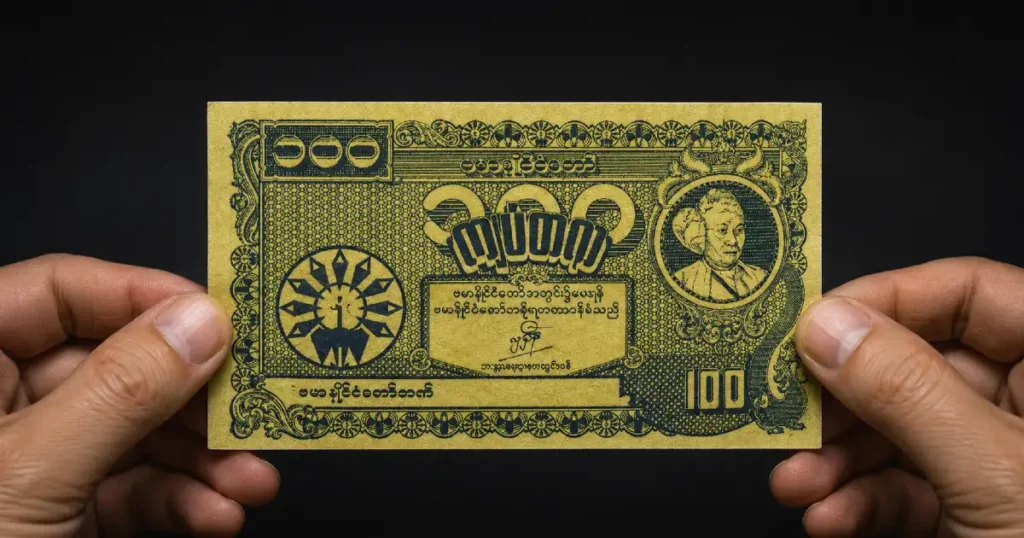
The Ba Maw 100 Kyat note occupies a legendary position among rare Burma State Bank banknotes. Produced under emergency conditions in 1945 as Allied forces advanced on Rangoon, this specific note represents the very first time a Burmese paper currency portrayed a living domestic political leader.
- Dimensions: 155 x 95 mm
- Primary Colors: Deep blue and light green underprint
- Obverse design: stylized peacock; Ba Maw in national dress with gaungbaung (cloth turban); dragon
- Reverse design: Dragons; Mandalay Palace with moat; stylized peacock
- Signature: Hla Shein (Secretary of the Finance Department)
- Watermark / Security Array: None (Produced on locally procured plain paper stock)
- Printer: Independent Local Security Press (Rangoon, Burma)
Why the Note Was Produced
By early 1945, the maritime supply lines between Tokyo and Rangoon were entirely severed by Allied air superiority. To resolve the catastrophic shortage of high-denomination currency needed to pay state workers and military personnel, the government bypassed the Tokyo printing facilities and organized a secret, localized emergency printing run within Rangoon.
Iconography and Political Symbolism
The central vignette of the obverse features a highly detailed portrait of Dr. Ba Maw dressed in traditional Burmese attire, including a formal gaung baung headpiece and jacket. To explore Dr. Ba Maw’s firsthand account of the political pressures, severe currency shortages, and logistical chaos defining this exact printing phase, collectors can review his personal wartime memoirs, Breakthrough in Burma: Memoirs of a Revolution, 1939–1946.
The portrait is surrounded by defensive guardian dragons and the formal state seal, while the reverse maintains continuity by depicting the iconic Mandalay Palace and moat layout.
Why the Ba Maw 100 Kyat Note Was Never Issued
Although production was completed, historical records confirm that the Ba Maw 100 Kyat note never entered official circulation. The Japanese military administration, displeased by the overt focus on Ba Maw’s personality cult and wary of local hyperinflationary spikes, refused to grant the final distribution clearance. The notes remained locked in state vaults as the government evacuated Rangoon, rendering them unissued remainders.
Known Architectural Varieties
Collectors recognize two main structural varieties of this Ba Maw emergency issue:
- Variety 1 (Pick 22a / BNB B405a): Notes carrying full Burmese serial numbers stamped onto the lower layout fields.
- Variety 2 (Pick 22b / BNB B405b): Remainder notes lacking serial numbers entirely.
Additionally, uncut sheets of four notes (explicitly cataloged in the Pick reference text) and sheets of two notes have escaped into the market.
Varieties and Collecting Notes
While the entire catalog of Burma State Bank banknotes is relatively small, it presents a highly rewarding, complex field of study for advanced numismatists tracking specialized print varieties.
Decoding the Block Tracking System
Because the regular peacock Burma State Bank banknotes do not carry unique, sequential individual serial numbers, print runs are identified strictly by stamped Block Numbers (beginning at Block 0). Tracking scarce block sequences (such as Block 3 and 26 on the 1 Kyat note) allows collectors to chart the chronological order of delivery from Tokyo before shipping corridors collapsed.
Specimen Notes and Presentation Material
Official presentation formats exist for archival reference, showcasing distinct overprints across Burma State Bank banknotes in both specimen and presentation configurations:
- The Archive Script Type: Features a prominent red “Specimen” overprint stamped diagonally across the face of the note, frequently accompanied by two clean, punched cancellation holes.
- The Bureau Type: Features the bold Japanese characters 見本 (Mihon, meaning “Specimen”) applied vertically across the note panels.
Rarity and Survival
The current rarity of surviving Burma State Bank banknotes is directly tied to the destruction of maritime shipping in 1944. A significant percentage of the printed currency shipments never reached the shores of Burma, resting instead at the bottom of the ocean due to Allied shipping blockades.
The circulating notes that did arrive suffered heavy damage from rapid market velocity during the inflation spirals of early 1945. Consequently, finding pristine, choice uncirculated examples of any denomination—or acquiring a verified, serialized Ba Maw 100 Kyat note—represents a premier achievement in specialized World War II paper money collecting.
Collecting Burma State Bank Banknotes Today
The Burma State Bank banknotes of 1942–1945 occupy a unique and sobering position in world numismatics — simultaneously a product of wartime occupation administration and a mirror of Burma’s turbulent path through the final years of the Second World War. For the specialist collector, assembling a complete set across denominations, signatures, and surviving specimen formats represents one of the most challenging and rewarding pursuits in Southeast Asian paper money.
With the Japanese surrender in August 1945, the Burma State Bank era came to an abrupt close — leaving behind a small and finite population of surviving notes that continue to surface through dedicated collectors today. The next chapter in Burmese currency history belongs to the returning British administration and the fascinating transitional issues that followed — explore the KGVI Burma Overprint Banknotes to continue the story.