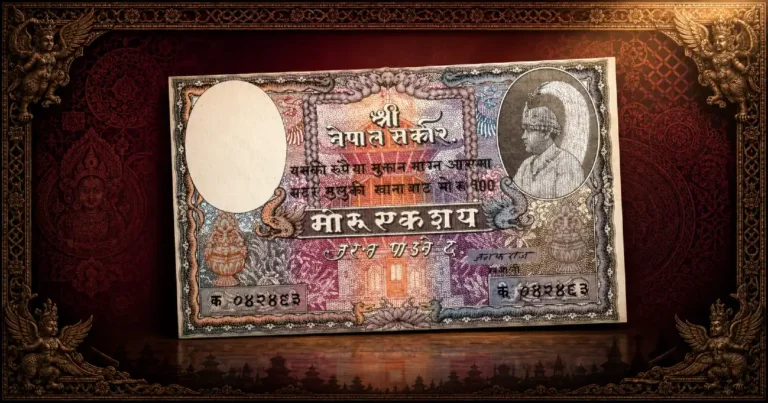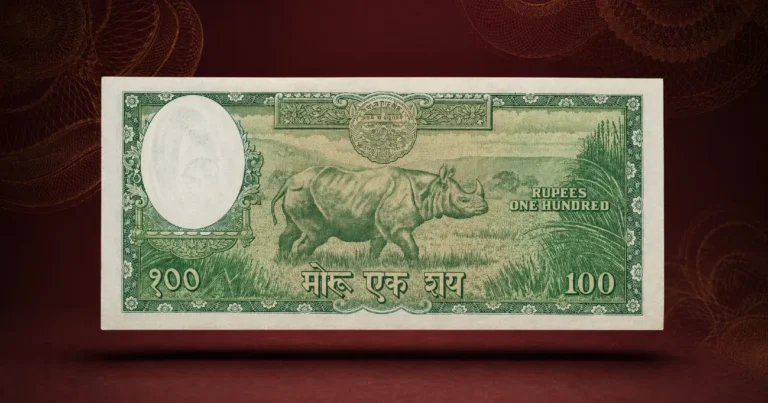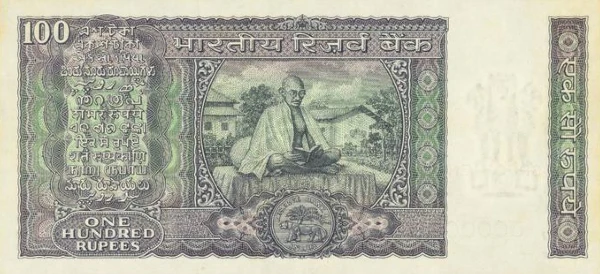
Nepal commemorative banknotes occupy a distinct and collectible niche within South Asian numismatics, capturing pivotal moments of royal transition, institutional history, and sovereign milestone celebrations on paper. Unlike standard circulating issues, these Nepal Rastra Bank commemorative releases introduce non-standard denominations, unusual security substrates, and design treatments that set them entirely apart from everyday currency. The four key issues in this catalog span three major milestones: King Birendra’s Silver Jubilee (1997), Gyanendra’s Coronation (2002), and the NRB Golden Jubilee (2005).
Each Nepal commemorative note reflects a specific moment when the state chose to mark its history on paper currency. The Silver Jubilee produced two simultaneous issues — the 25 Rupee and 250 Rupee denominations, both introduced in April 1997 — while the Coronation produced Nepal’s first polymer banknote, and the Golden Jubilee shifted focus entirely from royal portraiture to institutional heritage.
Because Nepal did not operate its own high-security printing works, the Nepal Rastra Bank partnered with Giesecke & Devrient in Germany and Note Printing Australia for production. These partnerships introduced multi-color intaglio vignettes, diffraction holograms, windowed security threads, and polymer substrates — security technologies that were genuinely advanced for the era and region.
Table of Contents
Master Reference Matrix: Pick & BNB Catalog Registry
To provide an immediate, structured overview for collectors mapping out a comprehensive type set of these Nepal commemorative banknotes, the following reference matrix catalogs every Nepal Rastra Bank commemorative issue by milestone, denomination, official release dates, Standard Catalog of World Paper Money (Pick catalog), and Banknote Book (BNB) reference numbers.
| Milestone | Denomination | Release Date | Pick Catalog | Banknote Book |
|---|---|---|---|---|
| King Birendra Silver Jubilee | 25 Rupees | 11 April 1997 | Pick 41 | B247 |
| King Birendra Silver Jubilee | 250 Rupees | 10 April 1997 | Pick 42 | B248 |
| Gyanendra Coronation | 10 Rupees | 30 September 2002 | Pick 45 | B251 |
| Nepal Rastra Bank Golden Jubilee | 50 Rupees | 8 September 2006 | Pick 52 | B267 |
Nepal Rastra Bank commemorative issues follow distinct production and distribution conventions that differ substantially from standard circulation notes — for a broader overview of how commemorative banknotes work across world currencies, see our commemorative banknotes guide.
King Birendra 25 Rupee Silver Jubilee Note (1997)
The Nepal Rastra Bank authorized this Nepal commemorative banknote to mark the Silver Jubilee of King Birendra Bir Bikram Shah Dev’s accession to the throne. King Birendra ascended the throne on 31 January 1972, and the 1997 Silver Jubilee marked 25 years of his reign. To directly engage the public with this milestone, the monetary authorities introduced an entirely new denomination, making this among the most structurally unusual Nepal commemorative notes ever issued. As the first 25 Rupee denomination in Nepalese currency history, this Nepal commemorative note became an immediate collector target on release.
Specifications:
- Catalog Classifications: Pick 41 / BNB B247
- Dimensions: 140 × 70 mm
- Primary Colors: Brown, green, and red
- Signature: Satyendra Pyara Shrestha
- Introduction Date: 11 April 1997
- Prefix: Ka (क) – 01 to Ka (क) – 40
- Replacement Prefix: Ka (क) – 41 (Replacement notes are identified by their distinct prefix block — see our replacement notes guide)
- Printer: Giesecke & Devrient GMBH, Germany
- Quantity: 40,000,000 notes approx
Graphic Layout:
The obverse face of this issue displays the portrait of King Birendra Bir Bikram Shah Dev facing forward-left, wearing the highly ornate, traditional royal Nepalese plumed crown. Adjacent to this central royal portrait, the German engravers incorporated detailed architectural renderings of the historic Hanumandhoka Palace complex and the contemporary Parliament building in Kathmandu. To clearly reinforce its commemorative status, a circular silver jubilee logo hologram sits positioned on the front design. The obverse also integrates a coin motif near the upper right and the central bank name in clear Devanagari script.
The reverse layout depicts a single red cow—the sacred national animal of Nepal—grazing peacefully on the open grass fields of the Terai region. In the background, the iconic double-peaked silhouette of Mount Machhapuchhre (the famously revered “Fishtail” mountain of the Himalayas) rises sharply into the skyline. Security parameters include dual serial numbers printed cleanly on the lower front face, an integrated paper watermark showing the Nepalese Royal Crown, and a 1.2 mm windowed clear-text security thread running vertically through the note structure.
Documented Collecting Varieties:
- Variety 1 (BNB B247a): Standard issued note without an explicit calendar release date printed on the face. Distributed through normal commercial banking channels starting 11 April 1997.
- Variety 2 (BNB B247as): Specimen note. Marked clearly by a large, bold diagonal red “SPECIMEN” overprint running across both the obverse and reverse faces. It features an all-zero serial number. Specimen notes across all four issues follow standard archival production protocols — for full attribution see our specimen banknote guide.
King Birendra 250 Rupee Silver Jubilee Note (1997)
Issued simultaneously with the 25 Rupee note, this Nepal commemorative banknote was commissioned as a premium low-mintage numismatic product to celebrate the 25th year of King Birendra’s reign. While the 25 Rupee note served as a practical unit for smaller commercial transactions, the 250 Rupee note was engineered as a premium, low-mintage numismatic product intended largely to be kept as a souvenir. Sourcing this note has become a primary target within the sub-category of Nepal commemorative banknotes due to its tightly restricted production.
Specifications:
- Catalog Classifications: Pick 42 / BNB B248
- Dimensions: 172 × 70 mm
- Primary Colors: Purple, blue, green, and red
- Signature: Satyendra Pyara Shrestha
- Introduction Date: 10 April 1997
- Prefix: Ka (क) – 1
- Printer: Giesecke & Devrient GMBH, Germany
- Quantity: 0.5 million notes approx (serial numbers range from 000001 – 500000)
Graphic Layout:
The obverse design showcases King Birendra Bir Bikram Shah Dev in his signature plumed crown on the left. The complex background plates integrate a pair of traditional stylized heraldic dragons framing the upper central borders, a prominent multi-color silver jubilee logo hologram, the House of Representatives building, and the historic royal palace of Hanuman Dhoka. Running along the top frame is an elegant Devanagari script line celebrating the anniversary, underlaid at the bottom center by an explicit English text line reading: “Commemorative Issue on the Special Occasion of Silver Jubilee of His Majesty’s Accession”. A coin motif sits balanced on the upper right.
The reverse of this Nepal commemorative note presents an expanded layout of the sacred red cow standing squarely in the middle foreground, set against the plains of Terai and the dual peaks of Mount Machhapuchhre. The left side features an open white window area bordered by two grand stone lions sitting atop decorative pillars. The right panel contains the state coat of arms underlaid by a massive decorative geometric rosette pattern. Security upgrades include a 1.5 mm colored windowed clear-text security thread running vertically next to the central building vignette, paired with a multi-toned paper watermark of the Royal Plumed Crown.
Documented Collecting Varieties:
- Variety 1 (BNB B248a): Standard issued note without an explicit printed calendar date. Issued cleanly into public circulation on 10 April 1997 with serial numbers running up to 500000.
- Variety 2 (BNB B248b): Major total omission error. Confirmed by specialists as a printing error where the metallic silver jubilee logo hologram is completely missing from the upper center front layout.
- Variety 3 (BNB B248as): Specimen note. Features five distinct diagonal red “SPECIMEN” overprints stamped heavily across both the front and back layouts, and an all-zero serial string.
Gyanendra 10 Rupee Polymer Coronation Note (2002)
Following the sudden passing of King Birendra, Gyanendra Bir Bikram Shah Dev formally assumed the throne of Nepal on 4 June 2001. To mark his coronation, the Nepal Rastra Bank authorized a landmark technological advancement: the production of Nepal’s first Nepal polymer banknote — a 10 Rupee issue and the only Nepal polymer banknote in the Nepal Rastra Bank commemorative catalog to date.
Specifications:
- Catalog Classifications: Pick 45 / BNB B251
- Dimensions: 133 × 70 mm
- Primary Colors: Brown, green, and lilac
- Signature: Tilak Bahadur Rawal
- Introduction Date: 30 September 2002
- Prefix: Nga (ङ) – 31 to Nga (ङ) – 80
- Replacement Prefix: Nga (ङ) – 81 to 85
- Printer: Note Printing Australia
- Quantity: 50,000,000 notes approx
Graphic Layout:
The obverse face features a formal left-facing portrait of Gyanendra Bir Bikram Shah Dev dressed in full ceremonial royal attire and wearing the iconic traditional plumed crown. The center contains an intricate intaglio rendering of the Garud Narayan sculpture sourced directly from the ancient Changu Narayan temple complex. The primary security feature is a complex clear see-through window on the right. Surrounding this clear oval portal, a precise Devanagari text string reads: “Issued on the auspicious occasion of HM King Gyanendra’s Accession to the Throne-2058”. A coin design sits balanced along the upper right-center margin.
The reverse side presents a beautifully composed wildlife vignette showing three black bucks (antelopes) grazing together in an open forest setting. This central nature scene is flanked by the official NRB central bank logo along the top center and the detailed state coat of arms on the right. Because it was struck on a plastic substrate, traditional paper watermarks were replaced with an advanced shadow image of the Crown embedded inside the plastic matrix, paired with a simulated windowed security thread and two-color serial numbers where numerical characters are printed in distinct, contrasting ink tones.
Documented Collecting Varieties:
- Variety 1 (BNB B251a): Standard polymer note. Officially introduced on 30 September 2002 and eventually withdrawn on 15 March 2011.
- Variety as (BNB B251as): Specimen note. Features a heavy, bold diagonal red “SPECIMEN” overprint applied across both the front and back faces, paired with an all-zero serial number.
Nepal Rastra Bank 50 Rupee Golden Jubilee Note (2005)
The Nepal Rastra Bank Golden Jubilee note marks a deliberate departure from the royal milestone format of the preceding issues — shifting design focus from royal portraiture onto the institutional heritage of the central bank itself after fifty years of operation.
Specifications:
- Catalog Classifications: Pick 52 / BNB B267
- Dimensions: 142 × 70 mm
- Primary Colors: Yellow, red, and green
- Signatures: Bijay Nath Bhattarai
- Introduction Date: 8 September 2006
- Prefix: Kha (ख) – 97 to 100, Ga (ग) – 1 to 16
- Replacement Prefix: Ga (ग) – 17
- Printer: Giesecke & Devrient GMBH, Germany
- Quantity: 20,000,000 notes approx
Graphic Layout:
The obverse face presents a distinct stylistic shift: instead of the grand plumed crown seen on previous royal milestone releases, Gyanendra is depicted wearing the traditional, pattern-woven Nepalese Doura civilian dress costume on the left side. The center layout includes an expansive view of the modern Nepal Rastra Bank head office building, the official multi-colored golden jubilee anniversary logo, an engraving of Mount Machhapuchhre (Fishtail), and the historic Ashok Stambha (Ashoka Pillar) in Lumbini. The number 50 serves as a registration device, balanced by a coin motif on the upper right margin.
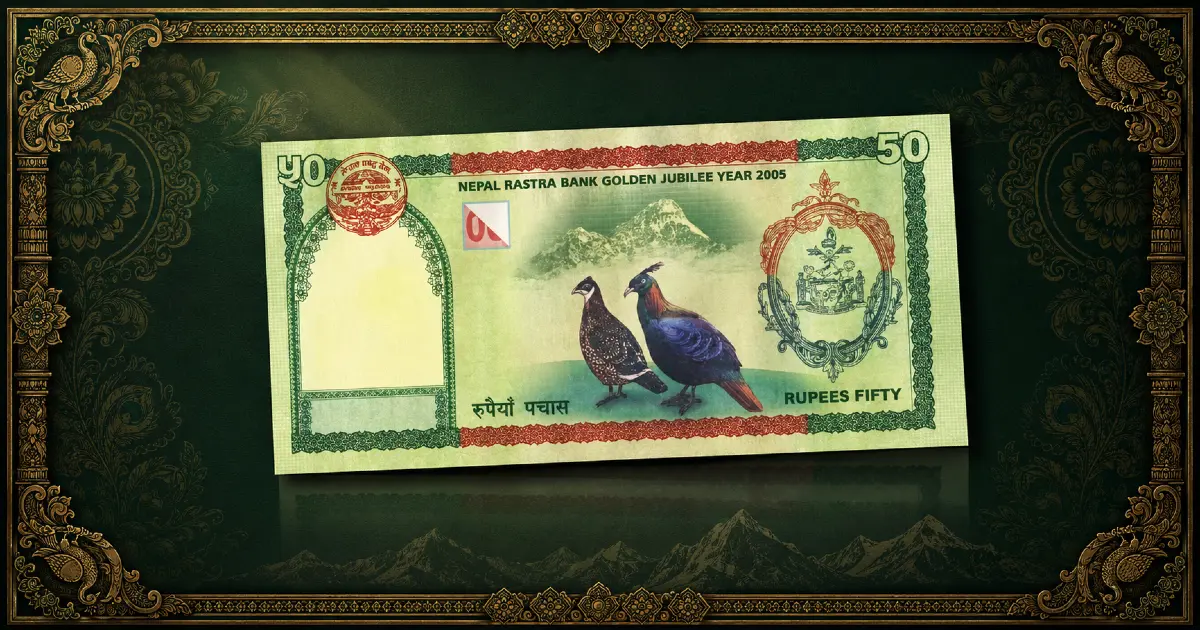
The reverse layout features two Danphe birds (the Himalayan monal, which serves as the official national bird of Nepal) standing together on a grassy knoll. The background landscape displays the snow-capped peak of Mount Amadablam, balanced by the central bank’s corporate logo on the upper left and the state coat of arms on the right. Advanced security parameters include a 1.2 mm wide windowed security thread featuring a demetalized, clear-text “NRB” script pattern, paired with dual serial numbers and a multi-toned paper watermark showing the portrait of Gyanendra.
Documented Collecting Varieties:
- Variety 1 (BNB B267a): Standard issued anniversary note, bearing the series year code of 2005. Officially introduced on 8 September 2006 and officially withdrawn from circulation on 15 March 2011.
- Variety 2 (BNB B267as): Specimen note. Features a large bold diagonal red “SPECIMEN” overprint stamped cleanly across both the front and back faces, alongside an all-zero serial tracker.
Nepal Commemorative Banknotes: Iconography
The physical design of Nepal commemorative banknotes reflects a deliberate selection of royal symbols, religious monuments, and environmental subjects — each chosen to present a specific facet of Nepalese identity on paper wealth:
- The Plumed Royal Crown: This centerpiece emblem dominates the portraits of King Birendra and King Gyanendra across the 1997 and 2002 releases, featuring fine cascading feathers, gemstone encrustations, and historic metalwork frames that symbolized the sovereignty of the Shah Dynasty.
- The Red Cow (Gai): As the sacred national animal of Nepal, the cow appears on the reverse faces of both Silver Jubilee notes, rendered in crisp intaglio as an immediate cultural identifier connecting monetary authority to traditional Nepalese values.
- The Black Buck (Krishnasar Antelope): Three black bucks grazing in an open forest setting occupy the reverse of the 2002 polymer note, representing the protected wildlife of the Terai lowlands and providing a deliberate design contrast to the sacred cow motif of the Silver Jubilee issues.
- The Danphe Birds: A pair of Himalayan monals — Nepal’s national bird — appear on the reverse of the 2005 Golden Jubilee 50 Rupee note, linking the central bank’s institutional issue to the unique avian biodiversity of the high mountain slopes.
- Himalayan Peaks: Mount Machhapuchhre (Fishtail) and Mount Amadablam appear across multiple denominations, engraved using fine-line safety screens that make the country’s physical geography the literal background of its economic transactions.
Taken together, these motifs give Nepal commemorative banknotes a visual coherence that makes the series immediately identifiable as a distinct collecting category within South Asian paper money.
Collecting Nepal Commemorative Banknotes
The four issues cataloged here span just nine years — 1997 to 2006 — yet cover an extraordinary range of numismatic ground. The catalog spans two non-standard Silver Jubilee denominations, Nepal’s first polymer banknote, and an institutional anniversary issue that set aside royal iconography entirely in favor of civilian and architectural motifs.
For type set collectors, a complete holding requires four notes at minimum — one of each Pick number — with the 250 Rupee Silver Jubilee presenting the greatest acquisition challenge due to its restricted mintage of approximately 500,000 pieces. Variety specialists will additionally target the missing hologram error on the 250 Rupee, the replacement prefix blocks across all four denominations, and the specimen issues documented under each BNB classification.
As Nepal’s political landscape shifted dramatically after 2006 — culminating in the abolition of the monarchy and the declaration of the Federal Democratic Republic — no further royal commemorative issues followed. These four notes, therefore, represent a closed and finite collecting set, their scarcity fixed by history rather than printing policy.