Thailand polymer banknotes represent one of the most technically progressive and collector-rich currency programs in Southeast Asian numismatics. Governed by the strict engineering standards of the Bank of Thailand (BOT), the nation has spent decades at the forefront of anti-counterfeiting development, producing Thai polymer notes that span two distinct developmental eras: the pioneer commemorative issues of the late 1990s under King Bhumibol Adulyadej (Rama IX), and the comprehensive modern substrate overhaul of the 2020s under King Maha Vajiralongkorn (Rama X). For collectors of Siam and Thailand paper money, these Thai polymer notes open an entirely separate and deeply rewarding collecting discipline.
What makes the Thai polymer banknote series so compelling to numismatists is not just the shift in substrate, but the immense layer of localized varieties, prefix structures, specialized distribution formats, and complex error notes that exist across these modern runs. This definitive guide to Thailand polymer notes establishes a standardized cataloging blueprint, breaking down every polymer note issued by the central bank into uniform diagnostic sections so collectors can identify varieties, verify prefix distributions, and source investment-grade pieces with confidence.
Table of Contents
The Pioneer Era of Thailand Polymer Banknotes
In 1996, Thailand marked one of the most celebrated events in its modern history: the 50th Anniversary (Golden Jubilee) of King Bhumibol Adulyadej’s (Rama IX) accession to the throne on 9 June 1946. To commemorate this milestone, the Bank of Thailand aimed to reflect the nation’s economic and technological modernization on its currency. This gave birth to Thailand’s pioneer polymer banknote program. Rather than utilizing traditional cotton paper, the central bank collaborated with international printing mints to issue its very first alternative-substrate banknotes, creating highly complex, multi-layered collectible pieces that were entirely new to the domestic marketplace.
Design Framework & Technical Specifications
Because both the 50 Baht and 500 Baht Golden Jubilee banknotes were developed in tandem as part of the same celebratory program, they established a unified technical and iconographic baseline that defines this founding chapter of Thailand polymer banknotes:
- Substrate Composition: Both notes utilize advanced biaxially-oriented polypropylene (BOPP) chemical structures supplied by Note Printing Australia (NPA).
- Royal Garuda Emblem: Each denomination features the prominent, highly detailed placement of the Royal Garuda emblem (Phra Khrut Pha).
- Jubilee Iconography: Both denominations feature a custom-designed royal ceremonial emblem of the Golden Jubilee, which displays a stylized royal crown flanked by white elephants.
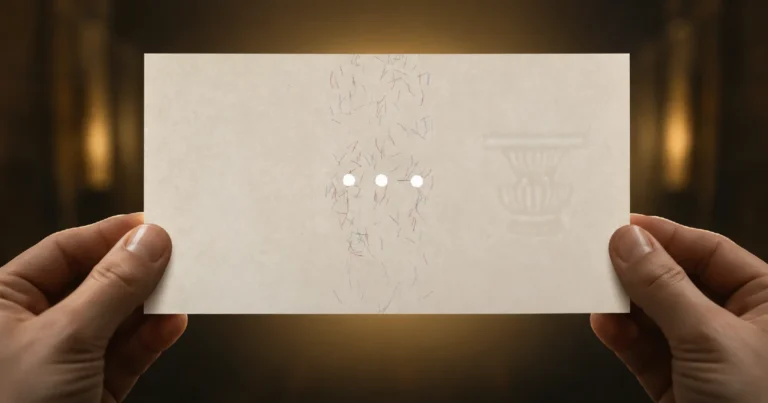
- Thread Omission: To maximize the visual real estate of the clear polymer windows and complex underprints, both notes were engineered completely without an internal metallic security thread, relying instead on shadow-image watermarks embedded into the substrate fields.
50 Baht Golden Jubilee Commemorative (Pick 99 / BNB B168)
- Dimensions: 144 x 72 mm
- Primary Color: Blue and yellow
- Obverse Design: Portrait of King Bhumibol Adulyadej (Rama IX) wearing uniform
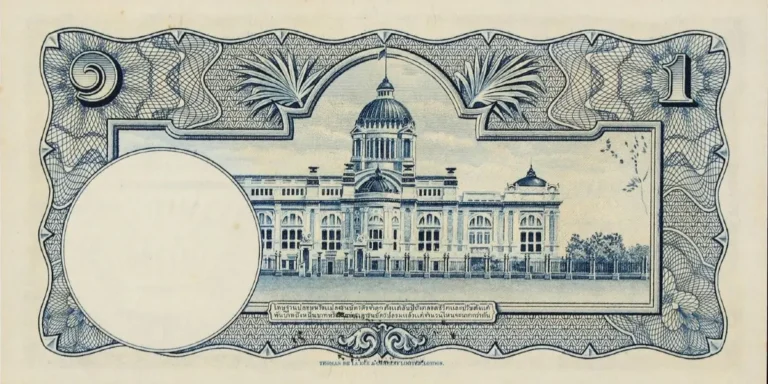
- Reverse Design: Wide-angle architectural engraving of the Ananta Samakhom Throne Hall within the Royal Dusit Palace complex in Bangkok; central statue of a seated King Rama VII modeled directly from the monument erected in front of the National Parliament building in Bangkok
- Varieties & Prefix Ranges: Collectors isolate exactly two signature varieties strictly bounded by distinct prefix brackets for these specialized Thailand polymer banknotes:
- Variety (a): Bodee Junnanon / Rerngchai Marakanond. Western Prefix Range: 9A to 9E. Introduced on 3 December 1996.
- Variety (b): Amnuay Veeravan / Rerngchai Marakanond. Western Prefix Range: 9F to 9T.
50 Baht Fancy Number Raffle Sets
During the initial public offering of the Golden Jubilee series, the Bank of Thailand made premium, uncirculated 50 Baht polymer banknotes bearing fancy numbers available to collectors through official raffle draws. These specialized sets are highly elusive today. These sets feature prized patterns such as 1000001, 2000002 up to 9000009, 2111112, 2333332 up to 2999992, and 9990999, 9991999 up to 9998999. For a complete look at how these combinations affect market premiums, read our guide on Fancy Serial Numbers Explained: Types, Rarity & Values.
50 Baht Polymer Specimen Issue (BNP105 / PNL)
Archival reference versions prepared for presentation to central bank dignitaries and institutional collections. To learn more about identifying specimen stamps, review our comprehensive Specimen Banknote Guide: History, Markings & Authentication.
Two distinct specimen varieties exist within this class of Thailand polymer banknotes—one with a Thai language ตัวอย่าง overprint and one with an English language SPECIMEN overprint.
Common to Both Varieties
- Horizontal red typographic overprint on both front and reverse panels
- Red specimen control number on the center left front field
- All-zero serial number (0A 0000000)
500 Baht Golden Jubilee Commemorative (Pick 101 / BNB B170)
Unlike standard notes intended for daily transactions, the 500 Baht Golden Jubilee polymer banknote was engineered exclusively as a premium numismatic product, never released directly into open circulation. The total print run was strictly capped at 1,000,000 notes, split evenly with 500,000 notes dedicated to each of the two primary signature combinations. Every note was sold directly to the public in a colorful Thai silk presentation folder of various colors and shades.
The note operates on a non-standard 5-digit serial number array, always prefixed with 9, following the format 50Z 9XXXX — where 50 is a fixed prefix, Z represents an alpha character in both Thai and Western script, and XXXX is the sequential number. With 10,000 notes per prefix across 100 total prefixes, the entire issue accounts for exactly 1,000,000 notes.
The Bank of Thailand utilized a tiered premium pricing model based entirely on serial number status. Ordinary notes (9XXXX) were sold at a baseline premium of 1,100 Baht. Notes with serials ending in the auspicious digit 9 (matching the pattern 9XXX9) were sold at an elevated premium of 1,300 Baht. As every serial begins with 9, the only true solid number possible within this format is 99999 — making it the single most desirable serial in the entire print run. Special sets featuring fancy and semi-fancy numbers commanded significantly higher premiums, with select master configurations accompanied by custom crystal frames. The Banknote Book catalogs these presentation sets under BNP107a and BNP107b.
- Dimensions: 171 x 91 mm
- Primary Colors: Deep gold, emerald green, and violet
- Obverse Design: Central portrait of a seated King Bhumibol Adulyadej (Rama IX) wearing full uniform; a detailed engraving of a kinnon (a mythological Southeast Asian creature, half bird, half man).
- Reverse Design: Sprawling natural waterfall and agricultural irrigation dam; central standing portrait of King Rama IX holding a field radio, a pen, a folded map, and an SLR camera; agricultural crops; working farmers in an open field backed by a rural village profile.
- Varieties: Two signature combinations are known:
- Variety (a): Surakiet Sathienthai / Vijit Supinit. Introduced on 11 January 1996.
- Variety (b): Bodee Junnanon / Rerngchai Marakanond.
Official 1996 Fancy Number Presentation Sets
During the public offering of the Golden Jubilee series, the Bank of Thailand packaged select groups of fancy and semi-fancy serial numbers into elite collectible sets, offered at a premium price. The primary configurations include:
- The 84,000 Baht Set: A premium run of 9 notes featuring highly desirable end-repeats matching the numbers: 99099, 99199, 99299, 99399, 99499, 99599, 99699, 99799, and 99899.
- The 70,500 Baht Set: A premium run of 9 notes featuring inner-solid repeats matching the numbers: 90009, 91119, 92229, 93339, 94449, 95559, 96669, 97779, and 98889.
- The 53,400 Baht Set: A premium run of 9 notes featuring alternating echo numbers matching the numbers: 90909, 91919, 92929, 93939, 94949, 95959, 96969, 97979, and 98989.
- The 35,000 Baht Set: A premium run of 8 notes featuring solid 4-digit repeating numbers matching the numbers: 91111, 92222, 93333, 94444, 95555, 96666, 97777, and 98888.
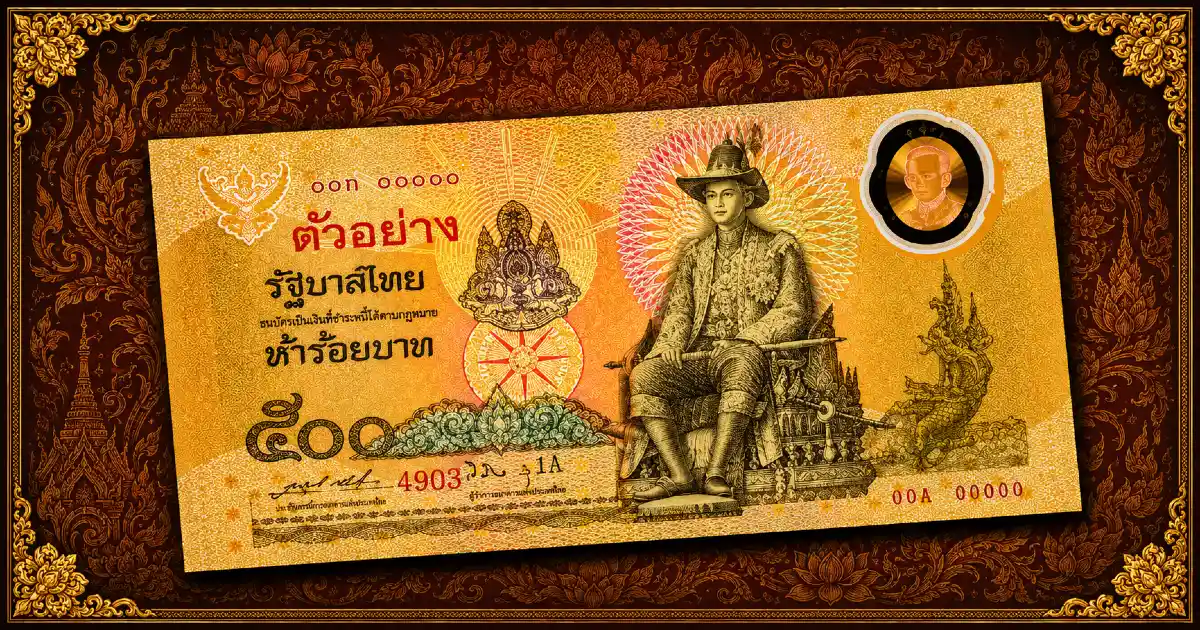
500 Baht Specimen Issue (BNP106 / PNL)
As with the 50 Baht polymer issue, two distinct specimen varieties exist, set apart only by the language of the specimen overprint—Thai ตัวอย่าง or English SPECIMEN.
Common Characteristics
- Horizontal red overprint on both front and reverse panels
- Red specimen control number on the lower left front field
- All-zero serial number (00A 00000)
Series 15: Regular Circulating Thailand Polymer Banknotes
Issued between 1997 and 2005, Series 15 spans five denominations — 20, 50, 100, 500, and 1,000 Baht. All denominations were printed on traditional paper substrate with the sole exception of the 50 Baht, which was initially issued in polymer.
50 Baht Polymer Note (Pick 104 / BNB B173)
Following technical data gathered from the 1996 commemorative polymer issues, the Bank of Thailand authorized its first polymer note for standard daily circulation. Printed on circulating-grade polymer substrate by Note Printing Australia (NPA), this entry in our Thailand polymer banknotes catalog features a shadow-image watermark of King Rama IX and omits an internal security thread, relying instead on a double-sided Dok Loi optical registration device for counterfeit deterrence. The note was eventually replaced by a returning paper issue in 2004.
- Dimensions: 144 x 72 mm
- Primary Color: Blue
- Obverse Design: King Bhumibol Adulyadej (Rama IX) wearing the formal ceremonial uniform of the Supreme Commander of the Armed Forces
- Reverse Design: An astronomical globe and a scientific telescope; a central portrait of King Rama IV (King Mongkut) seated in deep study; an architectural engraving of the grand Phra Pathom Chedi stupa located in Nakhon Pathom province
- Varieties & Prefix Ranges: There are four signature combinations produced across the standard prefix print runs:
- Variety (a): Amnuay Veeravan / Rerngchai Marakanond. Introduced on 18 August 1997.
- Variety (b): Tarrin Nimmanahaeminda / Chaiwat Viboonswat
- Variety (c): Tarrin Nimmanahaeminda / Chatumonkol Sonakul
- Variety (d): Somkid Jatusripitak / Pridiyathorn Devakula
50 Baht Specimen Issue (BNP104as)
Regular issue specimen prepared for banking reference. Two distinct varieties exist — one with a Thai language ตัวอย่าง overprint and one with an English SPECIMEN overprint.
Common to Both Varieties
- Horizontal red overprint on both front and reverse panels
- Red specimen control number on the center left front field
- All-zero serial number (0A 0000000)
Series 17: Modern Thailand Polymer Banknotes (2022–Present)
As the Bank of Thailand advanced into the 2020s under the reign of King Maha Vajiralongkorn (Rama X), the central bank faced significant logistical expenditures maintaining low-denomination paper banknotes. These Thai polymer notes experience the highest marketplace velocity in daily commerce, making them highly prone to tearing, soiling, and moisture absorption. To permanently resolve these vulnerabilities, the Bank of Thailand initiated a sweeping technical overhaul, systematically phasing out traditional cotton paper for advanced, high-durability polymer substrates to extend the lifecycle of Thailand’s circulating money supply.
Common Design Framework & Technical Specifications
To maintain visual and technical cohesion across the modern circulating family, the Bank of Thailand implemented a standardized design and security baseline for all notes in this series:
- Advanced Clarity Windows: Each denomination incorporates a clear, see-through window field. These clear windows feature localized tactile embossing elements to assist the visually impaired and are over-layered with advanced optochemical elements that react to changing light.
- The Air Force Portrait Standard: The obverse face of these modern Thai polymer notes features a uniform, forward-facing portrait of King Rama X wearing his official Royal Thai Air Force uniform.
- Simulated Security Threads: Unlike the early 1996 experiments, the modern Series 17 polymers incorporate a high-visibility, simulated vertical security ribbon embedded directly within the polymer layers, featuring clean, demetalized denomination text in both Thai and Western scripts.
20 Baht Polymer Note (Pick 144 / BNB B200)
This polymer issue mirrors the paper 20 Baht in design but carries an independent serial number sequence with prefix restarting from 0A.
- Dimensions: 138 x 72 mm
- Primary Color: Green
- Obverse Design: Central portrait of King Maha Vajiralongkorn Bodindradebayavarangkun (Rama X)
- Reverse Design: Dual standing portraits of King Rama I (King Buddha Yodfa Chulaloke) and King Rama II (King Buddha Loetla Nabhalai) showcasing traditional royal dress
- Substrate Varieties: Two polymer substrate varieties exist, most readily identified by the appearance of the numeral “20” in the clear window — bright and vivid on Type I, noticeably darker on Type II.
- Signature Varieties: This series remains in active circulation and additional signature combinations are expected. Three signature combinations are currently documented:
- Variety (a): Arkhom Termpittayapaisith / Sethaput Suthiwartnarueput — Type I & Type II
- Variety (b): Srettha Thavisin / Sethaput Suthiwartnarueput
- Variety (c): Pichai Chunhavajira / Sethaput Suthiwartnarueput
The De La Rue Prefix/Serial Mismatch Error (2022)
Shortly after the rollout of the 20 Baht polymer note, the Bank of Thailand acknowledged a major manufacturing error inside an early production run printed under contract by De La Rue. Due to an automated indexing mismatch on the numbering press, a batch of these notes was released where the Thai script serial numbers and prefixes running horizontally did not match the English alphabetic prefixes and Western numerals running vertically on the opposite side of the note. It remains an interesting manufacturing error across all Thai polymer notes.
50 Baht Polymer Note (Pick 146 / BNB B201)
This note mirrors the contemporary paper 50 Baht issue in design while maintaining its own independent serial number sequence, with prefix restarting from 0A.
- Dimensions: 144 × 72 mm
- Primary Color: Blue
- Obverse Design: Central portrait of King Maha Vajiralongkorn Bodindradebayavarangkun (Rama X)
- Reverse Design: Half-length portraits of King Rama III and King Rama IV; Chinese junk to the lower left of King Rama III; Khao Wang observatory to the lower right of King Rama IV
- Signature Varieties: This series remains in active circulation and additional signature combinations are expected. One signature combination is currently documented:
- Variety (a): Pichai Chunhavajira / Sethaput Suthiwartnarueput
100 Baht Polymer Note (Pick 147 / BNB B202)
This note also mirrors the contemporary paper 100 Baht issue in design while maintaining its own independent serial number sequence, with prefix restarting from 0A.
- Dimensions: 150 × 72 mm
- Primary Color: Red
- Obverse Design: Central portrait of King Maha Vajiralongkorn Bodindradebayavarangkun (Rama X)
- Reverse Design: Half-length portraits of King Rama V and King Rama VI; King Rama V’s royal visit to Notodden, Norway, depicted to the lower left; King Rama VI on horseback with the founding of the Thai Boy Scouts to the lower right
- Signature Varieties: This series remains in active circulation and additional signature combinations are expected. Two signature combinations are currently documented:
- Variety (a): Pichai Chunhavajira / Sethaput Suthiwartnarueput
- Variety (b): Ekniti Nitithanprapas / Vitai Ratanakorn
2024 King Rama X 72nd Birthday Commemorative Note
In Thai culture, the 72nd birthday marks the completion of six full twelve-year zodiac cycles — an occasion of profound auspiciousness and national celebration. To honour this milestone, the Bank of Thailand issued a dedicated commemorative polymer banknote on 23 July 2024, making it only the second commemorative polymer note in Thai history, following the 1996 Golden Jubilee issue.
100 Baht 6th Cycle Birthday Commemorative (Pick 145 / BNB B204)
Printed by the Bank of Thailand Note Printing Works on polymer substrate in a distinctive vertical format, this note was released at face value with an optional presentation sleeve available for 10 Baht. The print run was strictly limited to 10,000,000 notes under a single signature combination, carrying the prefix 9ธ.
- Dimensions: 89 x 163 mm (vertical format)
- Primary Color: Brown print with yellow and pink background
- Obverse Design: Half-length portrait of King Rama X in royal gown wearing the Most Illustrious Order of Chula Chom Klao; the ceremonial emblem of the 6th Cycle Birthday Anniversary
- Reverse Design: Full-length portrait of King Rama X in full State Regalia; Cassia fistula (national flower of Thailand) in background
- Signature Variety: One signature combination issued:
- Variety (a): Srettha Thavisin / Sethaput Suthiwartnarueput
Future Outlook: Higher Denominations (500 and 1,000 Baht)
As the Bank of Thailand continues to evaluate operational durability data from the 20, 50, and 100 Baht polymer series, the future of Thailand’s highest denominations remains a key point of discussion. While rumors frequently circulate within numismatic circles regarding the imminent release of high-denomination Thai polymer notes, the central bank maintains strict parameters for its currency updates.
Because 500 Baht and 1,000 Baht banknotes do not experience the same high-frequency, abrasive marketplace velocity as the lower 20 Baht and 100 Baht notes, their paper-pulp variants do not degrade as rapidly in circulation. Consequently, the Bank of Thailand has prioritized keeping these high-value notes on advanced cotton paper stock layered with complex motion-window threads and metallic holograms. Any future transition to polymer for the 500 or 1,000 Baht notes will only be executed if marketplace data shows clear long-term fiscal savings or if emerging counterfeit methods necessitate a complete substrate overhaul.
Thailand Polymer Banknotes Catalog Matrices
The following matrices summarize every Thai polymer banknote issued to date across both commemorative and circulating categories.
Master Commemorative Polymer Banknotes (1996–2024)
| Milestone | Denomination | Pick Catalog No. | Banknote Book Ref. |
|---|---|---|---|
| 1996 Rama IX Golden Jubilee | 50 Baht | Pick 99 | B168 |
| 1996 Rama IX Golden Jubilee | 500 Baht | Pick 101 | B170 (BNP107) |
| 2024 Rama X 6th Cycle Birthday | 100 Baht | Pick 145 | B204 |
Master Regular Circulating Polymer Banknotes (1997–Present)
| Series | Base Denomination | Pick Catalog No. | Banknote Book Ref. |
|---|---|---|---|
| Series 15 | 50 Baht | Pick 104 | B173 |
| Series 17 | 20 Baht | Pick 144 | B200 |
| Series 17 | 50 Baht | Pick 146 | B201 |
| Series 17 | 100 Baht | Pick 147 | B202 |
Collecting Thailand Polymer Banknotes
Thailand polymer banknotes represent one of the most systematically documented and technically layered collecting fields in all of Southeast Asian numismatics. From the pioneering 1996 Golden Jubilee issues — the very first polymer notes ever produced for Thailand — through the comprehensive Series 17 circulating overhaul of the 2020s, each chapter in this story introduces new substrate varieties, signature combinations, and prefix structures that reward the attentive specialist.
For collectors entering this field, the logical starting point is the 1996 Golden Jubilee issues — Thailand’s first polymer banknotes — with all subsequent issues remaining accessible and straightforward to collect across both commemorative and circulating categories. Deeper avenues of specialization open through specimen notes, official fancy number presentation sets, and the rare De La Rue serial mismatch error.
As the Bank of Thailand continues its active rollout of polymer notes across the 20, 50, and 100 Baht denominations, the catalog of Thai polymer notes will only expand. Collectors who establish a firm diagnostic foundation today — understanding prefix structures, signature pairings, and substrate identification — will be best positioned to identify and secure the key varieties as they emerge. This guide will be updated as new issues and signature combinations are confirmed.