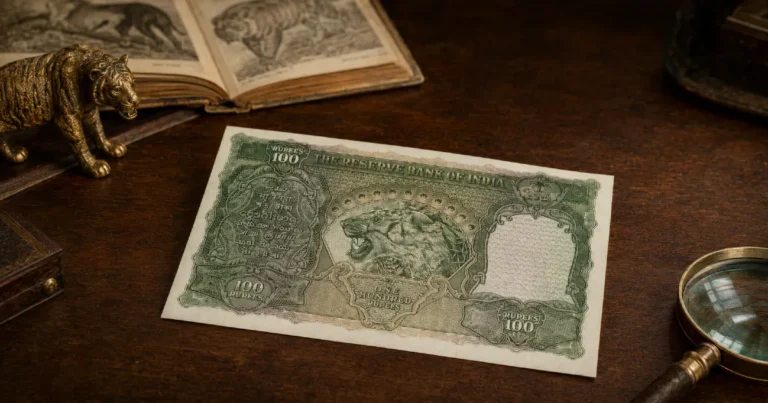
Animals on Nepal banknotes form one of the most distinctive and rewarding themes in South Asian paper money collecting. Across many decades of Nepalese currency, animals have appeared not only as decorative elements, but also as symbols of geography, national identity, ecology, culture, and everyday life.
For collectors, this makes Nepal especially interesting. A focused collection of animals on Nepal banknotes can include high Himalayan species, Terai grassland animals, sacred domestic animals, birds, big cats, and endangered wildlife. This combination of high-altitude, lowland, and domestic species within a single currency series gives Nepal’s banknotes an unusually broad animal theme.
This guide focuses on identifying the main animals on Nepal banknotes and understanding their place within Nepalese paper money, rather than cataloging every signature, date, watermark, or plate variety. Those details are covered in NumisAsia’s series-specific guides to individual Nepal banknote issues.
Table of Contents
Why Animals on Nepal Banknotes Are Popular
Nepal’s banknotes are closely connected with the country’s landscape. The country includes tropical lowlands, river valleys, forests, grasslands, mid-hills, and the high Himalayas. This geography is reflected in its paper money through a wide range of animal designs.
For collectors of animals on banknotes, Nepal offers a natural collecting structure. The subject can be approached by animal, by denomination, by habitat, by historical period, or by catalog number. It is also an accessible theme because many of the animals appear clearly on the back designs of widely collected Nepalese notes.
The main identifiable animals covered in this guide are: Black buck, cow, danphe, elephant, musk deer, one-horned rhinoceros, snow leopard, spotted leopard, swamp deer, tahr, tiger, and yak.
These animals make Nepal wildlife banknotes especially appealing. They represent both the natural world and the cultural world of Nepal. Some are associated with the Terai plains, such as the rhinoceros, elephant, tiger, black buck, and swamp deer. Others belong to mountain or Himalayan themes, such as the yak, tahr, snow leopard, musk deer, and danphe. The cow adds a sacred and domestic element, making Nepal animal banknotes more varied than a collection based only on wild species.
The appeal of animals on Nepal banknotes is also practical. A collector can begin with a simple type set, selecting one representative example of each animal. Collectors can later expand the same collection by denomination, catalog reference, date variety, signature variety, or issue type. This makes the theme suitable for both beginners and advanced paper money specialists.
Nepal Animal Banknotes by Geography
One reason animals on Nepal banknotes are so effective as a collecting theme is that the designs are geographically coherent. The animals are not a random selection. They reflect the country’s landscapes, from the Terai to the Himalayas.
The Terai plains contribute animals such as the one-horned rhinoceros, elephant, tiger, black buck, swamp deer, spotted leopard, and cow. These animals connect Nepal banknotes with grasslands, jungles, conservation areas, and agricultural life.
The Himalayan and mountain regions contribute animals such as the yak, tahr, snow leopard, musk deer, and danphe. These motifs connect Nepal wildlife banknotes with alpine scenery, mountain life, and the country’s identity as a Himalayan nation.
This geographic range allows collectors to build a Nepal animal banknotes collection in a highly structured way. A basic set might include one note per animal. A more specialized collection might divide the notes into Terai wildlife, Himalayan wildlife, sacred animals, domestic animals, birds, and big cats.
Checklist of Animals on Nepal Banknotes
The following checklist summarizes the principal animal motifs covered in this guide. It is intended as a thematic reference for collectors and pairs each Pick number with its corresponding Banknote Book number(s) for easier catalog cross-referencing.
| Animal | Denomination | Design | Pick Number (Banknote Book Number) |
|---|---|---|---|
| Black buck | 10 Rupees | Two black bucks grazing | Pick 24 (B218) |
| Black buck | 10 Rupees | Three black bucks grazing (paper) | Pick 31 (B227, B241); Pick 61 (B274); Pick 70 (B281) |
| Black buck | 10 Rupees | Three black bucks grazing (polymer) | Pick 45 (B251); Pick 54 (B261) |
| Black buck | 10 Rupees | One black buck standing | Pick 77 (B288) |
| Cow | 25 Rupees | Red cow on plains | Pick 41 (B247) |
| Cow | 250 Rupees | Red cow on plains | Pick 42 (B248) |
| Danphe | 50 Rupees | Two danphe, mountain background | Pick 52 (B267) |
| Elephant | 1000 Rupees | One elephant in field | Pick 28 (B222); Pick 36 (B234, B238, B246); Pick 44 (B250); Pick 51 (B259, B266); Pick 67 (B272); Pick 68 (B279); Pick 75 (B286) |
| Elephant | 1000 Rupees | Two elephants in field | Pick 82 (B293) |
| Musk deer | 1 Rupee | Two musk deer jumping over creek | Pick 22 (B215); Pick 37 (B240) |
| One-horned rhinoceros | 100 Mohru | Rhinoceros in jungle | Pick 4 (B103); Pick 7 (B107) |
| One-horned rhinoceros | 100 Mohru | Rhinoceros in grassy plain | Pick 11 (B204) |
| One-horned rhinoceros | 100 Rupees | Rhinoceros in grassy plain | Pick 15 (B208); Pick 26 (B220); Pick 34 (B232, B236, B244); Pick 49 (B257, B264); Pick 57 (B270); Pick 64 (B277); Pick 73 (B284) |
| One-horned rhinoceros | 100 Rupees | Rhinoceros and calf in grassy plain | Pick 80 (B291) |
| Spotted leopard | 2 Rupees | Spotted leopard in tall grass | Pick 29 (B223, B235) |
| Snow leopard | 50 Rupees | Snow leopard, mountain scene | Pick 79 (B290) |
| Swamp deer | 20 Rupees | One swamp deer in field | Pick 32 (B229); Pick 38 (B239, B242); Pick 47 (B255); PNL (B262); Pick 55 (B269); Pick 62 (B275); Pick 71 (B282) |
| Swamp deer | 20 Rupees | Two swamp deer in field | Pick 78 (B289) |
| Tahr | 50 Rupees | One tahr, mountain scene | Pick 33 (B231, B243); Pick 48 (B256, B263); Pick 63 (B276); Pick 72 (B283) |
| Tiger | 5 Mohru | One tiger in jungle | Pick 2 (B101); Pick 5 (B105) |
| Tiger | 500 Rupees | Two tigers drinking melted snow | Pick 20 (B213); Pick 27 (B221); Pick 35 (B233, B237, B245); Pick 43 (B249); Pick 50 (B258, B265); Pick 65 (B271); Pick 66 (B278); Pick 74 (B285) |
| Tiger | 500 Rupees | One tiger walking | Pick 81 (B292) |
| Yak | 5 Rupees | Two yaks grazing | Pick 23 (B216); Pick 30 (B225); Pick 46 (B253); PNL (B254); Pick 53 (B260, B268); Pick 60 (B273); Pick 69 (B280) |
| Yak | 5 Rupees | One yak, mountain scene | Pick 76 (B287) |
Footnote: PNL = Pick Not Listed — a variety recognized in the Banknote Book but not numbered in the Pick catalog.
Early Symbolic Animal Motifs on Nepal Banknotes
Before focusing on the main wildlife themes, collectors should note that early Nepalese banknotes also include symbolic, decorative, and mythological animal motifs.
Dogs, makaras, peacocks, snakes, and dragons appear in early Nepal banknote designs, often as symbolic or ornamental elements rather than as the main naturalistic animal vignettes seen on later issues. The makara is particularly significant in South Asian visual culture. It is a mythological aquatic creature, often combining features of several animals.
Collectors who want to study these early symbolic animals in more detail should compare them with the main wildlife designs discussed below. For a deeper look at the earlier period Nepal banknotes, see our guide to Government of Nepal Banknotes.
Black Buck on Nepal 10 Rupees Banknotes
The black buck is one of the most recognizable animals on Nepal 10 Rupees banknotes. It appears across several designs and is therefore one of the best animals for collectors who want to follow changes within a single denomination.
The earlier design shows two black bucks grazing on the 10 Rupees note, cataloged as Pick 24 / B218. Later versions show three black bucks grazing. These include Pick 31 / B227 and B241, Pick 45 / B251, Pick 54 / B261, Pick 61 / B274, and Pick 70 / B281. The motif also appears on commemorative polymer and standard polymer issues.
A later design shows one black buck standing in a field on the 10 Rupees note, cataloged as Pick 77 / B288. This gives collectors a clear progression from two animals, to three animals, and then to a single standing black buck.
For a thematic collection of animals on Nepal banknotes, the black buck is useful because it is associated with a popular and accessible denomination. It also represents the grassland wildlife theme, alongside the swamp deer and one-horned rhinoceros.
Cow on Nepal Commemorative Banknotes
The cow appears on Nepal’s commemorative 25 Rupees and 250 Rupees issues. The design shows a red cow on the plains of the Terai. The 25 Rupees commemorative issue is cataloged as Pick 41 / B247, while the 250 Rupees commemorative issue is cataloged as Pick 42 / B248.
The cow is especially important because it is not simply another animal motif. It carries cultural, religious, and national significance. As the national animal of Nepal, the cow gives Nepal animal banknotes a symbolic dimension that differs from purely wildlife-based designs.
For collectors, the cow issues provide an important contrast to the rhinoceros, tiger, elephant, and other wild species. They show that animals on Nepal banknotes include sacred and domestic animals as well as endangered wildlife and mountain fauna.
Because these are commemorative issues, they can also be collected within a broader special-issue framework. Collectors interested in this area should also see our article on Nepal Commemorative Banknotes.
Danphe on Nepal 50 Rupees Banknotes
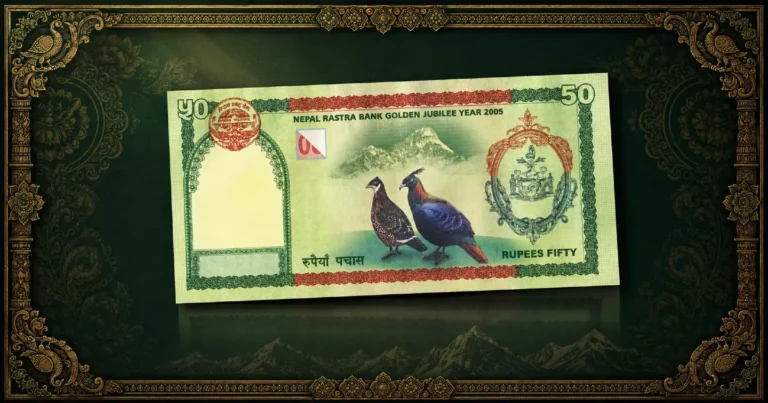
The danphe, or Himalayan monal, appears on the 50 Rupees banknote. The design shows two danphe with a mountain background and is cataloged as Pick 52 / B267.
This bird is significant because it is the national bird of Nepal. Its inclusion on the 50 Rupees note gives the animal theme an important avian component. While many collectors focus on mammals, the danphe is essential for a complete collection of animals on Nepal banknotes.
The danphe also strengthens the Himalayan identity of Nepal wildlife banknotes. Its mountain setting connects the note with Nepal’s high-altitude landscapes and natural heritage. For collectors of birds on banknotes, it is one of the key Nepalese designs.
Within a Nepal animal banknotes collection, the danphe pairs naturally with the tahr, snow leopard, yak, and musk deer. Together, these animals help represent Nepal’s mountain and alpine regions.
Elephant on Nepal 1000 Rupees Banknotes
The elephant is the principal animal motif of Nepal’s 1000 Rupees banknotes. Earlier designs show one elephant in a field. These include Pick 28 / B222, Pick 36 / B234, B238 and B246, Pick 44 / B250, Pick 51 / B259 and B266, Pick 67 / B272, Pick 68 / B279, and Pick 75 / B286.
A later 1000 Rupees design shows two elephants in a field, cataloged as Pick 82 / B293. This creates a clear distinction between the single-elephant and double-elephant types.
The elephant is one of the major Terai wildlife motifs on Nepal banknotes. As a large and visually prominent animal, it provides a strong anchor for collectors building a high-denomination wildlife set. It is also relevant for collectors who specialize in elephants on world banknotes or large mammals on Asian paper money.
In a thematic collection of animals on Nepal banknotes, the 1000 Rupees elephant note often serves as a centerpiece because of its denomination, size of motif, and strong association with Nepal’s lowland wildlife.
Musk Deer on Nepal 1 Rupee Banknotes
The musk deer appears on Nepal 1 Rupee banknotes. The design shows a male and female musk deer jumping over a creek. It is listed as Pick 22 / B215 and Pick 37 / B240.
This is one of the more active animal scenes in Nepalese paper money. Unlike static field or standing animal designs, the musk deer motif shows movement. This makes it especially attractive within a thematic display of Nepal animal banknotes.
The musk deer also helps broaden the collection beyond large and famous animals. While the rhinoceros, elephant, and tiger dominate many discussions of Nepal wildlife banknotes, the musk deer represents smaller mountain and forest species. It adds balance to the overall theme.
For collectors, the 1 Rupee musk deer notes are useful because they provide a lower-denomination animal type. They also connect well with the Himalayan and mid-hill wildlife group that includes the tahr, yak, danphe, and snow leopard.
One-Horned Rhinoceros on Nepal 100 Mohru and 100 Rupees Banknotes
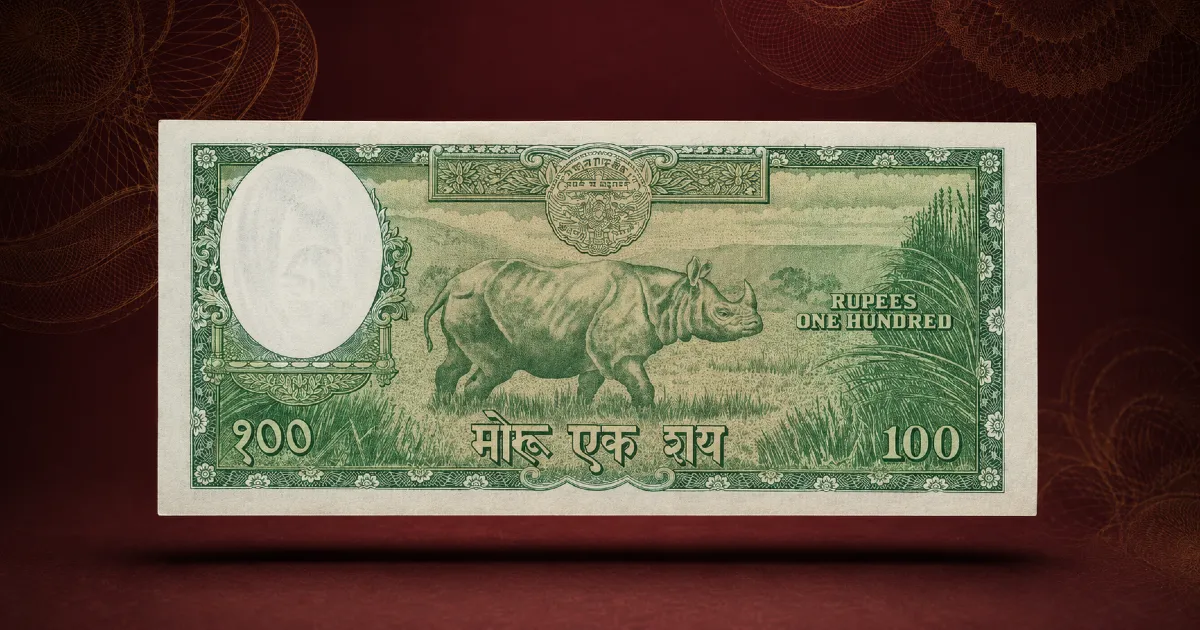
The one-horned rhinoceros is one of the most important and widely recognized animals on Nepal banknotes. It appears on both 100 Mohru and 100 Rupees notes and has been used across multiple issues.
Early 100 Mohru notes show a one-horned rhinoceros in a jungle scene. These include Pick 4 / B103 and Pick 7 / B107. A later 100 Mohru issue shows a one-horned rhinoceros in a grassy plain, cataloged as Pick 11 / B204.
After Nepal Rastra Bank assumed currency issuance in 1956, the rhinoceros continued as a major design on 100 Rupees notes. Examples include Pick 15 / B208, Pick 26 / B220, Pick 34 / B232, B236 and B244, Pick 49 / B257 and B264, Pick 57 / B270, Pick 64 / B277, and Pick 73 / B284. A modern design shows an adult rhinoceros and calf in a grassy plain, cataloged as Pick 80 / B291.
For many collectors, the rhinoceros is the central animal in Nepal wildlife banknotes. It is closely associated with the Terai and with Nepal’s conservation identity. It is also one of the most visually distinctive motifs in the entire series of Nepal animal banknotes.
A collection of animals on Nepal banknotes would feel incomplete without at least one rhinoceros note. Advanced collectors may choose to include multiple rhinoceros designs, separating jungle scenes, grassy plain scenes, and the adult-with-calf type.
Snow Leopard on Nepal 50 Rupees Banknotes
The snow leopard appears on the 50 Rupees note in a mountain scene. It is cataloged as Pick 79 / B290.
This is one of the most important modern high-altitude animal motifs on Nepal banknotes. The snow leopard is associated with remote mountain environments and Nepal’s high-altitude conservation programs.
Within a collection of Nepal wildlife banknotes, the snow leopard represents the alpine predator theme. It also complements the tiger and spotted leopard, creating a strong big cat group within Nepal animal banknotes.
For collectors, the snow leopard note is attractive because it combines a well-known endangered species with a clear mountain setting. It also shows how the 50 Rupees denomination has been used for several Himalayan themes, including the tahr, danphe, and snow leopard.
Spotted Leopard on Nepal 2 Rupees Banknotes
The spotted leopard appears on Nepal 2 Rupees banknotes, shown in tall grass. It is cataloged as Pick 29 / B223 and B235.
Although the spotted leopard does not appear across as many issues as the tiger or rhinoceros, it is important for completing the animal type set. It gives collectors another big cat motif and represents a predator other than the tiger and snow leopard.
The 2 Rupees denomination also adds variety to a Nepal animal banknotes collection. Many of the most famous animal designs appear on higher denominations such as 100, 500, and 1000 Rupees. The spotted leopard brings the big cat theme into a smaller denomination.
For collectors who organize animals on Nepal banknotes by category, the spotted leopard belongs naturally with the tiger and snow leopard. Together, these three notes form one of the most attractive sub-themes in Nepal wildlife banknotes.
Swamp Deer on Nepal 20 Rupees Banknotes
The swamp deer is the main animal motif of Nepal 20 Rupees banknotes. Several issues show one swamp deer in a field. These include Pick 32 / B229, Pick 38 / B239 and B242, Pick 47 / B255, PNL / B262, Pick 55 / B269, Pick 62 / B275, and Pick 71 / B282.
A later design shows two swamp deer in a field on the 20 Rupees note, cataloged as Pick 78 / B289.
The swamp deer is an important grassland animal within the wider theme of animals on Nepal banknotes. It connects naturally with the black buck and rhinoceros as part of the Terai and grassland wildlife group.
For collectors, the 20 Rupees swamp deer notes offer a practical way to expand beyond the most famous animal motifs. They also provide multiple catalog references within a single denomination, allowing a collector to build either a simple type example or a more detailed denomination study.
Within Nepal wildlife banknotes, the swamp deer is especially valuable because it represents a specific habitat rather than a general animal symbol. It helps show how Nepalese currency reflects the ecological variety of the country.
Tahr on Nepal 50 Rupees Banknotes
The tahr appears on Nepal 50 Rupees banknotes in a mountain scene. It is listed under Pick 33 / B231 and B243, Pick 48 / B256 and B263, Pick 63 / B276, and Pick 72 / B283.
The tahr is one of the key Himalayan animals on Nepal banknotes. Its mountain setting links it directly with Nepal’s alpine regions and highland wildlife. It also helps explain why the 50 Rupees denomination is so important for thematic collectors.
A Nepal animal banknotes collection can use the tahr to represent mountain mammals. It pairs naturally with the yak, musk deer, snow leopard, and danphe. Together, these notes create a strong Himalayan wildlife group.
For collectors who want to avoid focusing only on large famous animals, the tahr is a useful addition. It expands the collection beyond the rhinoceros, tiger, and elephant and gives the set a more complete representation of Nepal’s animal imagery.
Tiger on Nepal 5 Mohru and 500 Rupees Banknotes
The tiger is one of the most powerful and popular animals on Nepal banknotes. It appears on early 5 Mohru notes and later 500 Rupees notes.
The early tiger design shows one tiger in a jungle scene. These notes are cataloged as Pick 2 / B101 and Pick 5 / B105. The 500 Rupees denomination later introduced the well-known design of two tigers drinking melted snow. This appears on Pick 20 / B213, Pick 27 / B221, Pick 35 / B233, B237 and B245, Pick 43 / B249, Pick 50 / B258 and B265, Pick 65 / B271, Pick 66 / B278, and Pick 74 / B285.
A later 500 Rupees note shows one tiger walking, cataloged as Pick 81 / B292.
The tiger is one of the strongest visual motifs in Nepal wildlife banknotes. It also appeals to collectors outside Nepalese numismatics, especially those who collect big cats, predators, endangered animals, or animals on world banknotes.
For a thematic collection of animals on Nepal banknotes, the tiger is essential. Some collectors may choose one representative tiger note, while others may collect all three major tiger arrangements: one tiger in jungle, two tigers drinking melted snow, and one tiger walking.
Yak on Nepal 5 Rupees Banknotes
The yak appears on Nepal 5 Rupees banknotes and is one of the most important Himalayan domestic animal motifs in the series. Earlier designs show two yaks grazing. These include Pick 23 / B216, Pick 30 / B225, Pick 46 / B253, PNL / B254, Pick 53 / B260 and B268, Pick 60 / B273, and Pick 69 / B280.
A later design shows one yak in a mountain scene, cataloged as Pick 76 / B287.
The yak is especially important because it represents mountain life rather than only wildlife. In Himalayan regions, yaks are connected with transport, milk, wool, agriculture, trade, and daily survival. This makes the yak one of the most culturally meaningful animals on Nepal banknotes.
Within a Nepal animal banknotes collection, the yak can be grouped with the tahr, snow leopard, musk deer, and danphe as part of the Himalayan theme. It can also be grouped with the cow as part of a domestic and culturally significant animal group.
For collectors of Nepal wildlife banknotes, the yak should be understood as both an animal motif and a symbol of high-altitude life. It helps make the Nepalese animal theme more complete and more distinctive than a collection based only on wild animals.
How to Build a Nepal Animal Banknotes Collection
Animals on Nepal banknotes can be collected in several practical ways. Most collectors start with a type set, then expand into a denomination, habitat, or sub-theme as the collection grows — the same structures used across Banknote Collecting Themes more broadly.
Building a Type Set
The simplest approach is a type set: one representative note for each animal motif, regardless of catalog variety. A basic Nepal animal type set includes: Black buck on 10 Rupees, cow on 25 Rupees or 250 Rupees, danphe on 50 Rupees, elephant on 1000 Rupees, musk deer on 1 Rupee, one-horned rhinoceros on 100 Mohru or 100 Rupees, snow leopard on 50 Rupees, spotted leopard on 2 Rupees, swamp deer on 20 Rupees, tahr on 50 Rupees, tiger on 5 Mohru or 500 Rupees, and yak on 5 Rupees.
This set is clear, attractive, and manageable, and it represents the full range of the theme without requiring every signature, date, or catalog subtype. The rhinoceros, tiger, yak, black buck, elephant, and swamp deer each offer multiple design and catalog opportunities for collectors who want to expand further — see the checklist above for the full Pick and Banknote Book references.
Collecting by Habitat: Terai and Himalayan Wildlife
Nepal’s animal designs split naturally along the country’s geography. A Terai-focused collection draws on the 10 Rupees black buck, 20 Rupees swamp deer, 100 Rupees rhinoceros, 500 Rupees tiger, 1000 Rupees elephant, 2 Rupees spotted leopard, and the commemorative cow notes. Several of these species are tied to protected habitats, national parks, and forest reserves, which makes the Terai group especially relevant for collectors interested in conservation themes.
A Himalayan collection draws on the 5 Rupees yak, 1 Rupee musk deer, and the 50 Rupees notes, which have carried three different mountain animals across separate series: tahr, danphe, and snow leopard. This makes the 50 Rupees denomination a useful sub-theme on its own for collectors tracking design changes within a single note value.
Building a Big Cat Sub-Theme
Tiger, snow leopard, and spotted leopard form a compact big cat set spanning three denominations — 5 Mohru and 500 Rupees, 50 Rupees, and 2 Rupees — and multiple design periods. It’s one of the easiest sub-themes to assemble and display in full.
Sacred, Domestic, and Commemorative Issues
The cow and yak round out the theme beyond wild species. The cow appears on the commemorative 25 Rupees and 250 Rupees notes and, as Nepal’s national animal, carries religious and constitutional significance. The yak appears on 5 Rupees notes and reflects the mountain economy, domestic life, and high-altitude communities of the Himalayan region.
Commemorative and polymer issues add a further layer for advanced collectors: the cow appears only on commemorative notes, while the black buck spans traditional paper, commemorative polymer, and standard polymer 10 Rupees issues. A general type set needs only one representative example of each animal, but collectors building a more advanced collection may want both paper and polymer versions where they exist. Commemorative issues are best studied alongside Nepal Commemorative Banknotes, since they carry a different collecting profile from regular circulating notes.
Collecting Animals on Nepal Banknotes
Animals on Nepal banknotes offer a complete and visually engaging theme within South Asian paper money. From the one-horned rhinoceros on the 100 Rupees and the tiger on the 500 Rupees to the yak on the 5 Rupees and the elephant on the 1000 Rupees, Nepal’s currency presents a broad record of wildlife, geography, culture, and national identity.
The strength of this theme lies in its variety. Nepal wildlife banknotes include grassland animals, jungle animals, mountain species, birds, big cats, sacred animals, and domestic animals. This gives collectors many ways to build a meaningful collection without being restricted to a single denomination or period.
For beginners, the best approach is to collect one representative example of each animal. This creates a clear and attractive type set. For advanced collectors, the same theme can be expanded through date varieties, signature varieties, catalog references, commemorative issues, and condition.
Nepal animal banknotes also connect naturally with wider collecting fields, including animals on world banknotes, Asian wildlife currency, Himalayan themes, conservation themes, and national symbols on paper money.
Animals on Nepal banknotes also illustrate how currency design can document a country’s wildlife, geography, and cultural symbols. These notes record the animals and landscapes that help define Nepal. For collectors of South Asian paper money, wildlife banknotes, or thematic banknote collections, this is one of the most rewarding areas to study.