Government of Nepal banknotes mark the birth of paper money in a kingdom that had never before issued a printed currency note. Spanning 1945 to 1960, this foundational series of Nepal Mohru currency was produced under the direct authority of the state treasury — not a central bank — and printed by the India Security Press in Nashik for circulation across the rugged Himalayan terrain of Kathmandu and beyond. At the heart of the design program sits the unmistakable portrait of King Tribhuvan Bir Bikram Shah Dev, making these King Tribhuvan banknotes among the most iconographically powerful issues ever produced in South Asia.
The series opened on 17 September 1945 with three inaugural denominations — 5 Mohru, 10 Mohru, and 100 Mohru — each carrying a treasury promise of convertibility into precious metal coin, validated by the signature of the presiding Khajanchi. A fourth denomination, the 1 Mohru, followed in 1953. Over the fifteen years of treasury-directed issuance, three Khajanchi signed the notes, and the printing plates underwent one significant orthographic correction, creating the clean variety structure that makes completing a type set of Government of Nepal banknotes a realistic and deeply rewarding collecting objective.
This comprehensive guide provides an exhaustive technical breakdown of the entire series: denomination profiles, catalog classifications, signature varieties, prefix sequences, and the typographic transitions that distinguish early from later production runs — serving as a definitive field reference for variety specialists and monetary historians alike.
Table of Contents
The Institutional Framework of the Treasury Era
The Government of Nepal banknotes issued between 1945 and 1960 reflect a currency system built entirely around direct treasury authority rather than central bank infrastructure. Understanding the institutional framework that governed their production — and the visual and textual conventions that distinguish them — is essential for accurate attribution and variety classification.
The Sadar Muluki Khana and Sovereign Identity
The first fifteen years of Nepalese paper currency were defined by direct treasury control. The Government of Nepal initially held the responsibility of issuing Nepal Mohru currency through the Sadar Muluki Khana (Central Treasury) from September 1945 to February 1960. During this foundational era, the central infrastructure for a modern national reserve bank did not yet exist. The Sadar Muluki Khana functioned as the center for the state’s bullion reserves, tax receipts, and fiscal allocations.
This treasury-directed currency regime remained completely uninterrupted until February 1960, when the responsibility of paper money administration was formally handed over to the newly operational Nepal Rastra Bank, which had been founded in 1956 to modernize the nation’s financial systems. Consequently, Nepal Mohru currency carrying the explicit ‘Government of Nepal’ authority remains a highly sought-after, self-contained collecting category that represents the true birth of paper money in the country.
Sourcing Visual and Textual Modifiers
The initial family of banknotes introduced by the state treasury in September 1945 consisted of three primary denominations: 5 Mohru, 10 Mohru, and 100 Mohru. These early issues are instantly recognizable by their inclusion of the traditional Nepali word for the currency, explicitly printed on the plates as “Mohru” (मोरू) on the obverse — while the reverse carries the English equivalent “Rupees,” reflecting the dual-language conventions inherited from the British Indian monetary framework. This linguistic pairing reflects the colloquial commercial nomenclature used across the marketplaces of Kathmandu while maintaining administrative continuity with regional currency standards.
To ensure complete public trust in these new paper tokens, the treasury engraved a promise of convertibility into precious metal coin stock across the front of each note. Every plate featured a standard Devanagari text string guaranteeing that the bearer would receive the face value immediately upon presenting the note at the central treasury gates. The administration of this system required the personal validation of the state’s highest financial officer, the Khajanchi (Head of the Central Treasury), whose handwritten signature varieties form the primary structural classification system utilized by modern numismatic catalogers.
Master Reference Catalog Matrix
To provide a clean, organized overview for variety collectors and type set catalogers tracking Government of Nepal banknotes, the following reference matrix details the denominations, signatures, and catalog numbers for the entire 1945 to 1960 Nepal Mohru currency series:
| Denomination | Signature | Pick Catalog | Banknote Book |
|---|---|---|---|
| 1 Mohru | Narendra Raj | Pick 1 | B104 |
| 5 Mohru | Janak Raj | Pick 2 | B101 |
| 5 Mohru | Bharat Raj | Pick 2 | B105 |
| 5 Mohru | Narendra Raj | Pick 5 | B105 |
| 10 Mohru | Janak Raj | Pick 3 | B102 |
| 10 Mohru | Bharat Raj | Pick 3 | B106 |
| 10 Mohru | Narendra Raj | Pick 6 | B106 |
| 100 Mohru | Janak Raj | Pick 4 | B103 |
| 100 Mohru | Bharat Raj | Pick 4 | B103 |
| 100 Mohru | Narendra Raj | Pick 7 | B107 |
Shared Architectural and Iconographic Blueprints
Before exploring the highly specific, denomination-by-denomination technical profiles, catalog researchers must first understand the core visual and industrial frameworks shared across this early family of Government of Nepal banknotes — frameworks that give the series its coherence as a collecting category. Rather than introducing completely radical, unaligned designs for every single face value, the state treasury utilized a unified visual strategy to build public familiarity and counter basic counterfeiting attempts.
The Royal Portraiture of King Tribhuvan
The defining feature shared across all early Government of Nepal banknotes (with the single exception of the minor 1 Mohru note) is the prominent official portrait of King Tribhuvan Bir Bikram Shah Dev. He governed Nepal as the reigning sovereign during this vital developmental era, and his image was placed on the plates to assert royal state authority.
Across the 5, 10, and 100 Mohru denominations, his portrait is presented inside a clean, formal oval frame positioned along the upper right-hand side of the obverse layout. The King is depicted facing forward-left, wearing the highly ornate, traditional royal Nepalese plumed crown. This crown features fine cascading bird-of-paradise feathers and embedded gemstones, a potent symbol of the Shah Dynasty’s lineage. To complement this engraved portrait, a matching watermark profile was embedded directly into the paper security stock of each King Tribhuvan banknote.
Global Production via the India Security Press
Because the Kingdom of Nepal lacked a domestic, high-security industrial printing facility capable of producing fine line intaglio banknotes, the state treasury turned to regional allies to execute the physical manufacture of the notes. The entire family of early Government of Nepal banknotes issued between 1945 and 1960 was printed by the India Security Press in Nashik.
1 Mohru Government of Nepal Banknote
- Catalog Classifications: Pick 1b / BNB B104
- Dimensions: 65 × 101 mm
- Primary Colors: Grey-blue, and brown
- Obverse Design: A temple; Himalaya mountains; a crawling Elephant; an obverse of a coin
- Reverse Design: Reverse of a coin; a Kalash (a holy vase)
- Signature: Narendra Raj Pandit
- Introduction Date: 1953
- Prefixes: Ka (क) 0 to Ka (क) 27
5 Mohru Government of Nepal Banknote
- Dimensions: 126 × 73 mm
- Primary Colors: Violet and brown
- Obverse Design: King Tribhuvan wearing his royal plumed crown on the right side; Garuda holding a snake in its mouth; Himalaya mountains; dogs
- Reverse Design: A tiger in the jungle surrounded
Variety 1
- Catalog Classifications: Pick 2a / BNB B101a
- Nepali text: Shree Nepal Sarkar
- Signature: Janak Raj Pandit
- Introduction Date: 17 September 1945
- Prefix: Ka (क)
Variety 2
- Catalog Classifications: Pick 2b / BNB B101b
- Nepali text: Shree Nepal Sarkar
- Signature: Bharat Raj Pandit
- Introduction Date: 1948
- Prefixes: Ka (क), Kha (ख)
Variety 3
- Catalog Classifications: Pick 5 / BNB B105
- Nepali text: Shree Nepal Sarakar
- Signature: Narendra Raj Pandit
- Introduction Date: September 1953
- Prefixes: Kha (ख), Ga (ग), Gha (घ), Nga (ङ), Cha (च), Chha (छ), Ja (ज), Jha (झ), and Yan (ञ)
10 Mohru Government of Nepal Banknote
- Dimensions: 146 × 82 mm
- Primary Colors: Gray-blue
- Obverse Design: King Tribhuvan wearing his royal plumed crown on the right side; temple of goddess Guheswori; stylized dragons and native peacocks amidst flowers
- Reverse Design: Coat of arms; peacocks perched in trees; snakes, flowers, and traditional architectural arches
Variety 1
- Catalog Classifications: Pick 3a / BNB B102a
- Nepali text: Shree Nepal Sarkar
- Signature: Janak Raj Pandit
- Introduction Date: 17 September 1945
- Prefix: Ka (क)
Variety 2
- Catalog Classifications: Pick 3b / BNB B102b
- Nepali text: Shree Nepal Sarkar
- Signature: Bharat Raj Pandit
- Introduction Date: 1948
- Prefix: Ka (क)
Variety 3
- Catalog Classifications: Pick 6 / BNB B106
- Nepali text: Shree Nepal Sarakar
- Signature: Narendra Raj Pandit
- Introduction Date: September 1953
- Prefixes: Ka (क), Kha (ख), Ga (ग), Gha (घ), Nga (ङ), Cha (च), Chha (छ), Ja (ज), Jha (झ), Yan (ञ), Ta (ट), Tha (ठ), and Da (ड)
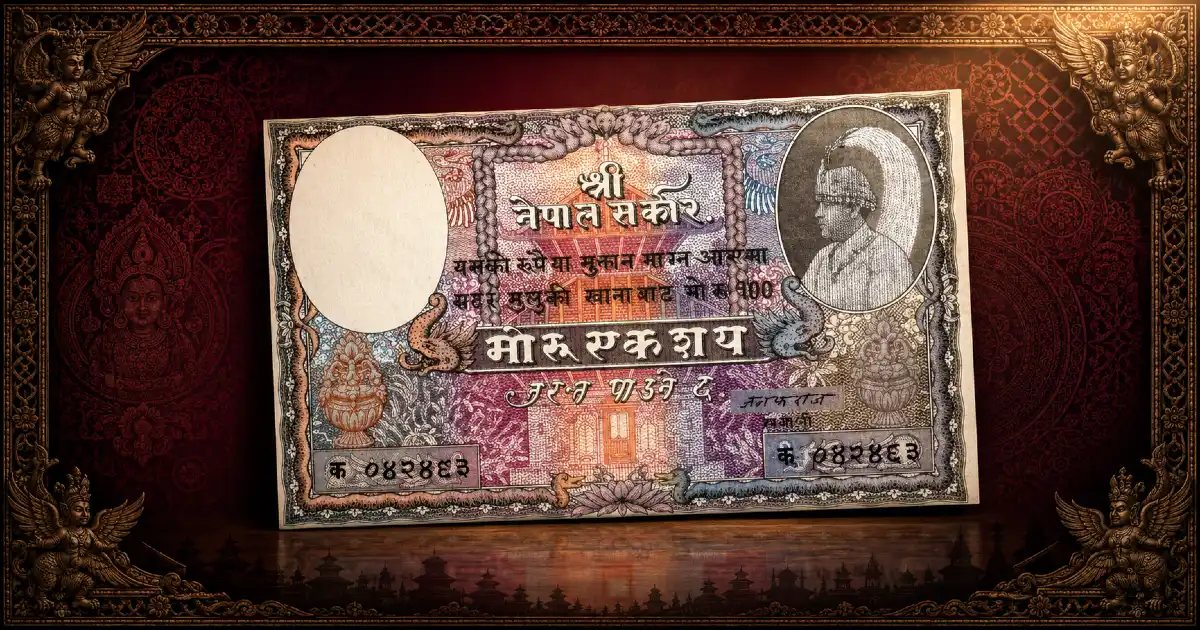
100 Mohru Government of Nepal Banknote
- Dimensions: 108 × 171 mm
- Primary Colors: Green
- Obverse Design: King Tribhuvan wearing his royal plumed crown on the right side; Pashupatinath Temple complex in Kathmandu; makaras (mythological water creatures), kalash (sacred urn), peacocks, and lotus flowers
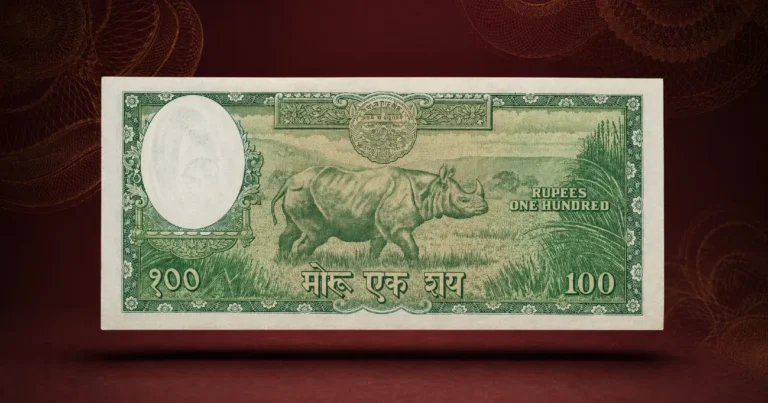
- Reverse Design: A single-horned rhinoceros walking through a dense marsh and jungle environment; Garuda with snakes in mouth
Variety 1
- Catalog Classifications: Pick 4a / BNB B103a
- Nepali text: Shree Nepal Sarkar
- Signature: Janak Raj Pandit
- Introduction Date: 17 September 1945
- Prefix: Ka (क)
Variety 2
- Catalog Classifications: Pick 4b / BNB B103b
- Nepali text: Shree Nepal Sarkar
- Signature: Bharat Raj Pandit
- Introduction Date: 1948
- Prefix: Ka (क)
Variety 3
- Catalog Classifications: Pick 7 / BNB B107
- Nepali text: Shree Nepal Sarakar
- Signature: Narendra Raj Pandit
- Introduction Date: September 1953
- Prefix: Ka (क)
Treasury Signatures & Textual Transitions
For advanced variety specialists who study early Nepal Mohru currency, the true value and depth of a collection emerge from identifying the subtle administrative updates and plate alterations that occurred throughout the fifteen-year treasury printing run. Because these notes were generated over an era marked by rapid institutional development, the printing plates had to be adapted to reflect changing leadership and linguistic corrections.
Chronological Registry of Treasury Heads (Khajanchi)
The single most critical diagnostic metric for cataloging early Nepalese Mohru currency is the signature of the presiding Khajanchi (Head of the Central Treasury). Throughout the entire operational lifespan of the Sadar Muluki Khana note-issuing authority, only three master treasury heads held the official legal power to validate currency sheets. Modern variety collectors classify the notes into distinct generational families based on these three signature blocks:
- Khajanchi Janak Raj Pandit (Signature Variety #1): Janak Raj Pandit served as the premier treasury head who oversaw the launch of the country’s paper money system in September 1945. His signature lines dominate the first generation of 5, 10, and 100 Mohru notes.
- Khajanchi Bharat Raj Pandit (Signature Variety #2): Bharat Raj Pandit assumed control of the central treasury and managed the issuance of paper notes until 22 January 1952. His compact, tightly scripted signature characterizes the second family of notes issued during the late 1940s.
- Khajanchi Narendra Raj Pandit (Signature Variety #3): Narendra Raj Pandit took over the central treasury on 22 January 1952 and remained the chief signing authority until 25 April 1956. His signature style is found on the modified 1953 series, which includes the introduction of the 1 Mohru note.
Typographic Varieties: The Sarkar to Sarakar Transition
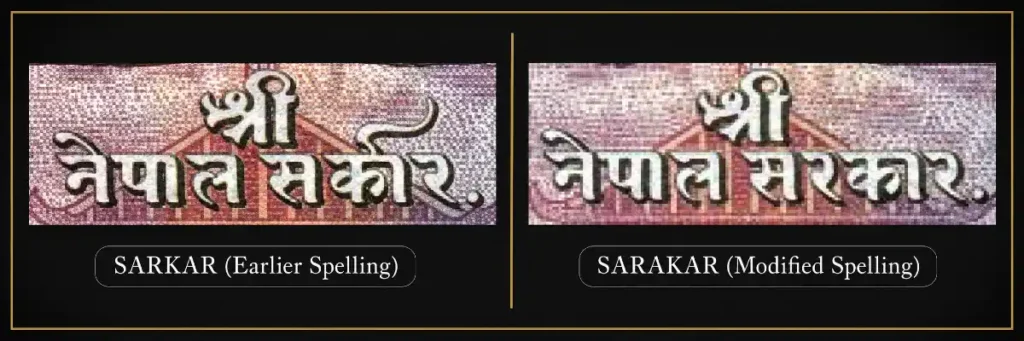
Beyond tracking signature changes, advanced catalogers must carefully inspect the Devanagari header text printed across the obverse of each denomination. The issuer title “Government of Nepal” underwent a deliberate orthographic correction between the early and later production generations — a plate modification that creates a clean, identifiable variety across the 5 Mohru, 10 Mohru, and 100 Mohru denominations simultaneously.
The earlier issues — all notes bearing the signatures of Janak Raj Pandit and Bharat Raj Pandit (Pick 2–4 / BNB B101–B103) — carry the header in its original spelling: “Shree Nepal Sarkar”. When the plates were revised for the September 1953 production runs under Narendra Raj Pandit (Pick 5–7 / BNB B105–B107), the header was officially corrected to read “Shree Nepal Sarakar”. This update applied uniformly across all three denominations simultaneously, making the title text a reliable and consistent generation marker across the entire treasury series.
Importantly, there is no overlap between signature and title text across any denomination — each signature variety aligns cleanly with its corresponding header spelling, with no crossover examples. This makes completing a type set of Government of Nepal banknotes a relatively straightforward exercise by the standards of South Asian numismatics: three signature varieties each for the 5 Mohru, 10 Mohru, and 100 Mohru, plus a single variety for the 1 Mohru, gives a total of ten distinct varieties for a complete holding.
A Complete Treasury Series Worth Pursuing
The fifteen-year run of Government of Nepal banknotes issued by the Sadar Muluki Khana stands apart from virtually every other South Asian collecting category in one important respect: it is genuinely completable. Ten distinct varieties across four denominations, three treasury signatures, and a single clean typographic transition give collectors a defined roadmap that rewards careful, methodical pursuit.
For those beginning a type set, the 5 Mohru, 10 Mohru and 100 Mohru denominations in first-signature Janak Raj Pandit are the natural anchors — visually commanding, historically significant as the inaugural issues of 17 September 1945, and an immediate statement of intent in any South Asian collection. The 1 Mohru, while modest in size, stands alone as the only Government of Nepal banknote without a King Tribhuvan portrait, making it a distinctive addition.
The greater challenge — and the deeper satisfaction — lies in prefix completion. The 5 Mohru and 10 Mohru issues under Narendra Raj Pandit extended across nine and thirteen prefixes respectively, representing the full commercial confidence the treasury had built in Nepal Mohru currency by the early 1950s. Pursuing these prefix runs moves a collection from type set into specialist territory.
When the Nepal Rastra Bank assumed responsibility for paper money issuance in February 1960, it inherited a public that had already placed complete trust in printed currency — a trust built note by note across this foundational treasury era. Surviving high-grade examples of Government of Nepal banknotes are not simply scarce numismatic rarities. They are the documentary record of a nation learning, for the first time, to carry its economy on paper.