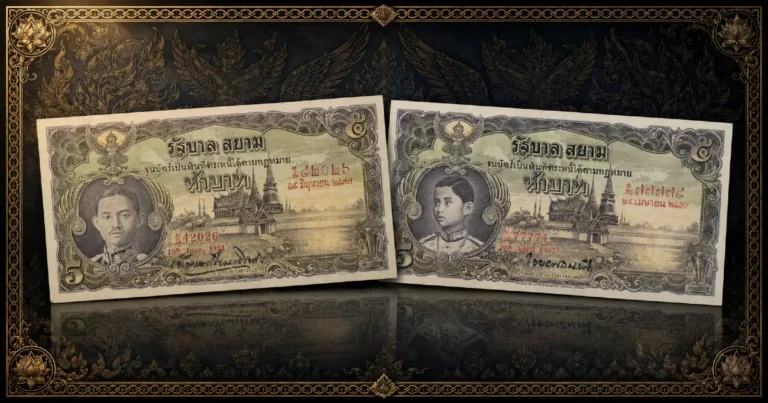
The Thailand Series 5 Banknotes occupy a unique and prominent position within the monetary history of Southeast Asia during World War II. Widely known among paper money specialists and numismatists as the Japanese print series Thai banknotes, this highly distinctive run of wartime paper money represents a defining chapter of political realignment, logistics under duress, and intense financial administration. Issued between 1942 and 1945, Series 5 stands as the only banknote series in Thai history produced entirely under Japanese wartime printing arrangements.
The Pacific War severed Thailand’s traditional overseas currency supply lines entirely, forcing the fifth-series banknotes into existence out of stark necessity. They followed directly from the developments observed in the preceding Thailand Series 4 Banknotes, which had faced mixed production circumstances — starting as high-art intaglio imports from London and concluding as local emergency printings.
With access to British security printing services cut off entirely, the Thai government was forced to look to its wartime ally for currency production. The resulting banknotes, printed across a vast geographic footprint that included Japan, Java, and Saigon, offer a compelling field of study for advanced collectors. Series 5 banknote rewards detailed structural analysis, presenting an intricate web of design departures, format types, color variations, and extraordinary transport anomalies.
Table of Contents
Alliance and Monetary Realignment
For nearly half a century, Thailand — known as Siam until 1939 — maintained an unbroken banknote printing relationship with Thomas De La Rue & Co. Ltd. in London. From Series 1 through the initial phase of Series 4, De La Rue served as Thailand’s sole overseas currency manufacturer, a partnership that defined the visual and technical standards of Thai paper money.
The surprise attack on Pearl Harbor shattered this arrangement entirely. Japanese imperial forces advanced into Thai territory, and Prime Minister Field Marshal Plaek Phibunsongkhram faced an impossible choice — resist and risk civilian destruction, or negotiate. Choosing pragmatism, the Thai government signed a formal alliance pact with Japan on 21 December 1941, and barely five weeks later declared war on Great Britain and the United States.
The consequences were immediate. Thai assets in Western nations were frozen, maritime trade routes closed, and the London banknote contract became untenable overnight. The Royal Thai Survey Department produced emergency local variants of the Series 4 notes, but Thailand lacked the paper mills, machinery, and security inks to sustain a national economy facing wartime inflation and expanding military expenditure. An external solution was urgently needed.
Maintaining Sovereignty in Occupied Southeast Asia
Thailand’s monetary experience under the Axis alliance was notably different from that of its neighbours. Across British Burma, Malaya, and the Dutch East Indies, Japanese military administrations demonetized pre-war currencies and replaced them with Japanese Invasion Money (JIM) — fiat issues backed by nothing beyond military authority. Thailand avoided this fate entirely. Despite its alliance with Japan, the kingdom retained full monetary sovereignty, continuing to issue its own nationally backed paper money throughout the war.
The Role of Mitsui Bussan Kaisha
To secure an external printing solution, the Thai government petitioned Japan for industrial assistance. The trading conglomerate Mitsui Bussan Kaisha was appointed as coordinating intermediary between the Thai Ministry of Finance and Japan’s Cabinet Printing Bureau. This arrangement marked the first time Thailand had entrusted its national currency production to a non-Western printer, transforming the face of WWII Thailand paper money.
Japanese Engraving and Production Geography
The engraving commission for the Thailand Series 5 Banknotes went to Kurakichi Kato, Chief Engraver of Japan’s Cabinet Printing Bureau and one of the most accomplished steel-plate portrait engravers of the Shōwa era. With over fifty foreign banknote issues to his credit since 1932, Kato brought exactly the technical depth the emergency commission demanded.
Working under exceptional time pressure, Kato completed the master portrait plate of King Ananda Mahidol (Rama 8) in just 26 working days between June and August 1942, working from a childhood photograph of the King. The result balanced youthful facial dimensions with regal authority — a masterpiece of fine-line intaglio executed at speed.
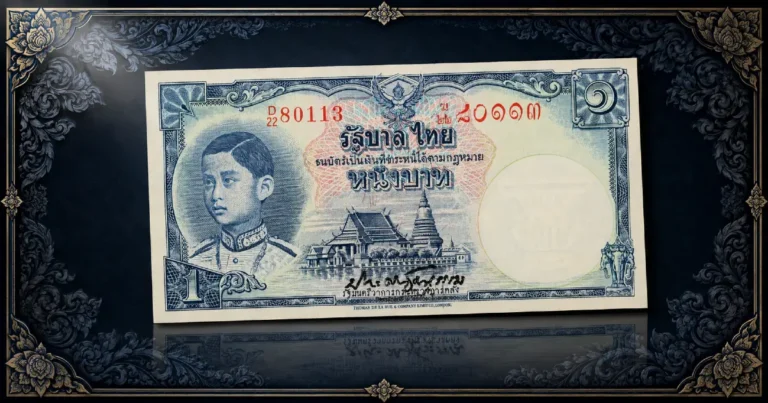
The portrait also introduced two significant departures from established Thai currency convention. First, the royal portrait frame moved from its traditional left-side position to the right of the obverse. Second, the King was depicted in a direct, forward-facing pose — the first front-facing royal portrait in Thai currency history. Kato completed the remaining architectural and landscape vignettes — Thai temples and palace pavilions — at roughly ten days per plate, producing a visually coherent and technically secure series despite the disruptive conditions surrounding its production.
Specialized Papermaking and Mitsumata Fiber
The paper stock chosen for Thai Series 5 notes broke sharply from the cotton-blend papers used by Western security printers. Japanese technicians used mitsumata fiber — a traditional botanical resource prized in Japanese papermaking for producing exceptionally strong, smooth, and crisp sheets. In practical terms, mitsumata paper’s natural structural resilience made it well-suited to the heavy friction, moisture, and heat of wartime tropical circulation — conditions that would have accelerated the deterioration of standard Western security paper considerably faster.
Core Visual and Structural Design Elements
The Thailand Series 5 banknotes maintain a remarkably consistent design language across all values. With the exception of the 50 Satang note, which deviates due to its sub-Baht denomination and smaller format, every Baht denomination follows a standardized graphic blueprint.
Obverse Geometry and Portrait Architecture
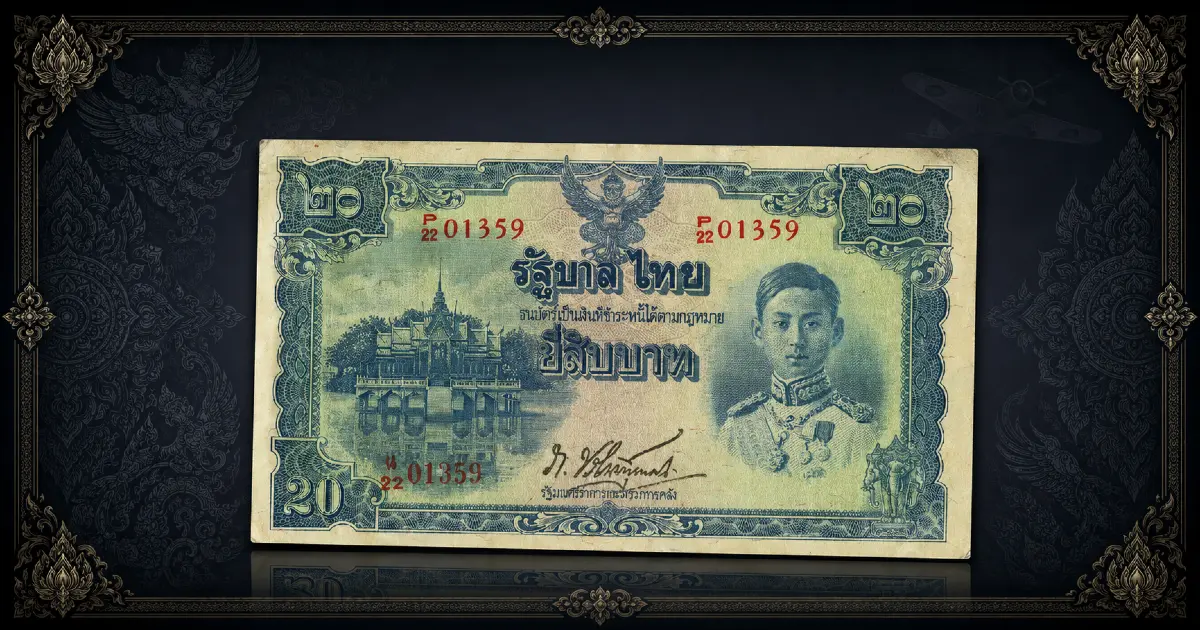
The obverse splits geometrically to balance security and aesthetics. Kurakichi Kato’s front-facing portrait of King Ananda Mahidol dominates the right-hand field, framed by fine security scrollwork. The national title “Government of Thailand” runs prominently across the upper center above the legal tender declaration, with denominations spelled out in Thai script and supported by numeral strings. A clean, unprinted circular field is reserved for watermark inspection.
Traditional State Emblems and Symbolism
Two national emblems anchor the obverse, projecting royal authority into daily commerce. The Royal Garuda sits at the top center above the title line as the official seal of executive state power. The Airapote — the three-headed elephant — occupies the lower right beneath the portrait, representing Chakri sovereignty and spiritual continuity. Amongst Thailand Series 5 banknotes, the 50 Satang note is the sole exception: its compact format omits the Airapote entirely, shifting the Garuda to the upper-left corner instead.
Secure Watermark Framework
Most Baht denominations carry the Constitution-on-pedestal tray watermark — a design carried directly from Series 4 to reinforce constitutional continuity. Two categories break from this: the 50 Satang note carries no watermark at all, and the late-war 1945 Type II issues of the 5 Baht and 10 Baht denominations omitted the watermark due to emergency paper sourcing constraints.
The Unified Reverse Motifs
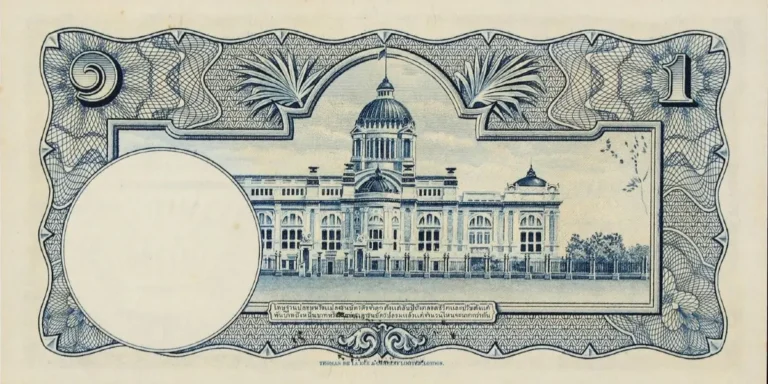
While each denomination’s obverse features a distinct Thai temple or palace pavilion, every reverse among these Thailand Series 5 banknotes shares a single centerpiece: Padej Dusakorn Fort and the Grand Palace in Bangkok. The engraving captures the fort’s defensive stone ramparts alongside the Grand Palace spires rising behind them — a composition that grounds the series in Bangkok’s historic core. Face values are repeated in Thai and Western numerals, accompanied by a standardized forgery-penalty inscription.
Major Format Classifications: Type I vs. Type II
International catalogs — including The Banknote Book and the Standard Catalog of World Paper Money (Pick) — divide Thai Series 5 notes into two primary types based on color deployment across the obverse and reverse faces, cutting through the more granular serial number and font-based subdivisions used in domestic Thai references.
Type I: Same-Color Format
The standard production format from the series debut in 1942 through early 1945. Obverse and reverse share the same dominant ink color family, maintaining the visually uniform appearance of pre-war Thai currency. All seven denominations launched under this format, and the 50 Satang, 1 Baht, and 1,000 Baht notes remained exclusively Type I throughout the war.
Type II: Different-Color Format
Introduced during the final months of the war in 1945, Type II of the Thai Series 5 notes mark a genuine milestone — the first time in Thai currency history that the reverse was deliberately printed in a contrasting ink family to the obverse. The shift was driven by severe chemical ink shortages in Saigon and Java rather than design intent, but the result is among the most visually striking issues in the entire series. Type II applies to the 5 Baht, 10 Baht, 20 Baht, and 100 Baht denominations and is typically paired with modern seven-digit serial numbers.
Understanding the Serial Number Structural Rules
One of the most rewarding components of studying the Thailand Series 5 banknotes is deciphering the systematic evolution of their serial configurations. Rather than arbitrary design changes, the alterations in serial number placements, counts, and character sets were dictated directly by different production phases and expanding wartime inflation. Advanced variety specialists group these formatting shifts into four distinct structural rules:
Rule 1: Three Serial Positions with Mixed Digits (Early Phase)
Utilized during the initial print runs, this layout features three distinct serial number stamps on the obverse face. While the upper tracking lines utilize standard Western numerals, the lower-left serial number is rendered strictly in traditional Thai digits. This complex format is found on early issues of the 1 Baht, 5 Baht, 10 Baht, and 20 Baht notes.
Rule 2: Three Serial Positions with Western Digits (Transitional Phase)
As production demands increased, the lower-left serial position transitioned from Thai characters to Western digits. The three-position layout was preserved, but the digitization was standardized across the note, providing a clean visual marker for the second major sub-type block.
Note: Within this rule, the 20 Baht denomination exhibits two distinct sub-types based on the character used for the top-right prefix — one sub-type carries an English letter while the other carries a Thai character in the equivalent position.
Rule 3: Two Serial Positions (Mid-to-Late Phase)
In this serialization configuration, technicians eliminated the lower-left serial position, leaving only two serial stamps positioned along the upper-left and upper-right margins. This streamlined layout governs the late Type I same-color notes and applies uniformly across the entire issued runs of the 100 Baht and 1,000 Baht denominations.
Rule 4: Seven-Digit Serial Strings (Type II Phase)
Introduced strictly in 1945 alongside the Type II different-color formatting shift, the 5 Baht, 10 Baht, and 20 Baht denominations were upgraded to prominent, elongated seven-digit serial number formats. This structural change was implemented by Japanese printers to track the massive expansion of paper money tracking blocks required to fuel skyrocketing wartime inflation.
Master Reference Matrix: Pick & BNB Numbers
To provide variety specialists and type set collectors with an instant, structured overview of the entire series, the following master matrix maps out the circulating denominations, their corresponding catalog classifications under the international Pick system and the Banknote Book (BNB) registries, and their primary reverse color rules.
| Denomination | Format Type | Pick Number | Banknote Book |
|---|---|---|---|
| 50 Satang | Same-Color Format | Pick 43 | B109 |
| 1 Baht | Same-Color Format | Pick 44 | B110 |
| 5 Baht | Same-Color Format | Pick 45 | B111 |
| 5 Baht | Different-Color Format | Pick 46 | B112 |
| 10 Baht | Same-Color Format | Pick 47 | B113 |
| 10 Baht | Different-Color Format | Pick 48 | B114 |
| 20 Baht | Same-Color Format | Pick 49 | B115 |
| 20 Baht | Different-Color Format | Pick 50 | B116 |
| 100 Baht | Same-Color Format | Pick 51 | B117 |
| 100 Baht | Different-Color Format | Pick 52 | B118 |
| 1,000 Baht | Same-Color Format | Pick 53 | B119 |
In-Depth Denomination Profiles
The Thailand Series 5 banknotes were issued in seven denominations: 50 Satang, 1 Baht, 5 Baht, 10 Baht, 20 Baht, 100 Baht, and 1000 Baht. Each denomination carries its own distinct color profile and vignette.
50 Satang Series 5 Banknote (Pick 43 / BNB B109)
- Dimensions: 117 x 63 mm
- Primary Colors: Green and pink
- Obverse Design: King Ananda Mahidol (Rama 8)
- Format Type: Exclusively Type I (Same-Color format)
50 Satang Variety Breakdown:
- Variety a: Signature: Pao Pienlert Boripanyuthakit. Prefixes: 1V – 100Z (Prefix 1Z is recognized as the first prefix).
- Variety b: Signature: Leng Srisomwong. Prefixes: 1U – 55U.
1 Baht Series 5 Banknote (Pick 44 / BNB B110)
- Dimensions: 125 x 65 mm
- Primary Colors: Brown
- Obverse Design: King Ananda Mahidol (Rama 8); mythical Naga serpents guarding the main entrance stairs to the historic Wat Phumin temple in Nan Province
- Format Type: Exclusively Type I (Same-Color format)
1 Baht Variety Breakdown:
1st Sub-Type: 3 Serial Positions (Thai Digits in Lower-Left)
- Variety a: Signature: Pao Pienlert Boripanyuthakit. Prefixes: A/1 – A/40.
2nd Sub-Type: 3 Serial Positions (Western Digits in Lower-Left)
- Variety a: Signature: Pao Pienlert Boripanyuthakit. Prefixes: A/41 – B/100.
3rd Sub-Type: 2 Serial Positions (Top Margin Only)
- Variety a: Signature: Pao Pienlert Boripanyuthakit. Prefixes: C/1 – D/79.
- Variety b: Signature: Khuang Abhaiwongse. Prefixes: D/80 (s/n 00001–20000) and E/1 – E/5.
- Variety c: Signature: Leng Srisomwong. Prefixes: D/80 (s/n 20001–100000) and E/6 – E/56.
5 Baht Series 5 Banknote (Pick 45 & Pick 46 / BNB B111 & BNB B112)
- Dimensions: 135 x 75 mm.
- Primary Colors: Green on the obverse
- Obverse Design: King Ananda Mahidol (Rama 8); Wat Benchamabophit Dusitvanaram (famously known as the Marble Temple) in Bangkok
- Format Type: Split between Type I (Green reverse) and Type II (Contrasting purple reverse)
5 Baht Variety Breakdown:
1st Sub-Type: 3 Serial Positions (Thai Digits in Lower-Left)
- Variety a: Signature: Pao Pienlert Boripanyuthakit. Prefixes: K/1 – K/20.
2nd Sub-Type: 3 Serial Positions (Western Digits in Lower-Left)
- Variety a: Signature: Pao Pienlert Boripanyuthakit. Prefixes: K/21 – K/40.
3rd Sub-Type: 2 Serial Positions (Top Margin Only)
- Variety a: Signature: Pao Pienlert Boripanyuthakit. Prefixes: K/41 – K/60.
- Variety b: Signature: Khuang Abhaiwongse. Prefixes: K/61 – K/84.
- Variety c: Signature: Leng Srisomwong. Prefixes: K/84 – K/87.
4th Sub-Type: Type II Different-Color Format (7-Digit Serials & Purple Reverse)
- Variety a: Signature: Leng Srisomwong. Prefixes: K/88 – K/90.
10 Baht Series 5 Banknote (Pick 47 & Pick 48 / BNB B113 & BNB B114)
- Dimensions: 145 x 85 mm
- Primary Colors: Purple on the obverse
- Obverse Design: King Ananda Mahidol (Rama 8); Wat Phra Chetuphon Vimolmangklararm (famously known as Wat Pho) in Bangkok
- Format Type: Split between Type I (Purple reverse) and Type II (Contrasting green reverse)
10 Baht Variety Breakdown:
1st Sub-Type: 3 Serial Positions (Thai Digits in Lower-Left)
- Variety a: Signature: Pao Pienlert Boripanyuthakit. Prefixes: N/1 – N/20.
2nd Sub-Type: 3 Serial Positions (Western Digits in Lower-Left)
- Variety a: Signature: Pao Pienlert Boripanyuthakit. Prefixes: N/21 – N/40.
3rd Sub-Type: 2 Serial Positions (Top Margin Only)
- Variety a: Signature: Pao Pienlert Boripanyuthakit. Prefixes: N/41 – N/65.
- Variety b: Signature: Leng Srisomwong. Prefixes: N/81 – N/91.
- Note: Prefixes N/66–N/80 are currently unrecorded in the reference literature. Any example bearing these prefixes would be of significant numismatic interest.
4th Sub-Type: Type II Different-Color Format (7-Digit Serials & Green Reverse)
- Variety a: Signature: Leng Srisomwong. Prefixes: N/92 – N/99.
20 Baht Series 5 Banknote (Pick 49 & Pick 50 / BNB B115 & BNB B116)
- Dimensions: 155 x 90 mm
- Primary Colors: Blue on the obverse
- Obverse Design: King Ananda Mahidol (Rama 8); Aisawan Thiphya-Art wooden pavilion, sitting inside the lake at the Bang Pa-In Royal Palace in Ayutthaya Province
- Format Type: Split between Type I (Blue reverse) and Type II (Contrasting brown reverse)
20 Baht Variety Breakdown:
1st Sub-Type: 3 Serial Positions (Thai Digits in Lower-Left)
- Variety a: Signature: Pao Pienlert Boripanyuthakit. Prefixes: P/1 – P/20.
2nd Sub-Type: 3 Serial Positions (Top-Right Prefix in English Characters)
- Variety a: Signature: Pao Pienlert Boripanyuthakit. Prefixes: P/21 – P/30.
3rd Sub-Type: 3 Serial Positions (Top-Right Prefix in Thai Characters)
- Variety a: Signature: Pao Pienlert Boripanyuthakit. Prefixes: P/31 – P/33.
4th Sub-Type: 2 Serial Positions (Top Margin Only)
- Variety a: Signature: Pao Pienlert Boripanyuthakit. Prefixes: P/34 – P/70.
- Variety b: Signature: Khuang Abhaiwongse. Prefixes: P/70 – P/93.
- Variety c: Signature: Leng Srisomwong. Prefixes: P/94 – P/96.
5th Sub-Type: Type II Different-Color Format (7-Digit Serials & Brown Reverse)
- Variety a: Signature: Leng Srisomwong. Prefixes: P/97 – P/101.
100 Baht Series 5 Banknote (Pick 51 & Pick 52 / BNB B117 & BNB B118)
- Dimensions: 165 x 95 mm
- Primary Colors: Red on the obverse
- Obverse Design: King Ananda Mahidol (Rama 8); central prang of Wat Arun (Temple of the Dawn) along the edge of the Chao Phraya River in Bangkok
- Format Type Classification: Split between Type I (Red reverse) and Type II (Contrasting blue reverse)
100 Baht Variety Breakdown:
1st Sub-Type: Type I Same-Color Format (2 Serial Positions on Top Margin Only)
- Variety a: Signature: Pao Pienlert Boripanyuthakit. Prefixes: S/1 – S/6.
2nd Sub-Type: Type II Different-Color Format (2 Serial Positions & Blue Reverse)
- Variety a: Signature: Leng Srisomwong. Prefixes: S/7 – S/21.
1,000 Baht Series 5 Banknote (Pick 53 / BNB B119)
- Dimensions: 175 x 100 mm
- Primary Colors: Olive green
- Obverse Design: King Ananda Mahidol (Rama 8); Chakri Maha Prasat and Dusit Maha Prasat Throne Halls within the Grand Palace complex in Bangkok.
- Format Type Classification: Exclusively Type I (Same-Color format)
1,000 Baht Variety Breakdown:
1st Sub-Type: Type I Same-Color Format (2 Serial Positions on Top Margin Only)
- Variety a: Signature: Pao Pienlert Boripanyuthakit. Prefixes: T/1 – T/2.
Variety Checklist: Signatures & Prefixes
The sub-types within the Thailand Series 5 banknotes are dictated by the chronological alignment of structural serial positions, numeral characters, and presiding ministerial signatures. The following comprehensive reference checklist details every major collectible variety within the series.
| Denomination | Format Type | Serial Number Structural Rule | Signature | Prefixes |
|---|---|---|---|---|
| 50 Satang | Same-Color Format | Alphanumeric Prefix Block | Pao Pienlert Boripanyuthakit | 1V – 100Z (1Z is First Prefix) |
| 50 Satang | Same-Color Format | Alphanumeric Prefix Block | Leng Srisomwong | 1U – 55U |
| 1 Baht | Same-Color Format | 3 Serial Positions; Lower-Left Serial in Thai Digits | Pao Pienlert Boripanyuthakit | A/1 – A/40 |
| 1 Baht | Same-Color Format | 3 Serial Positions; Lower-Left Serial in Western Numerals | Pao Pienlert Boripanyuthakit | A/41 – B/100 |
| 1 Baht | Same-Color Format | 2 Serial Positions | Pao Pienlert Boripanyuthakit | C/1 – D/79 |
| 1 Baht | Same-Color Format | 2 Serial Positions | Khuang Abhaiwongse | D/80 (s/n 00001–20000) & E/1 – E/5 |
| 1 Baht | Same-Color Format | 2 Serial Positions | Leng Srisomwong | D/80 (s/n 20001–100000) & E/6 – E/56 |
| 5 Baht | Same-Color Format | 3 Serial Positions; Lower-Left Serial in Thai Digits | Pao Pienlert Boripanyuthakit | K/1 – K/20 |
| 5 Baht | Same-Color Format | 3 Serial Positions; Lower-Left Serial in Western Numerals | Pao Pienlert Boripanyuthakit | K/21 – K/40 |
| 5 Baht | Same-Color Format | 2 Serial Positions | Pao Pienlert Boripanyuthakit | K/41 – K/60 |
| 5 Baht | Same-Color Format | 2 Serial Positions | Khuang Abhaiwongse | K/61 – K/84 |
| 5 Baht | Same-Color Format | 2 Serial Positions | Leng Srisomwong | K/84 – K/87 |
| 5 Baht | Purple Reverse | 7-Digit Serial Formats | Leng Srisomwong | K/88 – K/90 |
| 10 Baht | Same-Color Format | 3 Serial Positions; Lower-Left Serial in Thai Digits | Pao Pienlert Boripanyuthakit | N/1 – N/20 |
| 10 Baht | Same-Color Format | 3 Serial Positions; Lower-Left Serial in Western Numerals | Pao Pienlert Boripanyuthakit | N/21 – N/40 |
| 10 Baht | Same-Color Format | 2 Serial Positions | Pao Pienlert Boripanyuthakit | N/41 – N/65 |
| 10 Baht | Same-Color Format | 2 Serial Positions | Leng Srisomwong | N/81 – N/91 |
| 10 Baht | Green Reverse | 7-Digit Serial Formats | Leng Srisomwong | N/92 – N/99 |
| 20 Baht | Same-Color Format | 3 Serial Positions; Lower-Left Serial in Thai Digits | Pao Pienlert Boripanyuthakit | P/1 – P/20 |
| 20 Baht | Same-Color Format | 3 Serial Positions; Top-Right Prefix in English Characters | Pao Pienlert Boripanyuthakit | P/21 – P/30 |
| 20 Baht | Same-Color Format | 3 Serial Positions; Top-Right Prefix in Thai Characters | Pao Pienlert Boripanyuthakit | P/31 – P/33 |
| 20 Baht | Same-Color Format | 2 Serial Positions | Pao Pienlert Boripanyuthakit | P/34 – P/70 |
| 20 Baht | Same-Color Format | 2 Serial Positions | Khuang Abhaiwongse | P/70 – P/93 |
| 20 Baht | Same-Color Format | 2 Serial Positions | Leng Srisomwong | P/94 – P/96 |
| 20 Baht | Brown Reverse | 7-Digit Serial Formats | Leng Srisomwong | P/97 – P/101 |
| 100 Baht | Same-Color Format | 2 Serial Positions | Pao Pienlert Boripanyuthakit | S/1 – S/6 |
| 100 Baht | Blue Reverse | 2 Serial Positions | Leng Srisomwong | S/7 – S/21 |
| 1,000 Baht | Same-Color Format | 2 Serial Positions | Pao Pienlert Boripanyuthakit | T/1 – T/2 |
Production Remainders and Japanese Specimens
Beyond the standard varieties that successfully passed through official banking channels, the Thailand Series 5 banknotes house a parallel tier of high-rarity items that never saw official public circulation. These pieces are highly prized by elite numismatists as pure artifacts of wartime currency production.
Official Unissued Remainders
Due to the sudden and abrupt nature of Japan’s surrender in August 1945, production lines across the regional centers ground to a halt instantly. Today, collectors can locate official production remainders for the 50 Satang, 1 Baht, 100 Baht, and 1,000 Baht denominations. These fascinating items feature authentic, fully printed graphic frames and legal prefix blocks, but remain completely blank within the serial number lines and lack the official signatures of the Ministers of Finance.
The “見本” (Mihon) Japanese Specimen Issues
To facilitate quality assurance, plate verification, and diplomatic approvals between Tokyo and Bangkok, the Cabinet Printing Bureau prepared a small tier of archival specimens. Because these notes were produced in Japanese-controlled environments, they do not carry traditional Western “SPECIMEN” stamps.
Instead, they are stamped cleanly with the Japanese kanji characters “見本” (Mihon). Specialized variety registries catalog two distinct configuration classes for these elusive pieces:
- Single Kanji Overprints: Banknotes featuring a single, prominent “見本” overprint stamped cleanly across the face of the note.
- Dual Kanji Overprints: Banknotes featuring two distinct “見本” stamps flanking opposite sides of the obverse layout to permanently bar the paper stock from being misused as legal tender.
These specimen variations exist across the 50 Satang, 1 Baht, 100 Baht, and 1,000 Baht blocks. They serve as exceptional archival specimens, offering collectors definitive confirmation of the technical parameters established by Chief Engraver Kurakichi Kato during the height of the Pacific War conflict.
Exceptional Wartime Anomalies: Excess Prints & Rail Theft
The study of the Thailand Series 5 banknotes extends far beyond their official catalog listings. Because they were printed and shipped across vast distances during a global conflict, this series is directly associated with two fascinating administrative anomalies: unauthorized excess printing and large-scale armed theft during transport. These historic disruptions reveal how the breakdowns in regional Axis control mechanisms allowed genuine currency blocks to enter circulation outside normal legal channels.
Air Transport Losses and the Hunan Incident
The physical transport of the finished currency from the Cabinet Printing Bureau in Japan to the vaults of the Bank of Thailand required a perilous combination of air, sea, and rail transit routes. As Allied air superiority intensified across Southeast Asia, these shipping pipelines faced constant danger.
According to archival reports compiled by Mitsui Bussan Kaisha, one cargo transport aircraft carrying an early consignment of the 100 Baht different-color Type II notes (Red obverse with a blue reverse) suffered a critical technical failure and was forced to execute an emergency landing on Hunan Island. During the chaotic grounding, a secure shipping crate was heavily fractured, and 11,518 individual 100 Baht notes were officially reported as destroyed by fire.
Under normal security protocols, these burned notes would have been wiped from state registers. However, toward the final chaotic months of the war, identical 100 Baht banknotes emerged within the local marketplaces of Thailand, bearing forged signatures of the Minister of Finance. This re-appearance indicates that portions of the fractured Hunan consignment were illicitly salvaged from the crash site or pilfered by local handlers, later receiving illicit signature stamps to blend into circulation.
The Excess-Printed 100 Baht Discrepancies
Following the conclusion of hostilities, the Bank of Thailand discovered that Japanese state printing agencies had manufactured currency blocks far exceeding the exact production figures officially handed over to Thai state custody. Because emergency conditions severely limited real-time verification and audits, these massive printing discrepancies went entirely unnoticed by Bangkok until the notes were already passing through public hands.
This administrative leak primarily impacted the high-value 100 Baht denomination, which was heavily utilized to pay for soaring Japanese military expenditures inside Thailand. To stabilize circulation, the Ministry of Finance launched an extensive investigation, culminating in a detailed, historic decree issued on 14 February 1945. This document explicitly isolated which serial runs were official and which represented unauthorized excess production.
According to the Ministry of Finance declaration, the following clear serial-number gaps within the S/13 and S/14 prefix runs were officially classified as not lawfully issued:
Prefix S/13 Unauthorized Serial Ranges:
- Serial numbers 00001 – 05000
- Serial numbers 07001 – 08000
- Serial numbers 10001 – 13000
- Serial numbers 15001 – 17000
- Serial numbers 20001 – 21000
Prefix S/14 Unauthorized Serial Ranges:
- Serial numbers 95001 – 96000
These banknotes are almost universally accompanied by a crude, forged ministerial signature stamp, applied clandestinely outside official state channels. Rather than penalizing citizens who had accepted these notes in good faith, the post-war Treasury Department enacted a pragmatic compromise, allowing individuals to exchange these anomalous notes for standard legal tender if they could verify they had received them before the announcement date.
The Great Rail Heist: “Thai Theeb” & “Leng Tha Chang” Banknotes
The most dramatic currency disruption involving the Thailand Series 5 banknotes occurred on 10 July 1945 at the Tha Chang railway station in Surat Thani Province. Because Allied naval blockades had rendered maritime deliveries to the port of Bangkok entirely suicidal, a large consignment of Thai Series 5 notes was routed through the port of Singapore and forwarded north toward the capital via rail under heavily armed Japanese military escort.
During the scheduled stop at Tha Chang station, local resistance operatives and opportunistic thieves managed to breach the secure cargo compartments. Recognizing that the heavily sealed wooden crates were far too massive to lift quietly, the thieves used their feet to forcefully kick and shove the crates out of the train doors onto the side of the tracks, where they split open and were rapidly dispersed into the local community.
This audacious heist generated two famous numismatic terms that remain heavily utilized in Thai collector literature to this day:
- Thai Theeb Banknotes: Derived directly from the Thai word theeb (ถีบ), meaning “to kick or push away by foot,” immortalizing the method used to eject the crates.
- Leng Tha Chang Banknotes: Combining the name of the Minister of Finance whose signature was later forged onto the stolen paper stock (Leng Srisomwong) with the geographic location of the heist at Tha Chang station.
Denomination Breakdown of Stolen Rail Stocks
Through the recovery of contemporary Ministry of Finance memoranda and Bank of Thailand data logs, the exact quantities of stolen Thai Theeb banknotes can be accurately mapped by prefix and serial range:
5 Baht Stolen Blocks:
- Prefix K/91: Serials 366001 – 403000
- Prefix K/91: Serials 773001 – 810000
- Cumulative Impact: 74,000 individual notes stolen (Note: Unsigned notes under prefix K/80 exist but have not been definitively linked to this specific heist)
10 Baht Stolen Blocks:
- Prefix N/95: Serials 0631001 – 0659000
- Prefix N/96: Serials 0163001 – 0191000
- Prefix N/96: Serials 0387001 – 0415000
- Prefix N/97: Serials 0283001 – 0311000
- Prefix N/97: Serials 0507001 – 0535000
- Prefix N/97: Serials 0703001 – 0731000
- Prefix N/98: Serials 0295001 – 0323000
- Cumulative Impact: 224,000 individual notes stolen
20 Baht Stolen Blocks:
- Prefix P/99: Serials 0756001 – 0780000
- Prefix P/100: Serials 0068001 – 0092000
- Prefix P/101: Serials 0932001 – 0956000
- Cumulative Impact: 72,000 individual notes stolen
100 Baht Stolen Blocks:
- Prefix S/16: Serials 00001 – 40000
- Prefix S/17: Serials 49001 – 49668
- Prefix S/17: Serials 49781 – 50000
- Cumulative Impact: 40,968 individual notes stolen
On 24 August 1945, the Ministry of Finance issued an official administrative decree addressing the Tha Chang incident. Reassuring a public panicked by rumors that the government would completely disavow any currency stolen while under Japanese military transit, authorities declared that they would evaluate individual claims. Where officials were fully satisfied that a citizen had accepted a Thai Theeb note in open commerce without fraudulent intent, the notes were accepted, providing an extraordinary chapter of postwar monetary reconciliation.
The Complex Monument of Alliance Warfare
The Thailand Series 5 banknotes remain an undeniably complex monument to wartime fiscal survival. They represent a fascinating structural counterpoint to the preceding series: while Series 4 witnessed foreign-produced clandestine warfare via the Allied Seri Thai Banknotes, Series 5 exhibits the deep internal vulnerabilities, transit blockades, and administrative pressures of operating within an official Axis alliance.
For the modern collector, this series represents a premier numismatic playground. Whether tracking down an unwatermarked 50 satang token, a beautiful same-color Type I intaglio note from the Kolff plant, or a legendary Thai Theeb rail heist variety carrying a forged signature block, Series 5 provides an absolute masterclass in how global conflict can shape the physical and administrative life of a nation’s paper wealth.