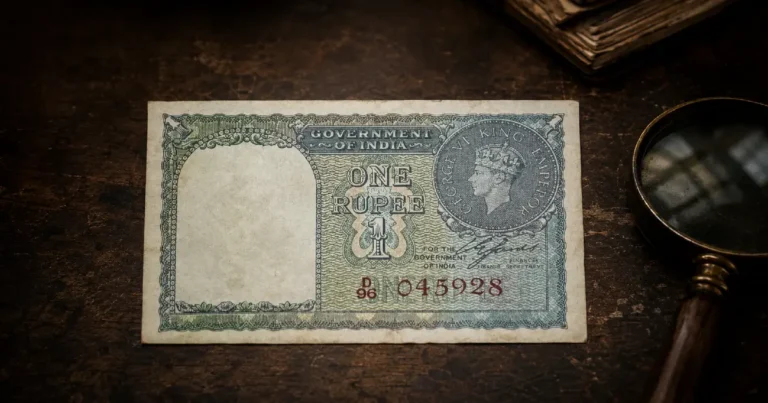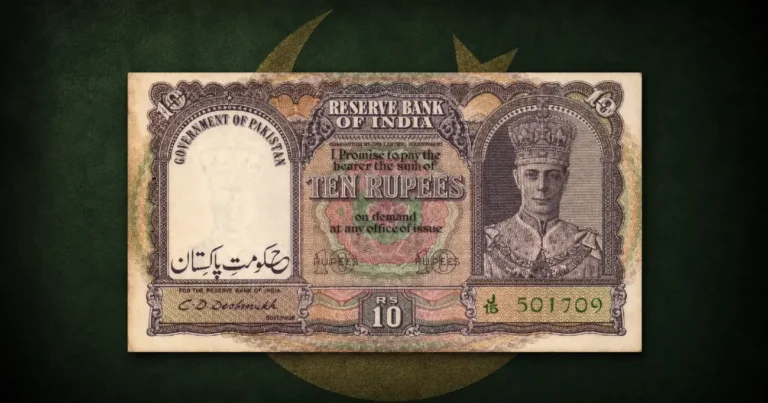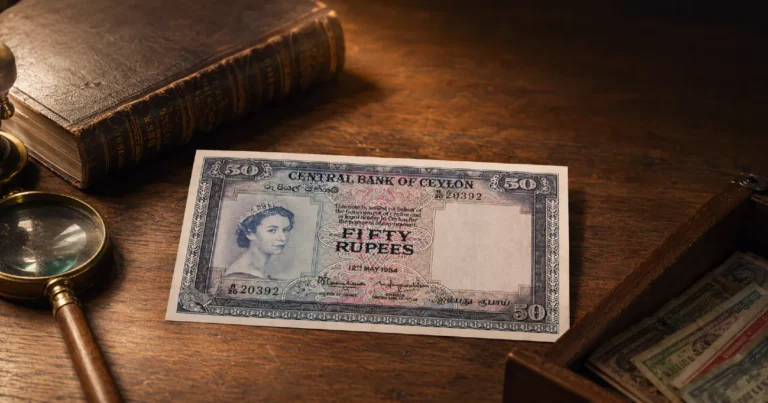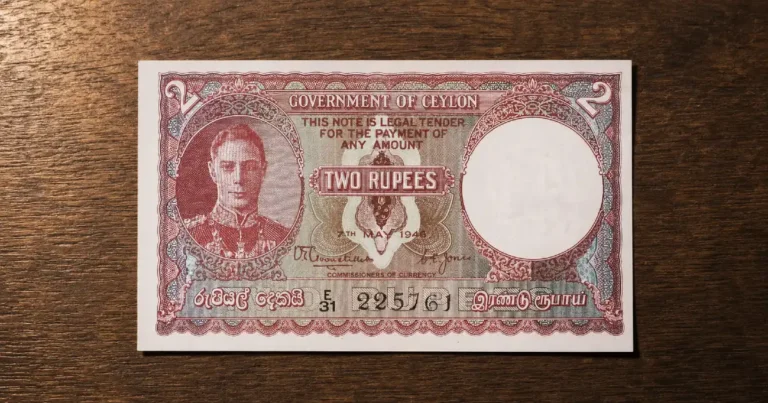
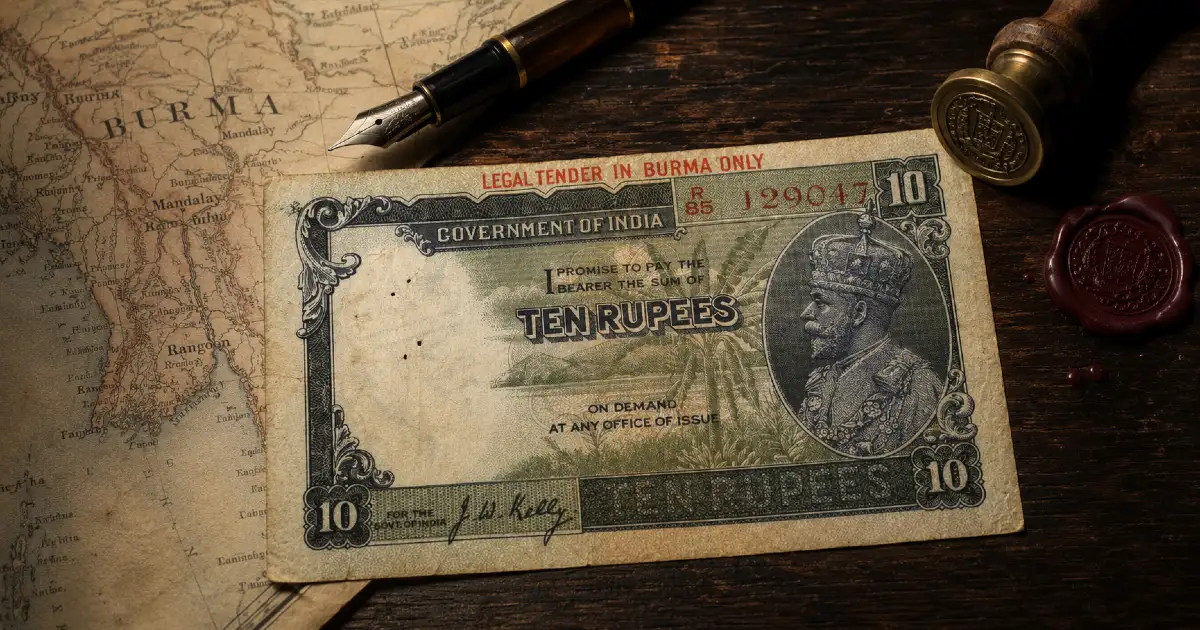
KGV Burma overprint banknotes represent the definitive opening chapter in the separate paper money history of Burma. Released into active circulation on 1 April 1937, these KGV Burma banknotes were created to solve a pressing geopolitical problem: how to establish an independent monetary system for a newly separated colony overnight without causing widespread commercial panic or economic paralysis. To achieve this, the British colonial authorities took existing, unissued stocks of King George V Government of India banknotes and modified them with a clean, single-line typographic overprint reading strictly “LEGAL TENDER IN BURMA ONLY”. This historic 1937 Burma provisional series served as an immediate financial bridge, protecting public confidence while a permanent, custom-designed currency network was engineered behind the scenes.
Issued across three primary circulating denominations—5 Rupees, 10 Rupees, and 100 Rupees—these provisional overprint banknotes seamlessly retained the complex security designs, high-grade intaglio plates, and familiar iconographies of the standard Government of India currency while establishing a strict geographic boundary for their use. Officially cataloged under Pick designations P1 through P3 in the Standard Catalog of World Paper Money and listings B101 through B103 in The Banknote Book, these 1937 overprints are highly prized by collectors of British Commonwealth and East Asian numismatics.
Today, the study of King George V Burma overprints has evolved into a highly specialized field. Due to an incredibly compressed circulation window, extensive post-war demonetization, and unique institutional audit procedures that resulted in the systematic destruction of full-size notes, surviving legal tender in Burma only examples are remarkably scarce. This comprehensive reference guide provides an exhaustive analysis of the series, detailing its administrative origins, production variations, exact prefix ranges, rarity scales, and the long-standing controversies that define this classic transitional era.
Table of Contents
Historical Background and Geopolitical Context
To understand why a provisional currency issue was required for Burma in 1937, one must examine the complex administrative history of the British Empire in Southeast Asia. Since the conclusion of the Anglo-Burmese Wars in the nineteenth century, Burma had been administered not as a separate country, but as a far-eastern province of British India. Consequently, the two regions shared a single economic framework, a centralized banking network, and a completely unified paper currency system managed by the Government of India. For a broader overview of how Burma’s currency evolved across all eras, see our complete Burma banknotes guide.
The Government of Burma Act 1935
By the 1930s, growing political movements within Burma, paired with a desire by British planners to streamline imperial administration, led to the decision to politically separate the territory, ultimately necessitating the KGV Burma overprint banknotes series. The constitutional mechanism for this transition was established by the British Parliament through the passage of the Government of Burma Act 1935. This sweeping piece of legislation dissolved the provincial status of Burma and decreed that it would become an independent Crown Colony.
While the 1935 Act laid down clear legal guidelines for political governance, it created monumental complications for the region’s monetary plumbing. Prior to separation, standard British India paper money that preceded Burma’s separation flowed seamlessly across the borders. Merchants in Rangoon, timber traders along the Irrawaddy River, and bankers in Calcutta utilized the exact same paper currency notes without friction. The formal partitioning of the territory meant this unified cash flow had to be permanently severed.
The Monetary Challenges of Partition
On 1 April 1937, day one of the new separate Crown Colony, the newly established treasury in Rangoon was hit with an immediate economic imperative: it had to isolate Burma’s money supply from mainland India. If non-overprinted Indian notes continued to move freely back and forth across the Bay of Bengal, the independent Burmese administration would have no capacity to accurately calculate its own trade balances, manage localized gold or sterling reserves, or enforce independent credit and fiscal policies.
However, the physical logistics of currency production stood in the way of an immediate replacement. Designing a completely new, definitive series of banknotes required months of specialized artwork, master steel plate engraving, security ink formulation, and coordinated factory print runs. Furthermore, the local population was notoriously conservative regarding paper currency. Introducing completely unfamiliar designs overnight could trigger public anxiety, causing merchants to reject the notes and demand payment in silver coin, which would rapidly deplete the colony’s physical bullion reserves.
The Emergency Stopgap Solution
Faced with these overlapping technical and psychological barriers, colonial monetary planners developed a brilliant, cost-effective compromise. Instead of attempting a rushed printing of a brand-new currency, they decided to partition the existing money supply using localized print modifications.
By taking unissued vaults of trusted, highly familiar King George V Indian banknotes and overprinting them with the inscription “LEGAL TENDER IN BURMA ONLY”, they created the KGV Burma banknotes — an instant, legally binding separate currency jurisdiction for Burma. This brilliant stopgap allowed daily marketplace trade to continue without a single day of interruption, giving the authorities the time they required to build a permanent monetary system.
Production, Letterpress Mechanics, and Overprint Varieties
The manufacturing of KGV Burma overprint banknotes represents a fascinating two-stage security production process. Understanding how these KGV Burma banknotes were made requires careful study by collectors looking to separate genuine pieces from unauthorized alterations.
Issuer and Printing Authority
The foundational banknotes utilized for this provisional series were originally manufactured by the Government of India framework and printed at the India Security Press located in Nasik. These notes perfectly preserved the high-grade security features of the era..
To transform these standard Indian assets into the authorized 1937 Burma provisional issue, designated blocks of these unissued sheets were moved to secondary letterpress printing machines to receive the compulsory “LEGAL TENDER IN BURMA ONLY” text stamp.
The Mechanics of the Secondary Press Run
The application of the overprint text was executed using heavy mechanical letterpress blocks utilizing custom-justified metal type configurations. Because this secondary text stamp was applied directly over completed sheets of banknotes that had already undergone high-pressure intaglio printing and numerical serialization, the exact placement of the overprint can fluctuate by a few millimeters from note to note.
Evolution of the “LEGAL TENDER IN BURMA ONLY” Overprint Color Variants
As production expanded throughout 1937 to meet the high demand of local commerce, the visual presentation of the overprint underwent a major structural modification, dividing the entire series into two highly sought-after collecting categories:
- The Black Overprint Variety (Early Phase): The initial emergency print runs of KGV Burma overprint banknotes utilized a deep black carbon ink to stamp the words “LEGAL TENDER IN BURMA ONLY”. This text was struck directly across the main design fields of the note body. While technically secure, the black ink frequently blended into the dense, dark background intaglio scrollwork, making it difficult for everyday cash handlers to quickly confirm the note’s geographic restriction.
- The Red Overprint Variety (Late Phase): To enhance visibility on KGV Burma overprint banknotes and speed up currency verification for bank tellers, the India Security Press modified the production parameters. The ink formulation was changed to a bright, high-contrast red aniline dye, and the overprint type block was repositioned to strike cleanly within the blank, unprinted upper margins on both the obverse and reverse faces of the banknote.
Both color styles of KGV Burma overprint banknotes are recognized as official issues across all three verified denominations.
Underlying Base Notes: Portrait and Signature
To accurately authenticate the 1937 Burma provisional series, collectors must look beyond the overprint stamp itself and scrutinize the underlying Indian base notes. Because these notes were modified from unissued currency stocks held at the India Security Press, they were strictly confined to specific, cataloged print runs of the Government of India series.
Every genuine 5, 10, and 100 Rupees overprint note features the distinctive left-facing profile portrait of King George V and must bear the printed signature of J.W. Kelly (James Wright Kelly), who served as the Controller of Currency. The official print runs were executed exclusively on these specific underlying base sheets:
- 5 Rupees Overprint Base: Printed strictly on Indian home-market issues cataloged as Pick 15b / Banknote Book BNB B149b (Indian chapter).
- 10 Rupees Overprint Base: Printed strictly on Indian home-market issues cataloged as Pick 16b / Banknote Book BNB B151b (Indian chapter).
- 100 Rupees Overprint Base: Printed on large-format sheets cataloged under Pick A8f (Burma chapter) / BNB B144r3 (Indian chapter).
The Complete KGV Burma Overprint Series
The official 1937 Burma provisional issue is strictly limited to three circulating denominations. Because each value was processed through both the early black and late red print phases, the complete basic family of KGV Burma overprint banknotes consists of six distinct, cataloged varieties.
The following master cross-reference matrix lays down the precise alignment between the major international numbering systems:
Master Cross-Reference Matrix
| Denomination | Overprint Color Variety | Pick Catalog Number | Banknote Book |
|---|---|---|---|
| 5 Rupees | Black Overprint | Pick 1b | B101a |
| 5 Rupees | Red Overprint | Pick 1a | B101b |
| 10 Rupees | Black Overprint | Pick 2b | B102a |
| 10 Rupees | Red Overprint | Pick 2a | B102b |
| 100 Rupees | Black Overprint | Pick 3b | B103a |
| 100 Rupees | Red Overprint | Pick 3a | B103b |
5 Rupees Burma Overprint Banknote (Pick 1a–b / BNB B101a–b)
The lowest denomination of the 1937 Burma provisional issue that handles the vast majority of high-velocity marketplace transactions across urban and rural colonial centers.
- Dimensions: 127 x 73 mm
- Primary Colors: Brown, violet, orange, and green
- Obverse Design: King George V facing left
- Reverse Design: Language panel
- Variety 1: Black Overprint
- Prefixes: S/88 (serial numbers 200001 to 1000000), S/89 and S/90
- Variety 2: Red Overprint
- Prefixes: T/18, T/19, T/20, T/21, and T/22
10 Rupees Burma Overprint Banknote (Pick 2a–b / BNB B102a–b)
The primary commercial workhorse among the KGV Burma overprint banknotes utilized by merchant houses, rice mills, and urban retail networks across the colony.
- Dimensions: 146 x 84 mm
- Primary Colors: Violet, olive green, and blue
- Obverse Design: King George V facing left; palm tree
- Reverse Design: Language panel; mahouts on elephants
- Variety 1: Black Overprint
- Prefixes: R/42, R/43, R/44, R/45, R/46, R/47, R/48, and R/49
- Variety 2: Red Overprint
- Prefixes: R/82, R/83, R/84, R/85, R/86, R/87, R/88, and R/89
100 Rupees Burma Overprint Banknote (Pick 3a–b / BNB B103a–b)
The elite, highest-value KGV Burma overprint banknote of the 1937 Burma provisional issue, represents an immense sum of purchasing power.
- The Rangoon Circle Factor: The notes utilized unissued stocks from the Rangoon Circle
- Dimensions: 171 x 108 mm
- Primary Colors: Violet and green
- Obverse Design: King George V facing left
- Reverse Design: Language panel
- Variety 1: Black Overprint
- Prefixes: T/32 (serial numbers 700001 to 1000000) and T/41 (serial numbers 000001 to 100000)
- Variety 2: Red Overprint
- Prefixes: T/41 (serial numbers 100001 to 1000000) and T/47 (serial numbers 000001 up to 606000)
Clarifying the Institutional Purpose of Quarter-Cut Notes
One of the most visible and historic areas of collecting within British Burma numismatics involves the study of fractional or cut banknotes—specifically the 100 Rupees overprint issues. For decades, traditional coin-shop folklore stated that these quartered notes were created exclusively during the panicked 1942 British military retreat from invading Japanese forces or were used as 25 Rupees emergency currency.
Modern research into the archival records of the Reserve Bank of India and British colonial treasury procedures has completely clarified the true institutional purpose behind these pieces. When high-denomination currency notes like the 100 Rupees were officially redeemed, canceled, or withdrawn from circulation at central bank windows, the British authorities did not simply burn them whole immediately. Instead, to prevent internal fraud and create an unassailable audit trail, treasury officials cut away and destroyed the main body portion of the note while systematically retaining the specific quarter section containing the serial number and prefix array for accounting verification and final ledger audits.
Scarcity Impact and Alternative Collecting Strategies
This institutional reality has a massive impact on the present-day rarity of these KGV Burma overprint banknotes. Because thousands of high-value KGV Burma banknotes were systematically sliced into pieces during official treasury withdrawals, full-size, complete, and uncut 100 Rupee notes are extraordinarily rare. This is particularly true for the early black overprint variety, which commands immense premiums when found in an unmarred, complete state.
Faced with the extreme scarcity and high cost of full-size notes, collectors actively pursue collecting these official quarter-cut notes. Far from being damaged space-fillers, these cut pieces are celebrated as legitimate, highly affordable, and deeply fascinating historical artifacts that offer an undeniable window into the strict fiscal accounting protocols of a colony on the brink of war. To explore a comprehensive gallery of surviving archival census examples, read our dedicated sister-site study on the British Burma King George V 100 Rupee Quarter Cut Note.
The 1,000 Rupees Burma Overprint Controversy
No study of the 1937 provisional series is complete without an in-depth investigation into the single most intense debate in modern Burmese numismatics: the validity of a King George V 1,000 Rupees Burma overprint note.
The Historical Document Baseline
For nearly seventy years following the close of the colonial era, the historical baseline regarding KGV Burma overprint banknotes was completely clear. Every shred of contemporary archival documentation indicated that the 1937 Burma provisional issue was strictly restricted to the 5, 10, and 100 Rupee notes. The 1,000 Rupees value was entirely absent from the definitive reference text The Coins and Banknotes of Burma by Michael Robinson and L.A. Shaw, and it was completely omitted from the groundbreaking original 2000 edition of Kishore Jhunjhunwalla’s Standard Reference Guide to Indian Paper Money. It was likewise totally unrecognized by the Standard Catalog of World Paper Money.
The Mid-2000s Discovery Shift
The entire landscape shifted dramatically in the mid-2000s when roughly ten examples of a King George V 1,000 Rupees note bearing a red “LEGAL TENDER IN BURMA ONLY” stamp suddenly surfaced on the international market. The note was subsequently illustrated in the revised edition of The Standard Reference Guide to Indian Paper Money and later listed in The Banknote Book as B104 with the description “crude red stamped.”
Why Advanced Specialists Disputed the Note
Despite its inclusion in modern reference listings, the vast majority of advanced British Burma specialists and academic numismatists heavily dispute whether these qualify as genuine KGV Burma overprint banknotes, classifying them as fraudulent fabrications rather than official colonial treasury productions. The reasons for this skepticism are structurally unassailable:
- Overprint Placement Violations: On all officially authorized red overprint notes (the 5, 10, and 100 Rupees), the type block was uniformly struck inside the blank, white upper margin on both sides of the note to maximize visibility. On the surfaced 1,000 Rupees examples, the red stamp sits deep within the main body graphics, positioned directly below the “Government of India” title line.
- Anomalous Typographic Elements: The controversial 1,000 Rupees notes display a secondary red decorative print marking struck beneath the primary legal tender text—an anomalous layout feature that appears nowhere else on the six verified provisional varieties.
- Magnification Diagnostics: Under high-power magnification, the ink bleeding patterns, font serif metrics, and micro-alignment traits of the red type block on the 1,000 Rupees notes display severe structural differences when contrasted against the verified letterpress patterns applied at Nasik.
For the serious collector, this controversy underscores the absolute value of adhering strictly to documented prefix parameters and verified historical data before investing capital into unverified high-tier rarities.
Security Features and Forgery Diagnostics
To safeguard a collection against loss, numismatists must understand the historical market forces that shaped the forgery landscape surrounding KGV Burma overprint banknotes and the 1937 Burma provisional issue. During the 1980s and 1990s, the market value of standard Indian home-market base notes was significantly lower than that of the rare KGV Burma overprint banknotes. Because specialized numismatic literature was highly limited during this era—particularly regarding verified treasury print runs—counterfeiters took advantage of this sharp price delta, resulting in fake KGV Burma overprint banknotes entering the market.
Fortunately, these modern fabrications are highly straightforward to identify. A KGV Burma overprint banknote does not need to fail every operational test; if a note exhibits even one of the following three diagnostic features, it is a confirmed forgery.
When evaluating surviving examples, familiarity with the banknote grading scale is essential — PMG-graded notes in this series command significant premiums.
1. Verification Against the Correct Prefix Range
The prefix strings on the 1937 Burma provisional issue were inherited directly from unissued Indian note runs and are fully documented. However, collectors must navigate a critical error in modern reference literature: the revised edition of The Standard Reference Guide to Indian Paper Money incorrectly expanded the authentic prefix ranges for the 100 Rupees black overprint variety. This expansion likely occurred because catalogers mistakenly logged a deceptive modern forgery as a legitimate new prefix discovery.
To avoid this trap, specialists must rely strictly on the uncorrupted prefix boundaries of the 100 Rupees black overprint recorded in the original 2000 edition of The Standard Reference Guide to Indian Paper Money by Kishore Jhunjhunwalla. Any note bearing a prefix that falls outside those original 2000 parameters must be immediately rejected.
2. The J.B. Taylor Signature Trap
Every genuine KGV Burma overprint banknotes was struck using specific Indian base sheets (Pick 15b / BNB B149b for the 5 Rupees, Pick 16b / BNB B151b for the 10 Rupees, and Pick A8f / BNB B144r3) and must bear the printed signature of Controller of Currency J.W. Kelly.
Many modern 5 and 10 Rupee fakes were executed by applying fraudulent stamps to Indian base notes carrying the signature of J.B. Taylor. Because the J.B. Taylor varieties for these Government of India notes were printed earlier in the production timeline, the authorized Burma overprint program exclusively utilized the later unissued note stocks carrying the signature of J.W. Kelly. Therefore, no genuine KGV Burma overprint banknotes exist with a Taylor signature.
3. Overprint Typography and Placement Anomalies
The execution of the “LEGAL TENDER IN BURMA ONLY” stamp generally falls into two distinct counterfeit categories:
- High-Quality Forgeries: These fakes mimic the correct upper margin or body positioning cleanly, but fail under 10x magnification. High-quality fakes typically exhibit completely flat ink profiles, blurry digital boundaries, or incorrect ink chemical cross-sections.
- Low-Quality Forgeries: These crude fabrications are immediately recognizable because they utilize completely incorrect font profiles—frequently struck using a basic, standard office typewriter—or place the text in entirely erroneous positions.
Understanding Contemporary Circulation Forgeries
In addition to the modern fabrications designed to cheat collectors, researchers must also account for contemporary forgeries produced during the actual period of circulation.
Archival research indicates that during the fluid administrative transitions of 1937, some traders stubbornly refused to accept standard, non-overprinted Indian notes out of confusion or fear of sudden legal tender invalidation. This localized market panic forced certain traders to apply crude, contemporary handstamps to genuine Indian currency simply to facilitate daily commerce and ensure their cash remained acceptable in local markets.
Ultimately, far from dismissing these deceptive pieces, advanced numismatists often deliberately seek out and catalog both contemporary and modern forgeries, transforming them from market liabilities into invaluable reference banknotes for ongoing research, comparative authentication, and historical study.
Legacy and Conclusion: A Currency Born of Necessity
Though originally conceived as a brief, emergency monetary stopgap, the 1937 KGV Burma overprint banknotes ultimately established the structural bedrock of an entire nation’s independent paper money timeline. By demonstrating that a complex administrative separation could be seamlessly executed through the strategic modification of existing security assets, British colonial planners successfully preserved commercial stability at a time when administrative chaos could have easily triggered an economic collapse. These historic notes closed out the grand era of King George V paper money in the region, neatly clearing a path for the sovereign currency designs that would follow.
For the modern numismatist, assembling a verified set of KGV Burma overprint banknotes across all six official varieties remains a premier landmark of historical collecting. KGV Burma overprint banknotes are not merely Indian base notes with an added “LEGAL TENDER IN BURMA ONLY” text stamp; they are tangible, material survivors of a major geopolitical partition. Explore our collection of rare Burma banknotes available to collectors.
To trace how this monetary journey evolved immediately after this transitional 1937 Burma provisional issue was phased out, continue to our master reference guide on the definitive Burma Peacock banknotes. Alternatively, if you want to explore how British authorities managed the local money supply after eventually liberating the region from axis occupation later in the war, see our complete catalog covering the post-war KGVI Burma overprint banknotes issued under the Military Administration of Burma and the Burma Currency Board.