The Constitution of Thailand on banknotes represents one of the most historically significant and numismatically complex collecting fields in Southeast Asian currency history. Celebrated for its intricate artistic execution and high-security engineering standards, Thai paper money serves as a deep reflection of the nation’s political and social evolution — and no motif captures this more powerfully than the constitutional charter displayed atop its ceremonial pedestal tray. For advanced currency collectors, tracing the Thai constitution on banknotes across decades of issue offers a fascinating window into how a sovereign state used currency to broadcast civic values, validate new institutional regimes, and project national identity into the hands of its citizens.
The introduction of the Thai Constitution on banknotes followed directly from the 1932 transition to constitutional governance, serving as a visual bridge between ancient monarchical traditions and modern constitutional principles. For nearly twenty years, this foundational legal charter — prominently displayed atop a dual-tiered ceremonial pedestal tray — became the primary visual signature of the Ministry of Finance and the Bank of Thailand. It appeared not only as a central design vignette on obverse and reverse plates but also as the primary security watermark deployed to safeguard domestic trade against counterfeiters during periods of extreme economic and wartime disruption.
To successfully navigate the field of the Constitution of Thailand on banknotes, a collector must master the precise technical variations that define this iconic era. The iconographic catalog spans far beyond simple paper-mold watermarks — encompassing blind-embossed emergency plates, lithographic ink overprints applied under wartime stress, short-lived fractional currency designs, and distinct signature combinations. This definitive guide establishes a standardized technical framework, breaking down every major banknote series featuring the constitutional symbol to help collectors accurately isolate key varieties and build a sophisticated type-set collection.
Table of Contents
The Siamese Revolution of 1932
Thailand’s modern political framework took shape during the early decades of the twentieth century, an era marked by shifting global economic conditions and intensive domestic calls for administrative reform. The catalyst for this institutional transformation was the Siamese Revolution of 1932. Executed on the morning of 24 June 1932 (Buddhist Era 2475) by a coalition known as the Khana Ratsadon (the People’s Party), this landmark revolution transformed Siam from an absolute monarchy into a constitutional system. Before this historic fracture, the reigning monarch wielded supreme, unlimited authority over the state, operating with no formalized parliament or written body of codified law to limit royal decrees.
Motivated by demands for political modernization, economic reform in the wake of the Great Depression, and social equality, the Khana Ratsadon secured a transfer of power. King Prajadhipok (Rama 7) agreed to yield his absolute prerogatives, remaining on the throne as a constitutional monarch whose powers would henceforth be strictly delimited by a supreme body of codified law. The provisional charter signed on 27 June 1932 declared that ‘the highest power in the land belongs to all people’ [provisional constitution of Siam, 27 June 1932].
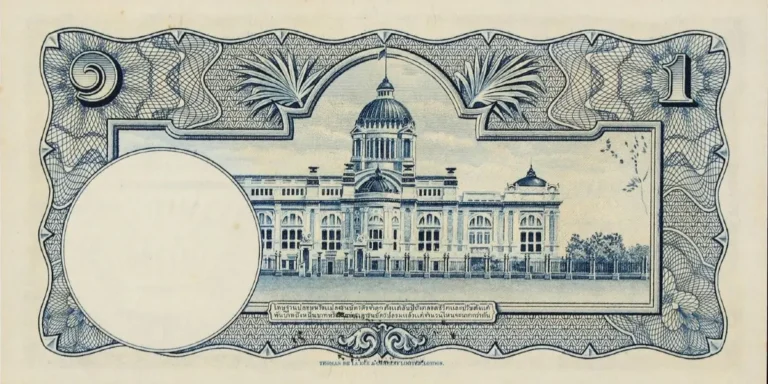
On 10 December 1932, King Prajadhipok was seated on the throne in the Ananta Samakhom Throne Hall when he formally granted the Constitution of the Kingdom of Siam — presented on an ornate ceremonial pedestal tray, reflecting its status as a document of national significance. This pivotal date is celebrated annually as Constitution Day, marking the official beginning of constitutional governance in Thailand. The Hall itself has played a prominent role in Thai banknote design, as detailed in our companion article on Ananta Samakhom Throne Hall: Thai Banknotes & History.
Iconographic Evolution of the Constitution
In traditional Thai culture, a tray with a pedestal — known locally as a Phan — functions as a deeply sacred item reserved for religious, royal, and high-state ceremonies. Crafted from fine metals such as gold, silver, or polished brass, the Phan holds sacred texts, offerings, or objects of supreme reverence when presented to figures of immense authority, Buddhist monks, or members of the royal family. It serves as a visual manifestation of honor, structural respect, and high cosmic order.
During the promulgation ceremony on 10 December 1932, the physical manuscript of the new national charter was elevated upon an ornate pedestal tray before being presented to the King for his royal signature — an act that framed the constitutional text as a gift granted to the populace. This image was later immortalized on a grand civic scale at the Democracy Monument on Bangkok’s Ratchadamnoen Avenue, opened on 24 June 1940 to mark the eighth anniversary of the revolution. It is precisely this icon — the Constitution resting atop its ceremonial Phan — that made a natural transition onto Thailand’s paper currency, becoming one of the most recognizable examples of the Thai constitution on banknotes.
Thai Constitution Watermark
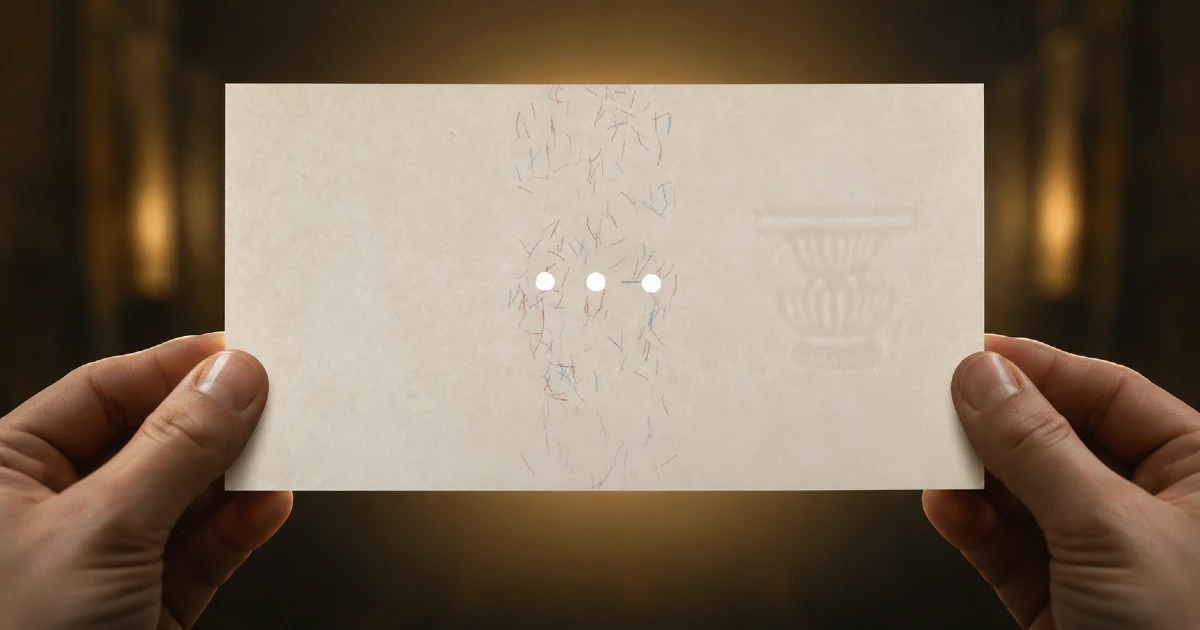
The implementation of the Constitution on a tray with a pedestal as an anti-counterfeiting watermark is one of the most significant security shifts in Thai numismatic history. Prior to 1938, the Series 3 banknotes utilized a watermark featuring Erawan, the mythical three-headed white elephant of Thai royal iconography. By replacing the three-headed elephant with the Constitution watermark, the government broadcast its new political framework directly into the hands of every citizen.
The Constitution watermark era was not a single, unbroken production line, but rather a complex, multi-series evolution cutting through international wartime disruptions, shifting print contracts, and specialized denominational exceptions.
Series 4 (Thomas De La Rue)
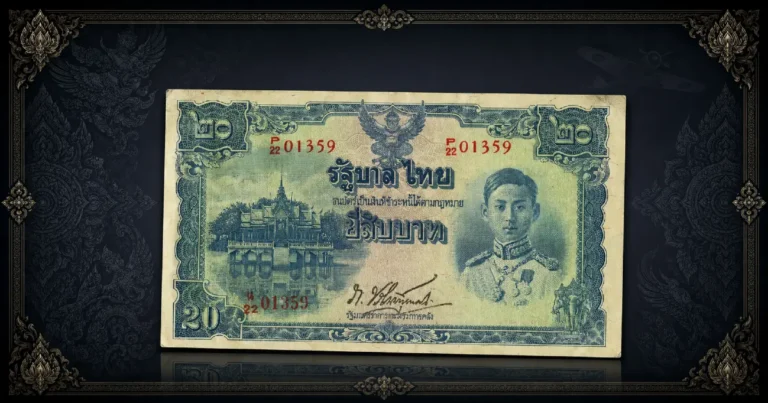
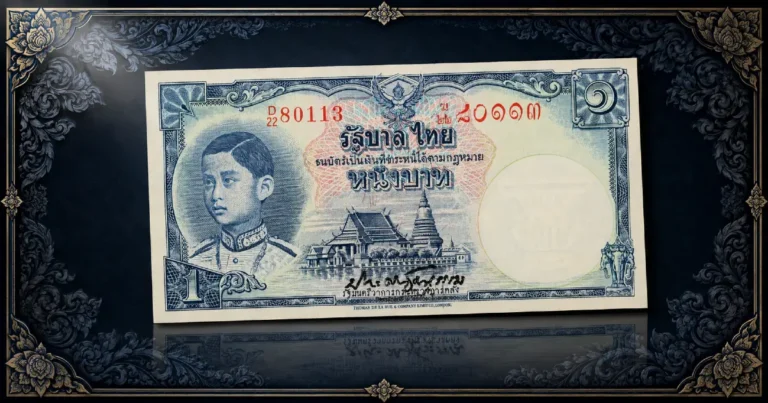
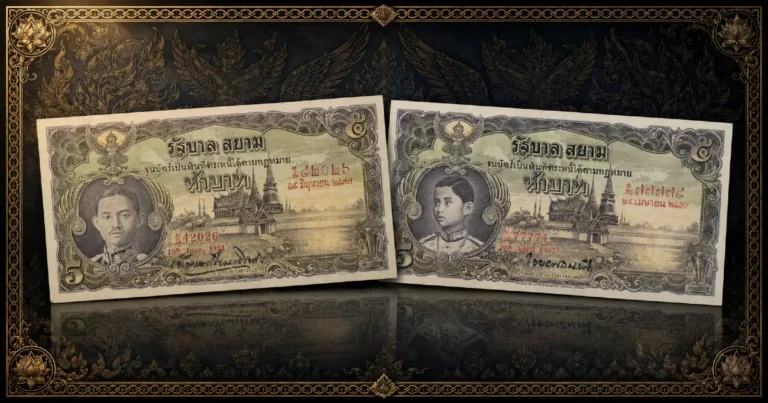
Introduced in 1938, the initial run of Series 4 banknotes was printed in London by Thomas De La Rue & Co. Ltd. These notes featured the portrait of King Ananda Mahidol on the obverse, balanced by a clear watermark window containing the Constitution on a pedestal tray. For collectors, this marks one of the most important early uses of the Constitution watermark on Thai banknotes, establishing the security format that would continue through later wartime and post-war issues.
The Series 4 family contains a vital sub-variety tracking the official renaming of the state. The initial 1938 batches carry the traditional state title “Government of Siam” (Ratthaban Siam). By 1940, as nationalist policies expanded under the military administration of Field Marshal Plaek Phibunsongkhram, the state plates were updated to display the new official title: “Government of Thailand” (Ratthaban Thai). Despite this text shift, the underlying Constitution watermark remained the security core of the paper stock.
Series 4 (Royal Thai Survey Department)
As international shipping channels began to destabilize before the formal outbreak of World War II in the Pacific, the Bank of Thailand authorized the domestic Royal Thai Survey Department to initiate parallel print runs of the Series 4 banknotes using localized plates. These domestic entries maintained the identical structure of the Constitution watermark, although the notes can be immediately differentiated from the TDLR issues in paper density, ink texture, and watermark transparency.
Series 5 (Japanese Print)
Following the entry of Japanese military forces into Thailand in December 1941, direct maritime shipping lines to Thomas De La Rue in London were permanently severed. Facing a critical currency shortage as wartime inflation accelerated, the Thai government transferred its high-security printing contracts to the Japanese Empire. This gave rise to the Series 5 banknotes, manufactured by the Japanese Ministry of Finance Printing Bureau in Tokyo.
Despite facing severe raw material blockades and sharp differences in ink chemistry, Japanese engraving teams reproduced the Constitution on a pedestal tray in their localised watermark molds. However, collectors must note a vital denominational exception within this series: the low-value 50 Satang banknote contains no watermark whatsoever, as it was printed on simplified, low-cost paper pulp.
Series 6 and Series 7 (Local Printings)
As the air war intensified and Allied bombing raids increasingly targeted coastal shipping networks, reliance on transport vessels from Tokyo became unsustainable. The Thai government was therefore forced to mobilize domestic printing capacity, leading to the creation of the Series 6 and Series 7 emergency banknotes. These notes were produced locally under difficult wartime conditions by Thai institutions, using rudimentary commercial paper stocks and operating amid severe material limitations and power shortages. Some varieties are also known with the Constitution watermark, adding an important collecting distinction within these locally printed wartime issues.
Special Series Issues
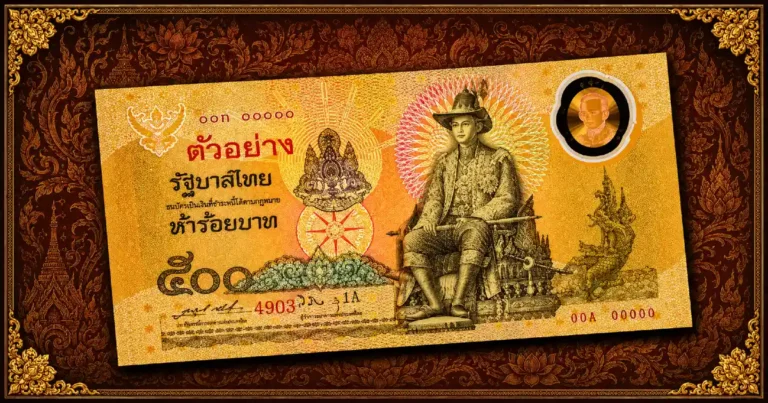
The Constitution watermark appears on both the 1,000 Baht local printing, including the lighter-hued type (Pick 60 / B129) and the darker variety (Pick 61 / B130). Although these notes were produced under difficult wartime conditions by the Royal Thai Survey Department, the use of the Constitution watermark gave them an important symbolic and security element, linking the emergency currency to Thailand’s constitutional identity.
The Thai Constitution watermark was also used on the unissued 1 Dollar notes prepared for the four Malay states returned to Thailand during World War II. These notes were intended for circulation in Si Rat Malai but were never issued as originally planned; instead, the unissued notes were overprinted as 50 Baht notes, with the original dollar denomination obscured by black bars and Thai overprints.
Series 9 Early Printings (Thomas De La Rue)
Introduced in 1948 following the end of World War II, the iconic Series 9 banknotes represent the final and most extensive circulating family to utilize the classic constitutional watermark. Printed back under contract by Thomas De La Rue in London, this series was released in denominations of 1 Baht, 5 Baht, 10 Baht, 20 Baht, and 100 Baht, featuring an elegant portrait of King Bhumibol Adulyadej (Rama 9) on the obverse face.
For the initial nine years of Series 9 production, the Constitution watermark remained active inside the watermark window of the paper stock. However, a major denominational exception must be noted: the initial 50 Satang note was issued completely without a watermark. This configuration was revised in 1957 when the Bank of Thailand retired the Constitution watermark in favour of the King’s portrait.
Temporary Return: 2007 Commemorative 16 Baht Uncut Sheet
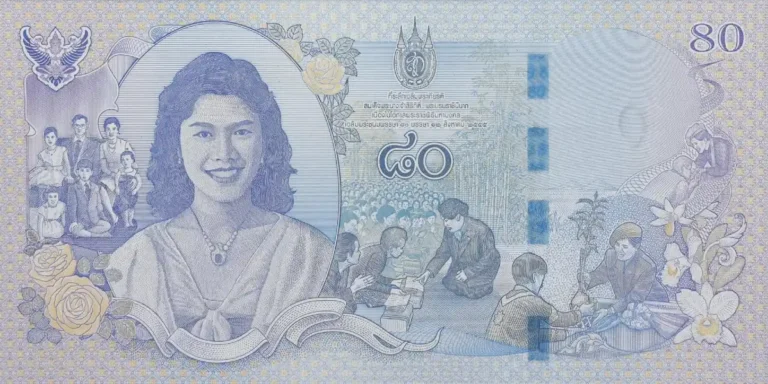
Although the Constitution watermark was retired from regular circulating Thai banknotes after the early Series 9 period, it made a temporary commemorative return in 2007 on the 16 Baht uncut banknote sheet issued for the 80th Birthday Anniversary of King Bhumibol Adulyadej. This special issue combined facsimiles of the old 1, 5, and 10 Baht notes on the front with a large commemorative reverse design celebrating scenes from the King’s life and reign. Its paper included a Constitution-on-phan watermark, making it an important modern tribute to one of Thailand’s most historically significant banknote security motifs.
Thai Constitution Non-Standard Watermark
Wartime resource shortages, chemical blockades, and physical machinery failures forced Thai security engineers to develop non-standard methods for implementing the constitutional symbol on currency when traditional paper-mold watermarks were impossible to produce.
The 1942 1 Baht Embossed Variety (Pick 58 / BNB B127)
One of the most famous technical anomalies occurred during the 1942 domestic emergency run managed by the Royal Thai Survey Department. Facing a total shortage of pre-watermarked security paper for the 1 Baht Special Series banknote, engineers designed a specialized mechanical stamping apparatus mounted directly onto the finishing press.
Instead of embedding a watermark inside the wet paper pulp, this machine physically pressed a highly detailed embossed raised image of the Constitution on a tray with a pedestal directly onto the finished, dry paper stock. This created a tactile, raised stamp that merchants could physically feel with their fingertips to verify the note’s authenticity, representing a solution during a time of extreme wartime resource scarcity.
The Printed Watermark Varieties
When watermarked paper stocks bearing the Constitution ran completely dry, banknote printers utilized another technical substitution: using lithographic ink plates to print a visible line illustration of the Constitution on a pedestal tray directly onto the designated watermark window area of alternative paper stocks. This process produced several distinct collector varieties across multiple series:
- Series 4 (Royal Thai Survey Department): On select varieties of the 10 Baht banknote, printers utilized alternative paper carrying a simple, generic wavy line watermark. To ensure the note carried the mandatory state symbol, they overprinted a detailed, visible printed constitution on phan motif directly over the banknote.
- Series 5 (Japanese Prints): A variety of the 5 Baht banknote featuring a distinct alternative reverse color matrix incorporates a custom printed constitution on phan emblem applied directly onto the reverse watermark field.
- Series 6 (Domestic Emergency Issues): On certain varieties of both the 20 Baht and 100 Baht banknotes, printers faced a total lack of security paper. They substituted generic paper stocks carrying a simple wavy line watermark and overprinted the highly detailed printed constitution motif directly across the window area.
- Series 7 (Local Commercial Contracts): Introduced in 1945 and printed by various local commercial sub-contractors, most banknotes were manufactured using basic wavy line watermark paper stocks, over-layered with a highly visible printed constitution typographic stamp to validate their release.
Thai Constitution as a Surface Vignette
As the nation emerged from World War II, the Ministry of Finance updated its currency designs to move the Thai Constitution on banknotes out of hidden watermark fields and directly onto visible surface plates.
Reverse Design: Series 8 (Tudor Press)
To secure production lines that war-torn domestic presses could no longer sustain, Thailand looked across the Atlantic, awarding a high-security printing contract to the Tudor Press based in Boston, Massachusetts. The technical finishing phases—including precision cutting, serial numbering, and secure vault packing—were managed by the United States Bureau of Engraving and Printing (BEP) in Washington, D.C.
Unlike many of the earlier series which depicted the Ananta Samakhom Throne Hall on the reverse, this post-war series moved the Constitution from the hidden watermark field onto the visible reverse plate — a deliberate design shift that reinforced its role in Thailand’s civic identity.
Obverse Design: 50 Satang of Series 9
When the Bank of Thailand unveiled the elegant Series 9 circulating family in 1948, they introduced a low-value fractional 50 Satang banknote. Unlike its high-value counterparts that hid the pedestal icon inside the watermark windows, this fractional bill moved the icon directly onto the front face of the currency.
The obverse of the 50 Satang places the Constitution on the pedestal tray as the central design element — ensuring the constitutional symbol remained visible to everyday users even on a low-value note without a watermark window.
Catalog Matrix: Thai Constitution on banknotes
The following catalog index provides a streamlined, uniform reference tracking every major appearance of the Thai Constitution on banknotes.
| Series | Denomination | Printer | Iconographic Field Placement |
|---|---|---|---|
| Series 4 (Siam) | 1, 5, 10, 20, 1000 Baht | Thomas De La Rue | Watermark |
| Series 4 (Thai) | 1, 5, 10, 1000 Baht | Thomas De La Rue | Watermark |
| Series 4 (Thai) | 1, 10, 20, 100 Baht | Royal Thai Survey Dept. | Watermark |
| Series 4 (Thai) | 10 Baht | Royal Thai Survey Dept. | Wavy Line Wmk + Printed Constitution on wmk window |
| Series 5 | 1, 5, 10, 20, 100, 1000 Baht | Japanese Ministry | Watermark |
| Series 5 | 5 Baht (Alternate color reverse) | Japanese Ministry | Printed Constitution on wmk window (reverse) |
| Series 6 | 20, 100 Baht | Royal Thai Survey Dept. | Watermark |
| Series 6 | 20, 100 Baht | Royal Thai Survey / Naval Hydrographic Dept. | Wavy Line Wmk + Printed Constitution |
| Series 7 | 10 Baht | Local Sub-Contractors | Watermark |
| Series 7 | 1, 5, 10, 50 Baht | Local Sub-Contractors | Wavy Line Stock + Printed Constitution on wmk window |
| Series 8 | 1, 5, 10, 20, 100 Baht | Tudor Press | Reverse Vignette |
| Special Series | 1 Baht | Royal Thai Survey Dept. | Embossed stamp in wmk window |
| Special Series | 1000 Baht | Royal Thai Survey Dept. | Watermark |
| Special Series | Si Rat Malai 1 Dollar / 50 Baht overprint notes | Royal Thai Survey Dept. | Watermark |
| Series 9 | 50 Satang | Thomas De La Rue | Obverse Vignette |
| Series 9 (Early Printings) | 1, 5, 10, 20, 100 Baht | Thomas De La Rue | Watermark |
| Commemorative | 16 Baht (uncut sheet) | Note Printing Works | Watermark |
The Legacy of the Thai Constitution on Banknotes
The visual chronicle of the Constitution of Thailand on banknotes stands as a vivid testament to a nation managing the competing pressures of political modernization and national identity formation. For nearly twenty years — from the first deployment of the Constitution watermark in 1938 through the Bank of Thailand’s retirement of the motif in 1957 — the image stood as the defining motif of Thai paper currency. It served not merely as a high-security watermark to deter counterfeiters, but as a daily civic reminder of a new political era founded upon codified law and shared popular sovereignty.
As political climates evolved and power dynamics centered back around the traditional prestige of the monarchy, the constitutional watermark naturally yielded its place to royal portraiture. Yet, for dedicated numismatists and paper money specialists, these vintage banknotes remain far more than fiscal relics — they are primary historical documents recording a kingdom’s transition to constitutional governance. The Constitution on a Phan is also one of the most rewarding banknote collecting themes in Asian numismatics: a single motif pursued across series, printers, wartime substitutions, and commemorative revivals.
Whether you are hunting for the embossed emergency issues of 1942, a clean reverse engraving from the post-war Tudor Press run, or a rare Series 9 overlap variety, you are preserving the rich legal, political, and cultural legacy of a nation permanently shaped by its founding charter.