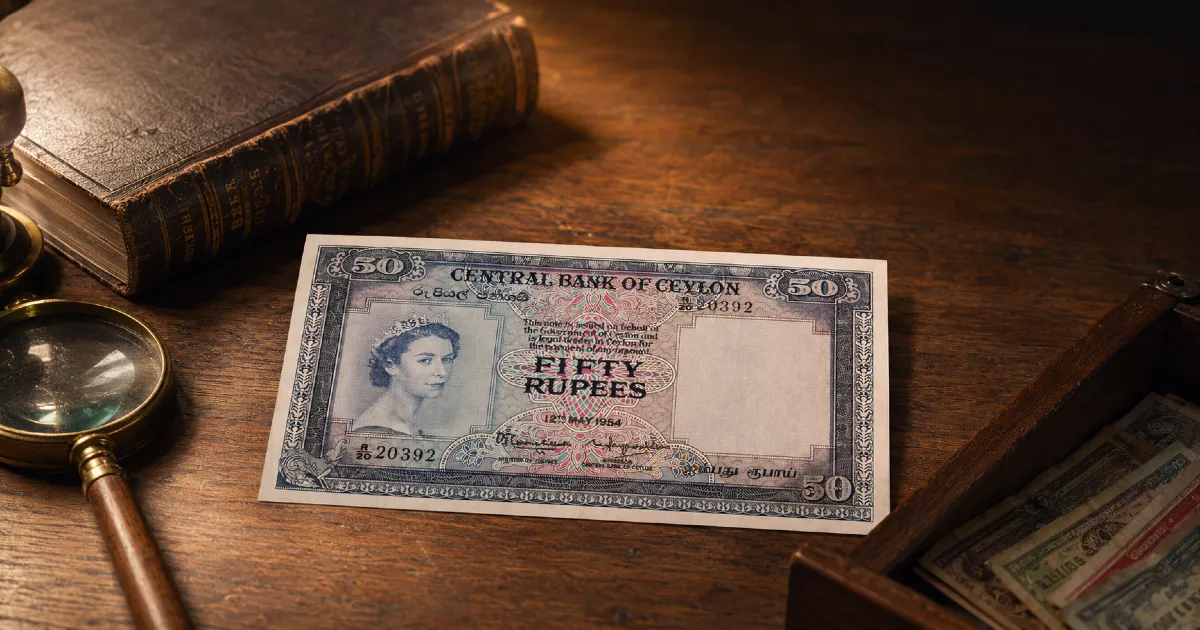
Queen Elizabeth II Ceylon Banknotes form a short but important series in the history of Ceylon paper money. Issued by the Central Bank of Ceylon between 1952 and 1954, these notes were the first Ceylon banknotes to feature the portrait of Queen Elizabeth II and among the earliest circulating banknotes in the world to show the young Queen.
The series followed the 1951 King George VI Central Bank of Ceylon issues, of which only the 1 rupee and 10 rupees notes were released into circulation. After the death of King George VI on 6 February 1952, Ceylon quickly introduced a new portrait series using Queen Elizabeth II’s image. The first Queen Elizabeth II Ceylon Banknotes entered circulation on 3 June 1952, one year before her coronation.
For collectors, this is a compact and well-defined series. It includes six denominations: 1 rupee, 2 rupees, 5 rupees, 10 rupees, 50 rupees, and 100 rupees. Across these denominations, there are 12 main varieties based on date, signature combination, and color changes.
The series is especially interesting because it combines Commonwealth portraiture with local Ceylonese design elements. The obverse shows Queen Elizabeth II based on the Dorothy Wilding portrait, while the reverse designs feature historic and cultural subjects such as moonstones, guard stones, Medirigiriya pillars, Sigiriya frescoes, and the statue of King Parakramabahu.
Table of Contents
What Are Queen Elizabeth II Ceylon Banknotes?
Queen Elizabeth II Ceylon Banknotes are Central Bank of Ceylon issues, produced during the early reign of the Queen. The Central Bank of Ceylon, now known as the Central Bank of Sri Lanka, was responsible for issuing these notes. They were printed by Bradbury, Wilkinson & Co., and issued in the early 1950s.
The series includes the following denominations: 1 Rupee, 2 Rupees, 5 Rupees, 10 Rupees, 50 Rupees, and 100 Rupees.
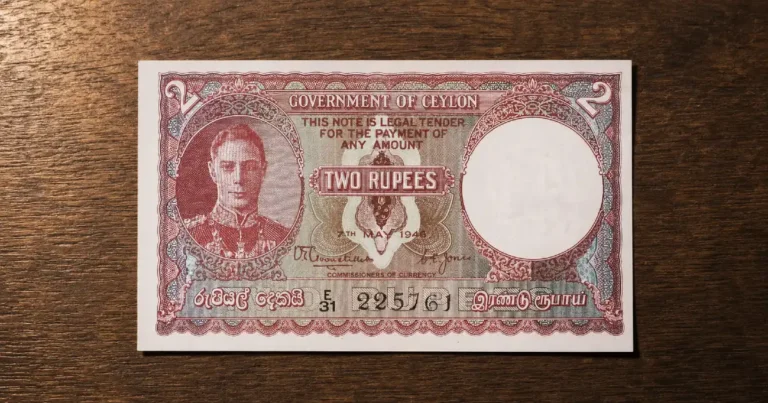
These notes replaced the short-lived King George VI Central Bank of Ceylon portrait series. They retained much of the same general design framework, including the Central Bank of Ceylon title, trilingual text in English, Sinhala, and Tamil, local reverse imagery, and the Ratanapura lion watermark.
A QEII Ceylon Note can usually be identified by four major features: the portrait of Queen Elizabeth II on the left side of the front, the Central Bank of Ceylon issuing authority, the Ratanapura lion watermark, and the reverse design showing a Ceylonese cultural or archaeological subject.
The series is not large, but it has several important varieties. Some denominations exist in both 1952 and 1954 versions. The 5 rupee note is especially important because the 1954 issue changed color to reduce confusion with the 2 rupee note. Date, signature, and prefix range are therefore essential for correct identification.
Ceylon Banknotes in the Elizabeth II Era
The Central Bank of Ceylon began operations on 28 August 1950 under the Monetary Law Act No. 58. Its first banknote series, dated 1951, still featured King George VI. That issue was intended to include more denominations, but only the 1 rupee and 10 rupees notes were issued into circulation before the king’s death.
Queen Elizabeth II became monarch on 6 February 1952. Ceylon then moved quickly to prepare and release new notes carrying her portrait. The first Queen Elizabeth II Ceylon Banknotes were issued on 3 June 1952. This timing is significant because it came before the Queen’s official coronation in June 1953.
Ceylon is widely credited by Commonwealth banknote specialists as the first country to issue circulating banknotes bearing Queen Elizabeth II’s portrait, predating issues from other Commonwealth nations by months. This gives the series importance beyond Ceylon paper money alone. It also makes the notes relevant to Commonwealth collectors, portrait-note collectors, and collectors of early Elizabeth II currency.
The series circulated during a period of political and cultural transition. Ceylon was still a Dominion within the Commonwealth, but national identity was becoming increasingly important in public institutions, currency design, language policy, and government symbols. Within only a few years, later Ceylon banknotes would move away from British monarch portraits and adopt national emblem designs.
For that reason, Queen Elizabeth II Ceylon Banknotes represent both a beginning and an ending. They were the first Commonwealth notes with Queen Elizabeth II, but they were also the last Ceylon banknotes to use a British monarch portrait.
Queen Elizabeth II Portrait and Design
The portrait used on Queen Elizabeth II Ceylon Banknotes was based on the well-known Dorothy Wilding photographic portrait of the young Queen. Wilding’s portraits became some of the most familiar early images of Queen Elizabeth II and were widely adapted for stamps, coins, and banknotes across the Commonwealth.
On the Ceylon notes, Queen Elizabeth II appears facing slightly forward-left and wearing Queen Mary’s Girls of Great Britain and Ireland tiara. The portrait is placed on the left side of the obverse, replacing the King George VI portrait used on the earlier 1951 Central Bank issues.
The notes retained a formal Central Bank layout. The issuer appears as Central Bank of Ceylon, with value text and legal tender wording arranged around the central design. English, Sinhala, and Tamil inscriptions appear on the notes, reflecting Ceylon’s multilingual currency tradition.
The notes include printed signatures of the Minister of Finance and the Governor of the Central Bank of Ceylon. These signature pairs vary by date and are important for identifying the different Queen Elizabeth II Ceylon note varieties.
The reverse designs feature local cultural and archaeological subjects. These include Polonnaruwa moonstone steps, Medirigiriya Vatadage pillars, the statue of King Parakramabahu, a guard stone motif, Anuradhapura steps, and Sigiriya fresco imagery.
Bradbury Wilkinson Printing
Queen Elizabeth II Ceylon Banknotes were printed by Bradbury, Wilkinson & Co., one of the major British security printing firms of the period. This gives the series a different production context from the India Security Press issues used for many earlier Government of Ceylon notes.
Security Features
The main security feature on Queen Elizabeth II Ceylon Banknotes is the Ratanapura lion watermark. It shows a lion standing on its hind legs, facing left, and holding a bent whip. The series does not include a security thread, which is useful to note when identifying and authenticating these early 1950s issues.
The Ratanapura lion watermark was also used in the preceding King George VI Ceylon issues. It should not be confused with the later sword-bearing lion associated with the modern Sri Lankan flag and national emblem. The Ratanapura lion belongs to an older Ceylonese heraldic tradition and is an important diagnostic feature for collectors.
For a broader explanation of how watermarks, threads, and other features are used to protect paper money, see our guide to banknote security features.
1952 and 1954 QEII Ceylon Note Varieties
Queen Elizabeth II Ceylon Banknotes can be divided into two main date groups: the first release of 1952–1953 and the later 1954 varieties.
The first group includes 1 rupee, 2 rupees, 5 rupees, 50 rupees, and 100 rupees notes dated 3 June 1952, and the 10 rupees dated 1 July 1953. These notes carry earlier signature combinations and represent the first Elizabeth II portrait notes issued by Ceylon.
The 3 June 1952 notes are signed by Junius Richard Jayewardene as Minister of Finance and John Exter as Governor. The 1 July 1953 10 rupees note is signed by Junius Richard Jayewardene as Minister of Finance and Neville Ubeysin-gha Jayawardena as Governor.
The second group includes notes dated 12 May 1954 or 16 October 1954. These later issues carry different signature combinations and, in the case of the 5 rupees, an important color change.
The 12 May 1954 notes are signed by Oliver Ernest Goonetilleke as Minister of Finance and Neville Ubeysin-gha Jayawardena as Governor. The 16 October 1954 notes are signed by M. D. H. Jayawardena as Minister of Finance and Arthur Godwin Ranasinha as Governor.
The 5 rupees note is the most obvious design change in the series. The 1952 5 rupees note was printed in purple, orange, and green. According to numismatic accounts, confusion with the 2 rupees note in everyday use prompted the Central Bank to change the 1954 5 rupees note to red, orange, and green.
QEII Ceylon Banknotes Reference Table
The table below summarizes the issued varieties in the Queen Elizabeth II Ceylon Banknotes series. 1 rupee and 10 rupees Queen Elizabeth II Ceylon Banknotes continue the numbering sequence from the issued 1951 King George VI Central Bank of Ceylon notes.
| Denomination | Date | Pick Number | BNB Number | Prefix Range |
|---|---|---|---|---|
| 1 Rupee | 3 June 1952 | Pick 49 | B303a | A/31 – A/42 |
| 1 Rupee | 16 October 1954 | Pick 49 | B303b | A/43 – A/67 |
| 2 Rupees | 3 June 1952 | Pick 50 | B304a | E/1 – E/15 |
| 2 Rupees | 16 October 1954 | Pick 50 | B304b | E/16 – E/27 |
| 5 Rupees | 3 June 1952 | Pick 51 | B305 | G/1 – G/10 |
| 5 Rupees | 16 October 1954 | Pick 54 | B306 | G/11 – G/18 |
| 10 Rupees | 1 July 1953 | Pick 55 | B307a | L/21 – L/30 |
| 10 Rupees | 16 October 1954 | Pick 55 | B307b | L/31 – L/45 |
| 50 Rupees | 3 June 1952 | Pick 52 | B308a | R/1 – R/15 |
| 50 Rupees | 12 May 1954 | Pick 52 | B308b | R/16 – R/25 |
| 100 Rupees | 3 June 1952 | Pick 53 | B309a | V/1 – V/20 |
| 100 Rupees | 16 October 1954 | Pick 53 | B309b | V/21 – V/30 |
1 Rupee QEII Ceylon Note
- Catalog Classifications: Pick 49 / BNB B303
- Dimensions: 110 x 60 mm
- Primary Colors: Blue, orange, and green
- Obverse Design: Queen Elizabeth II portrait on the left
- Reverse Design: Moonstone steps from the Polonnaruwa Vatadage with guard stones
- Date and Prefixes:
- 3 June 1952: A/31 – A/42
- 16 October 1954: A/43 – A/67
Collectors should distinguish between the 1952 and 1954 varieties by checking the date, signature combination, and prefix range. The 1952 issue belongs to the first release of Queen Elizabeth II Ceylon Banknotes, while the 1954 issue belongs to the later printing group.
2 Rupees QEII Ceylon Note
- Catalog Classifications: Pick 50 / BNB B304
- Dimensions: 120 x 66 mm
- Primary Colors: Brown, violet, and green
- Obverse Design: Queen Elizabeth II portrait on the left
- Reverse Design: Lotus stem pillars of the Medirigiriya Vatadage in Polonnaruwa
- Date and Prefixes:
- 3 June 1952: E/1 – E/15
- 16 October 1954: E/16 – E/27
The violet tones of the 2 rupee notes are cited as a contributing factor to confusion with the original 1952 5 rupee notes — one reason the 5 rupee color was changed in 1954.
5 Rupees QEII Ceylon Note
- Catalog Classifications: Pick 51 / BNB B305; Pick 54 / BNB B306
- Dimensions: 133 x 72 mm
- Primary Colors:
- 1952 issue: Purple, orange, and green
- 1954 issue: Red, orange, and green
- Obverse Design: Queen Elizabeth II portrait on the left
- Reverse Design: Statue of King Parakramabahu I near Pothgul Vehera in Polonnaruwa
- Date and Prefixes:
- 3 June 1952: G/1 – G/10
- 16 October 1954: G/11 – G/18
The 5 rupees note is one of the most important Queen Elizabeth II Ceylon Banknotes because it exists in two clearly different color types. The first 1952 issue was printed in purple, orange, and green. The later 1954 issue changed to red, orange, and green. This creates two major varieties that collectors should identify separately.
10 Rupees QEII Ceylon Note
- Catalog Classifications: Pick 55 / BNB B307
- Dimensions: 147 x 79 mm
- Primary Colors: Green and purple
- Obverse Design: Queen Elizabeth II portrait on the left
- Reverse Design: Guard stone showing naga-raja
- Date and Prefixes:
- 1 July 1953: L/21 – L/30
- 16 October 1954: L/31 – L/45
Unlike the 1, 2, 5, 50, and 100 rupee notes, the first 10 rupee Queen Elizabeth II issue is dated 1 July 1953 rather than 3 June 1952 — the only denomination in the series without a 3 June 1952 first issue.
50 Rupees QEII Ceylon Note
- Catalog Classifications: Pick 52 / BNB B308
- Dimensions: 157 x 88 mm
- Primary Colors: Blue and red
- Obverse Design: Queen Elizabeth II portrait on the left
- Reverse Design: Moonstone and stone steps at Anuradhapura
- Date and Prefixes:
- 3 June 1952: R/1 – R/15
- 12 May 1954: R/16 – R/25
The 50 rupees note’s second issue is dated 12 May 1954 — distinct from the 16 October 1954 date used for the 1, 2, 5, and 100 rupee notes — and carries the Goonetilleke/Ubeysin-gha Jayawardena signature pair rather than the Jayawardena/Ranasinha pair used on the October notes.
100 Rupees QEII Ceylon Note
- Catalog Classifications: Pick 53 / BNB B309
- Dimensions: 170 x 98 mm
- Primary Colors: Brown and violet
- Obverse Design: Queen Elizabeth II portrait on the left
- Reverse Design: Sigiriya fresco showing two women holding lotus flowers
- Date and Prefixes:
- 3 June 1952: V/1 – V/20
- 16 October 1954: V/21 – V/30
At 100 rupees, this is the highest denomination issued in the series, making it a key piece for type and date-set collectors.
Specimen and Color Trial QEII Ceylon Notes
Beyond the issued circulation varieties, Queen Elizabeth II Ceylon banknotes also exist as specimen notes and color trials produced by Bradbury, Wilkinson & Co. These non-circulating pieces were made for printer records, institutional reference, presentation, or approval-related purposes, rather than for everyday use.
Specimen examples may carry SPECIMEN overprints, specimen perforations, all-zero serial numbers, or other markings showing that they were not intended for circulation. Color trials show denominations printed in alternative color schemes that were not adopted for general issue, offering a rare glimpse into the design and approval process behind the series.
Known color trial examples include the 1 rupee in green, 2 rupees in violet, 5 rupees in olive green, 10 rupees in brown, 50 rupees in purple, and 100 rupees in green. These trial colors should be treated separately from the issued circulation colors and are generally of interest to advanced collectors.
For a broader explanation of how specimen notes differ from issued banknotes, see our specimen banknote guide.
Why QEII Ceylon Banknotes Matter
Queen Elizabeth II Ceylon Banknotes are a compact but historically important series in South Asian and Commonwealth paper money. Issued between 1952 and 1954, they represent the first Ceylon notes to feature Queen Elizabeth II and the final Ceylon notes to carry a British monarch portrait — a position that marks both the end of one design tradition and the start of another. By the mid-1950s, Ceylon’s currency design policy was shifting away from British royal portraiture toward national symbols, with the official coat of arms of Ceylon, including the lion holding a sword, replacing the monarch portrait in later series. The Queen Elizabeth II series therefore sits at a genuine turning point in Ceylonese currency design, reflecting the country’s broader political and cultural transition during this period.
The series is attractive to collectors because it is clearly defined. Six denominations were issued, and the main varieties can be identified by date, signature pair, and prefix range. The notes combine the Dorothy Wilding portrait of Queen Elizabeth II with distinctive Ceylonese reverse designs, including Polonnaruwa, Medirigiriya, Anuradhapura, Sigiriya, and traditional guard stone imagery.
The 1954 5 rupees color change is especially important, while the 50 and 100 rupees notes are key higher-denomination pieces. The Ratanapura lion watermark, Bradbury Wilkinson printing, and Central Bank of Ceylon issuing authority give the series strong technical and historical identity — making it a benchmark issue in mid-20th century Asian numismatics, whether collected as a type set, Commonwealth portrait series, early Elizabeth II issue, or Ceylon paper money group.