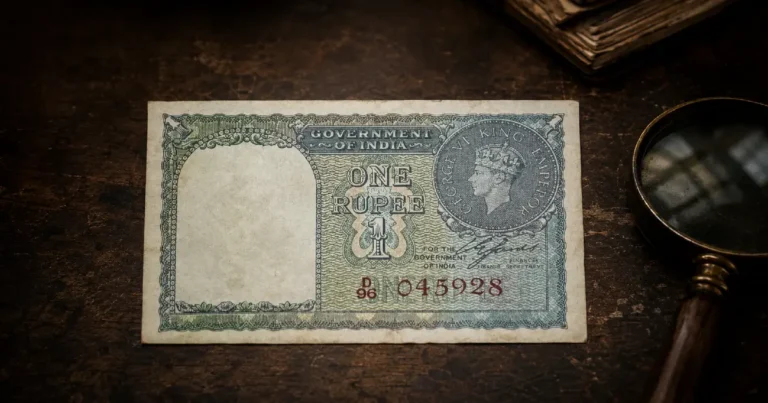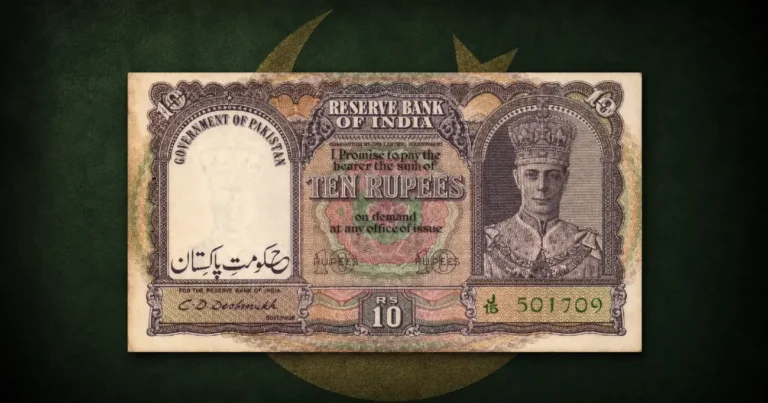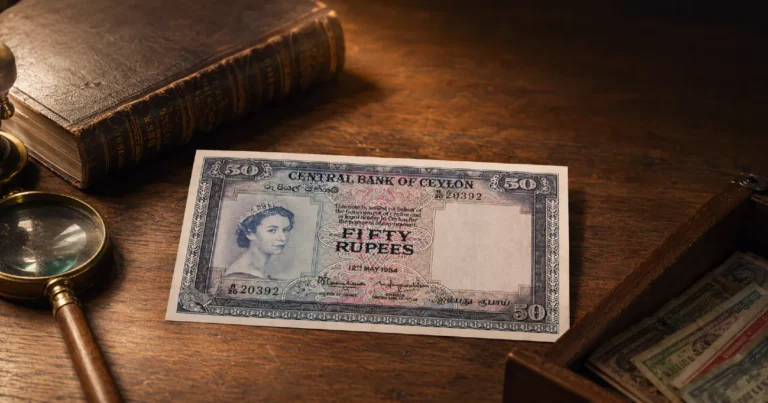
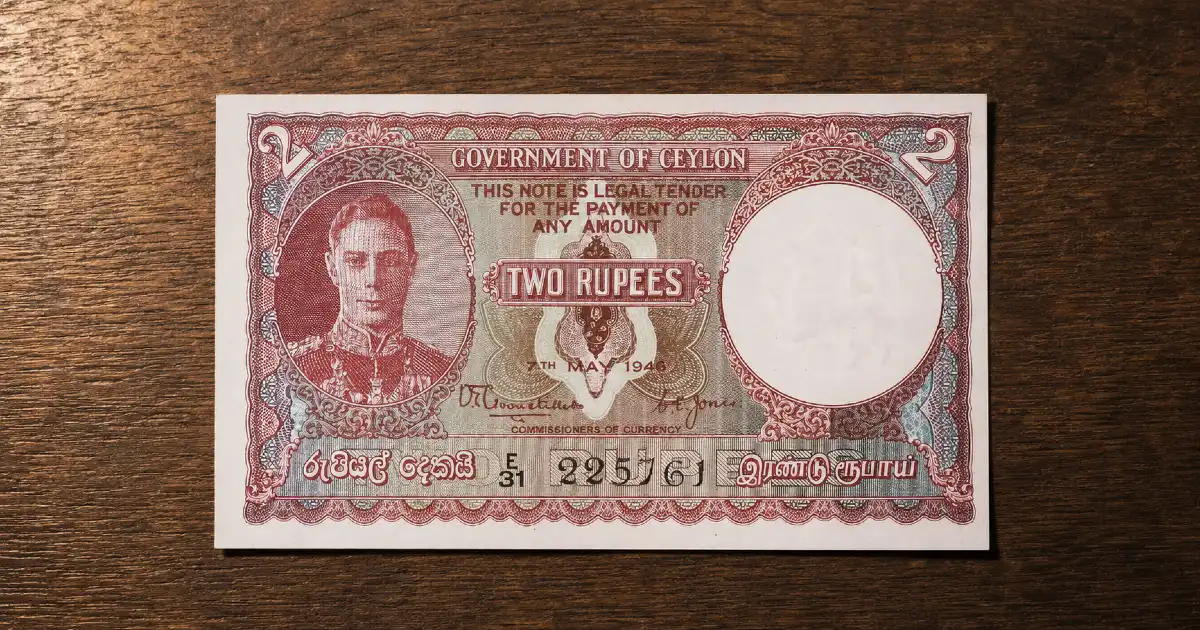
King George VI Ceylon banknotes form one of the most documented and actively collected groups of mid-20th century Ceylon paper money. Issued during the final decade of British rule and the early years of Ceylon’s monetary transition, these notes cover wartime emergency currency, Government of Ceylon issues, high-denomination treasury notes, and the first Central Bank of Ceylon issues.
The period from 1941 to 1951 was especially significant because Ceylon’s currency system transitioned away from its earlier ties to Indian monetary administration and toward a more independent national framework. World War II created shortages of coins and disrupted normal currency supply. At the same time, Ceylon’s paper money designs became more localized, using regional imagery, local security features, and distinct inscription styles.
For collectors, King George VI Ceylon banknotes are valuable because they include several identifiable varieties. These include emergency postal card fractional notes, India Security Press issues, booklet-perforated notes, high-denomination treasury notes, Bradbury Wilkinson printed Central Bank of Ceylon issues, and unissued Ceylon banknotes known mainly through archival proofs.
This guide explains the main King George VI Ceylon banknotes from 1941 to 1951, including catalogue references, design features, watermark details, denominations, prefix ranges, unissued varieties, and authentication points. It is intended as a practical reference for collectors studying Ceylon paper money from the late colonial and early central bank period.
Table of Contents
What Are King George VI Ceylon Banknotes?
King George VI Ceylon banknotes are paper money issues produced for Ceylon during the reign of King George VI. The main collecting period runs from the early 1940s through the first Central Bank of Ceylon issues of 1951.
These notes were issued under two main authorities:
- Government of Ceylon
- Central Bank of Ceylon
The Government of Ceylon issues include wartime fractional notes, 1 rupee to 10,000 rupees denominations, and several important varieties printed by the India Security Press. The later Central Bank of Ceylon issues were printed by Bradbury, Wilkinson & Co. and represent the beginning of Ceylon’s modern central bank note series.
King George VI Ceylon banknotes are collected for their historical importance, design variety, security paper, prefix ranges, signatures, and condition rarity. Some denominations were issued into circulation, while others are known only as unissued Ceylon banknotes, archival proofs, or specimen material.
1941 – 1951 Ceylon Paper Money History
The 1941–1951 period was a transitional decade for Ceylon paper money. The Second World War placed pressure on currency supply, shipping routes, coin availability, and security printing arrangements. These conditions affected the choice of printer, the materials used, and the timing of new note issues.
Ordinance No. 21 of 1941 was an important monetary development. It helped formalize changes in Ceylon’s currency system and supported a more distinct local monetary framework. During this period, Ceylon paper money increasingly moved away from reliance on earlier regional monetary arrangements and developed its own identity.
The India Security Press played a major role in wartime and post-war Ceylon banknote production. Several Government of Ceylon issues were printed there, including circulating rupee notes and high-denomination notes. These issues used detailed designs, local scenes, and the distinctive Ratanapura lion watermark.
The final stage of the King George VI period came with the 1951 Central Bank of Ceylon issues. These notes were printed by Bradbury, Wilkinson & Co. and marked the start of a new issuing authority. Only the 1 rupee and 10 rupees notes from the planned 1951 Central Bank series entered circulation, while other denominations remained unissued.
The Ratanapura Lion Watermark
The Ratanapura lion watermark is one of the most important security features on King George VI Ceylon banknotes. It appears on the security paper used for many Ceylon issues from this period and is a key authentication point for collectors.
The watermark shows a stylized lion standing on its hind legs and facing left. The lion holds a bent whip in its right paw. This design is derived from the historic Royal Kandy period flag and should not be confused with the sword-bearing lion used on the modern Sri Lankan flag.
For collectors, the Ratanapura lion watermark matters for three reasons. First, it helps confirm that the note was printed on the correct security paper. Second, it helps separate genuine notes from crude reproductions or altered pieces. Third, it connects the banknotes to a specifically Ceylonese visual tradition rather than a generic colonial security design.
When examining King George VI Ceylon banknotes, collectors should check the watermark under backlighting. The lion should appear clearly within the paper structure, not as a surface impression, stain, or printed imitation.
This Ratanapura lion structure debuted across the standard circulating issues from 1941 onwards. While the final 1951 Central Bank series saw only the 1 Rupee and 10 Rupee values fully authorized and released into commercial circulation, a complete planned set of watermarked security papers spanning the 1, 2, 5, 10, 50, and 100 Rupee denominations was successfully manufactured by Portals.
If such unprinted watermark sheets survive in archival or institutional collections, they would offer physical evidence of the broader denominational series originally planned before only two values entered circulation.
1938 Pre-War Trial Notes
Before the main wartime issues, there were 1938 pre-war trial notes connected to proposed Ceylon currency designs. These pieces are of particular interest to advanced collectors because they document design proposals that predate the circulating King George VI Ceylon banknotes of the 1940s.
The known 1938 trial formats include 10 rupees and 50 rupees designs carrying the printed date 1st July 1938. They are generally associated with archival specimens, proof material, dummy signatures, and all-zero serial number formats.
These notes were not released for public circulation. They should therefore be treated as unissued Ceylon banknotes or archival proof material rather than circulating currency. Their importance lies in showing the design development that preceded the later issued notes.
King George VI Ceylon Banknotes Reference Table
The following table summarizes the main King George VI Ceylon banknotes from the Government of Ceylon period and the 1951 Central Bank of Ceylon series.
Government of Ceylon Issues (1941–1949)
| Denomination | Primary Inscription Text | Pick Number | BNB Number |
|---|---|---|---|
| 10 Cents | The Government of Ceylon | Pick 43 | B237 |
| 25 Cents | The Government of Ceylon | Pick 44 | B238 |
| 50 Cents | The Government of Ceylon | Pick 45 | B239 |
| 1 Rupee | The Government of Ceylon… Promises … | Pick 30 | B221 |
| 1 Rupee | Government of Ceylon … This Note … | Pick 34 | B226 |
| 2 Rupees | The Government of Ceylon… Promises … | Pick 31 | B222 |
| 2 Rupees | Government of Ceylon … This Note … | Pick 35 | B227 |
| 5 Rupees | The Government of Ceylon… Promises … | Pick 32 | B223 |
| 5 Rupees | Government of Ceylon … This Note … | Pick 36 | B228 |
| 10 Rupees | The Government of Ceylon… Promises … | Pick 33 | B224 |
| 10 Rupees | Government of Ceylon … This Note … | Pick 36A | B229 |
| 50 Rupees | Government of Ceylon … This Note … | Pick 37 | B230 |
| 100 Rupees | Government of Ceylon … This Note … | Pick 38 | B231 |
| 1,000 Rupees | Government of Ceylon … This Note … | Pick 39 | B232 |
| 10,000 Rupees | Government of Ceylon … This Note … | Pick 39A | B233 |
Central Bank of Ceylon Issues (1951 Series)
| Denomination | Status | Pick Number | BNB Number |
|---|---|---|---|
| 1 Rupee | Issued | Pick 47 | B301 |
| 2 Rupees | Unissued | Unlisted | B301.2 |
| 5 Rupees | Unissued | Unlisted | B301.5 |
| 10 Rupees | Issued | Pick 48 | B302 |
| 50 Rupees | Unissued | Unlisted | B302.2 |
| 100 Rupees | Unissued | Unlisted | B302.5 |
1941 The Government of Ceylon Banknotes
The first issued group of King George VI Ceylon banknotes carries the front inscription “THE GOVERNMENT OF CEYLON PROMISES TO PAY THE BEARER ON DEMAND THE SUM OF…”. These notes were printed by the India Security Press and represent the early rupee issues of the King George VI period.
Although wartime conditions later made regional production especially important, the India Security Press connection should not be treated simply as a sudden wartime substitute. Known 1938 specimen and trial material with India Security Press attribution shows that plans for ISP-printed KGVI Ceylon banknotes existed before the main 1941 issued series. The 1941 issues therefore sit within a broader pre-war and wartime production framework.
This group includes the 1, 2, 5, and 10 rupees denominations. Some dates of the 1, 2, and 5 rupees notes are known with perforated left edges because they were originally bound in booklets and could be torn out when needed.
1 Rupee KGVI Ceylon Note
- Catalog Classifications: Pick 30 / BNB B221
- Dimensions: 114 x 64 mm
- Primary Colors: Violet, olive green, and blue
- Obverse Design: King George VI portrait on the left
- Reverse Design: Elephant, mahout, and palm tree scene
- Watermark: Ratanapura lion on hind legs holding a whip
- Signatures: H.J. Huxham & C.H. Collins
- Date: 1 February 1941
- Prefixes: A/1 – A/11
This KGVI Ceylon note variety was later replaced by the revised legal tender wording used on Pick 34 / BNB B226.
2 Rupees KGVI Ceylon Note
- Catalog Classifications: Pick 31 / BNB B222
- Dimensions: 127 x 76 mm
- Primary Colors: Violet and brown
- Obverse Design: King George VI portrait on the left
- Reverse Design: Sigiriya Rock, lake, and trees
- Signatures: H.J. Huxham & C.H. Collins
- Date: 1 February 1941
- Prefixes: E/1 – E/4
This King George VI Ceylon banknote was later replaced by the revised legal tender wording used on Pick 35 / BNB B227.
5 Rupees KGVI Ceylon Note
- Catalog Classifications: Pick 32 / BNB B223
- Dimensions: 140 x 89 mm
- Primary Colors: Brown, blue, and violet
- Obverse Design: King George VI portrait on the left
- Reverse Design: Thuparama Dagoba with lotus stem pillars
- Signatures: H.J. Huxham & C.H. Collins
- Date: 1 February 1941
- Prefixes: G/1 – G/4
Collectors should distinguish it from the later Pick 36 / BNB B228 5 rupees issue, which has different legal tender wording.
10 Rupees KGVI Ceylon Note
- Catalog Classifications: Pick 33 / BNB B224
- Dimensions: 152 x 102 mm
- Primary Colors: Blue, violet, and green
- Obverse Design: King George VI portrait on the left
- Reverse Design: Paththirippuwa, or octagon building, at the Temple of the Sacred Tooth Relic in Kandy
- Signatures: H.J. Huxham & C.H. Collins
- Date: 1 February 1941
- Prefixes: J/1 – J/4
This King George VI Ceylon banknote should be separated from the later Pick 36A / BNB B229 10 rupees issue, which uses the revised legal tender inscription.
1941–1949 Government of Ceylon Banknotes
The next major group of King George VI Ceylon banknotes carries the revised front inscription “GOVERNMENT OF CEYLON THIS NOTE IS LEGAL TENDER FOR THE PAYMENT OF ANY AMOUNT.” The easiest visual way to separate this group from the earlier BNB B221 to B224 notes is the wording at the top of the note: the earlier group begins with “THE GOVERNMENT OF CEYLON,” while this later group omits the word “THE” and begins simply with “GOVERNMENT OF CEYLON.”
This revised legal tender wording reflects the currency changes introduced under Ordinance No. 21 of 1941, which regulated Ceylon’s currency system and helped separate the Ceylon rupee from its earlier link with the Indian rupee.
These notes were printed by the India Security Press and include the main circulating rupee denominations from 1 rupee to 10,000 rupees. Some dates of the 1, 2, and 5 rupees notes are known with perforated left edges because they were bound in booklets and could be torn out when needed.
1 Rupee KGVI Ceylon Note
- Catalog Classifications: Pick 34 / BNB B226
- Dimensions: 114 x 64 mm
- Primary Colors: Violet, olive green, and blue
- Obverse Design: King George VI portrait on the left
- Reverse Design: Elephant, mahout, and palm tree scene
| BNB | Date | Signatures | Prefixes |
|---|---|---|---|
| B226a | 20 December 1941 | Huxham & Collins | A/11 – A/19 |
| B226b | 19 September 1942 | Huxham & Collins | A/19 – A/34 |
| B226c | 4 August 1943 | Huxham & Collins | A/34 – A/42 |
| B226d | 12 July 1944 | Huxham & Collins | A/42 – A/52 |
| B226e | 24 June 1945 | Goonetilleke & Collins | A/53 – A/63 |
| B226f | 7 May 1946 | Goonetilleke & Jones | A/63 – A/71 |
| B226g | 1 March 1947 | Goonetilleke & Jones | A/71 – A/81 |
| B226h | 1 June 1948 | Jones & Perera | A/81 – A/91 |
| B226i | 1 March 1949 | Jones & Perera | A/91 – B/8 |
2 Rupees KGVI Ceylon Note
- Catalog Classifications: Pick 35 / BNB B227
- Dimensions: 127 x 76 mm
- Primary Colors: Violet and brown
- Obverse Design: King George VI portrait on the left
- Reverse Design: Sigiriya Rock, lake, and trees
| BNB | Date | Signatures | Prefixes |
|---|---|---|---|
| B227a | 20 December 1941 | Huxham & Collins | E/4 – E/8 |
| B227b | 19 September 1942 | Huxham & Collins | E/8 – E/13 |
| B227c | 4 August 1943 | Huxham & Collins | E/13 – E/18 |
| B227d | 12 July 1944 | Huxham & Collins | E/18 – E/24 |
| B227e | 24 June 1945 | Goonetilleke & Collins | E/24 – E/30 |
| B227f | 7 May 1946 | Goonetilleke & Jones | E/31 – E/34 |
| B227g | 1 March 1947 | Goonetilleke & Jones | E/34 – E/40 |
| B227h | 1 June 1948 | Jones & Perera | E/40 – E/46 |
| B227i | 1 March 1949 | Jones & Perera | E/46 – E/56 |
5 Rupees KGVI Ceylon Note
- Catalog Classifications: Pick 36 / BNB B228
- Dimensions: 140 x 89 mm
- Primary Colors: Brown, blue, and violet
- Obverse Design: King George VI portrait on the left
- Reverse Design: Thuparama Dagoba with lotus stem pillars
| BNB | Date | Signatures | Prefixes |
|---|---|---|---|
| B228a | 20 December 1941 | Huxham & Collins | G/4 – G/7 |
| B228b | 19 September 1942 | Huxham & Collins | G/7 – G/12 |
| B228c | 4 August 1943 | Huxham & Collins | G/12 – G/19 |
| B228d | 12 July 1944 | Huxham & Collins | G/20 – G/29 |
| B228e | 24 June 1945 | Goonetilleke & Collins | G/30 – G/36 |
| B228f | 7 May 1946 | Goonetilleke & Jones | G/37 – G/40 |
| B228g | 1 March 1947 | Goonetilleke & Jones | G/40 – G/41 |
| B228h | 1 June 1948 | Jones & Perera | G/41 – G/45 |
| B228i | 1 March 1949 | Jones & Perera | G/45 – G/47 |
10 Rupees KGVI Ceylon Note
- Catalog Classifications: Pick 36A / BNB B229
- Dimensions: 152 x 102 mm
- Primary Colors: Blue, violet, and green
- Obverse Design: King George VI portrait on the left
- Reverse Design: Paththirippuwa, or octagon building, at the Temple of the Sacred Tooth Relic in Kandy
| BNB | Date | Signatures | Prefixes |
|---|---|---|---|
| B229a | 20 December 1941 | Huxham & Collins | J/4 – J/5 |
| B229b | 19 September 1942 | Huxham & Collins | J/5 – J/10 |
| B229c | 4 August 1943 | Huxham & Collins | J/10 – J/16 |
| B229d | 12 July 1944 | Huxham & Collins | J/16 – J/26 |
| B229e | 24 June 1945 | Goonetilleke & Collins | J/26 – J/36 |
| B229f | 7 May 1946 | Goonetilleke & Jones | J/36 – J/44 |
| B229g | 1 June 1948 | Jones & Perera | J/44 – J/47 |
50 Rupees KGVI Ceylon Note
- Catalog Classifications: Pick 37 / BNB B230
- Dimensions: 165 x 114 mm
- Primary Colors: Mauve, brown, green, and blue
- Obverse Design: King George VI portrait on the left
- Reverse Design: Farmers and water buffalo plowing a paddy field
| BNB | Date | Signature | Prefixes |
|---|---|---|---|
| B230a | 1 September 1941 | Huxham & Collins | K/1 |
| B230b | 19 September 1942 | Huxham & Collins | K/2 |
| B230c | 4 August 1943 | Huxham & Collins | K/2 – K/3 |
| B230d | 12 July 1944 | Huxham & Collins | K/3 – K/7 |
| B230e | 24 June 1945 | Goonetilleke & Collins | K/7 – K/20 |
100 Rupees KGVI Ceylon Note
- Catalog Classifications: Pick 38 / BNB B231
- Dimensions: 175 x 125 mm
- Primary Colors: Green, orange, pink, and blue
- Obverse Design: King George VI portrait on the left
- Reverse Design: Laxapana Waterfall
| BNB | Date | Signatures | Prefixes |
|---|---|---|---|
| B231a | 1 September 1941 | Huxham & Collins | L/1 |
| B231b | 4 August 1943 | Huxham & Collins | L/1 – L/2 |
| B231c | 12 July 1944 | Huxham & Collins | L/2 – L/3 |
| B231d | 24 June 1945 | Goonetilleke & Collins | L/3 – L/19 |
| B231e | 1 March 1947 | Goonetilleke & Jones | L/19 – L/21 |
1,000 Rupees KGVI Ceylon Note
- Catalog Classifications: Pick 39 / BNB B232
- Dimensions: 192 x 140 mm
- Primary Colors: Mauve, blue, and green
- Obverse Design: King George VI portrait on the left
- Reverse Design: Coastal scene with sailboat approaching a palm-lined beach
| BNB | Date | Signatures | Prefixes |
|---|---|---|---|
| B232a | 1 September 1941 | Huxham & Collins | M/1 |
| B232b | 12 July 1944 | Huxham & Collins | M/1 – M/2 |
10,000 Rupees KGVI Ceylon Note
- Catalog Classifications: Pick 39A / BNB B233
- Dimensions: 192 x 140 mm
- Primary Colors: Green, brown, purple, blue, and orange
- Obverse Design: King George VI portrait on the left
- Reverse Design: Kandy Lake with mountains, buildings, trees, and clouds
| BNB | Date | Signatures | Prefix |
|---|---|---|---|
| B233a | 15 October 1947 | Jones & Perera | O/1 |
1942 Emergency Issues
The 1942 emergency issues were created in response to a wartime shortage of small-denomination coins. These low-denomination notes were printed on paper or card stock originally associated with rubber coupons or postal-style use. They were printed by Ceylon Government Press.
5 Cents Emergency Note
- Catalog Classifications: Pick 42 / BNB B234
- Dimensions: 85 x 58 mm
- Primary Colors: Black and blue-gray
- Obverse Design: 2-cent and 3-cent postcard-style images including King George VI in profile
- Reverse Design: Blank with serial number
- Signatures: H.J. Huxham & C.H. Collins
- Prefixes: A through G
- Varieties:
- Without vertical center perforation
- With vertical center perforation for separating into 2-cent and 3-cent units
The 5 cents B234 is notable among King George VI Ceylon banknotes for its perforated dual-denomination format. The vertical perforation variety allowed the note to be separated into 2-cent and 3-cent units, making it a practical response to coin shortages.
25 Cents Emergency Note
- Catalog Classifications: Pick 40 / BNB B235
- Dimensions: 88 x 60 mm
- Primary Colors: Green and black
- Obverse Design: Central 25 cents value panel
- Reverse Design: Blank
- Signature: H.J. Huxham & C.H. Collins
- Prefixes: A/1 to A/4
Collectors should distinguish this emergency 25 cents note from the later 1942–1949 fractional 25-cent note.
50 Cents Emergency Note
- Catalog Classifications: Pick 41 / BNB B236
- Dimensions: 88 x 60 mm
- Primary Colors: Green and black
- Obverse Design: Central 50 cents value panel
- Reverse Design: Blank
- Signature: H.J. Huxham & C.H. Collins
- Prefixes: A/1 – A/4
Collectors should distinguish this emergency 50 cents note from the later 1942–1949 fractional 50-cent note.
1942–1949 Fractional Issues
The 1942–1949 fractional issues were low-denomination notes printed by the India Security Press to ease the wartime shortage of coins. This group includes 10 cents, 25 cents, and 50 cents denominations.
10 Cents KGVI Ceylon Note
- Catalog Classifications: Pick 43 / BNB B237
- Dimensions: 96 x 55 mm
- Primary Colors: Blue, violet, and green
- Obverse Design: King George VI portrait at the center
- Reverse Design: Serial number only
| BNB | Date | Signatures | Prefixes |
|---|---|---|---|
| B237a | 1 February 1942 | Huxham & Collins | A/1 – A/30 |
| B237b | 14 July 1942 | Huxham & Collins | A/30 – A/60 |
| B237c | 23 December 1943 | Huxham & Collins | A/61 – A/74 |
25 Cents KGVI Ceylon Note
- Catalog Classifications: Pick 44 / BNB B238
- Dimensions: 102 x 51 mm
- Primary Colors: Brown and violet
- Obverse Design: King George VI portrait at center
- Reverse Design: Serial number only
| BNB | Date | Signatures | Prefixes |
|---|---|---|---|
| B238a | 1 February 1942 | Huxham & Collins | A/1 – A/22 |
| B238b | 14 July 1942 | Huxham & Collins | A/23 – A/46 |
| B238c | 7 May 1946 | Goonetilleke & Jones | A/47 – A/51 |
| B238d | 1 March 1947 | Goonetilleke & Jones | A/52 – A/57 |
| B238e | 1 June 1948 | Jones & Perera | A/57 – A/61 |
| B238f | 1 December 1949 | Jones & Perera | A/61 – A/68 |
50 Cents KGVI Ceylon Note
- Catalog Classifications: Pick 45 / BNB B239
- Dimensions: 109 x 57 mm
- Primary Colors: Violet, blue, and green
- Obverse Design: King George VI portrait on the left
- Reverse Design: Serial number only
| BNB | Date | Signatures | Prefixes |
|---|---|---|---|
| B239a | 1 February 1942 | Huxham & Collins | A/1 – A/17 |
| B239b | 14 July 1942 | Huxham & Collins | A/17 – A/33 |
| B239c | 7 May 1946 | Goonetilleke & Jones | A/33 – A/38 |
| B239d | 1 June 1948 | Jones & Perera | A/38 – A/47 |
| B238e | 1 December 1949 | Jones & Perera | A/48 – A/50 |
1951 Central Bank of Ceylon Issues
The 1951 Central Bank of Ceylon issues marked a major shift in Ceylon paper money. These notes were issued under the newly established Central Bank of Ceylon and printed by Bradbury, Wilkinson & Co.
Only the 1 rupee and 10 rupees notes were released into circulation. Because King George VI died on 6 February 1952, these notes represent the final issued Ceylon banknotes bearing his portrait before later designs featuring Queen Elizabeth II.
1 Rupee KGVI Central Bank of Ceylon Note
- Catalog Classifications: Pick 47 / BNB B301
- Date: 20 January 1951
- Dimensions: 110 x 60 mm
- Primary Colors: Blue, orange, and green
- Obverse Design: King George VI portrait on left
- Reverse Design: Moonstone steps from the Polonnaruwa Vatadage with guard stones
- Signature: J.R. Jayewardene & J. Exter
- Prefixes: A/1 – A/30
10 Rupees KGVI Central Bank of Ceylon Note
- Catalog Classifications: Pick 48 / BNB B302
- Date: 20 January 1951
- Dimensions: 147 x 79 mm
- Primary Colors: Green and purple
- Obverse Design: King George VI portrait on the left
- Reverse Design: Guard stone with naga-raja
- Signature: J.R. Jayewardene & J. Exter
- Prefixes: L/1 – L/20
Unissued 1951 Central Bank of Ceylon Notes
The planned 1951 Central Bank of Ceylon series also included 2, 5, 50, and 100 rupees denominations that were not issued for public circulation. These are generally known from archival proofs, specimens, or unconfirmed proof material.
These unissued King George VI Ceylon banknotes, listed in the Banknote Book, are specialized archival material rather than normal circulation issues. They should not be grouped with issued notes unless clearly described as proofs or specimens.