The Si Rat Malai currency — prepared by Thailand for the four occupied northern Malay states of Kedah, Perlis, Kelantan, and Terengganu during World War II — is one of the more closely studied anomalies in Southeast Asian numismatics. The Thai administrative name translates as “Four Malay States,” and the territory’s brief existence produced a distinct set of occupation banknotes and coins now considered rare survivors of the period.
The planned currency regime was never fully executed in its intended territory, blocked by the Japanese military command and overtaken by the territory’s return to British administration in 1945. What remains is significant for variety specialists: the unissued Thai 1 Dollar banknote, its emergency repurposing into the domestic 50 Baht overprint series, and a corresponding run of fractional tin coins, together documenting Thailand’s attempt to assert monetary authority over the territory during its brief administration.
Table of Contents
Geopolitical Context: The Birth of Si Rat Malai
The Si Rat Malai currency cannot be separated from the territorial history that preceded it. The four northern Malay states changed hands twice in the first half of the twentieth century: first ceded by Siam to Britain in 1909, then returned to Thailand by Japan in 1943 as a reward for wartime alliance. The sections below trace that sequence — from the original cession, through Thailand’s 1941 alliance with Japan, to the formal transfer of administrative control — establishing the political conditions under which the unissued 1 Dollar note and its later 50 Baht overprints were produced.
The Legacy of the Anglo-Siamese Treaty of 1909
To understand the political motivations behind the Si Rat Malai currency, it helps to look back to the territorial re-configurations of the early twentieth century. For generations, the northern Malay states of Kedah, Perlis, Kelantan, and Terengganu existed under the suzerainty of the Kingdom of Siam. During the reign of King Chulalongkorn (King Rama V), Siam faced sustained pressure from European colonial powers expanding their interests throughout Southeast Asia.
In a diplomatic maneuver to safeguard the independence of the Siamese heartland, the royal government signed the Anglo-Siamese Treaty of 1909. Under the terms of this international accord, Siam officially ceded all suzerain rights, administrative titles, and territorial claims over Kedah, Perlis, Kelantan, and Terengganu to Great Britain.
The British absorbed these territories into their colonial network, designating them as the Unfederated Malay States (UFMS) within British Malaya. The treaty established what is now the modern border between Thailand and Malaysia. Within Thailand’s nationalist military and political establishment, the cession was later characterized as a concession forced by colonial pressure — a grievance that would shape Thai foreign policy in the lead-up to the Japanese alliance.
The Japanese Invasion and the Phibunsongkhram Alliance
The geopolitical landscape of Southeast Asia shifted in December 1941. In a series of amphibious landings and land-based assaults launched the same day as the attack on Pearl Harbor, imperial Japanese forces invaded the coastal areas of Thailand and British Malaya. Facing Japan’s military superiority, the Thai government, led by Prime Minister Field Marshal Plaek Phibunsongkhram, quickly adjusted its foreign policy to ensure national survival.
On 21 December 1941, Thailand signed a formal offensive-defensive alliance pact with the Empire of Japan. This accord granted Japanese forces unhindered military transit through Thai territory, transforming the kingdom into a staging ground for Japanese campaigns against British assets in Burma and Malaya
For Phibunsongkhram’s administration, the alliance was viewed not merely as a defensive compromise to avert a Japanese occupation, but as an opportunity to reclaim lost territory. By aligning with Japan, Thailand aimed to roll back the borders set by earlier colonial treaties and restore its pre-1909 territorial extent.
The Transfer of Administrative Control (1943)
As the Pacific War progressed, Japan sought to keep the Thai government firmly committed to the alliance. As a reward for Thailand’s logistical support and its declaration of war against the Allied powers, Japanese Prime Minister Hideki Tojo visited Bangkok in July 1943 and announced that several occupied British territories would be returned to Thai administration. The formal transfer agreement was signed the following month, on 20 August 1943, between Prime Minister Phibunsongkhram and the Japanese ambassador.
On 18 October 1943, the four northern Malay states were formally detached from the Japanese military administration of Malaya and absorbed into the domestic governance structure of Thailand under the collective legal title of Si Rat Malai. Within the updated Thai administrative registry, the four states were renamed to reflect their historical Thai designations:
- Kedah became Syburi
- Perlis became Palit
- Kelantan became Kalantan
- Terengganu became Trangkanu
The Thai government established the regional capital of this newly acquired territory at Alor Setar (the historical seat of Kedah), placing it under the oversight of civil governors and military administrators dispatched directly from Bangkok. This territorial absorption remained in place for nearly two years — outlasting Phibunsongkhram’s own government, which fell in August 1944 — until Japan’s surrender led to the return of the four states to British administration on 2 September 1945.
The Sovereign Fiscal Strategy of Si Rat Malai
When the Thai civil administration assumed responsibility for governance within Si Rat Malai, they were immediately confronted with a fractured and highly inflationary monetary environment. The local population was accustomed to utilizing the British Malayan Dollar, a stable currency backed by sterling reserves. Following the British retreat, the Japanese military had flooded the local marketplaces with their own provisional fiat money, widely known as Japanese Invasion Money (JIM) or “banana notes,” denominated in dollars and cents.
The Thai Ministry of Finance sought to integrate the economy of the four states into Bangkok’s financial system without alienating local merchants. The Thai Baht was unfamiliar to the population of northern Malaya, and forcing its immediate adoption risked marketplace resistance, hoarding, and a sharp drop in trade.
Pragmatically, the Thai authorities chose to maintain the familiar currency denominations of the territory while asserting their political authority over its manufacture. They devised a two-part currency system:
- Paper Currency: A baseline 1 Dollar banknote designed to satisfy primary transactions and wholesale trade.
- Fractional Token Coinage: A series of minor decimal coins denominated in 1 Cent, 5 Cents, and 10 Cents to facilitate micro-transactions and change-making in daily market stalls.
By retaining the “Dollar” and “Cent” nomenclatures, the Thai government aimed to engineer a seamless economic transition for local citizens while embedding unambiguous symbols of Thai statehood across the face of the money. This strategy was designed to challenge the dominance of Japanese military currency and assert Thai administrative authority over the region.
Master Reference Matrix: Pick and BNB Numbers
To provide variety specialists, numismatists, and type set collectors with an instant, structured overview of the entire monetary footprint of this historic occupied territory, the following reference matrix maps out the unissued original formats alongside the subsequent emergency overprint varieties and token coinage:
| Denomination | Face Text / Overprint Configuration | Pick Catalog Number | Banknote Book (BNB) |
|---|---|---|---|
| 1 Dollar | Original Multilingual Base Design; No Overprints | Pick R1 | B133r |
| 50 Baht | Horizontal black ห้าสิบบาท (50 baht) ovpt on หนึ่งดอลลาร์ (1 dollar) at center front | Pick 62B | B133d-f |
| 50 Baht | Red 50 ovpt in watermark circle front; black bar ovpts front | Pick 62B | B133c |
| 50 Baht | Red 50 ovpt in watermark circle front/back; black bar ovpts front/back | Pick 62B | B133a-b |
The Unissued Thai 1 Dollar Banknote
The primary paper instrument designed for the territory was the Thai One Dollar banknote, manufactured under wartime security conditions in Bangkok. Conceived during a global war, its production faced severe material limitations, which shaped its graphic execution and resulted in the absence of complex security fibers.
Dimensions, Coloration, and Paper Stock
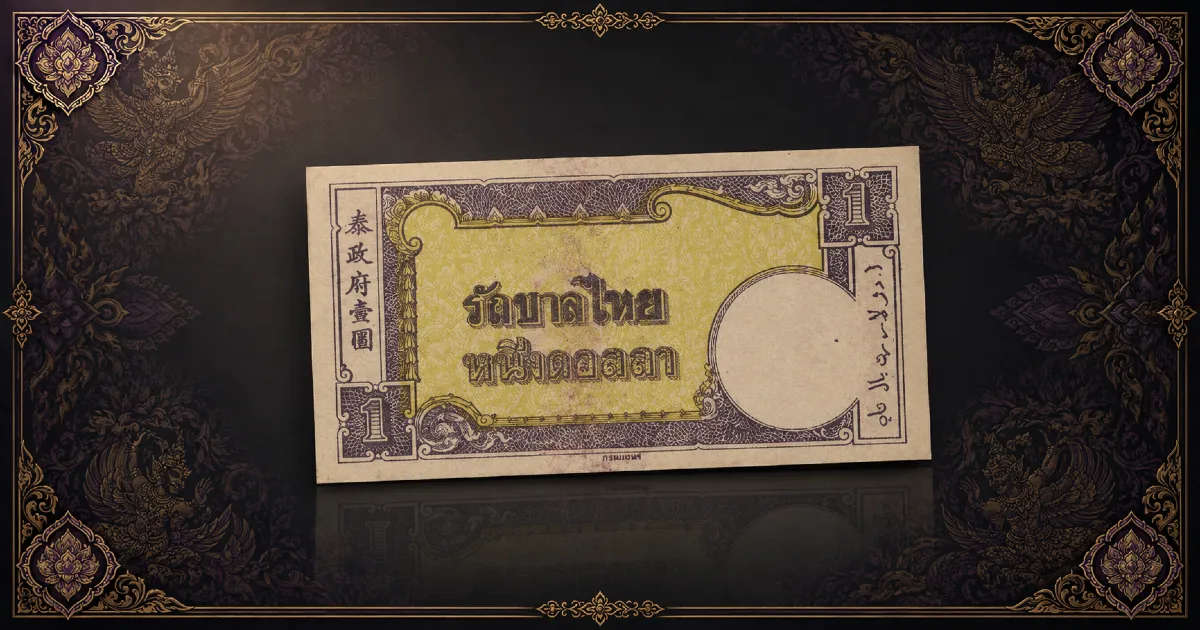
The Thai 1 Dollar note was printed on paper measuring 125 x 65 mm. The obverse uses a mauve-and-yellow color scheme, underlaid by fine lithographic safety tints intended to deter basic counterfeiting.
The paper chosen for the run was standard security stock featuring an embedded watermark displaying the constitution-on-pedestal tray motif, a highly symbolic icon introduced following the 1932 Siamese Revolution. The note was manufactured completely without embedded security threads or complex silk fibers.
The Multilingual Typography and Literacy Architecture
To serve the diverse population of the northern Malay states, the Thai Ministry of Finance implemented a multilingual text layout on the face of the currency. The main text block running across the top center front of the note features the prominent Thai language inscription: “รัฐบาลไทย หนึ่งดอลลาร์” (Ratthaban Thai Nueng Dollar), translating directly to “Thai Government One Dollar.”
Recognizing that regional trade was driven largely by Chinese merchants and Malay-speaking communities, the designers added two translation blocks beneath the core Thai inscription:
- Chinese Script Block: Rendered in traditional characters for clarity among the retail banking networks and merchant communities of the urban centers.
- Jawi Script Block: Written in Arabic characters adapted for the Malay language, intended to ensure legibility and acceptance among the rural agrarian populations of the provinces.
This inclusive multilingual strategy was not an entirely new development in Thai numismatic history. A similar approach had previously been used on the Series 1 banknotes issued by the Siamese state in 1902 during the reign of King Rama V.
Printer Imprints and Reverse Iconography
The physical production of the Thai 1 Dollar note was assigned to the master printers of the Royal Thai Survey Department (RTSD) in Bangkok, who had assumed responsibility for domestic currency production after international supply lines to Thomas De La Rue in London were severed. To record their manufacture, a clear printer imprint line reading “กรมแผนที่” (Krom Phaenthi – Royal Thai Survey Department) was engraved at the bottom margin of both the obverse and reverse plates.
For the reverse design, the artists relied on a familiar architectural silhouette to maintain graphic continuity with existing Thai currency. The reverse centerpiece features a detailed rendering of the Ananta Samakhom Throne Hall in Bangkok, showcasing its neoclassical European marble dome and grand symmetrical flanking arches.
This vignette had already appeared on Thailand’s Series 4 banknotes and the emergency Special Series 1 Baht issues of 1942. Its inclusion on the Malaya dollar note placed a recognizable symbol of Bangkok’s governance directly into the hands of Malay citizens.
Archetypes of Availability: Proofs, Specimens, and Remainders
Because Japanese military authorities ultimately blocked the introduction of these notes to preserve their own military currency monopoly, the completed stock remained held inside government vaults. Today, paper money variety specialists identify three distinct archetypes of this unissued currency:
- Archival Proofs: Struck on heavy cardboard or un-watermarked paper sheets, used during early plate alignment checks.
- Specimen Banknotes: Complete notes featuring the standard serial number configuration of 00000, typically featuring an overprint or perforation indicating their archival status.
- Unissued Remainders: Pristine, completed banknotes that retain the full base design but lack any serial number, overprint, or ministerial signature. Because these sheets were never signed off by the sitting Minister of Finance, the signature lines remain empty.
The 50 Baht Emergency Overprints
The history of the unissued Malayan Dollar notes does not end in a government storage vault. Instead, the end of the Si Rat Malai administrative arrangement led to one of the more notable emergency currency issues in domestic Thai history: the 50 Baht overprinted banknote series, catalogued as BNB B133 (Pick 62B).
The Economic Crisis of Bangkok (1944–1945)
By late 1944, the domestic economy of Thailand was facing a severe monetary crisis. The presence of Japanese military forces in the country had driven sharp inflation. Japanese forces continuously demanded large credit allocations from the Bank of Thailand to fund troop movements and fortification construction. To satisfy these demands, the Thai government was forced to flood the domestic market with new paper currency.
This expansion of the money supply pushed the production capacity of the Royal Thai Survey Department to its limit. Sourcing premium banknote paper from the Kanchanaburi Paper Mill had become increasingly difficult due to a scarcity of chemicals and coal. Furthermore, high-grade security inks were completely exhausted.
Bangkok was struck by an urgent currency shortage, particularly for high-value denominations needed to complete standard commercial transactions without requiring large sacks of low-value 1 Baht notes. The unissued stockpiles of the mauve and yellow 1 Dollar notes represented a valuable, unused reservoir of high-grade, pre-watermarked security paper that was already fully printed.
The Pragmatic Choice to Overprint
To save significant production time, conserve remaining inks, and bypass the papermaking process entirely, the Treasury Department authorized an emergency repurposing program. The unissued Malaya 1 Dollar sheets were transferred to domestic presses to be overprinted with a completely new denomination: 50 Baht.
This process lets the government produce a high-value domestic note quickly. Rather than destroying the Thai one dollar banknote, the original design elements — including the Chinese and Jawi text blocks — were obliterated or covered using contrasting ink stamps. This produced the sub-varieties of BNB B133 that are sought after by modern variety collectors today.
Typological Variety Breakdown: Sub-Types 1, 2, and 3
The emergency overprinting process was executed in multiple distinct production batches under deteriorating industrial conditions, resulting in three major variety classes recognized across international catalogs:
50 Baht Variety 1 (BNB B133d–f): The Horizontal Black Overprint
This variety uses the simplest overprint design in the emergency series. The overprinting process focused strictly on changing the legal face value while leaving the majority of the original Malayan background visible.
- Obverse Modifications: A single, bold horizontal line of black Thai text reading “ห้าสิบบาท” (Ha Sip Baht – Fifty Baht) is stamped directly across the center front of the note, positioned squarely over the original “One Dollar” English and Thai indicators.
- Reverse Modifications: None. The reverse face remains completely unaltered.
50 Baht Variety 2 (BNB B133c): The Multi-Stamp Obliteration
As the Treasury Department sought to minimize confusion in domestic marketplaces, they realized that leaving the Malayan dollar text visible could lead to errors. This led to the more intricate Variety 2 layout, which used multiple contrasting color stamps to systematically obscure the original design.
- The Red Value Circle: A large, solid red numeral “50” is printed inside the circular field reserved for inspecting the watermark on the front left side.
- The Black Deletion Bars: Heavy, solid black bars are stamped horizontally over the original “One Dollar” text blocks and the “$1” numeric symbols on the front face, completely blocking them from view.
- The Red Text Stamp: A prominent, stylized red inscription reading “ห้าสิบบาท” (Fifty Baht) is stamped across the center front.
- The Royal Garuda Seal: A solid red overprint of the Royal Garuda emblem is added to the upper center front, officially asserting domestic Thai state authority over the repurposed paper stock.
- Reverse Modifications: None. The reverse remains un-overprinted.
50 Baht Variety 3 (BNB B133a-b): The Dual-Sided Overprint
The final, most complex variety emerged during the chaotic closing weeks of the war. To ensure that these emergency notes could not be altered or misunderstood from either side, the presses were updated to execute a comprehensive, two-sided overprint pattern.
- Obverse Modifications: This run utilizes the exact same multi-stamp configuration as Variety 2, featuring the red “50” circle, the black horizontal deletion bars over the dollar indicators, and the red Garuda seal on the upper margin.
- Reverse Modifications: Unlike its predecessors, Variety 3 applies the overprint plates directly to the reverse side as well. Heavy black horizontal deletion bars are stamped across the “$1” symbols and English text frames flanking the corners of the Throne Hall engraving. Additionally, an identical large red numeral “50” is stamped cleanly into the matching reverse watermark window field.
The Fractional Decimal Tin Coins
To complement the paper 1 Dollar note, the Thai administration in Si Rat Malai planned a corresponding coin series to handle lower-value transactions. While the banknotes retained the British “Dollar” name, the coinage utilized the decimal “Cent” nomenclature, matching the monetary habits of Malayan marketplace shoppers.
Sourcing Tin Alloys under Wartime Scarcity
During the heights of the Pacific War, traditional coinage metals like copper, nickel, and silver were highly restricted strategic materials, reserved exclusively for the manufacture of military munitions, shell casings, and wiring. Sourcing these metals for minor civilian coinage was severely restricted.
However, Thailand held a major industrial advantage: the southern provinces of the Thai Isthmus and the newly acquired territories of northern Malaya contained some of the richest natural tin deposits in the world. Tin was cheap, readily available, easy to smelt, and highly malleable.
The Royal Thai Mint in Bangkok was tasked with striking a series of provisional coins using a high-purity tin alloy. While tin was an ideal emergency choice, its chemical profile makes it prone to rapid oxidation, scratching, and structural degradation when exposed to high humidity. This material vulnerability explains why surviving high-grade specimens of this series are exceptionally scarce today.
Visual Design and Graphic Architecture
The visual design of the Si Rat Malai coin series is remarkably uniform across all three denominations, featuring sharp reeded edges and a clear layout that combined traditional Thai royal iconography with international numbering:
- Obverse Design Matrix: The centerpiece features a stylized, traditional Chakra (the mythological throwing wheel) with a prominent marine anchor inserted cleanly through the central circle. Flanking the left and right margins are the out-stretched, stylized wings of a bird, sitting directly beneath the formal crown silhouette of the Phra Maha Mongkut (the Great Crown of Victory). Positioned beneath the left winglet, a clear Arabic numeral indicates the specific face value (1, 5, or 10), balanced on the right side by the abbreviated Thai text “St,” denoting Satang, the domestic Thai decimal subunit. Positioned directly along the lower border is the mint year inscribed in the Thai Buddhist Era calendar: “พ.ศ. 2486” (B.E. 2486), which translates to the Western calendar year 1943.
- Reverse Design Matrix: The reverse face relies on a bold, clean typographic layout to maximize clarity for the local population. A large, prominent Arabic numeral (1, 5, or 10) dominates the exact center of the coin field to state the denomination. Running along the upper curved rim is the explicit English text inscription reading “THAI GOVERNMENT”. The lower curved rim mirror-images this line, spelling out the denomination fully in English text as “ONE CENT”, “FIVE CENTS”, or “TEN CENTS” respectively.
Denomination Weight and Measurement Registry
To ensure absolute accuracy when classifying or verifying these rare pieces of provisional wartime coinage, collectors should reference these official physical measurement benchmarks:
1 Cent Tin Coin
- Diameter: 1.30 cm
- Thickness: 0.15 cm
- Total Weight: 1.07 grams
- Edge Profile: Finely Reeded
5 Cents Tin Coin
- Diameter: 1.75 cm
- Thickness: 0.20 cm
- Total Weight: 2.13 grams
- Edge Profile: Finely Reeded
10 Cents Tin Coin
- Diameter: 2.00 cm
- Thickness: 0.20 cm
- Total Weight: 3.60 grams
- Edge Profile: Finely Reeded
Just like the 1 Dollar banknotes, these tin coins were fully minted and prepared for shipment, but were never officially released into circulation within the Malay States due to late-war administrative vetoes by the Japanese occupation command. Because tin oxidizes rapidly into a dull, white or dark gray powdery crust when exposed to environmental changes, finding specimens that preserve their original mint luster is an exceptional rarity. The majority of surviving pieces show significant dark gray surface toning and minor rim pitting.
Si Rat Malai Currency: A Lasting Numismatic Record
The paper and metallic issues prepared for the short-lived territory of Si Rat Malai offer a detailed record of wartime administrative policy in Southeast Asia. They show that currency was used as more than a tool for marketplace trade — it served as an instrument of statecraft, projecting national identity and asserting territorial claims.
Whether examining an unissued multilingual 1 Dollar remainder, a dual-sided 50 Baht emergency overprint, or a 10 Cent tin token, advanced numismatists recognize these pieces as significant historical documents. They preserve a physical record of the moment global conflict redrew the borders, alliances, and monetary systems of Thailand and Malaya.