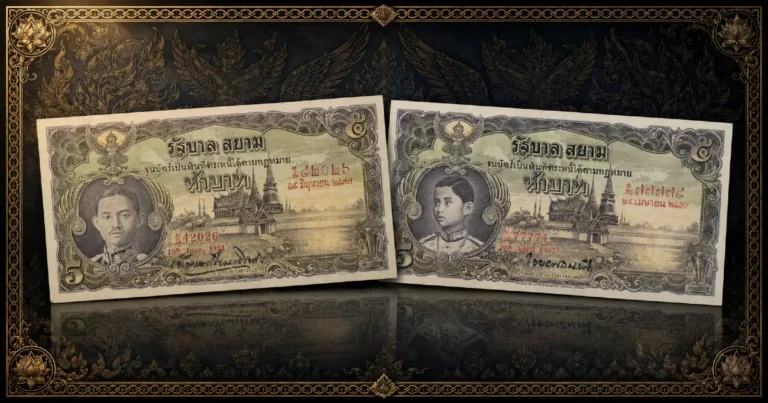
The study of paper money frequently intersects with the grand narratives of geopolitical conflict, but few chapters in the numismatic history of Southeast Asia are as compelling, dangerous, and historically profound as the story of the Seri Thai Banknotes. To the casual observer, these banknotes appear identical to the standard circulating currency of the late 1930s. However, to the advanced student of currency and military history, they represent a meticulously engineered, covert fiscal weapon manufactured by the British government to support a domestic underground resistance movement operating deep within occupied territory during World War II.
Classified in major modern catalog registries—such as the Banknote Book—under the technical designation of “British Counterfeits,” these unique bank notes were never intended to deceive the public for criminal profit. Instead, they were created as an official operation of statecraft and intelligence warfare. They were designed to provide clean, untraceable liquidity to the Free Thai Movement (Seri Thai), a network of patriotic Thai citizens who risked their lives to resist Axis occupation, gather intelligence for the Allies, and preserve the ultimate sovereignty of the kingdom. Understanding the context, manufacturing variations, printing figures, and prefix-serial distributions of these notes requires looking closely at the intersection of wartime espionage and the desperate struggle for Thai independence.
Table of Contents
Thailand’s Wartime Dilemma
To understand why the British government took the extraordinary step of using the original printing plates of a foreign nation to manufacture sovereign currency, one must first look at the geopolitical crisis that struck Bangkok in December 1941. Following the surprise attack on Pearl Harbor, Japanese imperial forces launched a massive, coordinated invasion of Southeast Asia. On 8 December 1941, Japanese troops landed along the coastal beaches of Thailand, demanding immediate, unhindered transit through the kingdom to attack British territories in Malaya and Burma.
Faced with overwhelming military superiority and wanting to protect the civilian population from total destruction, the Thai government, led by Prime Minister Field Marshal Plaek Phibunsongkhram, made the difficult tactical choice to cease resistance. This initial accommodation quickly escalated under intense pressure. On 21 December 1941, Thailand signed a mutual offensive-defensive alliance pact with Japan. This culminated on 25 January 1942, when the Thai government officially declared war on Great Britain and the United States.
Overnight, the kingdom was transformed into a vital staging ground for Axis operations in Southeast Asia. This shift severed Thailand’s long-standing economic and financial relationships with the Western allies, most notably freezing the nation’s currency supply contracts with the legendary printing house of Thomas De La Rue & Company Limited in London.
The Birth of the Seri Thai (Free Thai Movement)
The official declaration of war did not reflect the true consensus of the Thai people or its leadership. A profound internal schism split the government. The most significant act of defiance occurred in Washington, D.C., where the Thai Minister to the United States, Seni Pramoj, flatly refused to deliver the official declaration of war to the American government. Instead, he declared his independence from the Bangkok administration and immediately began organizing the Free Thai Movement (Seri Thai) abroad, recruiting Thai students studying in American universities to train with the Office of Strategic Services (OSS).
Simultaneously, an incredibly dangerous underground network was forming directly within the occupied capital of Bangkok. This domestic resistance was led covertly by Pridi Banomyong, a brilliant legal scholar, key architect of the 1932 Siamese Revolution, and the civilian regent for the young, absent King Ananda Mahidol (Rama 8). Operating under the code name “Ruth,” Pridi utilized his immense bureaucratic influence and high state office to shield an expanding network of underground resistance cells right under the noses of the Japanese military police (the Kempeitai).
The strategic goals of the Seri Thai were clear but incredibly difficult to execute:
- Establish clandestine communication channels with Allied forces in India and China.
- Construct hidden jungle drop zones and covert airfields deep within the Thai interior.
- Gather precise military intelligence on Japanese troop movements, supply depots, and fortifications to pass along to Allied bombers.
- Prepare a well-trained domestic paramilitary force capable of launching a coordinated uprising in synchronization with an eventual Allied invasion of Southeast Asia.
To achieve these monumental goals, the movement required an immense amount of material support. Clandestine radio operations, weapons maintenance, safehouse networks, and the logistics of keeping thousands of hidden partisan fighters fed and clothed across the provinces required a continuous supply of ready cash. The movement faced a critical bottleneck: They needed vast amounts of genuine-looking Thai currency, turning these Seri Thai banknotes into essential tools that could pass through the local banking system without raising the suspicions of Japanese auditors or collaborationist officials.
Operation Counterfeit: The British Sovereign Strategy
As the Seri Thai solidified its links with the British Force 136 intelligence branch operating out of India—records of which are preserved in the UK National Archives—Allied high commands recognized that standard logistics drops consisting entirely of weapons, medicines, and radios were insufficient. The partisans needed money, and dropping gold bullion or British pounds would instantly expose the underground network if intercepted in daily commerce. The solution lay in the secure archives of London.
Prior to the outbreak of hostilities, Thomas De La Rue & Company had been the official printer for the Siamese state, manufacturing the highly secure Thailand Series 4 Banknotes. When the war began, the original, master intaglio steel printing plates, color separation keys, and security design matrices remained securely stored in London. The British government, operating through intelligence channels, authorized an extraordinary project: using these authentic, original plates to reproduce exact, deceptive duplicates of pre-war Thai paper money.
This strategic choice was brilliant from an espionage perspective. Because they were printed using the official plates, the resulting Seri Thai banknotes were not crude imitations drawn by an artist; they were structurally correct duplicates. They carried the exact pre-war design configurations, including the portrait of the young King Ananda Mahidol on the obverse and the detailed engraving of the Ananta Samakhom Throne Hall on the reverse.
By utilizing these master materials, the British government produced millions of Baht in clean, high-grade liquidity. These Free Thai banknotes were packed into secure containers, flown over the treacherous “Hump” air routes, and parachuted directly into hidden jungle drop zones managed by Seri Thai operatives in the rural provinces of Thailand. Once on the ground, this cash seamlessly entered the daily flow of commerce, paying for food supplies, bribing local officials, maintaining safe houses, and funding the covert infrastructure of the resistance.
Identifying the Seri Thai Resistance Currency
For modern paper money specialists, the Seri Thai banknotes represent a premier collecting prize due to the extreme secrecy surrounding their production and the subtle, historic anomalies that set them apart from standard pre-war issues. Because these notes are categorized in the Banknote Book and standard reference literature as “British Counterfeits,” collectors must develop a keen, highly trained eye to identify them.
Despite using the original steel plates, the British authorities faced severe production limitations, particularly regarding the replicating of specialized security inks and paper fabric textures. This left tiny, identifiable traces on the banknotes themselves:
1. Shading and Line Weight Variations
The most reliable diagnostic feature for identifying the Seri Thai issues is a subtle difference in ink shading and line depth, particularly within the primary text frames on the obverse face. On the authentic, standard pre-war issues ordered by the Thai government, the intaglio ink application is exceptionally crisp, exhibiting a deep, uniform coloration.
On the British resistance prints, the ink density can appear slightly varied. When examined under high magnification, the delicate line work within the typography showcases tiny differences in contrast, resulting from alternative ink viscosities mixed under wartime constraints in London.
2. A Letterform Error in the Issuer Text
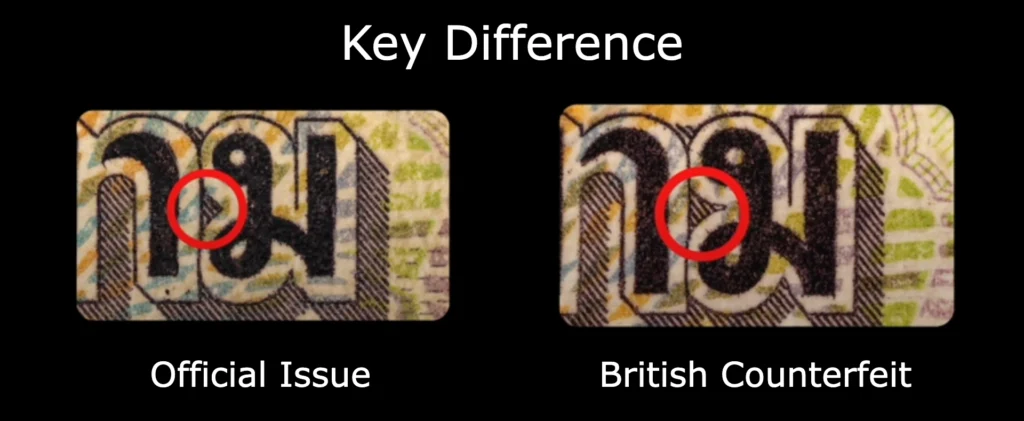
The most famous and definitive diagnostic marker occurs directly within the main “Government of Siam” (รัฐบาลสยาม) issuer text header at the upper front face of the note. While the master engravers reproduced the primary decorative borders flawlessly, a minute orthographic error slipped through during the photographic plate replication stages in London.
When observing the word “Siam” (สยาม) under high magnification, collectors can look directly at the central loop between the letters “า” and “ม”. On the genuine, authentic pre-war official issues, this loop is clearly defined with a sharp, open gap. On the British counterfeit resistance prints, the lines inadvertently bleed together, creating an entirely closed horizontal loop framework.
Master Reference Matrix: Banknote Book Number
To provide variety specialists with a clear, systematic checklist to accurately identify and verify these extraordinary pieces of resistance currency against standard reference works, the following master matrix maps out the specific denominations, the historical signatures they mimic, and their precise Banknote Book (BNB) classifications.
| Denomination | Replicated Signature | Banknote Book | Numismatic Status |
|---|---|---|---|
| 1 Baht | Chaiyos Sombat | BNB B244b | British Counterfeit / Resistance Issue |
| 1 Baht | Pradit Manudham | BNB B244d | British Counterfeit / Resistance Issue |
| 5 Baht | Pradit Manudham | BNB B245b | British Counterfeit / Resistance Issue |
| 10 Baht | Pradit Manudham | BNB B246b | British Counterfeit / Resistance Issue |
Production vs. Circulation: The Statistical Scarcity
A common misconception among newer collectors exploring this specialized niche is that the total volume of Seri Thai banknotes manufactured in London directly mirrors their modern availability in the hobby market. In reality, the physical volume of Seri Thai banknotes actually put into circulation inside occupied Thailand was an incredibly tiny fraction of the total amounts printed.
Based on official records obtained by the Thai Government from Thomas De La Rue, British authorities manufactured substantial stockpiles of the currency:
- One Baht Notes Printed: 1,500,012 notes
- Five Baht Notes Printed: 1,300,012 notes
- Ten Baht Notes Printed: 126,000 notes
However, according to formal military dispatches preserved by the British Embassy in Bangkok, only a tightly restricted sub-set of these Free Thai banknotes was ever formally issued to the British military to pass directly along to the frontline Seri Thai resistance forces and accompanying Allied groups:
- One Baht Notes Issued: 25,350 notes
- Five Baht Notes Issued: 46,127 notes
- Ten Baht Notes Issued: 15,672 notes
This maps out to a total value of exactly 412,705 Baht issued to military command channels. Out of this allocation, a stockpile valued at 42,162 Baht remained entirely unused by the British Military Accountant and was subsequently destroyed under strict auditing protocols following the war, though the exact denomination breakdown of those shredded Free Thai banknotes remains unrecorded.
Consequently, the final total value of notes actively pushed out into open circulation within Thailand was a mere 370,543 Baht. This remarkably low circulation count provides a definitive, empirical explanation for why genuine, verified examples of these resistance notes are so highly sought after and intensely scarce in the modern collector marketplace. The vast remainder of the notes printed in London were never deployed. Whether they were systematically destroyed post-war, locked away in an anonymous British government intelligence vault, or diverted for unrecorded covert security purposes remains one of the great unsolved mysteries of World War II numismatics.
Alphanumeric Prefix and Serialization Mechanics
To ensure that the resistance currency could completely escape administrative detection by occupation officials, Thomas De La Rue had to meticulously sync their numbering machines to follow the exact parameters of the original pre-war issues. Each Seri Thai banknote features its fractional alphanumeric prefix and a 5-digit serial number rendered in deep red ink, prominently displayed at the top front of the layout.
Following the dual-language tracking system of pre-war Siam, the tracking combination on the left uses the English alphabet paired with Roman numerals, while the matching combination on the right utilizes the Thai alphabet paired with Thai numerals. The primary numerator letters correspond directly to the targeted denomination: the 1 Baht issues rely on the A and B prefix blocks, the 5 Baht note relies on the K prefix block, and the 10 Baht note strictly operates within the N prefix block.
Based on official records kept by the Bank of Thailand and recovered data logs from Thomas De La Rue, the counterfeit printing runs strictly adhered to a highly specific pattern of duplicate prefix groups and serial blocks:
One Baht Seri Thai Serial Registry
| Prefixes | Serial range |
|---|---|
| A5, A66, and A92 | 00001 to 41667 |
| B7, B59, and B88 | 05001 to 46667 |
| A16, A24, and A75 | 10001 to 51667 |
| B34, B67, and B98 | 15001 to 56667 |
| A32, A49, and A80 | 20001 to 61667 |
| B43, B51, and B95 | 25001 to 66667 |
| A10, A64, and A94 | 30001 to 71667 |
| B19, B28, and B72 | 35001 to 76667 |
| A27, A36, and A78 | 40001 to 81667 |
| B3, B77, and B89 | 45001 to 86667 |
| A2, A57, and A81 | 50001 to 91667 |
| B27, B48, and B93 | 55001 to 96667 |
Five Baht Seri Thai Serial Registry
| Prefixes | Serial range |
|---|---|
| K1, K4, K7, K11, K13, and K22 | 00001 to 46429 |
| K5, K16, K18, and K21 | 10001 to 56429 |
| K6, K17, and K23 | 20001 to 66429 |
| K10, K15, and K20 | 30001 to 76429 |
| K8 and K12 | 40001 to 86429 |
| K3, K7, K14, K19, and K24 | 46430 to 92858 |
| K2, K4, K9, K11, and K25 | 53572 to 100000 |
Ten Baht Seri Thai Serial Registry
| Prefixes | Serial range |
|---|---|
| N3, N6, and N12 | 00001 to 07000 and 60001 to 67000 |
| N1, N10, and N14 | 20001 to 27000 and 70001 to 77000 |
| N4, N7, and N9 | 30001 to 37000 and 90001 to 97000 |
Banknote collectors must reference these exact structural combinations when verifying the legitimacy of a suspected Seri Thai banknote. If a piece features an obverse layout corresponding to these precise combinations and showcases the characteristic ink and paper profiles of the London wartime production runs, it can be confidently attributed as an authentic artifact of the clandestine campaign.
Denomination Profiles of Seri Thai Banknotes
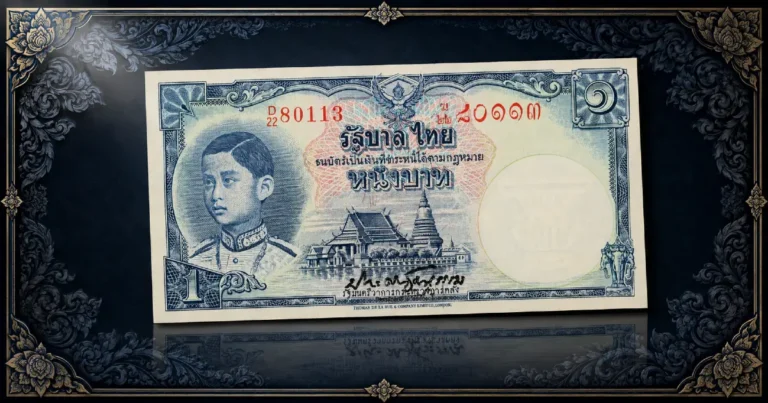
1 Baht Seri Thai Banknote (BNB B244b & BNB B244d)
- Dimensions: 125 x 65 mm
- Primary Colors: Blue and green
- Obverse Design: Portrait of the young King Ananda Mahidol (King Rama 8) in military uniform on the left; Royal Garuda emblem at upper center; Phra Samut Chedi temple and its river pagoda centered; three-headed elephant (Airapote) icon on the right margin. The upper header features the traditional pre-war legal title line reading “รัฐบาลสยาม” (Government of Siam).
Replicated Signature Variety 1 (BNB B244b):
- Technical Specifications: This variety duplicates the early pre-war print block carrying the official signature of Chaiyos Sombat.
Replicated Signature Variety 2 (BNB B244d):
- Technical Specifications: This highly sought-after variety replicates the subsequent pre-war production run carrying the signature of Pradit Manudham.
5 Baht Seri Thai Banknote (BNB B245b)
- Dimensions: 135 x 76 mm
- Primary Colors: Purple and green
- Obverse Design Matrix: King Rama 8 portrait on the left; Royal Garuda emblem at top center; Phra Pathom Chedi temple centered in the foreground frame; Airapote icon on the lower right field. The top header carries the “Government of Siam” text layout.
Replicated Signature (BNB B245b):
- Technical Specifications: This mid-denomination resistance issue duplicates the signature of Pradit Manudham paired with the dedicated K prefix tracking block used for the 5 Baht prints.
10 Baht Seri Thai Banknote (BNB B246b)
- Dimensions: 147 x 87 mm.
- Primary Color: Brown.
- Obverse Design Matrix: King Rama 8 portrait on the left; Royal Garuda emblem at top center; ramparts and watchtowers of Mahakan Fort in Bangkok; Airapote standing on the right frame border with the traditional “Government of Siam” header text.
Replicated Signature (BNB B246b):
- Technical Specifications: The highest denomination systematically reproduced for this run of Free Thai banknotes, this note replicates the signature of Pradit Manudham across the dedicated N prefix tracking fraction block.
From London Archives to Jungle Drop Zones
The journey of a Seri Thai banknote from a printing press in war-torn London to a partisan’s pocket in the deep jungles of Thailand is a testament to the incredible logistical coordination of Allied intelligence. Once the Free Thai banknotes were completed, they were packed into specialized waterproof canisters designed to withstand severe impacts. These currency shipments were transported to secure military airfields in India, where British Force 136 operatives managed the distribution.
Flying long-range heavy bombers, brave Allied crews navigated over enemy lines, braving treacherous weather patterns and anti-aircraft fire to reach the remote interior provinces of Thailand, such as Sakon Nakhon, Loei, and Phrae. Below, hidden in valley clearings and dense forest canopies, domestic Seri Thai teams stood ready, signaling the aircraft using primitive flashlight arrays and small bonfires.
When the containers parachuted into the drop zones, the cash was rapidly cataloged by resistance accountants under Pridi Banomyong’s decentralized command network. From these rural strongholds, the currency traveled along underground courier routes, hidden inside agricultural shipments, local fishing vessels, and traditional oxcarts.
Because the Seri Thai banknotes were visually correct and bore pre-war duplicate serial tracking numbers, they flowed smoothly through local banks, marketplace stalls, and provincial government offices without raising any administrative red flags. This funding stream allowed the movement to expand to over 50,000 active partisan fighters by 1945, fully armed and prepared to launch a devastating offensive against the occupying forces.
The Ultimate Document of Silent Bravery
The Seri Thai Banknotes occupy a legendary, almost sacred status within the history of global numismatics and military intelligence. They prove that paper currency is far more than a passive tool for measuring economic trade; in times of extreme crisis, it can function as an active, highly secure weapon of resistance and national liberation. Classified officially under the dry catalog title of “British Counterfeits,” these notes are, in reality, profound historical documents of silent bravery.
They preserve the exact physical record of a population that refused to capitulate to foreign occupation, utilizing the artistry of pre-war British engraving to secure the long-term survival of their state. For the modern collector, locating and verifying an authentic Seri Thai banknote is a profound experience—a chance to hold a physical piece of currency from this run of Free Thai banknotes that directly funded the preservation of Thailand’s freedom and national sovereignty during the darkest days of World War II.