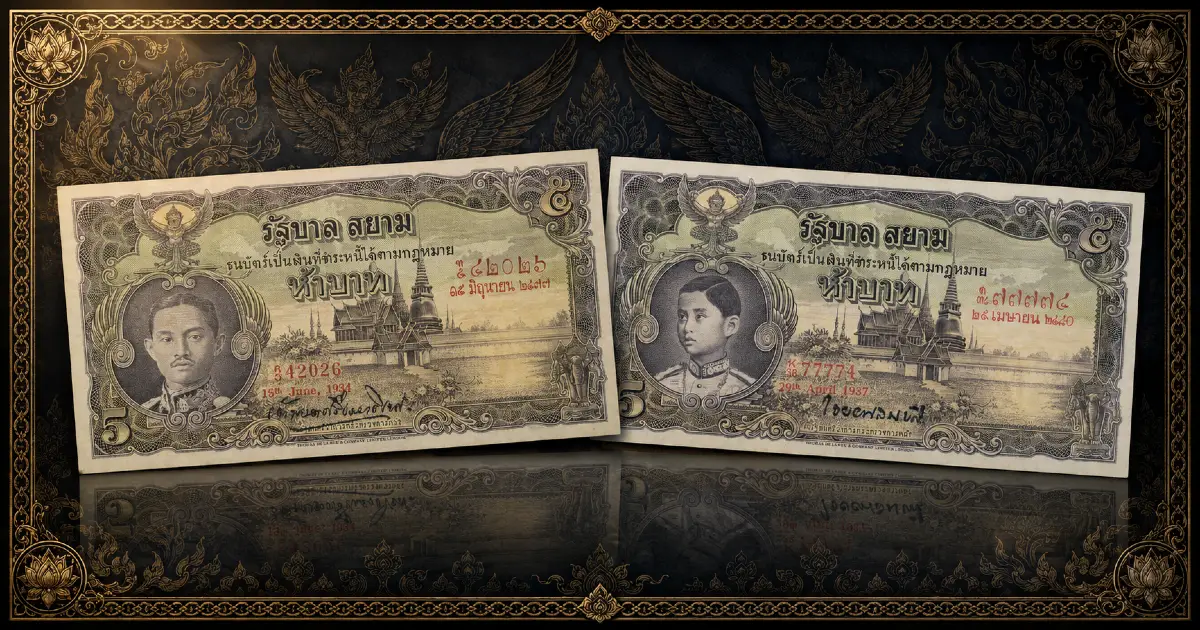
The introduction of the Thailand Series 3 Banknotes stands as one of the most revolutionary milestones in the monetary history of Southeast Asia. Before Series 3, Siamese banknotes across the two preceding series carried no royal portrait — only typographic text, royal emblems, and ceremonial vignettes. Thailand Series 3 Banknotes shattered this tradition by becoming the very first banknote series to feature a portrait of the reigning monarch as its primary design centerpiece. This completely restructured the visual identity of Siamese money, establishing a portrait-centric currency tradition featuring King Rama 7 (King Prajadhipok) and King Rama 8 (King Ananda Mahidol) that continues to this day.
Printed by the master engravers at Thomas De La Rue & Company Limited in London, this historic series captures a turbulent and profound epoch of political transformation. Spanning the monumental transition from an absolute monarchy to a constitutional government following the Siamese Revolution of 24 June 1932, the Thailand Series 3 Banknotes effectively mirror the shifting political tides of the state. For currency specialists, these issues offer an exceptionally vast and deeply technical landscape of study, characterized by a highly complex serial numbering system, changing royal portraits, and intricate signature varieties across two successive royal reigns.
Furthermore, this series marks a profound architectural and production finale in Thai numismatics: it was the final series to be issued with individual face dates printed directly on the notes. Because every individual fractional prefix corresponds to a distinct printing date, completing a set of dates requires completing a set of prefixes—a reality that makes the Thailand Series 3 Banknotes one of the ultimate tests of patience, research, and dedication for the serious banknote collector.
Table of Contents
The Royal Transition: Two Reigns on a Single Series
The primary reason the Thailand Series 3 Banknotes occupy such a legendary status among paper money specialists is that the series is fundamentally split into two distinct chronological and ideological halves. Due to sudden, dramatic shifts within the ruling Chakri Dynasty, a single series architecture had to adapt to accommodate two completely different monarchs on its obverse faces.
1. The 1934–1935 King Rama 7 Banknotes
The initial phase of the Thailand Series 3 Banknotes was conceived and prepared under the authority of King Rama 7, creating a historic run of highly prized Rama 7 banknotes. These banknotes showcase a refined, deeply etched portrait of the King in formal military regalia, positioned on the left side of the obverse face. However, the political shockwaves of the 1932 Revolution fundamentally altered the nature of the Siamese throne. Tensions between the new constitutional government and the crown ultimately culminated in King Rama 7’s historic abdication on 2 March 1935, while he was residing in England.
2. The 1935–1937 King Rama 8 Banknotes
Following his uncle’s abdication, the young Prince Ananda Mahidol was officially recognized as King Rama 8 by the National Assembly on 2 March 1935. At the time of his historic ascension, the new king was only nine years old and studying in Lausanne, Switzerland, where he had been sent for his personal safety following the political instability in Bangkok. The second phase of the Thailand Series 3 Banknotes adjusted beautifully to this transition. Master engravers at Thomas De La Rue modified the existing plates, replacing the image of the abdicated monarch with an elegant portrait of the young boy king wearing a formal military uniform.
This created an incredible numismatic phenomenon where the King Rama 7 and King Rama 8 notes share the exact same reverse architecture, the exact same background frames, and the exact same security patterns, but feature completely different royal faces on the front. Every element across the entire layout remains identical except for the royal portrait itself.
The Interim Vision: From Portrait to Parliament
An incredible archival detail connecting this period of royal transition to later Thai currency design involves the unadopted essays prepared by Thomas De La Rue immediately following the abdication of King Rama 7. In the mid-1930s, before the portrait of the young King Rama 8 was formally finalized for the printing plates, designers experimented with an alternative concept that would eliminate the royal portrait from the obverse entirely.
These archival essays proposed placing a large vignette of the newly established parliament building on the front of the note. For a thorough exploration of how this radical architectural layout was planned, read our comprehensive article on the Ananta Samakhom on Thai Banknotes. Ultimately, the government maintained the royal portrait tradition for Thailand Series 3 banknotes, but this archival experiment directly paved the way for the historic design choices of Series 4.
Technical Specifications and the Prefix-Date Dilemma
Every circulating denomination within the Thailand Series 3 Banknotes shares a highly regulated, standardized configuration for tracking, serialization, and security. Understanding these mechanics is essential for any collector attempting to navigate the advanced varieties of the series.
Alphanumeric Serial Fractions and Prefix Logic
Each banknote is equipped with a clean, 5-digit serial number accompanied by a fractional alphanumeric prefix. The prefix structure operates on a highly specific mathematical and chronological logic:
- The Letter Code: The numerator letter in the prefix fraction directly corresponds to the specific denomination of the note. “A”, “B”, “C”, “D”, and “E” prefixes are reserved for the 1 Baht notes, “K” prefixes designate the 5 Baht notes, “N” prefixes represent the 10 Baht notes, and “P” prefixes are strictly assigned to the 20 Baht notes.
- The Number Code: The denominator number in the prefix fraction starts explicitly at 1 and advances consecutively over time as printing blocks are exhausted.
- Resumption Rules: When a new official signature variety or governmental authority was introduced to the printing plates, the prefix numbering did not reset to 1; instead, it resumed exactly where the preceding signature block or variety had ended.
The Ministry Title Change: Text 1 and Text 2 Varieties
A subtle but historically significant detail within Series 3 concerns the printed title of the Minister of Finance — a variation that creates distinct collectible varieties across the series.
Two distinct Thai texts appear across the production run:
- Text 1 — “รัฐมนตรีว่าการกระทรวงพระคลัง” (Ratthamontri Wa Kan Krasuang Phra Khlang): the older, traditional title translating as “Minister of Royal Finance,” reflecting the ministry’s pre-constitutional identity.
- Text 2 — “รัฐมนตรีว่าการกระทรวงการคลัง” (Ratthamontri Wa Kan Krasuang Kan Khlang): the modernized title translating simply as “Minister of Finance,” introduced following the Act on the Reform of Ministries, Departments and Agencies B.E. 2476, announced on 9 December 1933.
What makes this particularly interesting for collectors is the bureaucratic lag visible in the notes themselves. Despite the official name change taking effect in December 1933, Text 1 — the older “Royal Finance” designation — continued to appear on banknotes carrying dates after the reform, a consequence of pre-engraved plates remaining in production use. Notes bearing Text 1 after December 1933, therefore, represent a transitional anomaly, one that adds a precise and verifiable historical layer to variety attribution within the series.
The Ultimate Challenge: Completing Every Date
The Thailand Series 3 Banknotes occupy a unique place in Thai paper currency as the last series to feature printed dates directly on the notes. More importantly, it features a strict structural rule: every unique alphanumeric prefix fraction is paired with a completely new printed face date.
This means that in order to complete a truly exhaustive “date collection” of Series 3, a collector must successfully locate and acquire every single prefix variant issued during the production life of the notes.
- The Attainable Targets (5, 10, and 20 Baht): For the higher denominations, this quest is highly challenging but entirely attainable. Because these values were printed in far lower quantities due to the economic realities of 1930s Siam, they utilized a tightly restricted number of prefixes (such as K/1 to K/40 for the 5 Baht, N/1 to N/50 for the 10 Baht, and P/1 to P/20 for the 20 Baht). Tracking down every date is difficult, but for these scarce Rama 7 banknotes, the boundaries of the collection are finite and known.
- The Infinite Abyss of the 1 Baht Note: Conversely, the 1 Baht denomination represents a nearly impossible challenge for completionists. As the absolute workhorse currency of daily Siamese commerce, the 1 Baht note was printed in massive, multi-million note runs encompassing prefixes running through the A, B, C, D, and E blocks. Because there are over 450 unique prefixes across these letter runs, there are over 450 distinct face dates printed onto the 1 Baht notes. This staggering volume makes a complete date collection of the 1 Baht note an endless, lifelong pursuit that very few collectors in the world have ever fully achieved.
Additional Fabric and Security Features
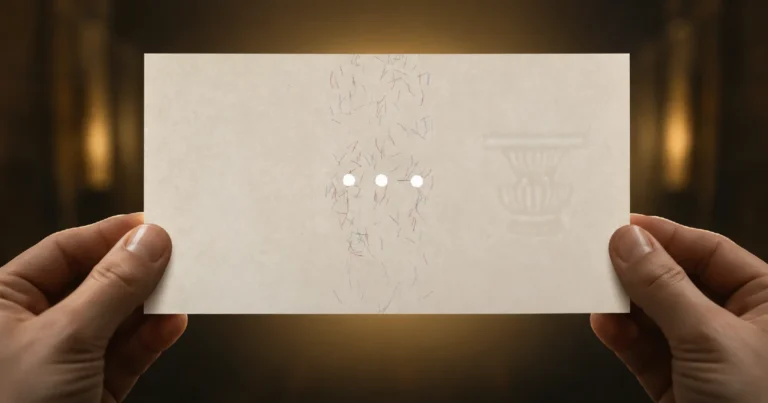
- Watermarks: The high-security paper stock utilized by Thomas De La Rue features an integrated watermark displaying the words “GOVERNMENT OF SIAM” alongside a highly detailed profile of the Airapote (the sacred three-headed elephant).
- Security Threads: Reflecting the global bank note printing standards of the mid-1930s, these banknotes were manufactured without an embedded metallic or plastic security thread.
- Paper Dimensions: The sizes of the banknotes scale upward progressively with their face value, providing immediate tactile recognition for users.
The Unified Reverse Design of Series 3
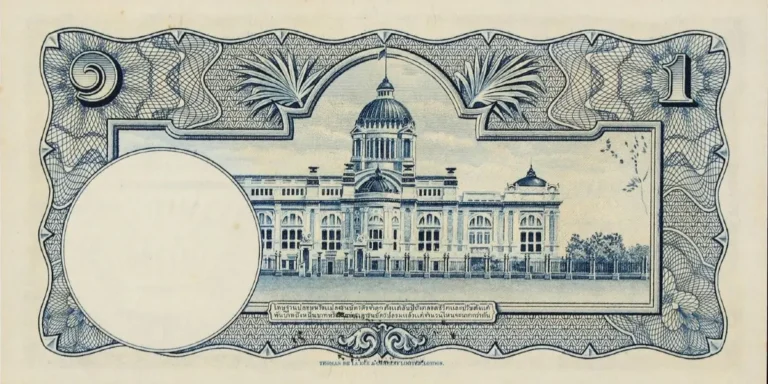
Before examining the individual denominations, it is vital to note that Thomas De La Rue engineered a beautifully consistent thematic link across the back of all circulating notes in the Thailand Series 3 Banknotes collection. Regardless of whether the note is a 1 Baht, 5 Baht, 10 Baht, or 20 Baht, and regardless of whether it features the portrait of King Rama 7 or King Rama 8, every single circulating banknote in Series 3 shares the exact same reverse design vignette.
The reverse architecture drops the multicolored security underprints of the front for a serene, uniform monochromatic print (with colors matching the primary ink profile of the denomination). The central focus is a beautifully rendered, highly detailed architectural engraving of the iconic Phra Samut Chedi temple and pagoda, rising gracefully from the waters of the Chao Phraya River in Samut Prakan province.
To the left of this central temple engraving sits a large, clean, unprinted circular window reserved entirely for viewing the Airapote watermark from behind. The value of the note is represented by prominent Western numerals on the right-hand side and Thai numerals on the left-hand side, all elegantly encased within a wide, flowing frame of geometric security patterns and classical floral scrollwork designed to prevent contemporary counterfeiting.
The Master Reference Matrix
To provide collectors with an instant, structured overview of the entire series as documented in specialized reference catalogs, the following master matrix maps out the denominations, their corresponding standard royal portraits, Pick numbers, and their Banknote Book (BNB) classifications. This reference structure mirrors the professional categorization standards utilized in elite numismatic listings.
| Denomination | Portrait | Pick Number | Banknote Book |
|---|---|---|---|
| 1 Baht | King Rama 7 | Pick 22 | BNB B234 |
| 1 Baht | King Rama 8 | Pick 26 | BNB B240 |
| 5 Baht | King Rama 7 | Pick 23 | BNB B235 |
| 5 Baht | King Rama 8 | Pick 27 | BNB B241 |
| 10 Baht | King Rama 7 | Pick 24 | BNB B236 |
| 10 Baht | King Rama 8 | Pick 28 | BNB B242 |
| 20 Baht | King Rama 7 | Pick 25 | BNB B237 |
| 20 Baht | King Rama 8 | Pick 29 | BNB B243 |
| 100 Baht (Unissued) | King Rama 7 | Unlisted | BNB B238 |
| 1,000 Baht (Unissued) | King Rama 7 | Unlisted | BNB B239 |
Detailed In-Depth Denomination Profiles
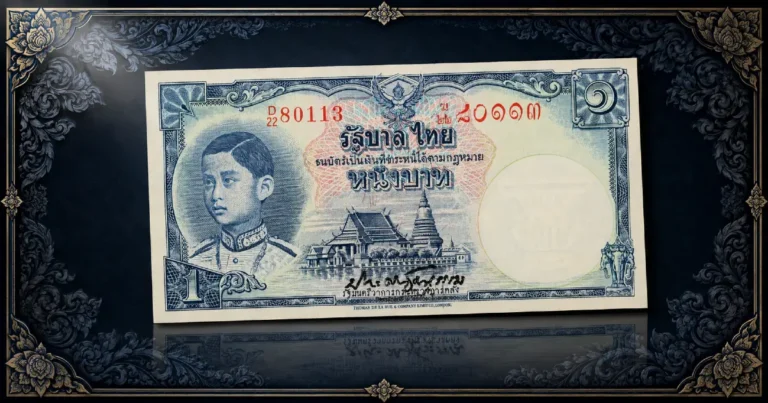
1 Baht Banknote (Pick 22 & Pick 26)
- Dimensions: 135 x 75 mm
- Primary Colors: Blue, orange, and yellow
- Obverse Design: Monarch portrait on the left; Royal Garuda emblem at top center; Royal Barge Suphanahongse on the Chao Phraya River in the center foreground; three-headed elephant (Airapote) on the right border
King Rama 7 Banknotes (Pick 22 / B234):
- Variety a: Minister of Finance Text: Text 1 (รัฐมนตรีว่าการกระทรวงพระคลัง – Minister of Royal Finance). Signature: Sridhamadhibes. Prefixes: A/1 – A/75. It was officially introduced on 8 August 1934.
- Variety b: Minister of Finance Text: Text 1 (รัฐมนตรีว่าการกระทรวงพระคลัง – Minister of Royal Finance). Signature: Manavarajasevi. Prefixes: A/76 – A/100.
- Variety c: Minister of Finance Text: Text 2 (รัฐมนตรีว่าการกระทรวงการคลัง – Minister of Finance). Signature: Manavarajasevi. Prefixes: B/1 – B/100.
King Rama 8 Banknotes (Pick 26 / B240):
- Variety a: Signature: Manavarajasevi. Prefixes: C/1 – C/48. It was officially introduced into circulation on 28 September 1936.
- Variety b: Signature: Chaiyos Sombat. Prefixes: C/49 – E/50.
5 Baht Banknote (Pick 23 & Pick 27)
- Dimensions: 155 x 75 mm
- Primary Colors: Purple and green
- Obverse Design: Monarch portrait on the left; Royal Garuda emblem at top left; central view of the main entrance and spires of the Temple of the Emerald Buddha (Wat Phra Kaew) within the Grand Palace complex; three-headed elephant (Airapote) on the right border
King Rama 7 Banknotes (Pick 23 / B235):
- Variety a: Minister of Finance Text: Text 2 (รัฐมนตรีว่าการกระทรวงการคลัง – Minister of Finance). Signature: Sridhamadhibes. Prefix range: K/1 – K/10. It debuted in Siamese commerce on 22 November 1934.
- Variety b: Minister of Finance Text: Text 2 (รัฐมนตรีว่าการกระทรวงการคลัง – Minister of Finance). Signature: Manavarajasevi. Prefix range: K/11 – K/20.
King Rama 8 Banknotes (Pick 27 / B241):
- Variety a: Signature: Manavarajasevi. Prefix range: K/21 – K/25. Introduced on 12 October 1936.
- Variety b: Signature: Chaiyos Sombat. Prefix range: K/26 – K/40.
10 Baht Banknote (Pick 24 & Pick 28)
- Dimensions: 175 x 95 mm
- Primary Color: Brown
- Obverse Design: Monarch portrait on the left; Royal Garuda emblem at top center; Mae Ping River with river craft; three-headed elephant (Airapote) on the right border
King Rama 7 Banknotes (Pick 24 / B236):
- Variety a: Minister of Finance Text: Text 1 (รัฐมนตรีว่าการกระทรวงพระคลัง – Minister of Royal Finance). Signature: Sridhamadhibes. Prefix range: N/1 – N/10. It entered public circulation on 22 June 1934.
- Variety b: Minister of Finance Text: Text 2 (รัฐมนตรีว่าการกระทรวงการคลัง – Minister of Finance). Signature: Manavarajasevi. Prefix range: N/11 – N/20.
King Rama 8 Banknotes (Pick 28 / B242):
- Variety a: Signature: Manavarajasevi. Prefix range: N/21 – N/30, with an introduction date of 13 August 1936.
- Variety b: Signature: Chaiyos Sombat. Prefix range: N/31 – N/50.
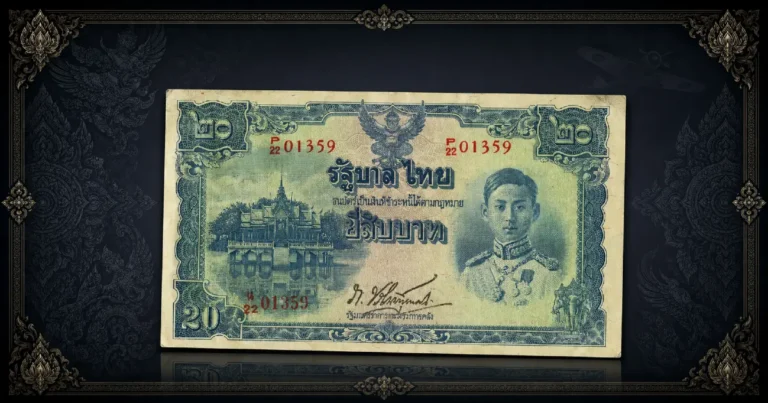
20 Baht Banknote (Pick 25 & Pick 29)
- Dimensions: 175 x 95 mm
- Primary Colors: Green and orange
- Obverse Design: Monarch portrait on the left; Royal Garuda emblem at top center; Siamese river community featuring thatched-roof houses raised on stilts over the water, floating boats, and a prominent temple pagoda on the shoreline; three-headed elephant (Airapote) on the right border
King Rama 7 Banknotes (Pick 25 / B237):
- Only 1 variety: Minister of Finance Text: Text 2 (รัฐมนตรีว่าการกระทรวงการคลัง – Minister of Finance). Signature: Manavarajasevi. Prefix range: P/1 – P/10. This variety was officially introduced into circulation on 7 September 1935.
King Rama 8 Banknotes (Pick 29 / B243):
- Only 1 variety: Signature: Chaiyos Sombat. Prefix range: P/11 – P/20. It was formally introduced to the Thai public on 15 December 1937.
Collector’s Master Variety Matrix
The following analytical matrix serves as a definitive checklist for variety collectors. It details the exact alignment between denominations, royal portraits, the printed signatory text, the presiding official signature, and the documented prefix blocks that dictate the individual face dates of the Thailand Series 3 banknotes.
| Denomination | Portrait | Signatory Text | Signature | Prefix Range |
|---|---|---|---|---|
| 1 Baht | King Rama 7 | Minister of Royal Finance | Sridhamadhibes | A/1 – A/75 |
| 1 Baht | King Rama 7 | Minister of Royal Finance | Manavarajasevi | A/76 – A/100 |
| 1 Baht | King Rama 7 | Minister of Finance | Manavarajasevi | B/1 – B/100 |
| 1 Baht | King Rama 8 | Minister of Finance | Manavarajasevi | C/1 – C/48 |
| 1 Baht | King Rama 8 | Minister of Finance | Chaiyos Sombat | C/49 – E/50 |
| 5 Baht | King Rama 7 | Minister of Finance | Sridhamadhibes | K/1 – K/10 |
| 5 Baht | King Rama 7 | Minister of Finance | Manavarajasevi | K/11 – K/20 |
| 5 Baht | King Rama 8 | Minister of Finance | Manavarajasevi | K/21 – K/25 |
| 5 Baht | King Rama 8 | Minister of Finance | Chaiyos Sombat | K/26 – K/40 |
| 10 Baht | King Rama 7 | Minister of Royal Finance | Sridhamadhibes | N/1 – N/10 |
| 10 Baht | King Rama 7 | Minister of Finance | Manavarajasevi | N/11 – N/20 |
| 10 Baht | King Rama 8 | Minister of Finance | Manavarajasevi | N/21 – N/30 |
| 10 Baht | King Rama 8 | Minister of Finance | Chaiyos Sombat | N/31 – N/50 |
| 20 Baht | King Rama 7 | Minister of Finance | Manavarajasevi | P/1 – P/10 |
| 20 Baht | King Rama 8 | Minister of Finance | Chaiyos Sombat | P/11 – P/20 |
Unissued High Denominations: Historical Design Patterns
Beyond the standard lower denominations that regularly passed through the hands of the public, the design history of the Thailand Series 3 Banknotes includes two high-value archival proof concepts: the 100 Baht (B238) and the 1,000 Baht (B239) banknotes.
Prepared by the master engravers at Thomas De La Rue and bearing a face date of 11th February 1933 under Sridhamadhibes signature, these notes were drafted to feature the portrait of King Rama 7 on the obverse alongside stunning panoramic views of Bangkok’s most iconic religious landmarks—the majestic entry gates of Wat Phra Kaew on the 100 Baht note, and a breathtaking profile of Wat Arun rising over the Chao Phraya River on the 1,000 Baht note.
Because of the sweeping political re-alignments following the 1932 Revolution and the King’s subsequent abdication from the throne, these high-value King Rama 7 banknotes were never officially approved for mass circulation. They remain classified as unissued and unconfirmed design patterns within major reference archives, serving as fascinating historical proof concepts that showcase the absolute peak of pre-war British security engraving.
Chronological Tapestry of Modern Thai Wealth
The Thailand Series 3 Banknotes occupy a legendary status in Thai numismatics for good reason. They achieved something genuinely difficult — preserving the prestige of the Chakri monarchy through individual royal portraits of King Rama 7 and King Rama 8, while simultaneously adapting to the realities of a newly constitutional state. The ministry title change from “Royal Finance” to “Finance,” the succession of signatures, and the strict prefix-to-date production rule together transform these notes from circulating currency into a paper archive of a nation redefining itself in real time.
For collectors, Series 3 is both a gateway and a destination. A basic type set—securing both the historical Rama 7 banknotes and the King Rama 8 issues per denomination—is an achievable and deeply satisfying goal The tight, finite prefix runs of the 5, 10, and 20 Baht notes offer advanced collectors a challenging but highly rewarding path toward completion. And a full date collection of the 1 Baht alone — spanning over 450 prefixes — remains a lifelong pursuit that very few have ever finished. Wherever a collector enters the world of Thailand Series 3 Banknotes, it rewards serious attention.
Thailand Series 3 banknotes also sets the stage directly for what follows. The design experiments it prompted — most notably the unadopted parliamentary essays prepared after Rama 7’s abdication — fed directly into the visual language of Series 4, which would cement the Ananta Samakhom Throne Hall as the defining reverse motif of Thai currency for decades. Understanding Series 3 is, in many ways, the essential foundation for understanding everything that came after it.