The Ananta Samakhom Throne Hall stands as one of the most magnificent and historically weighty architectural landmarks ever to grace the canvas of Thai banknotes. For serious numismatists and casual collectors alike, it represents far more than a mere decorative building etched onto the reverse of a banknote. It is, instead, a profound visual testament to a nation in transition. The Throne Hall represents a distinct period when Siam—later formally renamed Thailand—was radically redefining its national identity, balancing the ancient traditions of absolute monarchy with the modernizing forces of constitutional government, international architectural trends, and the intricate artistry of paper money design.
This comprehensive guide explores the deep historical background of the Ananta Samakhom Throne Hall, examining why it became the dominant reverse design of mid-twentieth-century Thai currency. We will delve into the specific banknote series that feature this iconic structure, the geopolitical forces that influenced their printing, the architectural marvel of the building itself, and the precise nuances that collectors must understand when approaching this rich and layered numismatic theme of Ananta Samakhom on Thai banknotes.
Table of Contents
The Architectural Genesis of a Numismatic Icon
To truly appreciate the presence of Ananta Samakhom Throne Hall on Thai banknotes, one must first understand the building’s architectural and historical origins. Commissioned in 1907 during the reign of King Chulalongkorn (Rama V), it was conceived as a grand reception hall for the expanded Dusit Palace complex. Chulalongkorn had traveled extensively through Europe in 1897 and 1907, observing the great palaces and civic buildings of the West, and recognized architecture as a powerful diplomatic tool. By raising a monumental European-style edifice in the heart of his capital, he intended to project an image of a modern, sovereign Siam fully capable of standing alongside Western colonial powers.
To execute this immense vision, the Siamese court employed a team of master Italian architects, engineers, and artists. The primary architects were Mario Tamagno and Annibale Rigotti, men who brought the sweeping, dramatic language of Italian Renaissance and Neoclassical architecture to the tropical landscape of Southeast Asia. Engineering oversight was provided by Carlo Allegri, ensuring that the massive structure could withstand the soft, marshy soils of Bangkok.
The building is famously constructed almost entirely of white Carrara marble imported directly from Italy. Its defining feature is a massive central dome, rising elegantly into the Bangkok skyline, flanked by six smaller surrounding domes. The exterior facades are adorned with classical columns, intricate friezes, and sweeping staircases that exude authority and permanence. Inside, the grand vaulted ceilings were painted by the celebrated Italian fresco artists Galileo Chini and Carlo Riguli. Their frescoes depict the history of the Chakri Dynasty, from the founding of Bangkok by King Rama I to the modernizing achievements of King Rama V, including the abolition of slavery and the introduction of the railway system.
The Throne Hall was finally completed in 1915, during the reign of King Vajiravudh (Rama VI). For numismatic purposes, this European architectural language is crucial. It gave the building a highly distinctive appearance, completely unlike traditional Thai temple or palace architecture with its sweeping, multi-tiered roofs, gilded chofahs, and colorful ceramic tiles. When this neoclassical marble dome was eventually engraved onto the reverse of paper money, it provided a striking, almost Western aesthetic to the currency, reinforcing the message of a modernized, economically stable state.
The 1932 Revolution: Transforming Architecture into a State Symbol
The symbolic weight of the Ananta Samakhom Throne Hall shifted dramatically following the Siamese Revolution of 24 June 1932. This pivotal event, orchestrated by a coalition of military officers and civil servants known as the Khana Ratsadon (the People’s Party), transformed the country overnight from an absolute monarchy into a constitutional monarchy. The revolution fundamentally altered the trajectory of the nation’s history.
Following the revolution, the new government required a physical space to conduct its legislative affairs. The Ananta Samakhom Throne Hall was repurposed to serve as the very first parliament house of Siam. For decades following the 1932 revolution, the grand marble halls that were originally built to host royal receptions instead echoed with political debates, legislative drafting, and the machinery of modern democratic governance.
This monumental transition explains precisely why the building became such a powerful, recurring banknote image in the years following the revolution. The Throne Hall ceased to be merely a royal asset; it became the physical embodiment of the new constitutional order, the voice of the people, and the legislative heart of the nation. It connected royal heritage, modern parliament, and national identity in a single, unassailable visual vignette. By placing the Throne Hall on paper money, the issuing authorities were projecting an image of institutional stability and the enduring strength of the new Thai state. It was an image that every citizen would carry in their pockets, reinforcing the reality of the new political era.
The Unadopted Essays: A Radical Proposal for Currency Design
One of the most fascinating and heavily researched numismatic footnotes regarding the Ananta Samakhom Throne Hall is its reported appearance on unadopted archival essays from the mid-1930s. Following the abdication of King Prajadhipok (Rama VII) in 1935, the country faced an unprecedented transition in its state imagery. The new monarch, King Ananda Mahidol (Rama VIII), was only a young boy residing in Switzerland.
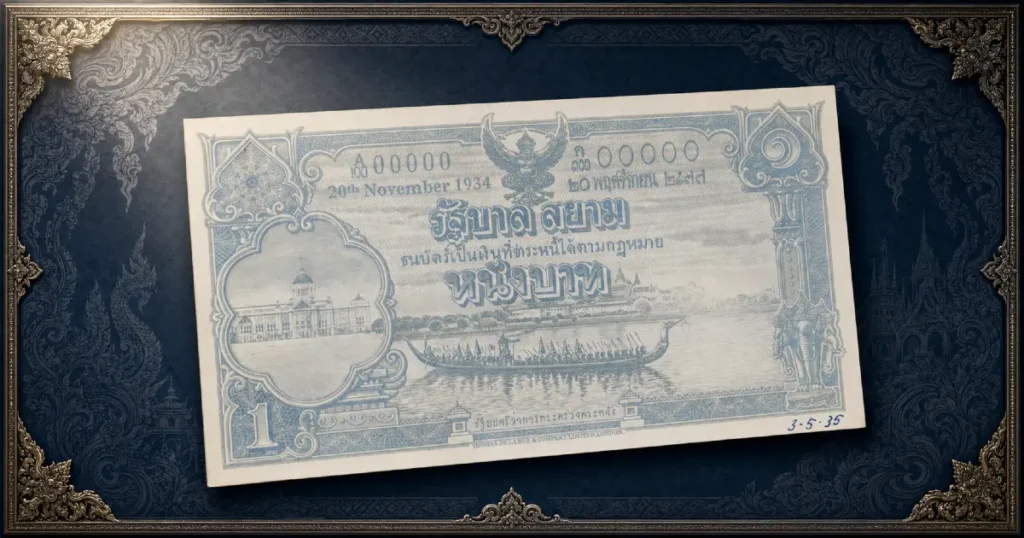
During this period of monarchical transition and ascending parliamentary power, archival records from the legendary British banknote printing firm Thomas De La Rue show proposed designs that radically altered the traditional hierarchy of Siamese currency. These unissued essays proposed placing the Ananta Samakhom Throne Hall on the obverse (the front) of the banknote, occupying the prominent space that was historically and traditionally strictly reserved for the portrait of the reigning monarch.
These proposed designs reflected the immense political shifts of the era. The concept of using the parliament building as the primary face of the nation’s currency was a bold statement regarding the supremacy of the constitutional government over the traditional monarchy. Ultimately, these specific essays were never adopted, and the young King Rama VIII’s portrait was eventually chosen for the obverse. However, the very existence of these archival proofs highlights the Throne Hall’s paramount importance to the state at that time, offering a glimpse into an alternative history of Thai currency design.
Series 4 Banknotes: The Defining Blueprint of a Numismatic Era
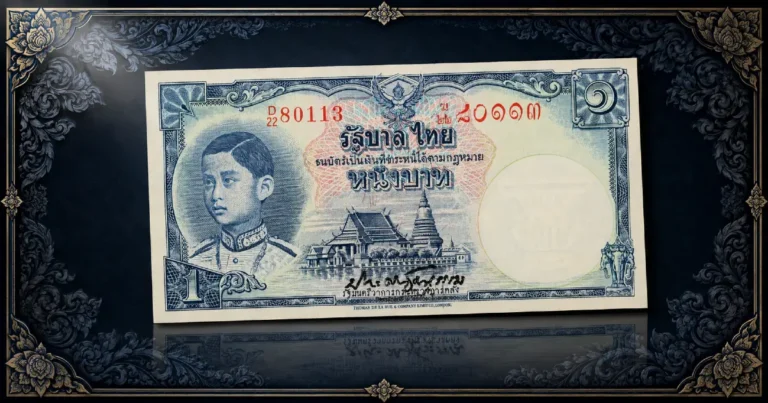
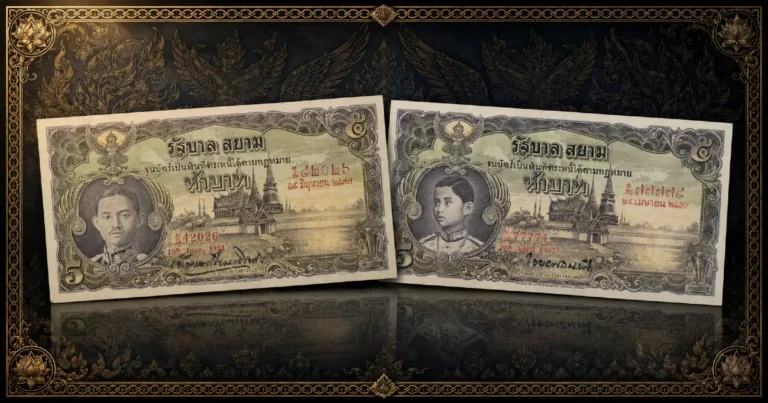
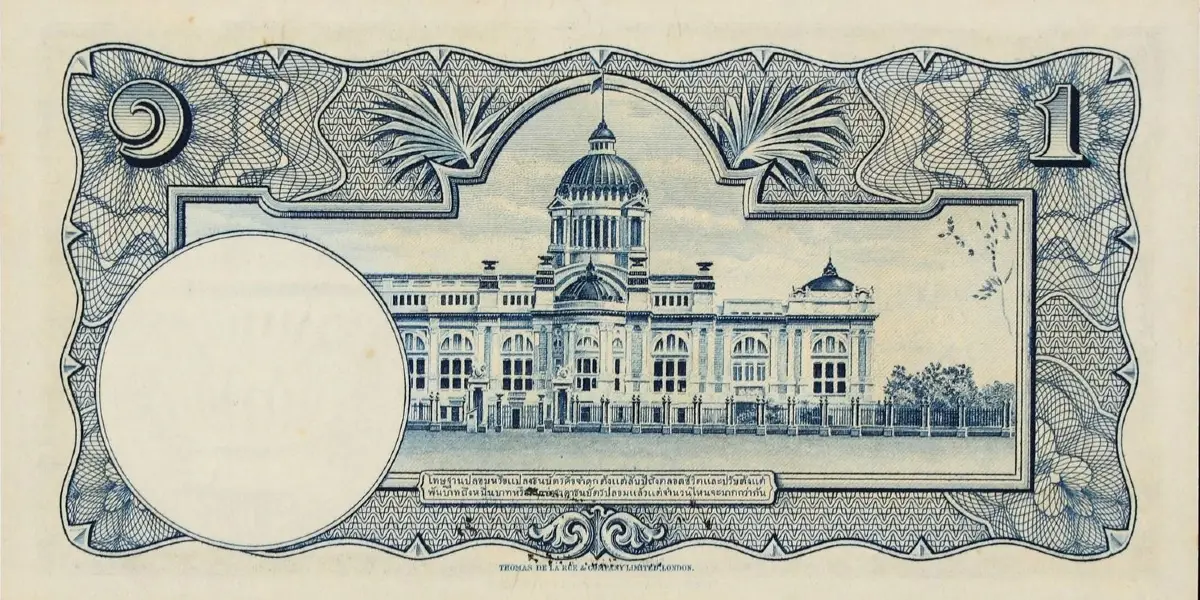
For collectors focusing on circulating issues, the definitive starting point is Series 4. Officially entering circulation in 1938, these notes established a visual standard that would dominate Thai currency for a generation. The series was produced by two distinct printers across its lifespan — the esteemed Thomas De La Rue & Company (TDLR) in London, and later the Royal Thai Survey Department domestically — yet both share the same fundamental design. The obverse prominently features the portrait of the young King Ananda Mahidol (Rama VIII), while the Ananta Samakhom Throne Hall takes center stage as the primary, framed vignette on the reverse.
The TDLR-printed notes were issued in five standard denominations: 1 Baht, 5 Baht, 10 Baht, 20 Baht, and the high-value 1,000 Baht note. The reverse design presents a masterful, finely detailed intaglio engraving of the Throne Hall, viewed from an angle that highlights its grand central dome and symmetrical, classical facade. The building is framed by complex guilloche patterns and intricate geometric lathe-work designed to deter counterfeiters.
For numismatists, Series 4 is deeply historic because it captures a crucial moment of national rebranding. Collectors divide the TDLR-printed notes into two distinct types based on the printed legends:
- Type I Notes: Issued initially, these notes bear the English and Thai legend “Government of Siam.”
- Type II Notes: Following Prime Minister Plaek Phibunsongkhram’s nationalistic mandate in 1939 to change the country’s name, the printing plates were altered. The new notes featured the legend “Government of Thailand.”
This precise shift in nomenclature makes Series 4 a profound historical touchstone. A complete type set requires securing both the “Siam” and “Thailand” variants. The Series 4 reverse is vital because it definitively established the Throne Hall as the central, framed vignette — a layout and architectural focus that would define the reverse side of Thai paper money for decades. The quality of the De La Rue engraving on these notes is superb, showcasing the deep, rich inks and crisp lines characteristic of pre-war British security printing.
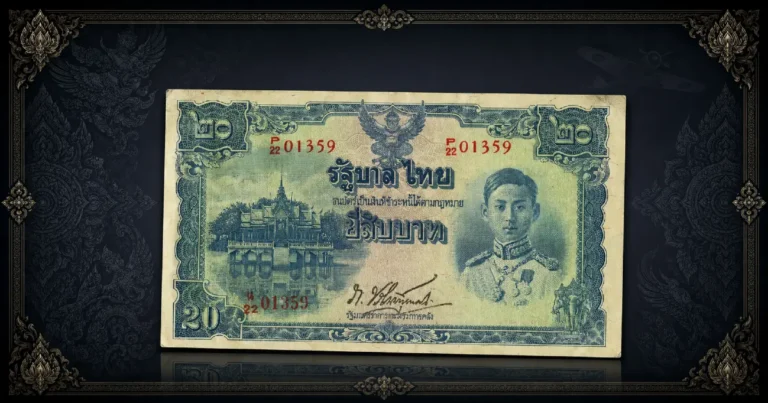
When Thailand declared war on Britain on 25 January 1942, the supply of notes from Thomas De La Rue was severed. To meet the country’s currency needs, the Royal Thai Survey Department stepped in to print Series 4 notes domestically, producing them in four denominations: 1 Baht, 10 Baht, 20 Baht, and 100 Baht. The obverse and reverse designs mirror those of the TDLR originals, but the execution tells a very different story — crude engravings, noticeably inferior paper sourced from a Thai paper mill in Kanchanaburi, and a general coarseness of print quality set these wartime issues apart immediately.
Series 6, 7, and Special Issues: Domestic Emergency Printing
With the supply of De La Rue notes severed following Thailand’s declaration of war on Britain in January 1942, the burden of currency production fell entirely on domestic resources. The notes that emerged from this period — spanning Series 6, Series 7, and a set of wartime Special Issues — tell a compelling story of improvisation under pressure, and all remain deeply connected to the Throne Hall on Thai banknotes visual legacy established by Series 4.
Series 6 (1945) was produced by the Royal Thai Survey Department and the Naval Hydrographic Department in the 20 Baht and 100 Baht denominations. Its design mirrors Series 4 directly, with the Ananta Samakhom Throne Hall retained as the central reverse vignette. The difference lies entirely in execution: domestic paper replaced imported security stock, printing shifted from fine intaglio to flatter lithography, and colors are often muted or slightly misregistered. The Throne Hall silhouette remains recognizable, but the contrast with a crisp pre-war De La Rue original is immediately apparent.
Series 7 (1945), covering the 1 Baht, 5 Baht, 10 Baht, and 50 Baht denominations, was contracted to private local printing companies as the Royal Thai Survey Department reached capacity. While the obverse design departs from Series 4, the reverse retains virtually the same Throne Hall composition. As a study object these notes are invaluable, capturing the economic strain of a nation operating under wartime blockade.
A separate but related category worth noting here is the Special Issues produced during the same period. The 1 Baht (Pick 58 / BNB B127), introduced in January 1942 and printed by the Royal Thai Survey Department, features the Ananta Samakhom Throne Hall on the reverse — though rendered in a slightly different composition from the Series 4 original.
A more unusual Special Issue is the 50 Baht (Pick 62B / BNB B133), also printed by the Royal Thai Survey Department, which was overprinted on an existing 1 Dollar denomination. This note originated from an emergency measure tied to the 1943 transfer of four Malay states — Kedah, Kelantan, Perlis, and Terengganu — to Thailand; notes originally prepared for circulation in those states were subsequently repurposed for domestic use. The Throne Hall appears on the reverse here as well, again in a treatment that departs subtly from the Series 4 standard.
Taken together, Series 6, Series 7, and the Special Issues form a distinct wartime chapter within the Throne Hall narrative. They demonstrate how the design established by Series 4 served not merely as an aesthetic choice but as a deliberate anchor of institutional continuity — the same image of the Throne Hall maintained across increasingly degraded production conditions, projecting stability precisely when it was most fragile.
Series 9: The Post-War Renaissance
With the war concluded and international trade routes restored, Thailand renewed its contract with Thomas De La Rue. The result was Series 9 — arguably the most important and expansive series for collectors of the Ananta Samakhom theme, and the one that made the Throne Hall an image of genuine daily familiarity for an entire generation of Thais.
Issued from 1948, Series 9 retained the proven reverse layout of Series 4 while making one defining change on the obverse: the portrait of the newly ascended King Bhumibol Adulyadej (Rama IX). The series spanned six denominations — 50 Satang, 1 Baht, 5 Baht, 10 Baht, 20 Baht, and 100 Baht — though it is worth noting that the 50 Satang carried a different reverse design; the Throne Hall appeared on all other denominations.
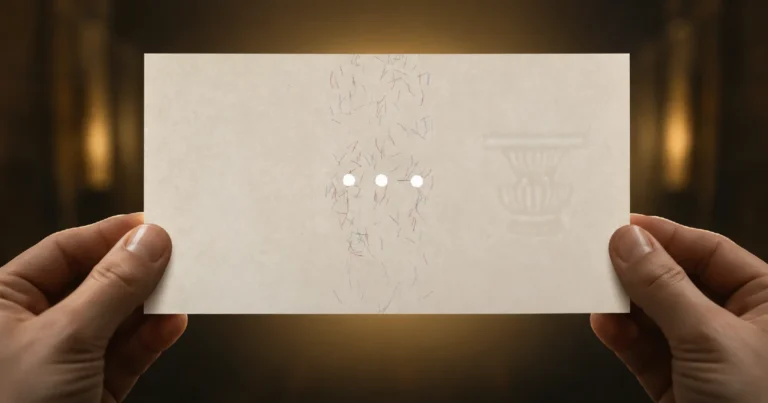
For collectors, Series 9 is both accessible and inexhaustible. A basic type set is well within reach for a newcomer, yet specialists find ample complexity in the series’ many sub-varieties: the shift from red to black serial numbers, changes in security thread insertions, watermark variations, and the numerous signature combinations reflecting the succession of Finance Ministers and Bank of Thailand Governors across the series’ long circulation life. The De La Rue intaglio printing throughout Series 9 returns the Throne Hall to the crisp, architecturally precise standard of the pre-war originals — a vivid contrast to the wartime domestic printings that preceded it.
From Centerpiece to Context: Modern Series
Series 9 marked the end of the Throne Hall’s long run as the dominant reverse motif on Thai banknotes. The political and design landscape shifted during the mid-1960s, and the 100 Baht Series 10 note introduced in 1968 became the first banknote since 1938 to feature neither the Ananta Samakhom Throne Hall nor the constitution — both potent symbols of the 1932 revolution that had shaped Thai currency design for three decades.
The building did not vanish entirely, but its role changed. When it reappeared, it did so as historical context rather than solitary subject. The 50 Baht Series 13 note (Pick 90 / BNB B159) and its polymer successor (Pick 99 / BNB B168) both feature the Throne Hall positioned behind the equestrian statue of King Prajadhipok (Rama VII) — a deliberately chosen pairing, given that it was under Rama VII that the building was converted from a royal hall into the national parliament following the 1932 revolution.
A similar logic governs its appearance in the 1,000 Baht commemorative issue of 2017 (Pick 134 / BNB B192), where the Throne Hall features as one element within a broader historical tableau.
These later appearances confirm the Throne Hall’s enduring place in Thai visual culture — no longer the bold, solitary centerpiece of a De La Rue engraving, but a layered historical reference that designers continue to reach for when the narrative calls for it.
The Enduring Legacy of the Marble Dome
Few architectural subjects in the history of paper money have carried as much interpretive weight as the Ananta Samakhom Throne Hall. Commissioned as a diplomatic statement, repurposed as a parliament, and then enshrined on the nation’s currency for decades, the building accumulated layers of meaning that no single engraving could fully contain — yet the engravers of Thomas De La Rue came remarkably close.
What makes the Throne Hall numismatically singular is precisely this density of history compressed into a single vignette. The same marble dome that appears on a pristine pre-war Series 4 Type I note bearing the legend “Government of Siam” reappears, crudely rendered on wartime domestic issues — and then again, in De La Rue’s finest intaglio, on a Series 9 note that an entire generation of Thais handled as ordinary pocket change. The building did not change. The nation around it transformed repeatedly.
For the collector, that continuity is the point. A focused holding of Ananta Samakhom Throne Hall on Thai banknotes — from the pre-war De La Rue originals through the wartime emergency printings and into the long Series 9 run — assembles not merely a type set but a compressed history of modern Thailand, each note a chapter in the same architectural story. The marble dome endures on paper long after the political circumstances that placed it there have passed into history.