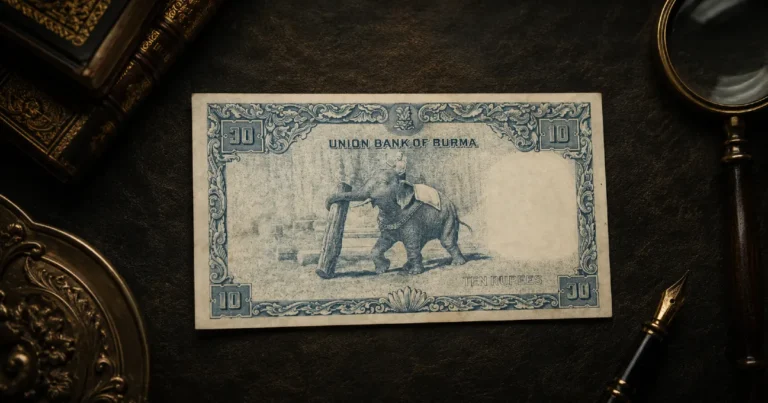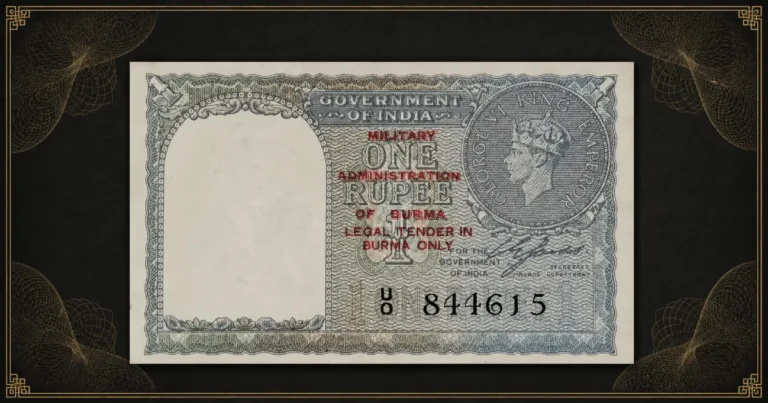
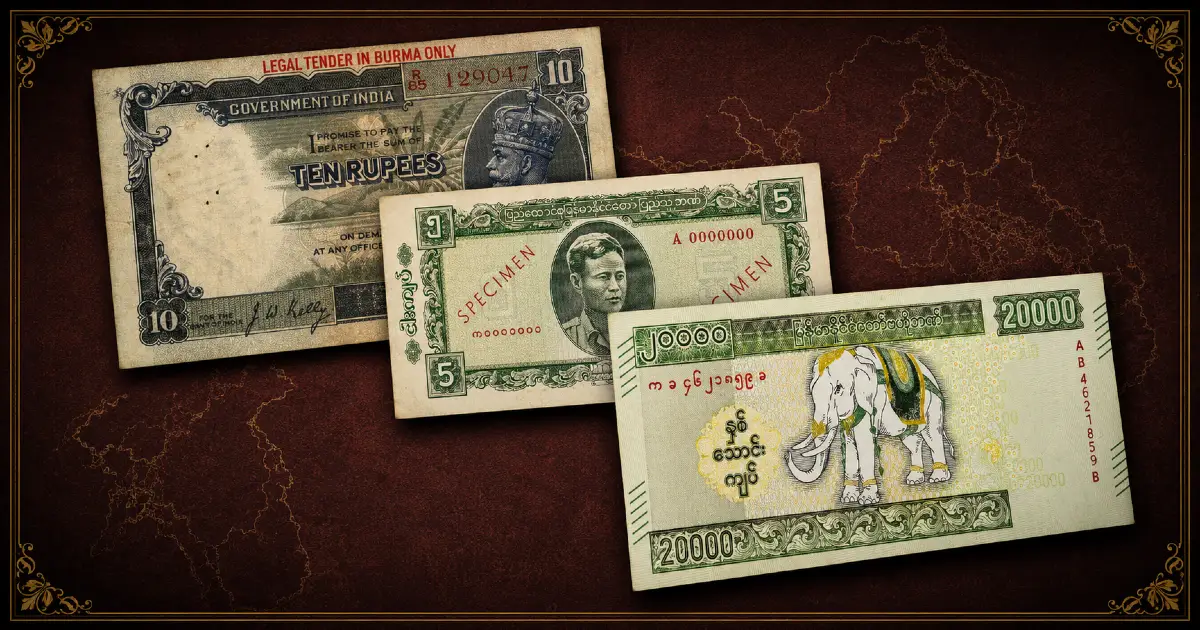
The Burma Banknotes Guide begins with one of the most complex, politically turbulent, and fascinating fields in global numismatics — a Burma paper money history spanning colonial overprints, revolutionary portraits, mystical odd denominations, and a complete national renaming across eight decades of continuous currency production.
Over the course of less than a century, the national money supply underwent dramatic structural transformations reflecting the rise and fall of colonial empires, the shocks of World War II, ideological upheaval, and successive constitutional renamings. For dedicated collectors, navigating these issues requires an understanding of a monetary system that repeatedly shifted its foundational currency unit — moving from Rupee to Kyat, back to Rupee, and finally settling into the standardized Kyat system that continues today.
What makes this journey uniquely compelling is the extraordinary diversity of issuing authorities behind it. Unlike nations with a single unbroken central banking lineage, Burma’s currency was steered by eleven distinct institutional entities across nine decades. As foreign empires, military regimes, civilian boards, and revolutionary state banks wrestled for financial control, each left its own political and technical fingerprint on the national money supply.
This Burma paper money catalog serves as the definitive reference map for both novice collectors and advanced specialists — dividing the national currency timeline into clear chronological eras so that collectors can trace the progression of printing standards, isolate major diagnostic varieties, and understand the deep political motivations behind each note’s creation.
🛒 Looking to Add Rare Currency to Your Collection?
Explore our premium, independently authenticated inventory of historical Burmese paper money. Browse our commercial gallery to find certified investment-grade pieces: Rare Burma Banknotes for Sale
Table of Contents
Introduction to Burma Paper Money History
To successfully build a specialized collection and map out Burma paper money history, a hobbyist must first master the two distinct tracks that define the catalog: fiscal denominational units and national iconographic standards.
The Fiscal Transitions: Shifting Between Rupee and Kyat Systems
Unlike most sovereign nations that maintain a single currency lineage, the issuing authorities in Yangon shifted back and forth between competing economic systems based on changing political regimes:
- The First Rupee Era: Rooted in British colonial governance, where the Burmese economy was legally tied directly to the Indian financial system.
- The First Kyat Transition: Enacted during World War II by the independent state administration under Japanese occupation, breaking away from British monetary standards.
- The Second Rupee Restoration: Launched by the returning British Military Administration and maintained through the early years of the independent Union of Burma.
- The Second Kyat Standardization: Established under the landmark 1952 Union Bank of Burma Act, which permanently retired the Rupee and introduced a fully decimalized national currency system.
Symbolism Tracker: Peacock, Chinthe Lion, and State Heraldry
The visual layouts evaluated across this Burma banknotes guide provide a clear mirror into the changing political alignment of the issuing state across each successive administration. Tracing these artistic shifts is critical to understanding the broader narrative of Burma paper money history.
The Dancing Peacock — the ancient heraldic symbol of the Konbaung Dynasty — appeared across British colonial issues, the Burma State Bank family, and the early Union of Burma series. Alongside the peacock, British colonial issues documented in this guide also featured the portraits of reigning British monarchs, projecting imperial authority directly onto the circulating money supply.
Following independence, the Chinthe — the mythical guardian lion of Buddhist pagodas — emerged as a powerful symbol of sovereign identity, appearing on early Union of Burma issues and then reappearing later in the Central Bank of Myanmar series, cementing its status as the most enduring post-colonial motif featured across this Burma banknotes guide.
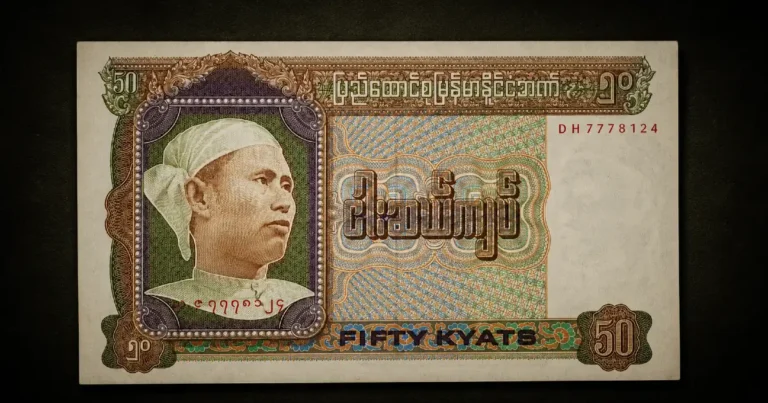
General Aung San, the martyred founding father of the nation, dominated the national money supply across the longest single-figure run tracked in this guide — from the inaugural 1958 Union Bank of Burma family through to the final odd denomination issues of the mid-1980s. His portrait briefly returned in the Central Bank’s first independent issue before returning again on the 72nd anniversary of independence.
The British Colonial, Wartime, & Provisional Eras (1937–1947)
The genesis of independent Burma paper money history was forged through colonial administration, which quickly dissolved into emergency wartime production as World War II expanded across Southeast Asia.
• KGV Burma Overprint Banknotes: 1937 Provisional Issue
- Issuing Authority: Government of India
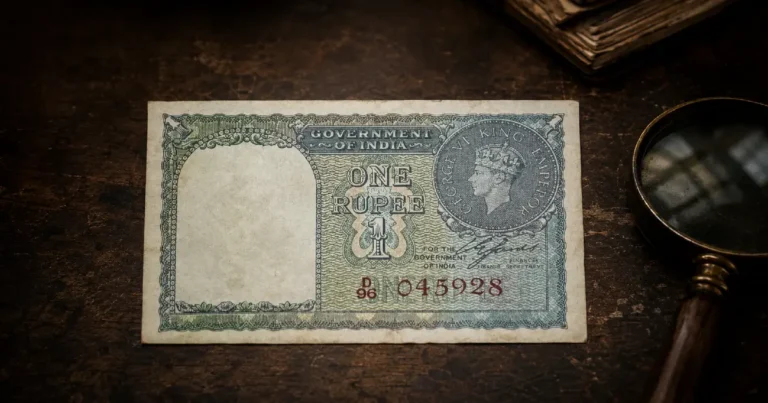
- Historical Context: Before 1937, Burma was administered as a province of British India, and standard Indian currency circulated freely across its markets. Following the legal separation of Burma into a distinct crown colony, emergency provisional banknotes were required while dedicated plates were being manufactured. The Government of India solved this by applying a distinct, localized stamp onto existing Indian bank note stocks. These are known among specialists as King George V overprint banknotes, featuring a bold black or red typographic print reading “Legal Tender In Burma Only.” For a detailed look at these initial provisional issues, review our KGV Burma banknotes guide: KGV Burma Overprint Banknotes: 1937 Provisional Issue.
• Burma Peacock Banknotes: 1938 RBI King George VI Series
- Issuing Authority: Reserve Bank of India (RBI)
- Historical Context: In 1938, the Reserve Bank of India released the first definitive series detailed in our Burma banknotes guide, custom-designed paper currency specifically for the colony. These magnificent notes display a proud portrait of King George VI on the right side of the plate, paired with the Dancing Peacock — appearing on the obverse of the 5 and 100 Rupees notes and carried over to the reverse of the high-value notes. This visual harmony between British imperial portraiture and traditional Burmese royal heraldry makes this series an absolute favorite for collectors. To explore the full denominational run of this iconic series, see our catalog: Burma Peacock Banknotes: 1938 RBI King George VI Series.
• Japanese Invasion Money Burma: JIM WWII Rupee Series
- Issuing Authority: Japanese Government
- Historical Context: The onset of the Pacific War completely altered the domestic monetary landscape. Following the Japanese military occupation of the country in 1942, the Japanese Government flooded the economy with fiat paper script known to collectors using this Burma banknotes guide as Japanese Invasion Money (JIM). This series retained the “Rupee” denomination name to minimize public friction, but introduced a major numismatic anomaly: the use of “Cent” fractions. For a full breakdown of block prefixes and serial configurations, read our guide: Japanese Invasion Money Burma: JIM WWII Rupee Series.
• Burma State Bank Banknotes: WWII Peacock & Ba Maw
- Issuing Authority: Burma State Bank
- Historical Context: In 1943, the Japanese military installed a puppet government under Dr. Ba Maw, which formally established the Burma State Bank. This newly minted institution immediately executed the nation’s First Kyat Transition, permanently demonetizing colonial currency and launching a new money supply explicitly denominated in Kyats. The issued series showcased a proud central dancing peacock emblem as its defining motif, establishing a vital anchor point inside this Burma banknotes guide. The pinnacle of the wartime catalog is the legendary 1945 unissued 100 Kyats note which featured a portrait of Dr. Ba Maw. To study these unique wartime issues, read our reference: Burma State Bank Banknotes: WWII Peacock & Ba Maw.
• KGVI Burma Overprint Banknotes: Military to Civil 1945–1947
- Issuing Authorities: (1) Military Administration of Burma (BMA), followed sequentially by the (2) Burma Currency Board
- Historical Context: Following the allied liberation of Yangon in 1945, the returning British authorities faced an immediate economic emergency caused by millions of pieces of worthless wartime script. Two successive administrations managed the transition back to legitimate currency: The Military Administration of Burma acted first, overprinting standard Indian banknotes with the text “Military Administration of Burma Legal Tender in Burma Only” to restore immediate commercial confidence. As civilian control was restored, the Burma Currency Board followed with its own overprinted issues bearing the text “Burma Currency Board Legal Tender in Burma Only.” Together, these two authorities bridged the gap between wartime emergency and full independence, producing some of the most historically layered overprint varieties in the entire timeline of Burma paper money history. To navigate these complex post-war variations, see our collector’s resource: KGVI Burma Overprint Banknotes: Military to Civil 1945–1947.
📊 Matrix I: Colonial & Wartime Issues Summary Table
To help collectors easily identify early provisional issues, wartime script, and post-war restoration overprints, the following reference guide functions as an introductory Burma paper money catalog index for the classic colonial era.
| Historical Era | Issuing Authority | Base Currency | Denominations | Key Iconographic |
|---|---|---|---|---|
| 1937 Provisional Run | Government of India | 1st Rupee Era | 5, 10, 100 Rupees | King George V Overprint |
| 1938 Definitive Series | Reserve Bank of India | 1st Rupee Era | 5, 10, 100, 1,000, 10,000 Rupees | King George VI & Dancing Peacock |
| 1942 JIM Issue | Japanese Government | JIM Emergency Rupee | 1, 5, 10 Cent / 1/4, 1/2, 1, 5, 10, 100 Rupees | Ananda Pagoda Temple Profiles |
| 1943 Nationalist Transition | Burma State Bank | Kyat Transition | 1, 5, 10, 100 Kyats | Central Dancing Peacock Emblem / Ba Maw |
| 1945–1946 Liberation Phase | Military Administration of Burma | 2nd Rupee Restoration | 1, 5, 10, 100 Rupees | King George VI Overprint |
| 1947 Liberation Phase | Burma Currency Board | 2nd Rupee Restoration | 1, 5, 10, 100 Rupees | King George VI Overprint |
Post-Independence & Evolutionary National Series (1948–1987)
Following the formal declaration of national independence on 4 January 1948, a new chapter of Burma paper money history was written as the newly sovereign government began systematically re-engineering its currency to reflect its newfound freedom, setting off an active evolutionary chain of institutional issuers documented throughout this Burma banknotes guide.
• Government & Union Bank of Burma Banknotes (1948–1953)
- Issuing Authorities: (1) Government of Burma, transitioning sequentially to the (2) Union Bank of Burma
- Historical Context: The initial years of independence represented a bridge era where the nation retained the Rupee currency unit while completely rewriting its visual designs. Low-denomination notes were issued under the legend Government of Burma, which was subsequently updated to Government of the Union of Burma following the declaration of the republic — both families abandoning the British monarch’s profile in favor of the Dancing Peacock and Chinthe Lion as the defining national emblems. On 1 July 1952, the Union Bank of Burma was granted full central bank authority under the new Union Bank of Burma Act. The following year, the bank introduced both the final Rupee issue and the landmark new Kyat series simultaneously — permanently retiring the colonial currency unit and introducing a fully decimalized Kyat system under the 1952 Currency Act. To map out this crucial transitional series, see our guide: Government & Union Bank of Burma Banknotes (1948-1953).
• Aung San Burma Banknotes Guide (1958–1979)
- Issuing Authorities: (1) Union Bank of Burma, followed by the (2) Peoples Bank of Burma, and finalized under the (3) Union of Burma Bank
- Historical Context: This era marked a decisive break from the Peacock and Chinthe Lion designs, replacing them with the portrait of General Aung San across three successive administrations and print houses. The 1958 Union Bank of Burma series, printed by Thomas De La Rue, portrayed Aung San in full military uniform with a peaked cap. The 1965 People’s Bank of Burma series, produced in East Berlin, shifted to a younger Aung San in civilian open-necked dress. The 1972–1979 Union of Burma Bank series, printed domestically by Security Printing Wazi, introduced the most varied portrait program — cycling through military, civilian, and traditional national dress across denominations. To review the full checklist of these classic portrait notes alongside this comprehensive Burma banknotes guide, access our reference tracking the Aung San Burma Banknotes Guide (1958-1979).
• Burma Odd Denomination Banknotes: 1985–1987 Unusual Notes
- Issuing Authority: Union of Burma Bank
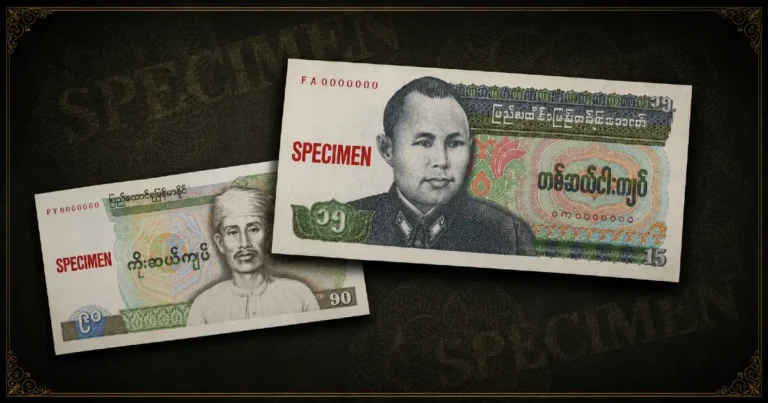
- Historical Context: The absolute final chapter of currency issued under the name of Burma stands as one of the most eccentric episodes in world numismatics. Driven by the personal beliefs of military chairman General Ne Win, the Union of Burma Bank was ordered to completely abandon standard base-10 counting to issue a non-standard series of Burma odd denomination banknotes. This series consisted of the highly unusual 15, 35, 45, 75, and 90 Kyats notes, whose values were dictated by mystical astrological calculations and numerology. The sudden introduction of these notes was paired with destructive, unannounced demonetization decrees that instantly wiped out the personal cash savings of millions of ordinary citizens. This economic shock directly fueled the massive public protests of 1988, which permanently closed the door on this monetary era. To explore the complex history and design profiles of this series, check out our reference: Burma Odd Denomination Banknotes: 1985-1987 Unusual Notes.
📊 Matrix II: Post-Independence Burma Issues Summary Table
To trace the rapid denominational changes following the end of colonial rule, the following index provides a consolidated Burma paper money catalog reference mapping the sovereign transition from the restoration era directly into decimalized currency standards.
| Historical Era | Issuing Authority | Base Currency | Denominations | Key Iconographic |
|---|---|---|---|---|
| 1948 Independence Bridge | Government of Burma | 2nd Rupee Restoration | 1, 5, 10, 100 Rupees | Dancing peacock & Chinthe lion |
| 1953 Rupee Series | Union Bank of Burma | 2nd Rupee Restoration | 1, 5, 10, 100 Rupees | Dancing peacock & Chinthe lion |
| 1953 Kyat Series | Union Bank of Burma | Kyat Standardization | 1, 5, 10, 100 Kyats | Dancing peacock & Chinthe lion |
| 1958 Portrait Era | Union Bank of Burma | Kyat Standardization | 1, 5, 10, 20, 50, 100 Kyats | Aung San |
| 1965 Portrait Era | Peoples Bank of Burma | Kyat Standardization | 1, 5, 10, 20 Kyats | Aung San |
| 1972 – 1979 Portrait Era | Union of Burma Bank | Kyat Standardization | 1, 5, 10, 25, 50, 100 Kyats | Aung San |
| 1985–1987 Numerology Era | Union of Burma Bank | Kyat Standardization | 15, 35, 45, 75, 90 Kyats | Aung San / Independence leaders |
The Central Bank of Myanmar Era (1990–Present)
The modern era of contemporary paper currency was officially inaugurated following the political transformations of the late 1980s, stabilizing the issuing framework under a single corporate entity.
• Myanmar Banknotes: Central Bank of Myanmar Catalog Guide
- Issuing Authority: Central Bank of Myanmar
- Historical Context: In 1989, the newly formed State Law and Order Restoration Council formally changed the country’s official English designation from the “Socialist Republic of the Union of Burma” to the “Union of Myanmar”. This constitutional renaming permanently closed the historical Burma catalog, transitioning all subsequent currency engineering under the authority of the Central Bank of Myanmar.
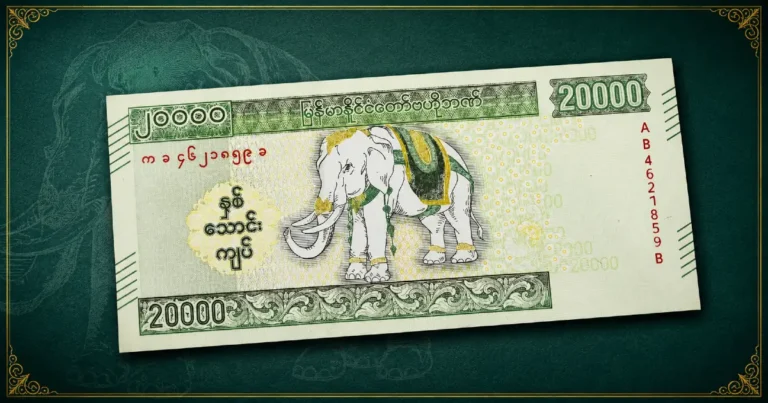
This modern family stabilized national commerce by returning to a predictable, base-10 system, opening a highly sophisticated chapter in Burma paper money history. This sequence forms the final segment of our Burma paper money catalog, famous for long-running series featuring the iconic Chinthe lion banknotes, the 2004 compact downsized notes, high-value 5,000 and 10,000 Kyat banknotes, the historic return of General Aung San’s portrait in 2020, and the celebrated 2023 commemorative 20,000 Kyat banknote. To study the full contemporary catalog from Pick 67 to the present day, explore our definitive modern guide: Myanmar Banknotes: Central Bank of Myanmar Catalog Guide.
5. Conclusion: Building a Historical Burmese Type Set
For modern numismatists and currency specialists, exploring Burma paper money history covered in this Burma banknotes guide offers one of the most rewarding and intellectually stimulating areas of study in global paper money collecting. The sheer volume of institutional changes—spanning from British colonial boards to wartime state banks, socialist revolutionary institutions, and the modern Central Bank of Myanmar—means that tracing this comprehensive Burma paper money catalog is akin to holding a physical piece of twentieth-century history in your hands.
Because many of the post-independence issues and modern commemorative series remain remarkably accessible and budget-friendly in crisp, uncirculated conditions, introductory collectors can easily assemble a comprehensive, highly impressive “type set”. When launching your collection, target a single core note from each of the major issuer blocks established in this guide, focusing heavily on protecting the delicate paper stocks from tropical humidity.
Whether your interest is captured by the elegant dancing peacock of the 1938 British series, the mystical numerological choices of the 1985–1987 odd-value family, or the state-of-the-art security features of the 2023 modern 20,000 Kyat elephant issue, you are preserving the paper legacy of a nation defined by extraordinary change. To cross-reference specific plate varieties, prefixes, and watermarks across these complex eras, you can easily filter your collection using our complete Burma paper money catalog database.
🏛️ Step into the NumisAsia Selling Vault
Ready to acquire investment-grade, certified paper currency from these historic eras? Visit our marketplace directory to purchase authentic, independently graded entries for your collection: Shop Certified Burmese Banknotes.