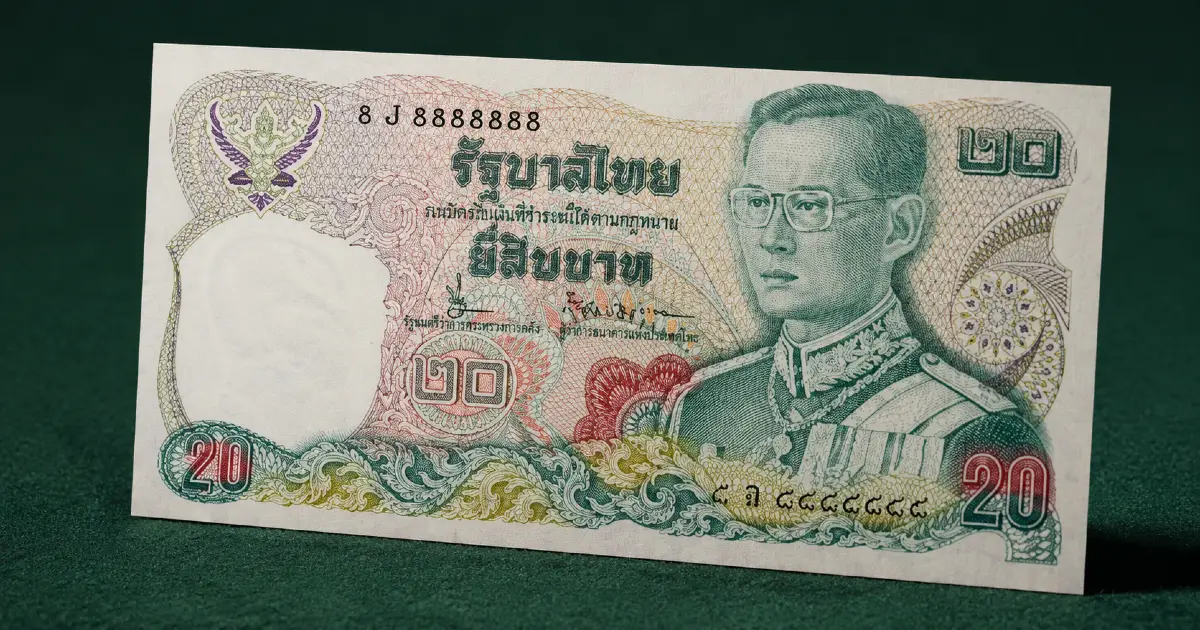
Fancy serial numbers are among the most popular and widely collected specialties in paper money collecting. Unlike ordinary banknotes, these notes feature unusual, memorable or visually appealing serial-number patterns that make them stand out to collectors. Familiar examples include solid serial numbers, ladder serial numbers, radar serial numbers, repeaters, low serial numbers and combinations that occur much less frequently than ordinary serials from the same issue.
For many collectors, the attraction lies in recognising a pattern and then finding a desirable example in an appropriate banknote and grade. Some collectors concentrate on one category, such as low numbers or radars, while others pursue culturally significant numbers such as 786, repeated eights or repeated nines. Two otherwise comparable banknotes can attract very different levels of demand when one carries a recognised fancy serial number, although the number alone does not determine value.
This guide explains the principal types of fancy serial numbers, broader semi-fancy and collector-market terminology, how rarity and desirability are assessed, and the factors that can influence value. Whether you are new to fancy serial number banknotes or developing an advanced collection, understanding these categories can help you evaluate collectible serials across Asian and world paper money.
Have a banknote serial number you would like to examine? Enter the complete prefix and serial in the NumisAsia Fancy Serial Number Checker to identify supported patterns such as solids, radars, repeaters, ladders, low numbers and prefix-enhanced combinations.
Table of Contents
What Are Fancy Serial Numbers?
A fancy serial number is a banknote serial number with an unusual, structured, symmetrical, sequential, culturally meaningful or otherwise desirable arrangement. Every issued banknote normally carries a serial number for identification and production control, but only a small proportion display combinations that attract specialised collector interest.
Some categories have precise mathematical definitions. A radar reads identically forwards and backwards, for example, while a true solid uses one repeated digit throughout the principal serial. Other expressions are less formal and may vary between dealers, grading services and regional collecting communities. This difference is important when comparing descriptions or deciding whether a particular note fits a recognised category.
The serial number should also be considered in the context of the banknote on which it appears. The same numerical pattern may have different availability and collector appeal depending on the issuing authority, denomination, series, prefix system, size of the print run and whether the issuer retained low or special numbers.
What Makes a Serial Number Fancy?
There is no single test covering every type of fancy number. Collectors generally look for one or more of the following characteristics:
- Repeating digits, such as 555555 or 7777777
- Complete ascending or descending sequences, such as 123456 or 7654321
- Symmetrical arrangements, such as 124421
- Repeating blocks, such as
258258or12341234 - Very low serial numbers, such as 000001 or 000008
- High numbers near the end of a known numbering sequence
- Milestone and trailing-zero numbers, such as 500000 or 1000000
- Rotationally symmetrical numbers, such as 108801
- Dominant repeated digits, pairs, triples or bookend patterns
- Culturally meaningful sequences, such as 786 or groups of auspicious digits
The mathematical frequency of a pattern can influence scarcity, but scarcity alone does not guarantee demand or value. A clearly recognised pattern on an attractive banknote will generally be easier for collectors to understand than an obscure arrangement that requires a complicated explanation.
Fancy, Semi-Fancy, Lucky and Special Serial Numbers
Collectors and dealers may use broad expressions such as lucky serial number banknotes, special serial number banknotes, golden serials, fancy number notes or auspicious serial numbers. These are generally collector-market or branding descriptions rather than universally defined mathematical categories.
Lucky serial number banknotes are usually sought because their digits carry cultural, religious or personal meaning. Repeated eights may appeal to collectors who associate the number with prosperity, while repeated nines can be particularly attractive in Thailand. The number 786 is collected in parts of South Asia and other markets because of its cultural and religious associations. Demand for these numbers can be strong, but it varies by country and collecting community.
The expression semi-fancy serial number is also informal. It commonly describes an attractive or memorable serial that does not fit one of the strictest traditional categories. Near solids, bookends, repeated pairs, partial consecutive sequences and long runs of the same digit may all be described as semi-fancy numbers. A semi-fancy serial can still be desirable, especially when the pattern is visually strong, but the expression should not be treated as a formal grading-service pedigree.
“Special serial number” can operate as an umbrella expression covering both strictly defined fancy patterns and broader collector-market numbers. When buying or selling, the precise pattern should therefore be stated instead of relying only on general descriptions such as lucky, golden, special or semi-fancy.
Why Collectors Seek Fancy Serial Numbers
Fancy serial numbers allow collectors to build collections across countries, denominations, issuers and historical periods. Unlike a collection limited to one nation or series, a serial-number collection can follow a numerical idea wherever it appears.
Some collectors pursue a single category, such as solids, ladders or low numbers. Others seek one representative note from each major pattern. Cultural preferences can also shape a collection: one person may focus on repeated eights, another on Thai serials containing nines, and another on 786-related numbers from South Asia.
The challenge is part of the appeal. Collectors may search dealer inventories, auction catalogues, fresh banknote bundles and everyday circulation for years before finding a suitable example. Premium certified notes can be particularly difficult to locate because both the serial number and the condition must satisfy the collector.
Fancy Serial Numbers vs Regular Banknotes
Most banknotes carry ordinary serial numbers allocated during production. These notes may still be collectible because of their design, history, issuing authority, scarcity, variety or condition, but the serial itself is not usually the primary attraction.
Fancy serial number banknotes derive part of their desirability from the serial pattern. Even a common modern note can become a specialist collectible when it bears an exceptional solid, ladder, radar, low number or combination. Conversely, an attractive serial does not erase the importance of the underlying banknote. Collectors normally assess the note and the number together.
For some specialists, the serial number becomes the main collecting focus. For others, it is an additional feature that enhances an already desirable type, denomination or historical issue.
Types of Fancy Serial Numbers
Collectors use numerous categories to describe desirable serial-number patterns. Some have strict mathematical definitions and broad international recognition; others are regional or informal market terms. The following sections explain both the principal fancy serial numbers and the additional semi-fancy patterns identified by the NumisAsia checker.
Solid Serial Numbers
A solid serial number occurs when every digit in the principal serial is identical. Examples include 333333, 7777777 and 88888888. The prefix is not counted when determining whether the principal serial itself is a standard solid.
Within a complete serial range of a fixed length, there are normally nine non-zero solids:
- 6-digit solids: 111111, 222222, 333333, 444444, 555555, 666666, 777777, 888888, 999999
- 7-digit solids: 1111111, 2222222, 3333333, 4444444, 5555555, 6666666, 7777777, 8888888, 9999999
- 8-digit solids: 11111111, 22222222, 33333333, 44444444, 55555555, 66666666, 77777777, 88888888, 99999999
The actual number issued or available to collectors can be lower because numbering practices differ. A series may not use every possible serial, and an issuer may retain, destroy or specially distribute certain numbers.
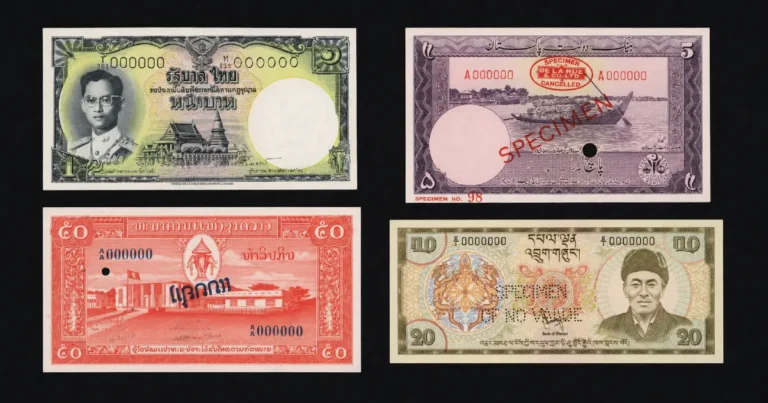
An all-zero serial, such as 000000 or 00000000, is treated separately rather than as an ordinary circulating solid. Depending on the issuer and issue, an all-zero serial may occur on a specimen, sample, test note, presentation item or another non-standard product. The number alone is not enough to determine the status or authenticity of the banknote.
Super Solid Serial Numbers
A Super Solid occurs when the numerical characters in the prefix match the repeated digit in the solid principal serial. Examples include B/88 888888, 9A 9999999 and 55A 555555. Letters and separators do not need to match; only the relevant numerical prefix characters and the serial digits are compared.
Super Solids are more restrictive than standard solids because the prefix and principal serial must align. Their true availability depends on the issuing authority’s prefix format and production system, so a universal probability should not be applied across every country and series.
The distinction between Solid and Super Solid is useful when describing the entire printed serial. A note can be a true Solid without being a Super Solid, while a qualifying Super Solid represents a stronger pattern extending into the prefix.
Serial Number 1 and Low Serial Numbers
Low serial numbers are associated with the beginning of a numbering sequence. Leading zeroes remain important because 000007 is visually and structurally different from an ordinary number containing 7 elsewhere in the sequence.The NumisAsia classification separates low numbers into practical tiers:
- Serial Number 1: a serial representing
1, such as000001 - Low Serial Number 2–10: examples include
000002,000007and000010 - Low Serial Number 11–100: examples include
000022and000100 - Low Serial Number 101–1000: a broader collector-market category including numbers such as
000888or001000
PMG recognises qualifying serial numbers 1 through 10 as a formal category. Numbers above 10 may still attract collector interest, particularly when they contain strong leading zeroes or culturally appealing digits, but they should not automatically be represented as carrying the same formal pedigree.
The lower the number, the more immediate its visual and numerical significance tends to be. Nevertheless, demand also depends on whether the note was actually available to collectors. In some issues, the earliest numbers may have been reserved for officials, presentation sets, charities or institutional archives.
High Serial Numbers
High serial numbers appear near the upper end of a numbering sequence. They may appeal to collectors building first-and-last-number sets or seeking notes associated with the completion of a prefix block.
Unlike low numbers, high numbers cannot always be identified from digit length alone. The terminal serial may vary by country, printer, denomination and series. A number such as 999999 may be the end of one system, while another system may continue to 1000000 or use a different rollover arrangement.
The NumisAsia checker can flag a number close to the all-nines limit for its digit length, but the result should be treated as a possible High Serial until the actual print-run structure is known. Documentary or series-specific information remains necessary when claiming that a note is the final issued number.
Million, Multi-Million and Trailing-Zero Serials
Milestone numbers are visually memorable because they consist of a significant opening number followed by a long block of zeroes. PMG describes a Million Serial as a number from 1 through 100 followed by six zeroes.
For clearer results, the NumisAsia checker distinguishes several forms:
- One Million Serial: exactly
1000000 - Multi-Million Serial: a whole number from 2 through 99 followed by six zeroes, such as
2000000or81000000 - Ten Million Serial: exactly
10000000 - One Hundred Million Serial: exactly
100000000
In Indian and South Asian collecting, hundred-thousand milestones such as 100000, 500000 and 900000 may be described as lakh serial numbers. Outside those markets, “hundred-thousand serial” or “trailing-zero serial” may be clearer.
A Trailing-Zero Serial is a broader classification for a number ending in a substantial uninterrupted block of zeroes without necessarily qualifying as a million serial. Examples include 123000, 450000 and 7600000. The longer and more visually dominant the zero block, the more noticeable the pattern becomes.
Ladder Serial Numbers
A ladder serial number contains digits that move consecutively across the complete principal serial. The progression may be ascending or descending.
Ascending Ladders
An Ascending Ladder increases by one digit at each position.
- 6-Digit Options:
012345,123456,234567,345678, and456789 - 7-Digit Options:
0123456,1234567,2345678, and3456789
Among these variations, sequences starting with one—such as 123456 or 1234567—remain the most coveted due to their iconic, straightforward progression. Some advanced portfolios expand the theme to include zero-terminating sequences like 567890 or 4567890, though traditionalists generally prefer standard strings.
Descending Ladders
A Descending Ladder decreases by one digit at each position.
- 6-Digit Options:
987654,876543,765432,654321, and543210 - 7-Digit Options:
9876543,8765432,7654321, and6543210
The numeric strings ending in one—specifically 654321 and 7654321—stand as the premium choices for descending variants, providing a visually striking countdown. While some collectors include leading-zero patterns like 098765 or 0987654, traditionalists typically stick to standard sequences.
Consecutive Ascending and Descending Runs
A serial may contain a consecutive run without being a complete ladder. For example, 451234 contains the ascending sequence 1234, while 987612 contains the descending sequence 9876.
The checker identifies a Consecutive Ascending or Consecutive Descending pattern when a sufficiently long run appears within the serial but does not occupy the entire number. These are useful semi-fancy descriptions, although they should not be confused with full Ascending or Descending Ladders.
Radar Serial Numbers
Radar serial numbers, also known as palindrome, read exactly the same forwards and backwards.
- 6-Digit Radar Examples:
123321,523325, and856658 - 7-Digit Radar Examples:
1234321,5237325, and8569658
Radars are popular because the symmetry is clear without calculation. A six-digit radar has three digits mirrored in reverse order; an odd-length radar has a central digit surrounded by mirrored digits.
Super Radar Banknotes
A Super Radar has matching outer digits and a solid inner block composed of one different repeated digit.
- 6-Digit Super Radar Example:
122221,533335, and855558 - 7-Digit Super Radar Example:
1222221,5333335, and8555558
The structure creates both symmetry and a strong central run. Depending on the serial, the checker may also identify a separate in-a-row or Non-True Binary characteristic, but Super Radar remains the stronger primary classification.
Radar Repeaters
A Radar Repeater satisfies both definitions: it reads the same forwards and backwards and contains a repeated block. Examples include 383383, 494494, 808808 and 101101.
This combination is stronger than an ordinary radar or repeater considered separately, so the checker displays Radar Repeater as the principal type and suppresses redundant subordinate labels where appropriate.
Repeater Serial Numbers
A Repeater contains a block of two or more digits repeated across the principal serial. The repeated block must cover the complete serial, rather than merely appearing twice somewhere within an otherwise unrelated number.
Examples include 258258 — the block 258 repeats twice, 369369 — the block 369 repeats twice, and 12341234 — the block 1234 repeats twice.
Different structural forms are commonly distinguished by collectors.
Staggered Repeaters
A Staggered Repeater uses a repeated three-digit block in an AAB or ABB arrangement. Examples include 447447, 477477, and 008008.
The name describes the offset placement of the two digits within the repeated unit.
Super Repeaters
A Super Repeater uses an alternating two-digit block repeated at least three times. Examples include 242424, 868686, and 35353535.
The repeating unit is shorter and appears more frequently than in a standard two-part repeater, creating a particularly strong visual rhythm.
Prefix-Enhanced Fancy Serial Numbers
Some banknote prefixes contain numerical characters that complete, extend or strengthen a pattern. Because collectors may not know where the prefix ends, the NumisAsia checker accepts the complete printed serial and evaluates the principal serial together with relevant numerical prefix characters.
For example, the numerical prefix and serial in 12A 3888321 combine as 123888321, creating a Prefix-Enhanced Radar. The principal serial also contains a Three-in-a-row pattern, which can be listed separately.
Supported prefix-enhanced descriptions include:
- Prefix-Enhanced Super Radar
- Prefix-Enhanced Radar Repeater
- Prefix-Enhanced Radar
- Prefix-Enhanced Staggered Repeater
- Prefix-Enhanced Super Repeater
- Prefix-Enhanced Repeater
PMG may use “Super” for a qualifying pedigree created or strengthened by the prefix. NumisAsia uses “Prefix-Enhanced” in many checker results to show clearly what the numerical prefix contributes. A Super Solid remains separately identified when every numerical prefix digit matches the solid principal serial.
Ascending, Descending and Repeating Pairs
Pair patterns divide an even-length serial into adjacent double-digit groups.
- Ascending Pairs: repeated pairs rise in sequence, as in
112233or223344 - Descending Pairs: repeated pairs fall in sequence, as in
332211or554433 - Repeating Pairs: the serial consists entirely of adjacent repeated pairs without a complete ascending or descending order, as in
112211or337744
These patterns are generally broader collector-market or semi-fancy classifications rather than the central traditional pedigrees. Their appeal depends on how clearly the paired structure appears.
Repeating Triples and Double Leopard Numbers
A Repeating Triples pattern consists entirely of solid three-digit groups. Examples include 111222333 and 444777999.
When a six-digit serial consists of two different solid three-digit groups, such as 111222 or 555888, it may be described as a Double Leopard in markets that use animal-name terminology. The name is informal and should be accompanied by an objective description of the number.
Near Solid Serial Numbers
A Near Solid contains one dominant digit in every position except one. Examples include 333331, 5555551 and 88888881.
If the dominant digits form one uninterrupted run, the in-a-row description is usually more informative than Near Solid. Thus:
333331is best described primarily as Five-in-a-row5555551is best described primarily as Six-in-a-row88888881is best described primarily as Seven-in-a-row
Near Solid is more useful when the different digit interrupts the repeated sequence, as in 888188 or 7772777. The checker prioritises the clearest structural description and avoids displaying redundant matches where possible.
Three-in-a-row and Longer Repeated Runs
An in-a-row pattern occurs when the same non-zero digit appears consecutively three or more times within the principal serial. The checker can describe runs from Three-in-a-row through Twelve-in-a-row, depending on the serial length.
Examples include 123338 — Three-in-a-row, 444411 — Four-in-a-row, 333331 — Five-in-a-row, 5555551 — Six-in-a-row, and 88888881 — Seven-in-a-row.
When the repeated block occurs at the end of the number, some Asian collector markets use animal names:
- Leopard Number: last three digits are identical
- Lion Number: last four digits are identical
- Tiger Number: last five digits are identical in some markets
- Elephant Number: last six digits are identical in some markets
- Dinosaur Number: often used for seven identical ending digits, although some sources apply the term differently
These names are regional and inconsistent. The objective “Five-in-a-row ending” or “Seven-in-a-row ending” description should therefore accompany or take priority over the animal term.
Bookend Serial Numbers
A Bookend begins and ends with the same block of at least two digits, with different digits between the matching ends. Examples include 128812, 453345 and 120012.
Some bookends also qualify as radars or repeaters. When a stronger complete pattern exists, the checker gives that pattern priority and may suppress Bookend as redundant. Bookend is most useful when the matching outer blocks are clear but the entire serial is not palindromic.
Culturally Significant Serial Numbers
Some serial numbers are collected because of cultural, religious, linguistic or personal associations rather than mathematical structure.
The 786 Sequence
The number 786 is widely recognised in parts of South Asia and in some Muslim collecting communities through its numerological association with the Arabic phrase “Bismillah al-Rahman al-Rahim.” Banknotes containing 786, including 000786 or 786000, may be marketed as 786 Numbers.
A serial such as 786786 is structurally stronger because it is both a Repeater and a 786 Repeater. Demand and premiums vary by region, denomination, issuing authority, condition and the placement of the digits.
Auspicious Eights, Nines and Other Numbers
In many Chinese-speaking communities, the number eight is associated with prosperity and good fortune. Numbers such as 000888, 008888 and solid 888888 serials can therefore attract particular interest.
In Thailand, repeated nines may appeal to collectors because nine has positive linguistic and cultural associations. A solid 999999 or 9999999 can combine the mathematical rarity of a Solid with strong regional demand.
Other combinations, including 168, may be promoted as auspicious in particular markets. These cultural descriptions should be distinguished from objective patterns. A sequence is not automatically rare or valuable merely because it carries a favourable association.
Birthday and Historical Date Serial Numbers
Some collectors seek six- or eight-digit serials that correspond to birthdays, anniversaries or historical dates. Possible formats include DDMMYY, MMDDYY, YYMMDD and longer year formats.
Date interpretation is inherently contextual. A number such as 010203 could represent more than one date depending on the format and country. Personal birthday notes may be meaningful to a particular buyer but have limited demand outside that connection. Historical dates can attract broader interest when the event and format are immediately recognisable.
For these reasons, the NumisAsia checker does not automatically label possible dates. The guide includes them as a collecting theme, not as an objective numerical pedigree.
Combination Fancy Serial Numbers
A single serial can satisfy several definitions at once. Combination numbers are particularly interesting because they appeal to collectors of more than one pattern.
The serial 808808, for example, can be analysed as:
- Radar: it reads identically forwards and backwards
- Repeater: the block
808appears twice - Rotator: it remains unchanged after a 180-degree rotation
- Non-True Binary: it contains exactly two digits, 0 and 8
The most useful primary description is Radar Repeater, with Rotator and Non-True Binary recorded as additional characteristics. This avoids presenting several overlapping labels as though they were unrelated patterns.
Other combinations include Binary Repeaters, Radar Rotators, Super Radars with long repeated runs and Prefix-Enhanced patterns. A combination can be scarcer than either component alone, but market demand still depends on how clearly collectors recognise and value the arrangement.
No Supported Fancy Pattern
Not every unusual-looking serial satisfies a supported definition. When the checker displays an em dash as the type and states that no supported fancy serial-number pattern was detected, it does not mean that the banknote is uncollectible or valueless. It means only that the numerical serial does not match one of the tool’s programmed categories.
The banknote may still be scarce because of its issue, variety, historical importance, error, replacement status or condition. Serial-number analysis is only one part of evaluating paper money.
You can check your banknote serial number by entering the complete printed prefix and serial. The checker identifies supported patterns but does not authenticate, grade or value the banknote.
PMG-Recognized Fancy Serial Numbers
Paper Money Guaranty describes fancy serial numbers as “special” serial numbers and offers qualifying pedigrees for recognised categories. Its published guide includes Ascending and Descending Ladders, Binary Serial Numbers, Million Serial Numbers, Radars, Repeaters, Serial Numbers 1 through 10, Solids, Rotators, combinations and certain Super pedigrees created or strengthened by prefix digits.
PMG’s definitions do not encompass every expression used in dealer listings or regional markets. Terms such as Non-True Binary, Near Solid, Bookend, Leopard, Lion, Tiger, Elephant and Dinosaur may be useful collector descriptions without constituting a formal PMG pedigree.
The distinction should be stated clearly. A result from an online checker is an identification aid, not confirmation that PMG or another grading service will place the same wording on its holder. Grading companies apply their own policies and may impose exclusions or attribution requirements.
Certification can provide an independent opinion regarding authenticity and condition and, where applicable, a recognised serial-number pedigree. It does not guarantee rarity, market liquidity, future demand or value. Collectors considering submission should review the current grading service requirements and the likely benefit relative to submission costs.
Read the Paper Money Guaranty guide to fancy serial numbers for its published definitions and examples.
How Fancy Serial Numbers Are Valued
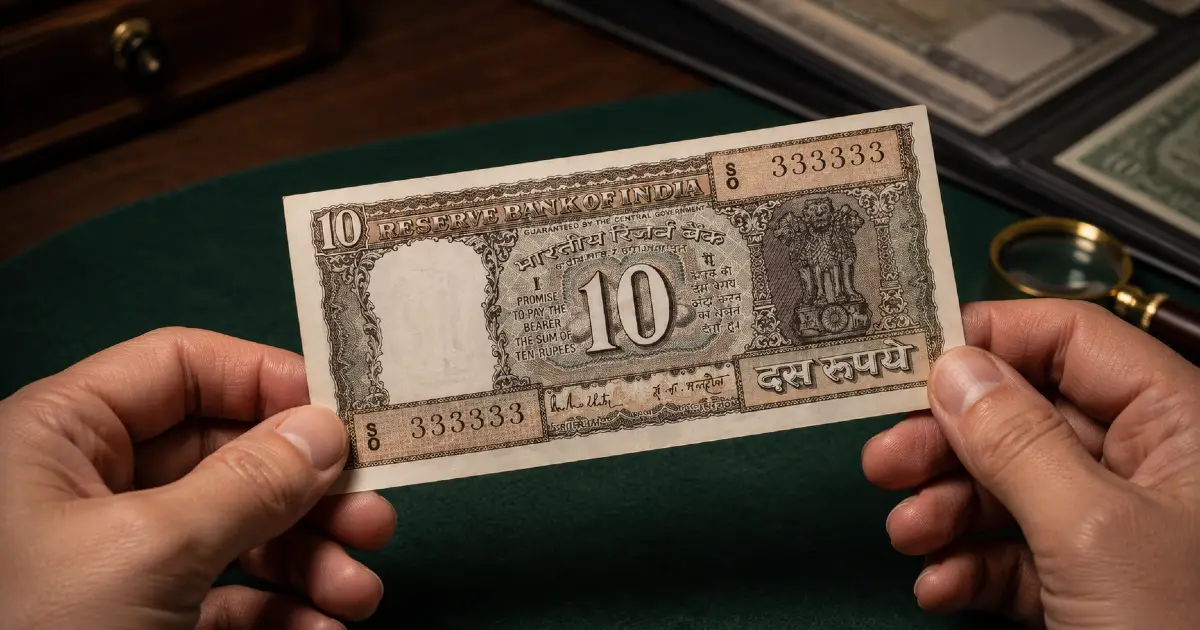
Not all fancy serial numbers are equally desirable. Value is influenced by the interaction between the pattern, the underlying banknote, condition, availability and collector demand. A visually impressive number can add interest to a common banknote, but it should not be assessed without considering the complete item.
Understanding how experienced collectors evaluate these factors can help buyers distinguish established categories from loosely marketed patterns. Collectors new to assessing scarcity may also find it helpful to learn how banknote rarity is determined.
Mathematical Frequency vs. Collector Demand
Mathematical frequency is a useful starting point, but it is not the same as market rarity. A theoretical pattern may occur only a limited number of times within a full numbering range, yet some of those notes may never have been issued, survived or become available to collectors.
Recognised categories such as true solids and complete ladders have immediate visual appeal and are easy to explain. Other patterns may be mathematically unusual but attract limited interest because collectors do not widely pursue them. Conversely, a culturally meaningful serial may attract strong regional demand even when its mathematical structure is less restrictive.
The relevant questions include:
- How many examples could theoretically occur?
- How many were likely printed in the particular issue?
- Were special numbers withheld or distributed separately?
- How many examples are known or available?
- Is the pattern widely recognised by collectors?
- Does the number have cultural or historical significance?
The strongest demand often develops where scarcity, clarity and collector recognition coincide.
Market Trends and Regional Preferences
Serial-number demand is not uniform. Regional preferences can influence which digits and patterns attract the most interest.
Repeated eights are popular in many Chinese-speaking communities because of their association with prosperity and good fortune. A solid 888888 may therefore combine a strict fancy pattern with cultural demand. Repeated nines can have particular appeal in Thailand, while 786-related numbers are collected in parts of South Asia and other markets.
These preferences do not establish a fixed premium. Demand may change according to country, denomination, note design, buyer population and the prominence of the digits. A small group of repeated eights embedded in an otherwise ordinary number is different from a true Solid or a long in-a-row sequence.
Collectors should distinguish cultural appeal from universal rarity. Both can contribute to desirability, but they operate in different ways.
The Importance of the Underlying Banknote
Collectors do not evaluate a serial number in isolation. The banknote itself can have a substantial effect on demand and value.
A fancy number on a common modern circulation note may be accessible to many collectors, while the same category on a scarce historical issue can be considerably more difficult to obtain. Issuing authority, denomination, date, signature combination, variety, replacement status and historical context can all matter.
For example, fancy serials on banknotes from Hong Kong, India, Malaysia, Singapore or Thailand may attract collectors who already specialise in those countries. When a sought-after serial appears on an independently scarce type, both attributes contribute to the note’s appeal.
Collectors interested in developing a focused strategy may also find value in building a banknote collection around particular countries, periods or numerical themes.
Condition, Grade and Eye Appeal
Condition is one of the most important factors affecting the desirability of a fancy serial number banknote.
A heavily circulated note can remain collectible because of an exceptional number, but an example with original paper, strong colour, sharp corners and minimal handling will generally appeal to a wider group of buyers. Folds, stains, tears, pinholes, repairs, pressing and other alterations may reduce demand.
The visual placement and clarity of the serial can also matter. A well-centred, sharply printed number is easier to appreciate than one affected by poor registration, ink weakness or damage. On banknotes carrying two serials, collectors may consider whether both are visible and consistent.
Understanding how banknotes are graded and authenticated can help collectors assess condition more carefully. Those unfamiliar with certified notes may also wish to review the PMG and PCGS 1–70 grading scale.
Third-Party Certification
Certification from services such as PMG or PCGS Banknote can provide an independent opinion concerning authenticity and condition. A recognised fancy-serial pedigree may also make the pattern easier for future buyers to identify.
Certification is most relevant when the banknote, serial number and expected market interest justify the cost. It does not automatically make a common or weak pattern rare, and it does not guarantee that a grading service will use the same terminology as a dealer or online checker.
Before submitting a note, consider:
- Whether the pattern is recognised by the grading service
- Whether a special attribution must be requested
- The likely grade and presence of problems
- Submission, insurance and shipping costs
- The value and scarcity of the underlying banknote
- Whether certification would materially improve confidence or marketability
Prefixes and Complete Serial Numbers
Prefixes can affect the interpretation of a fancy number. A principal serial may be ordinary by itself but form a radar or repeater when numerical prefix characters are included. Conversely, letters and separators may simply identify the print run without changing the pattern.
When recording or offering a banknote, show the entire printed serial rather than only the numerical core. This allows collectors to verify whether a claimed Super or Prefix-Enhanced pattern is complete. Clear photographs should show the prefix, serial and surrounding design without obstruction.
Common Pitfalls to Avoid
New collectors sometimes assume that any unusual or memorable number must be rare and valuable. In practice, value depends on more than novelty.
Before paying a premium, consider:
- Whether the description follows a recognised definition
- Whether the complete serial or only a selected portion creates the pattern
- Whether the prefix has been interpreted correctly
- Whether leading zeroes have been included
- Whether regional terminology is being presented as universal
- Whether the banknote itself is common or scarce
- The condition, authenticity and presence of repairs
- Comparable sales for similar notes rather than asking prices alone
- Current demand for the particular country and serial category
Marketing expressions such as “ultra rare,” “golden number,” “investment grade” or “one of a kind” should not replace careful analysis. A seller should explain the objective pattern and allow the buyer to evaluate its relevance.
Collectors should also remember that not every unusual number commands a premium. Understanding the key factors that influence banknote rarity can help distinguish established scarcity from an arrangement that merely appears uncommon.
By considering the serial, banknote, condition, issuing authority, availability and collector demand together, buyers can make more informed decisions and build collections based on knowledge rather than promotional language.
Building a Fancy Serial Number Collection
One of the attractions of fancy serial number collecting is the range of possible approaches. A collection can focus on strict mathematical patterns, regional preferences, a single country, one grading-service pedigree or a broader selection of memorable numbers.
A clear strategy helps collectors compare prospective purchases and avoid acquiring every loosely described “special” number they encounter.
Building a Collection by Serial Number Type
Many collectors begin with the major internationally recognised categories:
- Solid and Super Solid serial numbers
- Serial Number 1 and low serial numbers
- Ascending and Descending Ladders
- Radar and Super Radar serial numbers
- Repeater and Radar Repeater serial numbers
- Binary and Rotator serial numbers
- Million and other milestone serials
An expanded collection may add Near Solids, in-a-row patterns, bookends, pairs, triples, Prefix-Enhanced numbers and culturally significant serials.
Collecting one example of each major type provides a useful introduction to how the patterns differ. A specialist may later concentrate on a single category and seek different countries, digit lengths, denominations or prefix combinations.
Building a Collection by Country or Region
Another approach is to focus on one country, region or issuing authority. Collectors may specialise in:
- Hong Kong
- India
- Malaysia
- Singapore
- Thailand
- Burma/Myanmar
- Other Asian or world paper money issues
This approach combines serial-number collecting with the history, designs and production systems of the chosen country. It can reveal meaningful differences in prefix construction, number length, replacement-note practices and the availability of early or milestone numbers.
A country-focused collection may also be more coherent visually than a worldwide group, while still allowing the collector to pursue several numerical patterns.
Building a Collection Around Cultural Significance
FFor some collectors, the meaning of a number is more important than its mathematical structure. Possible themes include:
- 786-related numbers
- Repeated eights or serials containing 168
- Repeated nines on Thai banknotes
- Birth dates and anniversaries
- Independence dates or major historical events
- Numbers associated with personal milestones
Culturally significant collections can be highly personal and rewarding. However, the collector should recognise that a number meaningful in one market may have limited demand elsewhere.
Building Prefix-Enhanced Sets
Prefixes offer an advanced collecting theme. A collector might seek examples where the prefix transforms an ordinary principal serial into a radar, repeater or other complete pattern.
Such sets require careful documentation because the entire prefix-and-serial arrangement is essential. High-quality photographs and accurate descriptions are particularly important. It may also be useful to record the issuing authority’s prefix conventions so that another collector can understand why the combined pattern qualifies.
Focusing on Quality Rather Than Quantity
As collectors gain experience, many become more selective. Rather than pursuing every available fancy or semi-fancy number, they may concentrate on:
- Better-condition notes
- Stronger and more recognisable patterns
- Scarcer countries or issues
- Attractive serial placement and printing
- Certified examples where certification adds useful confidence
- Notes combining serial interest with historical or numismatic importance
A smaller collection of carefully selected notes can be more coherent and rewarding than a large group assembled without clear standards.
Setting a Budget and Comparing Examples
Fancy serial prices can vary considerably, especially where cultural demand or a rare banknote type is involved. Establishing a budget helps prevent the serial number from overshadowing condition or the underlying note.
When possible, compare examples with the same pattern, country, denomination and approximate grade. A solid on a common modern note is not directly comparable with a solid on a scarce colonial issue.
Setting Long-Term Collecting Goals
Successful collections are often built around clear objectives. Possible goals include:
- One example of every major fancy serial category
- A type set of solids, radars and repeaters from one country
- A collection of Serial Number 1 and low-number notes
- A group of Super Solid or Prefix-Enhanced notes
- A collection built around culturally significant digits
- A high-grade certified fancy-serial collection
Patience and selectivity are usually more important than quantity. Defining the purpose of the collection makes it easier to recognise a suitable acquisition and decline notes that do not contribute to the overall theme.
Recording and Protecting the Collection
Keep a record of the complete serial, prefix, denomination, issuing authority, catalogue number, grade, acquisition source and purchase price. Photographs should show both sides of the banknote and a clear close-up of the serial.
Store banknotes in appropriate archival holders and avoid PVC-containing materials. Handle raw notes carefully and do not attempt cleaning, pressing or repair. The serial number may create collector interest, but preservation remains essential to the long-term quality of the banknote.
Start Collecting Fancy Serial Numbers at NumisAsia
Finding desirable fancy serial number banknotes can be challenging. Strong patterns are often recognised quickly by dealers and collectors, while premium examples may appear only occasionally.
At NumisAsia, we specialise in Asian and world paper money, with particular interest in collectible banknotes selected for their rarity, condition, historical importance or serial-number appeal. Our inventory may include low serial numbers, ladders, radars, repeaters, solids and other notable combinations.
Carefully Selected for Collectors
Finding desirable fancy serial number banknotes can be challenging. Strong patterns are often recognised quickly by dealers and collectors, while premium examples may appear only occasionally.
At NumisAsia, we specialise in Asian and world paper money, with particular interest in collectible banknotes selected for their rarity, condition, historical importance or serial-number appeal. Our inventory may include low serial numbers, ladders, radars, repeaters, solids and other notable combinations.
Authenticity and Confidence
Authenticity is essential when purchasing collectible paper money. Where appropriate, third-party certification can provide additional confidence concerning authenticity and condition. Raw notes should be evaluated using clear images, accurate descriptions and reliable provenance wherever available.
Collectors should still consider the entire banknote. A fancy serial is one attribute among many, and its desirability depends on the note, condition, pattern and market.
Explore Our Fancy Serial Number Banknotes
Whether you are searching for your first fancy serial number banknote or adding a specialised example to an advanced collection, carefully compare the serial pattern, banknote type, grade and price.
Browse our collection of Fancy Serial Number Banknotes to discover currently available examples.