
Asian Date Converter for Banknotes and Coins
Use this Asian Date Converter to convert years found on Asian banknotes and coins into Common Era dates, identify regional calendar systems and read numerals used across Asia.
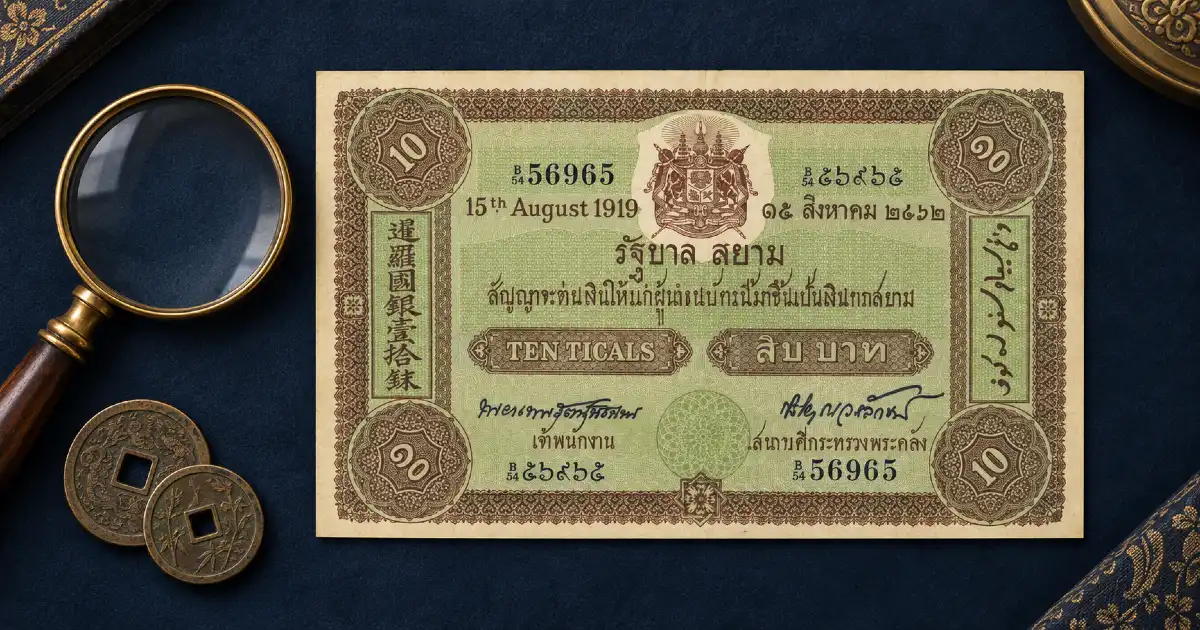
Dates on Asian paper money and coins are not always expressed in the Gregorian calendar. A Thai coin may carry a Buddhist Era year, a Japanese coin may be dated by an emperor’s reign, a Taiwanese issue may use the Republic of China calendar, and an Islamic coin may use a lunar Hijri date. Even when the calendar is known, the printed numerals may be unfamiliar.
This Asian date converter is designed for numismatic year identification. Enter the year exactly as it appears, including supported Asian numerals, select the relevant dating system and convert it into a Common Era year or range. You can also reverse the conversion by entering a CE year. Because several Asian calendars begin during a Gregorian year rather than on 1 January, some results correctly show two possible or overlapping CE years.
For collectors, the reference works as both a banknote date converter and a coin date converter. It also serves as an Asian calendar converter for the supported regional systems and as a Buddhist year converter for dates expressed in the Buddhist Era.
Use the Asian Date Converter
Select the calendar, enter the printed year and review the conversion together with its numismatic context
Please check the date
Conversion result
Entered date
Date system
Result
Think this result may be incorrect? Report a possible error.
The Asian Date Converter converts year information only. It does not identify, authenticate, grade or value a banknote or coin. Results described as approximate or overlapping require the original month, day, country or historical context for an exact date.
How to Use This Asian Date Converter
A year can only be converted correctly when the calendar or reign system is identified
Identify the country
Start with the issuing country or authority. Geography, language and the issuer’s name usually narrow the possible calendar systems considerably.
Select the date system
Choose the calendar or numbered era indicated by the country, inscription or catalogue. Reign-title and repeating-cycle dates are explained separately below.
Enter the printed year
Type Western or supported Asian numerals. The result explains whether the conversion is exact, approximate or one of several possible years.
Avoid choosing a calendar from the size of the number alone. The year 1357, for example, could be an Islamic, Solar Hijri or another regional date depending on the object. Likewise, “Year 15” is meaningless without knowing whether it refers to a Japanese emperor, the Republic of China, Mongolia or another reign or state era.
Systems Included in the Asian Date Converter
The supported systems focus on dates commonly encountered on Asian banknotes, coins and related numismatic material, rather than attempting to include every calendar or local dating convention historically used across Asia.
Buddhist Era
Where used: especially Thailand, and also Buddhist-calendar contexts in Laos and Cambodia. The calculator uses the conventional modern Thai rule: BE − 543 = CE.
Chula Sakarat / Burmese Era
Where used: historical Thailand and Myanmar, with related use elsewhere in mainland Southeast Asia. The year-only reference rule is CS or ME + 638 = CE, subject to the historical new-year date.
Rattanakosin Sok
Where used: Thailand, particularly documents and numismatic material from the Bangkok-era dating period. The conventional rule is RS + 1781 = CE.
Minguo / ROC Era
Where used: Republic of China issues, including Taiwan, and historical mainland Chinese material from the republican period. Minguo year + 1911 = CE.
Japanese Kōki
Where used: Japan and some Japanese-occupation issues. The imperial-year rule is Kōki − 660 = CE. Do not confuse it with Japanese nengō era names.
Juche Era
Where used: North Korea. Juche year 1 corresponds to 1912, so Juche + 1911 = CE. The system was introduced later but numbers years from 1912.
Korean Dangi
Where used: selected South Korean coins, documents and historical material. The conventional conversion is Dangi − 2333 = CE.
Mongolian Republican Era
Where used: early Mongolian republican issues that count from the 1911 independence era. The collector reference rule is numbered year + 1910 = CE.
Indian Vikram Samvat
Where used: India and some neighbouring South Asian contexts. Regional new-year conventions differ, so a printed year normally overlaps CE years VS − 57 and VS − 56.
Kollam / Malayalam Era
Where used: Kerala and related southwest Indian contexts. Because the year begins around August, ME + 824 and ME + 825 are the two overlapping CE years.
Nepalese Bikram Sambat
Where used: Nepal. A BS year begins around April, so the year-only result normally spans BS − 57 and BS − 56 CE.
Nepal Sambat
Where used: Nepal, particularly Newar historical and cultural material. Its new year falls around October or November, giving approximate overlaps of NS + 879 and NS + 880 CE.
Saka / Shalivahana Era
Where used: India and parts of South and Southeast Asia. The year begins in March or April in commonly encountered forms, so SE + 78 and SE + 79 may both be involved.
Islamic Lunar Hijri
Where used: Muslim-ruled and Muslim-majority areas across West, Central, South and Southeast Asia. The tool calculates the approximate CE span of an AH year using a tabular lunar calendar.
Iranian Imperial Era
Where used: Iran for a brief period in the 1970s. The Shahanshahi year retained the Solar Hijri new year but changed the era number; the converter accepts 2535–2537.
Solar Hijri
Where used: Iran and Afghanistan. A Solar Hijri year begins at Nowruz and overlaps SH + 621 and SH + 622 CE.
Common Era / Gregorian
Where used: modern issues throughout Asia, often alongside a national calendar. It is included as a reference and returns the entered CE year unchanged.
Understanding Dates on Asian Banknotes and Coins
Complex reign titles and repeating cycles need more information than a single year number
The Asian Date Converter above is intentionally limited to systems that can produce a useful result from one printed year. The following important systems are not offered in its date-system menu because a second identifier, a historical table or contextual evidence is essential. They remain highly relevant when dating Asian banknotes and coins.
Japanese nengō or imperial era names
A Japanese date combines an era name with an era year. For modern numismatic material, the principal eras are Meiji (1868), Taishō (1912), Shōwa (1926), Heisei (1989) and Reiwa (2019). To obtain the CE year, add the era year minus one to the era’s starting CE year. For example, Shōwa 12 is 1926 + 11 = 1937 CE. The first year may be written 元年, meaning year 1. A transition year can belong to two eras, so the month and day may be necessary.
Chinese imperial nianhao or reign titles
Imperial Chinese dates pair a reign title with a numbered year. The basic method is the same: identify the reign title, find its first CE year, then add the reign year minus one. For example, Guangxu began in 1875, so Guangxu year 20 corresponds broadly to 1894. Exact attribution still requires attention to the lunar new year, accession practices, mint, inscription and whether a coin continued to be made with an older legend. China used many reign titles across numerous dynasties, so a year number without its title cannot be converted responsibly.
Vietnamese reign-title dates
Many Vietnamese coins use an imperial era title rather than a continuously numbered national calendar. First identify the ruler and era name from the characters, then calculate from that era’s first year in the same way as a Chinese nianhao. Some titles resemble Chinese inscriptions, and imitation, private, presentation and later-cast pieces complicate attribution. A specialist Vietnamese cash-coin reference is safer than treating the visible characters as a simple arithmetic date.
Ganzhi stem-branch cycle
The Chinese sexagenary cycle combines one of ten heavenly stems with one of twelve earthly branches to produce 60 names. A designation such as Jiazi (甲子) repeats every 60 years and therefore cannot identify one CE year by itself. Use a known ruler, reign title, issue type or narrow historical period as the anchor, then test candidate years at 60-year intervals. The cycle is also encountered in Japan, Korea and Vietnam under local readings.
Korean imperial era names
Late Korean imperial dates may use Gwangmu (光武), beginning in 1897, or Yunghui (隆熙), beginning in 1907. Add the era year minus one to the starting year: Gwangmu 5 is 1897 + 4 = 1901 CE, while Yunghui 3 is 1907 + 2 = 1909 CE. Because the eras overlap their transition year in calendar terms, a full date may require closer checking.
Tibetan Rabjung cycles
A Tibetan year may be identified by a numbered 60-year Rabjung cycle and a year within that cycle. Both values are needed. For the commonly used numbering beginning with cycle 1, year 1 in 1027 CE, the reference formula is CE = (cycle − 1) × 60 + cycle year + 1026. Thus cycle 16, year 25 gives 1951 CE. Some coins use animal-element year names instead, which repeat and must be anchored by the type and historical context.
Regnal, accession and local lunisolar dates
Some Asian issues count from a ruler’s accession, a revolution, an independence declaration or another local epoch. Others use regional forms of the Saka, Vikram, Buddhist, Islamic or lunisolar calendars whose year boundaries differ from the simplified rules used by a year-only calculator. Ottoman and Turkish material may also require distinguishing lunar Hijri, fiscal Rumi and Gregorian dates. In these cases, identify the issuer and inscription first, consult an authority-specific catalogue, and use a full day-month-year converter when the complete date is present.
No practical web page can list every reign title and local calendar used across all periods of Asian history. The systems above cover the principal additional methods likely to be encountered by collectors, while the calculator focuses on the formulas that remain useful when only a year is known.
Asian Numeral Identification Guide
The Asian Date Converter accepts the numeral systems below, grouped geographically and alphabetized within each region
Reference Digits
Western digits
0 1 2 3 4 5 6 7 8 9 — the normalized form used in conversion results.
Southeast Asia
Khmer
០ ១ ២ ៣ ៤ ៥ ៦ ៧ ៨ ៩
Lao
໐ ໑ ໒ ໓ ໔ ໕ ໖ ໗ ໘ ໙
Myanmar
၀ ၁ ၂ ၃ ၄ ၅ ၆ ၇ ၈ ၉
Shan
႐ ႑ ႒ ႓ ႔ ႕ ႖ ႗ ႘ ႙
Thai
๐ ๑ ๒ ๓ ๔ ๕ ๖ ๗ ๘ ๙
South Asia
Bengali / Assamese
০ ১ ২ ৩ ৪ ৫ ৬ ৭ ৮ ৯
Devanagari
० १ २ ३ ४ ५ ६ ७ ८ ९
Gujarati
૦ ૧ ૨ ૩ ૪ ૫ ૬ ૭ ૮ ૯
Gurmukhi
੦ ੧ ੨ ੩ ੪ ੫ ੬ ੭ ੮ ੯
Kannada
೦ ೧ ೨ ೩ ೪ ೫ ೬ ೭ ೮ ೯
Malayalam
൦ ൧ ൨ ൩ ൪ ൫ ൬ ൭ ൮ ൯
Odia
୦ ୧ ୨ ୩ ୪ ୫ ୬ ୭ ୮ ୯
Tamil
௦ ௧ ௨ ௩ ௪ ௫ ௬ ௭ ௮ ௯
Telugu
౦ ౧ ౨ ౩ ౪ ౫ ౬ ౭ ౮ ౯
East Asia
Chinese / Japanese
〇 一 二 三 四 五 六 七 八 九 — dates may also use 十, 百, 千, 萬 and formal forms such as 零, 壹, 貳 and 參. Japanese 元年 means the first year of an era.
Mongolian
᠐ ᠑ ᠒ ᠓ ᠔ ᠕ ᠖ ᠗ ᠘ ᠙
Tibetan
༠ ༡ ༢ ༣ ༤ ༥ ༦ ༧ ༨ ༩
Central and West Asia
Arabic-Indic
٠ ١ ٢ ٣ ٤ ٥ ٦ ٧ ٨ ٩
Eastern Arabic / Persian
۰ ۱ ۲ ۳ ۴ ۵ ۶ ۷ ۸ ۹
The digit recognizer also normalizes full-width forms such as 0123456789. Korean does not require a separate decimal row: modern Korean dates normally use Western digits, while Hanja number characters can be read through the Chinese-character rules. A numeral set identifies the written digits, not the calendar; Persian digits, for example, may print either a lunar Hijri or Solar Hijri year.
Why the Asian Date Converter May Show a Date Range
Calendar years do not all begin on 1 January, and repeating cycles do not identify a unique year by themselves
A Nepalese Bikram Sambat, Saka, Solar Hijri, Nepal Sambat or Kollam year overlaps portions of two Gregorian years. Without the printed month and day, returning only one CE year would imply more precision than the inscription provides. The same principle applies to a lunar Hijri year, whose beginning can also vary by a day between calculated and observation-based calendars.
Ganzhi stem-branch names repeat every 60 years, while Chinese nianhao, Japanese nengō and Korean imperial dates require the correct era title. These systems are explained in the manual reference rather than placed in the one-field calculator. Dates on coins may additionally combine an accession year with a regnal year, use a frozen date after the original year, or reproduce an earlier date on a restrike.
The date printed on an object is not necessarily its exact production or circulation date. It may refer to a decree, authorization, calendar year, accession year, commemorative event, series or reused design. Always compare the result with a recognized catalogue and the history of the issuing authority.
For further verification of complete dates, collectors may consult the Okinawa Institute of Science and Technology Japanese year converter, the Hong Kong Observatory Gregorian–Lunar conversion tables, and the U.S. Naval Observatory’s Islamic calendar reference. These resources provide useful calendar context but do not authenticate or attribute a banknote or coin.
Asian Date Converter FAQs
Common questions about converting dates on Asian currency
The Asian Date Converter cannot identify a calendar reliably from a year alone. The same number can belong to several calendars. Select the country and date system from the inscription, issuing authority or catalogue context before converting it.
The selected calendar year begins during a Gregorian year and ends during the next one. Without a month and day, both CE years form part of the correct conversion.
The Islamic Hijri calendar is lunar and moves through the seasons. The Solar Hijri calendar used in Iran and Afghanistan follows the solar year and begins around the March equinox. Their year numbers cannot be converted with the same rule.
Yes. It recognizes the positional numeral sets listed in the numeral guide and normalizes them internally. Chinese and Japanese number characters are also accepted for ordinary year values.
A year number alone is insufficient for Japanese nengō, Chinese and Vietnamese reign titles, Korean imperial eras, Ganzhi names or Tibetan cycles. The manual section explains the additional information required and shows how the conversion is made.
No. The Asian Date Converter explains supported calendar years, but a plausible date does not establish authenticity. Authentication requires examination of the design, printing or striking method, material, security features, measurements and comparison with genuine examples.
Yes. The same year-conversion rules apply when the selected calendar appears on a coin. The coin date converter changes the year into the supported equivalent, but the issuing country and inscription must still be identified correctly.
Yes. Select Buddhist Era to use it as a Buddhist year converter. The Asian Date Converter applies the conventional modern Thai calculation and explains why historical new-year rules or usage in another country may affect the exact correspondence.
Continue Your Banknote Research
Continue with NumisAsia’s collector references after using the Asian Date Converter
Check a Serial Number
Test a complete banknote serial number for solid, radar, repeater, ladder and other collectible patterns.
Use the Serial Number CheckerExplore Banknote Guides
Continue with NumisAsia’s collector guides covering Asian banknotes, grading, identification and specialist topics.
Read Banknote Guides