
Fancy Serial Number Checker
Use our serial number checker to identify super solids, radars, repeaters, ladders, low numbers and other collectible banknote patterns
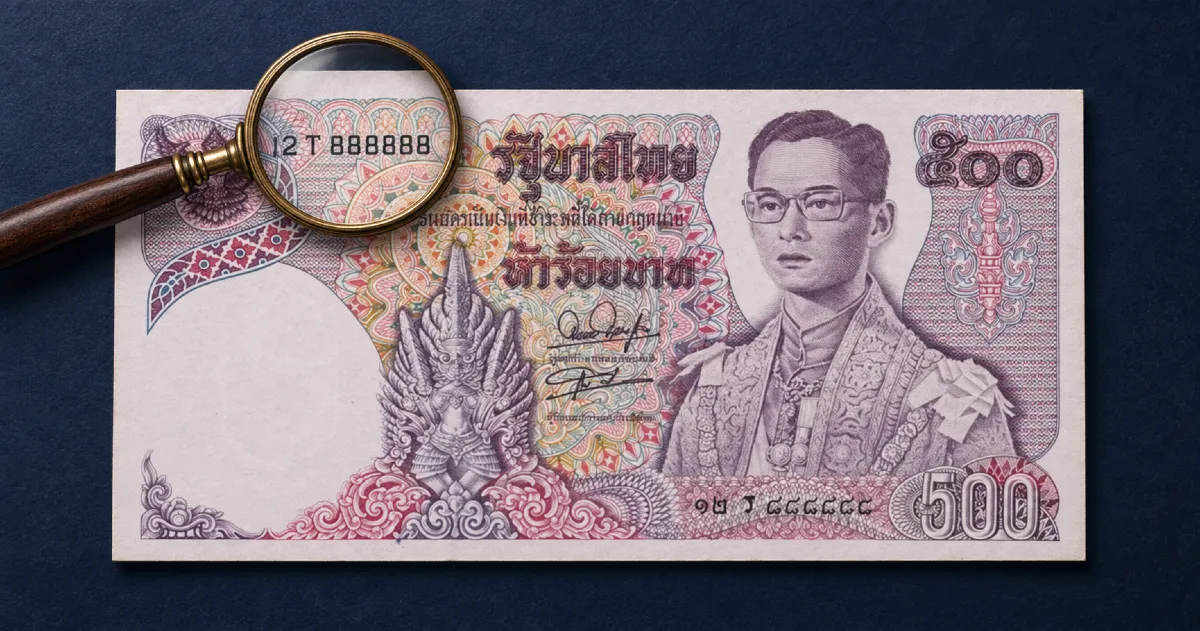
Fancy serial numbers are an established specialty within paper money collecting. A memorable sequence may contain repeated digits, symmetry, ascending or descending numbers, an unusually low number, or another visually distinctive structure.
The NumisAsia serial number checker examines the principal numerical serial together with relevant numerical characters in its prefix. Enter everything exactly as printed. You do not need to decide where the prefix ends or isolate the serial number yourself.
Check Your Banknote Serial Number
Enter the complete serial number exactly as printed on the banknote, including letters, numbers, spaces, slashes, or stars.
Serial number: 3–12 digits. Complete entry: maximum 20 characters.
Think this result may be incorrect? Report a possible error.
This tool identifies serial-number patterns only and does not authenticate, grade or value a banknote.
How to Use This Serial Number Checker
Enter the complete printed serial and let the checker identify the relevant parts and supported patterns
Enter Everything Printed
Include all letters, numbers, spaces, slashes and star symbols shown with the serial number. Leading zeroes must be entered because they form part of the number.
Analyze the Serial
Select Analyze Serial. The serial number checker separates the principal numerical serial from its prefix and examines both where appropriate.
Review the Results
The strongest classification appears as the type of serial number. Separate, non-redundant characteristics are listed underneath as additional pattern matches.
How the Serial Number Checker Reads Prefixes
Numerical prefix characters may complete or strengthen certain fancy serial-number patterns
A banknote prefix may contain letters, numbers, separators, or a mixture of these elements. Because collectors may not know which characters belong to the prefix, this tool accepts the complete printed serial and interprets it automatically.
For example, B/88 888888 is identified as a Super Solid because the numerical prefix and every serial-number digit are 8. Similarly, 9A 9999999 qualifies as a Super Solid, while 54C 789987 is interpreted using 54C as the prefix and 789987 as the radar serial.
A Prefix-Enhanced result means that numerical characters in the prefix complete or extend a pattern. For example, the numerical prefix and serial in 12A 3888321 combine as 123888321, creating a Prefix-Enhanced Radar. Because the principal serial also contains a Three-in-a-row pattern, that direct serial-number match is listed first.
Letters and separators are preserved when the result is displayed, but only numerical prefix characters are used when testing these patterns. A direct serial-number pattern is listed before a Prefix-Enhanced result. If the prefix creates the only supported fancy pattern, that result becomes the primary match.
What This Serial Number Checker Can Identify
A compact index of the principal classifications and collector terms supported by the checker
Special Numbers
Super Solid, Solid, Serial Number 1, low serial numbers through 1000, million serials, Trailing-Zero Serial, Zero Serial and High Serial.
Ladders & Sequences
Ascending Ladder, Descending Ladder, Consecutive Ascending and Consecutive Descending.
Radars
Super Radar, Radar and Radar Repeater, including supported Prefix-Enhanced forms.
Repeaters
Staggered Repeater, Super Repeater and Repeater, including supported Prefix-Enhanced forms.
Digit Patterns
Binary, Rotator, Ascending Pairs, Descending Pairs, Repeating Pairs, Double Leopard, Repeating Triples and Non-True Binary.
Repeated Digits
Near Solid and Three- through Eleven-in-a-row patterns, including the regional terms Leopard, Lion, Tiger, Elephant and Dinosaur.
Other Patterns
Bookend, 786 Number, 786 Repeater and Star Symbol Detected.
Understanding Your Serial Number Checker Results
The result separates interpretation from classification and removes redundant subordinate matches
Prefix
The letters, numbers and separators appearing before the principal numerical serial identified by the checker.
Serial Number
The principal numerical sequence examined for fancy patterns. Leading zeroes remain part of the calculation.
Type of Serial Number
The strongest broad classification, such as Super Solid, Solid, Low Serial Number, Radar, Repeater, or Ascending Ladder. An em dash appears when no supported fancy pattern is detected.
Pattern Matches
Detailed results shown in priority order, including the repeated digit, repeating block, numerical range, or other defining feature. Redundant matches are suppressed.
Fancy Serial Numbers in the Collector Market
Terminology can vary between countries and collecting communities
Collectors may describe patterned serial numbers on banknotes and paper money as lucky numbers, lucky serials, golden numbers, golden serials, special numbers or special serials. These are broad collector-market descriptions rather than separate numerical patterns, and their usage may vary between countries and collecting communities.
The NumisAsia checker uses objective pattern classifications wherever possible. Cultural or regional descriptions may be mentioned in the results, but they do not by themselves indicate rarity, authenticity or value.
PMG-Recognized Fancy Serial Numbers
Paper Money Guaranty recognizes qualifying categories including ladders, binary numbers, million serials, radars, repeaters, Serial Numbers 1 through 10, solids, rotators, combinations and certain Super serials involving prefix digits.
This checker also identifies broader collector-market classifications, including Low Serial Number 11–100 and Low Serial Number 101–1000, which may not qualify for a formal PMG attribution.
Frequently Asked Questions About the Serial Number Checker
Important points about prefixes, leading zeroes, supported lengths and interpreting the result
Yes. Enter the complete serial exactly as printed, including its prefix, letters, numbers, spaces, slashes and any star symbol. The checker will interpret the parts automatically.
Yes. Leading zeroes are part of the printed serial and may be essential when identifying Serial Number 1, low serial numbers, binary patterns and other classifications.
No. The tool identifies supported serial-number patterns only. A banknote’s value also depends on the particular issue, scarcity, condition, grade, collector demand and other factors.
Some numerical sequences genuinely satisfy more than one definition. The strongest classification is displayed first, while only distinct and useful additional matches are retained.
The principal numerical serial may contain 3–12 digits. The complete entry, including the prefix and separators, may contain up to 20 characters.
It recognizes supported numerical patterns but cannot determine country-specific print runs, undocumented replacement prefixes, or the true final serial for every banknote issue without additional information.