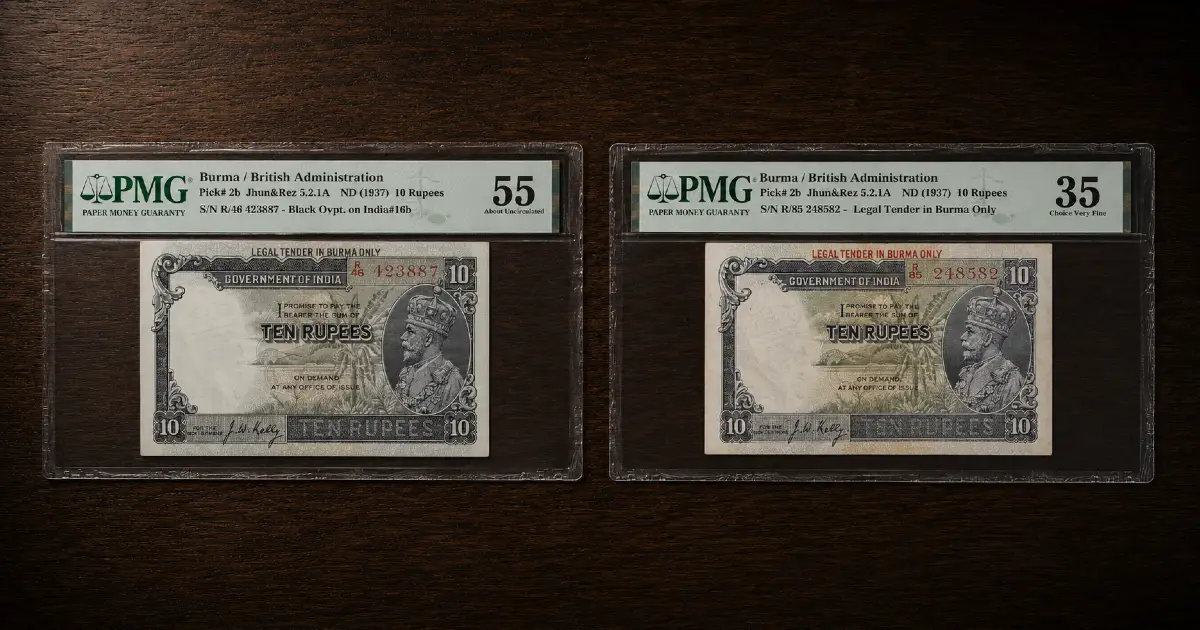
Banknote grading plays a central role in modern paper money collecting, providing collectors with a standardized method for evaluating condition, authenticity, and market confidence. Whether you are purchasing your first certified banknote, considering a submission to a professional grading service, or researching population data, understanding how grading works can help you make more informed collecting decisions.
Closely related to grading is banknote authentication, the process of verifying that a banknote is genuine and free from significant alterations or counterfeit characteristics. While grading focuses on assessing condition, authentication provides collectors with confidence that the note itself is legitimate. Together, grading and authentication have become important tools within the global numismatic market, influencing buying decisions, market liquidity, and long-term preservation.
Today, professional banknote authentication and grading services such as PMG and PCGS Banknote evaluate millions of banknotes using established industry standards developed through decades of numismatic practice and research. Their assessments help create a common language that allows collectors, dealers, auction houses, and investors to communicate consistently about condition and authenticity. However, certification is not always necessary, and not every banknote benefits equally from professional grading.
This guide takes a strategic approach to banknote grading and authentication. Rather than focusing on the technical details of grading scales and numerical definitions, it explores how collectors can use grading, certification, authentication, and population data to make smarter collecting decisions. You will learn when grading makes sense, when it may not be necessary, how professional authentication works, and how experienced collectors use certification information to evaluate and build their collections.
Whether you collect modern polymer notes, rare Asian paper money, or world banknotes, understanding the role of grading and authentication will help you navigate the market with greater confidence and make more informed decisions throughout your collecting journey.
Table of Contents
Why Banknote Grading Matters
Standardized banknote grading has become an integral part of modern paper money collecting. In a global marketplace where collectors trade across borders, deploying a unified system of banknote grading helps create market consistency and buyer confidence. Without grading standards, the description of a banknote’s condition would often be subjective, leading to misunderstandings and disputes between buyers and sellers.
Whether you are new to banknote collecting or building a specialized collection, grading provides an objective framework for evaluating condition, communicating quality, and comparing banknotes within the marketplace. Whether purchasing a common modern issue or a rare historical note, understanding how grading works allows collectors to make more informed decisions and better assess the significance of a particular specimen.
The Role of Banknote Grading in Modern Collecting
Condition is one of the most important factors affecting a banknote’s desirability. Two examples of the same note can attract very different levels of collector interest depending on their state of preservation.
Grading provides a standardized method for describing condition, allowing collectors, dealers, auction houses, and certification services to communicate using a common framework. This consistency is particularly valuable in an increasingly international marketplace where banknotes are frequently bought and sold across borders.
As a result, grading has become a fundamental part of how collectors evaluate, compare, and discuss paper money.
How Grading Creates a Common Language
Before standardized grading systems became widely adopted, condition descriptions often varied significantly between collectors and dealers. Terms such as “Fine,” “Very Fine,” or “Uncirculated” could mean different things to different people, making it difficult to compare notes accurately.
Modern banknote grading standards provide greater consistency by establishing shared criteria for evaluating condition. This common language allows collectors to better understand the quality of a banknote regardless of where it is being offered for sale.
For collectors who wish to understand the detailed numerical grading standards used throughout the hobby, see our comprehensive Banknote Grading Scale reference guide.
The Difference Between Banknote Grading and Banknote Authentication
Although the terms are often paired together, professional banknote grading and banknote authentication serve entirely different roles.
While banknote grading evaluates the physical condition of a banknote (taking into account handling and wear), banknote authentication focuses entirely on determining whether a banknote is genuine and identifying potential alterations, repairs, or counterfeit characteristics.
A banknote can be authentic but heavily circulated, or it can be well preserved but require expert examination to confirm its legitimacy. For this reason, both grading and authentication play important roles within the collecting process.
Understanding the distinction between these two concepts helps collectors appreciate why professional certification services provide both functions and why each contributes to greater confidence within the numismatic marketplace.
How Professional Graders Evaluate Banknotes
Professional banknote grading involves far more than simply looking for folds or assigning a numerical grade. When evaluating a banknote, graders examine a wide range of physical, visual, and structural characteristics to determine both its condition and overall eye appeal.
Although grading standards continue to evolve, the fundamental principles remain consistent across the hobby. Graders assess how well a banknote has been preserved, identify signs of circulation or damage, and evaluate whether the note retains the characteristics expected for its state of preservation.
Understanding these evaluation factors can help collectors better appreciate the grading process and make more informed decisions when buying, selling, or submitting banknotes for certification.
Physical Integrity
The physical condition of a banknote is one of the first areas examined during the banknote grading process. Graders look for evidence of folds, creases, tears, pinholes, edge splits, missing pieces, and other forms of physical damage that may have occurred during circulation or storage.
The location, severity, and cumulative impact of these issues are all considered. A minor fold may have a limited effect on a note’s overall grade, while more significant structural damage can substantially reduce its desirability and market appeal.
Physical integrity is particularly important because many forms of damage are permanent and cannot be reversed without altering the note.
Surface Preservation
The surface of a banknote often reveals important clues about its history and condition. Graders examine the note for dirt, stains, rust, discoloration, ink marks, adhesive residue, and other imperfections that may affect its appearance. Collectors interested in minimizing handling damage and environmental deterioration should also follow established banknote preservation practices.
Evidence of improper storage, environmental exposure, or excessive handling can also influence the overall assessment. Surface preservation is evaluated alongside physical condition because even structurally sound notes may suffer from visual distractions that reduce collector appeal.
A well-preserved surface generally contributes to a stronger overall presentation and greater market confidence.
Eye Appeal and Overall Presentation
Not all banknotes with similar technical characteristics appear equally attractive. For this reason, professional grading also considers overall eye appeal.
Factors such as colour vibrancy, centering, printing quality, margin balance, and general visual presentation all contribute to how a note is perceived. Two notes with comparable levels of wear may receive different levels of collector interest depending on their overall appearance.
Eye appeal often plays an important role in banknote grading and market desirability, particularly for premium examples sought by advanced collectors.
Security Features and Printing Elements
Modern banknotes incorporate a wide range of security features and sophisticated printing technologies. During evaluation, graders examine these elements to ensure they remain intact and consistent with the issuing authority’s production standards.
Foil features, security threads, watermarks, intaglio printing, holographic devices, and other specialized components may all form part of the assessment process. Damage, alterations, or unusual characteristics affecting these features can influence both grading and authentication outcomes.
Careful examination of these elements is a key part of banknote authentication and helps identify potential alterations, repairs, or counterfeit characteristics.
Paper vs Polymer Banknotes
Paper and polymer substrates age differently and exhibit distinct forms of wear. As a result, professional graders evaluate each substrate according to its own physical characteristics and preservation challenges.
Paper banknotes may develop folds, creases, stains, rust, handling wear, and other forms of deterioration associated with traditional currency paper. Polymer banknotes, while generally more resistant to moisture and tearing, can develop scratches, heat damage, surface scuffing, and wear affecting transparent windows or foil security features.
Because these materials behave differently in circulation and storage, graders assess them using criteria appropriate to each substrate. A defect that is common on a paper note may be uncommon on a polymer note, and vice versa.
Organizations such as the International Bank Note Society (IBNS) recognize these differences and publish separate grading standards for paper and polymer banknotes. Collectors seeking a more detailed technical understanding can consult the IBNS grading standards for paper banknotes and polymer banknotes.
Understanding these distinctions helps collectors appreciate why the same grading principles may be applied differently depending on the material from which a banknote is produced.
Ultimately, professional banknote grading is a holistic process. Rather than focusing on a single characteristic, graders consider multiple factors together to form an overall assessment of a banknote’s condition, preservation, and collector appeal.
Understanding Third-Party Certification
Third-party certification has become one of the most influential developments in modern numismatics. By combining independent grading, authentication, and encapsulation, certification services provide collectors with an impartial assessment of a banknote’s condition and authenticity. New collectors unfamiliar with numismatic terminology may find it helpful to consult a banknote glossary when researching certification services.
Today, certified banknotes are widely traded through dealers, auctions, online marketplaces, and collector networks around the world. For many collectors, certification offers an additional layer of confidence when evaluating a purchase or considering whether to submit a banknote for professional assessment.
Why Collectors Use Certification Services
The primary purpose of certification is to provide an independent banknote authentication opinion and condition assessment from a recognized third-party service. Rather than relying solely on a seller’s description, collectors can reference the assessment of a recognized third-party grading service.
Certification can also simplify transactions by creating a standardized framework for discussing condition. Buyers and sellers who may never meet in person can communicate more effectively when a note has been authenticated and professionally graded.
For some collectors, certification also provides peace of mind, particularly when purchasing higher-value banknotes or notes from unfamiliar sources.
PMG and PCGS Banknote
Two organizations dominate the modern banknote certification market: PMG (Paper Money Guaranty) and PCGS Banknote.
Both companies provide authentication, grading, and encapsulation services while applying established industry standards. Their certified holders are widely recognized throughout the numismatic marketplace and are commonly accepted by collectors, dealers, and auction houses worldwide.
Although individual collectors may have personal preferences, both services play important roles within the hobby and contribute to greater consistency and transparency across the market.
What Happens During the Certification Process
While procedures vary slightly between certification services, the overall process is generally similar.
After submission, a banknote undergoes banknote authentication and grading by trained professionals. The note is examined for evidence of wear, damage, alterations, repairs, and other characteristics relevant to grading and authentication. Once the evaluation is complete, the banknote is assigned a grade and encapsulated within a protective holder designed for long-term preservation.
The certified holder protects the note from routine handling while providing collectors with a permanent record of the grading service’s assessment.
Certification Costs and Turnaround Times
Certification is not free, and collectors should consider both costs and turnaround times before submitting banknotes for grading.
Fees typically vary according to factors such as declared value, service level, and turnaround requirements. Higher-value banknotes often require more expensive submission tiers, while expedited services generally carry additional costs.
Because certification represents an investment, collectors should carefully evaluate whether the potential benefits justify the expense. In many cases, certification can enhance confidence, marketability, and long-term preservation. In other situations, the costs may outweigh the practical advantages.
For this reason, understanding which banknotes are appropriate candidates for banknote grading and certification is an important part of any successful collecting strategy.
Raw vs Graded Banknotes
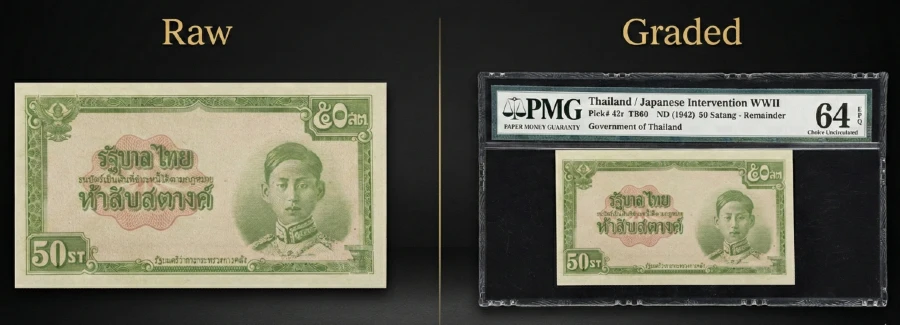
One of the most common decisions collectors face is whether to purchase raw or graded banknotes. Both options have advantages, and neither is inherently superior. The best choice depends on the collector’s goals, experience level, budget, and the specific banknote being considered.
Many successful banknote collections contain a combination of both raw and graded notes. Understanding the strengths and limitations of each approach allows collectors to make informed decisions and avoid unnecessary expenses.
| Raw | Graded |
|---|---|
| Lower cost | Higher cost |
| Flexible storage | Encapsulated |
| Requires expertise | Easier for beginners |
| Better for common notes | Better for expensive notes |
Advantages of Buying Raw Notes
Raw banknotes are notes that have not been submitted to a third-party certification service. They are typically sold in protective holders, sleeves, albums, or other storage formats without a professional grade or authentication opinion.
One of the primary advantages of raw notes is cost. Because certification fees have not been incurred, raw notes are often available at lower prices than comparable graded examples. This can make them attractive to collectors who wish to maximize the number of banknotes they acquire within a fixed budget.
Raw notes also provide collectors with greater flexibility. Some collectors enjoy evaluating condition themselves, conducting their own research, and deciding whether a note should eventually be submitted for certification.
Advantages of Buying Graded Notes
Graded banknotes offer the benefits of professional authentication, condition assessment, and encapsulation. For many collectors, these services provide additional confidence when purchasing a note, particularly in situations where authenticity, condition, or provenance may be difficult to assess independently.
Certification can also make it easier to compare similar notes within the marketplace. Buyers and sellers can reference a recognized grading standard rather than relying solely on subjective descriptions.
For higher-value banknotes, graded examples may attract a broader range of potential buyers and often trade more easily through major auction houses and professional dealers.
When Raw Notes Make More Sense
Raw notes are often appropriate for collectors who are still developing their banknote grading skills, pursuing lower-value material, or building collections where certification costs would represent a significant percentage of the note’s value.
They may also be preferable when purchasing directly from trusted dealers, established auction houses, or experienced collectors with strong reputations within the hobby.
For many collectors, raw notes provide an affordable and enjoyable way to build knowledge while expanding their collections.
When Graded Notes Make More Sense
Graded notes are often most useful when authenticity is a primary concern, when significant value is involved, or when a collector requires an independent assessment of condition.
Certification can be particularly beneficial for scarce, high-grade, or widely counterfeited banknotes where the risks associated with misidentification or condition disputes are greater.
Collectors who participate actively in auctions, buy internationally, or pursue premium examples may also find graded notes more convenient because certification provides a common framework that is widely recognized throughout the market.
Ultimately, the choice between raw and graded banknotes should not be viewed as an either-or decision. Most experienced collectors use both approaches, selecting the option that best suits the individual banknote and their collecting objectives.
Which Banknotes Should You Submit for Grading?
Professional certification can provide significant benefits, but not every banknote deserves to be graded. Because grading involves submission fees, shipping costs, insurance considerations, and waiting periods, collectors should carefully evaluate whether certification is likely to add meaningful value or confidence.
Experienced numismatists view grading as a strategic tool rather than a default step. The goal is to identify banknotes where authentication, professional evaluation, or market acceptance justify the cost of certification.
| Situation | Grade? |
|---|---|
| Common note worth $10 | No |
| Rare variety | Yes |
| Specimen | Usually |
| Major error | Usually |
| High-grade scarce issue | Yes |
High-Value Notes
As a general rule, the more valuable a banknote becomes, the stronger the case for professional certification.
High-value banknotes often attract greater scrutiny from potential buyers and may be subject to authenticity concerns, condition disputes, or differing opinions regarding market value. Professional banknote grading and authentication can help reduce these uncertainties by providing an independent assessment from a recognized certification service.
Certification may also improve marketability by making the banknote easier to sell through dealers, auctions, and online marketplaces.
Exceptional Uncirculated Examples
Not all valuable banknotes are rare. In many cases, exceptional condition is what creates collector demand.
Uncirculated examples with strong eye appeal often command significant premiums compared to circulated examples of the same note. When a collector believes a banknote may qualify for a premium grade, professional certification can help establish that distinction and provide confidence to future buyers.
This is particularly relevant for modern banknotes, where rarity may be limited but condition differences can have a substantial impact on market desirability.
Specimen Notes and Rare Varieties
Specimen issues, rare varieties, printing errors, and other specialized categories often benefit from certification because they can be difficult for non-specialists to evaluate accurately.
Authentication provides reassurance that the variety or error is genuine, while grading helps establish the note’s overall condition. Together, these factors can make certified examples easier to trade and more attractive to collectors seeking confidence in their purchases.
For specialized material, certification often serves as both an authentication tool and a market reference point.
Banknotes with Low Population Counts
Population reports track the number of notes certified at various grade levels by a grading service. In some cases, a banknote may have very few examples certified in a particular grade range.
Collectors pursuing top-condition examples often pay close attention to population data because scarcity within a grade category can influence demand. If a raw banknote appears capable of achieving a grade where few examples currently exist, certification may provide valuable market information and increase collector interest.
Particular attention is often given to “Top Pop” or “Top Population” notes—banknotes that share or hold the highest grade recorded within a certification service’s population report. In some collecting areas, these finest-known examples can attract significant premiums because collectors compete for the highest certified grades available.
However, population data should always be viewed alongside rarity, demand, and historical significance rather than as a standalone indicator of value. A note may be Top Pop simply because few examples have been submitted for grading, while a genuinely rare note may have a higher certified population because most surviving examples have already been certified.
Notes That Usually Do Not Need Grading
Not every banknote benefits from certification. Common notes with modest market value often do not justify grading costs, particularly when certification fees represent a large percentage of the note’s overall worth.
Similarly, heavily circulated notes that are readily available in the marketplace may gain little practical benefit from certification unless they possess unusual historical significance or are part of a specialized collecting objective.
In many situations, proper preservation, accurate identification, and careful documentation provide sufficient protection without the additional expense of professional third party grading.
Ultimately, the decision to submit a banknote should be based on value, rarity, condition, authenticity concerns, and collecting goals. Certification can be a powerful tool, but the most successful collectors use it selectively rather than automatically.
When Banknote Grading Adds Value—and When It Doesn’t
Many collectors assume that professional grading automatically increases the value of a banknote. While certification can certainly enhance desirability and market confidence, the relationship between grading and value is not always straightforward.
The true benefits of certification depend on the banknote itself, its condition, rarity, market demand, and the objectives of the collector. Understanding when grading adds meaningful value—and when it may provide limited practical benefit—can help collectors make more informed submission decisions.
Authentication and Confidence Benefits
One of the most significant advantages of professional certification is the confidence it provides regarding authenticity.
For higher-value banknotes, scarce issues, and notes commonly targeted by counterfeiters, professional authentication can reduce uncertainty and reassure potential buyers. This independent assessment becomes particularly valuable when purchasing notes from unfamiliar sources or participating in international transactions where in-person examination is not possible.
Even when certification does not dramatically increase market value, the confidence provided by authentication alone may justify the cost for many collectors.
Marketability and Liquidity
Certified banknotes are often easier to buy and sell because they provide a standardized assessment that is widely recognized throughout the numismatic market.
Dealers, auction houses, and collectors can evaluate certified notes more efficiently because an independent grading service has already examined the note. This can reduce disputes regarding condition and make transactions smoother, particularly for higher-value material.
For collectors who anticipate selling, trading, or consigning notes in the future, certification may improve overall marketability and broaden the pool of potential buyers.
Financial Considerations
In some situations, certification can contribute to higher realized prices. This is most common when a banknote is scarce, in exceptional condition, or difficult to evaluate accurately without professional expertise.
However, grading should not be viewed as a guaranteed method of increasing value. Certification fees, shipping costs, insurance expenses, and market conditions must all be considered when evaluating the potential return on investment.
Experienced collectors typically view grading as a tool for risk management and market transparency rather than a guaranteed path to profit.
When Grading Adds Little Value
There are many situations where certification provides limited practical benefit.
Common banknotes with modest market values may not justify grading costs, particularly when numerous similar examples are readily available. Likewise, heavily circulated notes often gain little additional market appeal simply because they have been certified.
Collectors should also avoid submitting notes solely in the hope of achieving an unexpectedly high grade. Certification is most effective when it serves a clear collecting, preservation, authentication, or market objective rather than speculation alone.
Ultimately, grading adds the greatest value when it reduces uncertainty. Whether that uncertainty involves authenticity, condition, market acceptance, or long-term preservation, certification is most effective when used strategically rather than automatically.
Understanding Population Reports
Population reports are among the most useful research tools available to modern collectors. Published by professional certification services, these reports track the number of banknotes that have been certified at various grade levels. By examining population data, collectors can gain valuable insights into the relative availability of certified examples within the marketplace.
However, population reports are often misunderstood. They do not measure the total number of banknotes that exist. Instead, they reflect only the notes that have been submitted to and certified by a particular grading service. Understanding both the strengths and limitations of population data is essential for using these reports effectively.
What Is a Population Report?
A population report is a database that records the number of banknotes certified by a grading service and groups them according to grade and designation.
For example, a population report may show how many examples of a particular banknote have been graded, how many exist within specific grade ranges, and how many have achieved the highest certified grades. Collectors frequently use this information when evaluating condition rarity and comparing certified examples within the marketplace.
Because population reports are updated as new notes are submitted, they provide an evolving picture of the certified population rather than a fixed measure of rarity.
How Collectors Use Population Data
Population reports can be valuable when comparing banknotes within the same series or issue. They help collectors understand how frequently certain grades appear and whether a particular note is uncommon in a given condition.
Advanced collectors often use population data to identify premium-condition examples, evaluate potential submissions, and better understand the competitive landscape surrounding highly sought-after notes. Auction houses and dealers may also reference population statistics when describing exceptional certified examples.
When used alongside other research tools, population reports can provide valuable context for collecting and purchasing decisions.
The Difference Between Rarity and Population
One of the most important concepts for collectors to understand is that rarity and population are not the same thing.
A banknote may have a very low certified population because few collectors have submitted examples for grading. Conversely, a genuinely rare banknote may have a relatively high certified population if most known examples have already been certified.
Population reports measure certified availability rather than total surviving numbers. As a result, collectors should always consider historical context, market demand, survival rates, and known rarity information alongside population data.
The most effective collecting decisions are based on a combination of research rather than any single metric.
Limitations of Population Reports
While population reports are extremely useful, they should not be viewed in isolation.
Certified populations can change over time as additional notes are submitted for grading. Some notes may also be resubmitted in pursuit of higher grades, potentially affecting population statistics. Furthermore, population reports only reflect notes certified by a specific grading service and do not account for uncertified examples held in private collections or institutional holdings.
For these reasons, population reports are best viewed as one research tool among many. When combined with auction records, dealer inventories, reference literature, and collector knowledge, they can provide a more complete understanding of a banknote’s availability and market position.
Used correctly, population reports help collectors move beyond simple assumptions and make more informed decisions regarding rarity, condition, and long-term collecting opportunities.
Banknote Authentication and Counterfeit Detection

While grading evaluates a banknote’s condition, banknote authentication focuses on something even more fundamental: determining whether a banknote is genuine.
Authentication has become increasingly important as the global market for collectible banknotes has expanded. Collectors today regularly purchase notes through online auctions, dealer websites, marketplaces, and international transactions where physical inspection may not be possible before purchase. In these situations, confidence in authenticity can be just as important as confidence in condition.
Professional authentication helps reduce uncertainty by providing an independent assessment of a banknote’s legitimacy and identifying potential concerns that may not be immediately apparent to collectors.
Why Authentication Matters
Authenticity is the foundation of every collection. Regardless of rarity, condition, or market value, a banknote must first be genuine before any other collecting considerations become relevant.
For common notes, authentication may seem straightforward. However, as values increase and collectors move into scarcer material, the risk of counterfeits, alterations, and misidentified notes becomes more significant.
Professional banknote authentication provides an additional layer of confidence that can benefit both buyers and sellers while helping to support transparency within the marketplace.
Common Signs of Alteration
Not all problematic banknotes are outright counterfeits. In some cases, genuine banknotes may have been altered in ways that affect their collectibility and market acceptance.
Examples can include repaired tears, replaced sections, removed writing, modified serial numbers, artificially improved appearance, or other attempts to enhance a note’s perceived condition or rarity.
While some alterations may be obvious, others can be difficult to detect without specialized knowledge or equipment. This is one reason why collectors often seek professional opinions when evaluating important purchases or considering certification.
Counterfeit Banknotes and Modern Reproductions
Counterfeit banknotes have existed for as long as paper money itself. Some counterfeits are intended to circulate as currency, while others are produced specifically to deceive collectors.
Modern technology has made high-quality reproductions easier to produce, increasing the importance of careful examination and authentication. Collectors should be particularly cautious when dealing with rare issues, high-value notes, and unfamiliar sellers.
Authentication does not eliminate all risks, but it can significantly reduce the likelihood of purchasing a problematic note and provide reassurance when making important collecting decisions.
When Professional Authentication Is Essential
Professional banknote authentication is most valuable when the stakes are highest, particularly for rare issues, high-value notes, and banknotes commonly targeted by counterfeiters.
Examples include high-value banknotes, scarce issues, rare varieties, major errors, unusual specimens, and notes commonly targeted by counterfeiters. Authentication may also be appropriate when provenance is uncertain or when a collector lacks sufficient experience with a particular series.
In many cases, the cost of authentication represents a small expense compared to the potential consequences of acquiring a counterfeit or altered banknote.
Ultimately, authentication is not about replacing collector knowledge. Rather, it serves as an additional tool that helps collectors manage risk, make more informed decisions, and participate in the market with greater confidence.
Common Misconceptions About Banknote Grading
Banknote grading has become an integral part of modern numismatics, but it is also one of the most misunderstood aspects of the hobby. New collectors often assume that grading automatically increases value, guarantees rarity, or removes the need for personal research. In reality, certification is a valuable tool, but it is most effective when used alongside knowledge, experience, and sound collecting judgment.
Understanding some of the most common misconceptions can help collectors make better decisions and avoid unrealistic expectations.
A Higher Grade Does Not Guarantee Higher Value
Condition is an important factor in determining desirability, but it is only one part of the equation. Rarity, demand, historical significance, and collector interest can all have a significant impact on market value.
A common banknote in a very high grade may still be less valuable than a genuinely rare note in a more modest grade. While exceptional condition often attracts premiums, collectors should always evaluate a banknote within its broader market context.
A successful banknote grading strategy balances condition with rarity, demand, and collecting objectives rather than focusing exclusively on the numerical grade.
Graded Does Not Mean Rare
Certification confirms a banknote’s authenticity and provides an independent assessment of condition, but it does not automatically make the note rare.
Many modern and widely available banknotes have been certified in large numbers. Conversely, some genuinely scarce notes may have relatively few certified examples simply because collectors have not submitted them for grading.
Collectors should therefore view certification and rarity as separate concepts. A graded note may be desirable, but rarity must be assessed through broader research and market knowledge.
Certification Is Not a Substitute for Research
Professional certification provides valuable information, but it should not replace a collector’s own study and understanding of the hobby.
Collectors who learn about issuing authorities, varieties, printing characteristics, historical context, and market trends are generally better equipped to make informed purchasing decisions. Certification can support that knowledge, but it cannot replace it.
The most successful collectors combine independent research with the information provided by grading and authentication services.
Not Every Banknote Needs Certification
Certification is a useful tool, but it is not necessary for every banknote.
Many collectors build impressive collections that contain both certified and uncertified material. Common notes, lower-value issues, and banknotes collected primarily for personal enjoyment may not require professional certification at all.
The decision to grade should be based on factors such as authenticity concerns, market value, rarity, condition, and collecting goals rather than the assumption that every note should be submitted.
Ultimately, grading is most effective when it supports a clear collecting objective. Collectors who understand both the benefits and limitations of certification are better positioned to use it strategically and gain the greatest value from the process.
Banknote Grading: Frequently Asked Questions
Final Thoughts on Banknote Grading & Authentication
Banknote grading and authentication have transformed the way collectors evaluate, buy, sell, and preserve paper money. By providing independent assessments of condition and authenticity, certification services help create greater confidence and consistency throughout the numismatic marketplace.
However, grading should be viewed as a tool rather than an objective in itself. While certification can provide significant benefits, including authentication, marketability, population data, and long-term protection, not every banknote requires professional grading. The most successful collectors understand when certification adds meaningful value and when it may offer limited practical advantages.
Throughout this guide, we have explored how professional graders evaluate banknotes, the role of third-party certification, the differences between raw and graded notes, and the factors that influence grading decisions. We have also examined the importance of authentication and the ways population reports can help collectors better understand the certified marketplace.
Ultimately, grading and authentication are most effective when combined with research, experience, and sound collecting judgment. A certified holder can provide valuable information, but it cannot replace an understanding of rarity, historical significance, market demand, and the broader context of a banknote.
Whether you collect modern polymer issues, classic paper money, replacement notes, specimens, or rare varieties, the goal should not be to certify every banknote. Instead, collectors should use grading strategically to reduce uncertainty, improve confidence, and support their long-term collecting objectives.
By understanding both the benefits and limitations of certification, collectors can make more informed decisions, avoid unnecessary expenses, and build collections that are guided by knowledge rather than assumptions. In the end, grading and authentication are not substitutes for expertise—they are tools that help collectors apply that expertise more effectively.