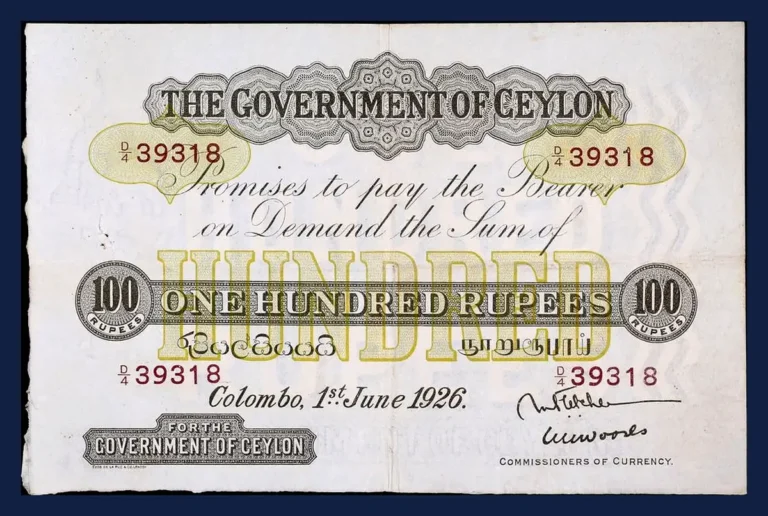
Learning how to check banknote value is one of the most important skills for any paper money collector. A banknote’s price is not based on age alone. Its real market value depends on a combination of identification, rarity, condition, collector demand, and recent sale prices.
Two notes may look similar at first glance but have very different values because of a signature variety, serial number prefix, issuing branch, overprint, watermark, replacement status, or condition grade. A common note in average circulated condition may be worth only a modest amount, while a scarcer variety in high grade can command a strong premium.
This guide explains how to evaluate paper money value using a practical, step-by-step approach. It is designed for collectors, sellers, heirs, and anyone trying to understand whether a banknote is common, scarce, rare, or potentially valuable. The goal is not to guess a price, but to build a reliable valuation method based on evidence.
By the end, you will know how to identify your note, assess its condition, compare recent market prices, understand catalog values, and decide when expert appraisal or professional grading may be worthwhile.
Table of Contents
What Determines Banknote Value?
Banknote value is usually determined by five main factors: identification, rarity, condition, demand, and recent market activity. A reliable banknote price guide should consider all five together.
Rarity and Surviving Supply
Rarity refers to how many examples of a particular banknote are believed to survive. This is different from age. Some old banknotes were printed in large quantities and survived in significant numbers, while others are valuable because they had short print runs, were recalled, or exist in limited numbers.
A note may be rare because of:
- Low original print quantity
- Short-lived signature combination
- Special issue or emergency issue
- Official withdrawal or demonetisation
- Wartime destruction or loss
- Regional overprint or branch issue
- Low survival rate in high grade
Scarcity becomes especially important when it is tied to strong collector demand. A rare note from a popular collecting area will usually be easier to sell and may achieve stronger prices than a rare note from a less active market.
Condition and Grade
Condition is one of the strongest drivers of banknote value. Paper money is easily damaged by folds, stains, tears, humidity, pinholes, ink marks, trimming, washing, and repairs. Even small differences in condition can create large differences in price.
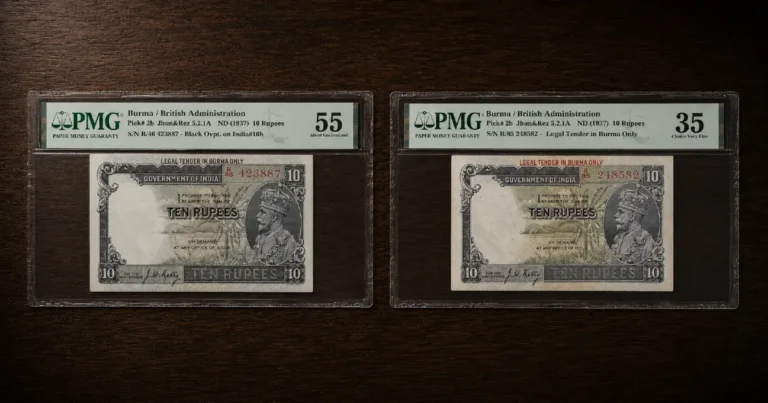
A banknote with original crisp paper, strong color, sharp corners, and no folds will usually be worth much more than the same note in worn condition. For valuable notes, collectors often rely on third-party grading services such as PMG or PCGS Banknote to confirm authenticity and grade, both of which directly affect banknote value.
For a more detailed explanation of condition terminology and the 1–70 grading system, see our dedicated Banknote Grading Scale: The Definitive PMG & PCGS 1-70 Guide.
Collector Demand
Demand is the market side of valuation. A banknote can be scarce, but if few collectors actively want it, the price may remain limited. Conversely, a moderately scarce note from a highly collected country or series can perform strongly because many buyers compete for it.
Demand is influenced by:
- Country or region
- Historical importance
- Popularity of the issuing period
- Design quality
- Portrait, monarch, or political theme
- Colonial or wartime connection
- Registry-set competition
- Availability of comparable examples
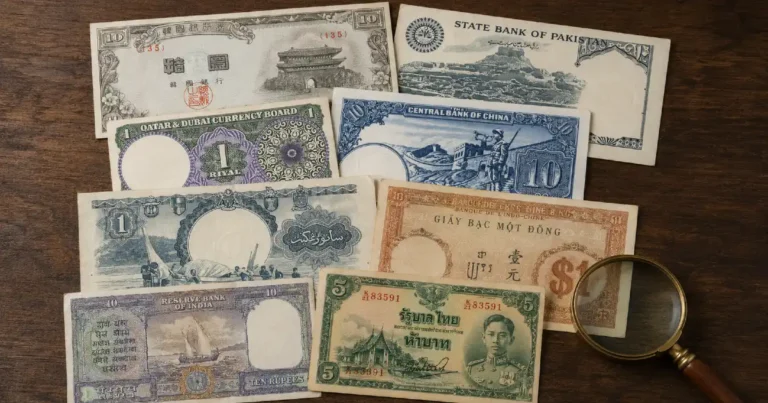
Asian banknotes, British colonial issues, Indian banknotes, Gulf Rupees, Thai banknotes, Burma banknotes, and high-grade specimen notes can attract strong interest when the variety and condition are desirable.
Recent Sale Prices
Actual completed sale prices are more reliable than asking prices. A seller can list a common banknote for any amount, but that does not mean buyers are willing to pay it. To check banknote market value accurately, focus on realized auction prices and completed marketplace sales.
The best pricing evidence usually comes from:
- Major auction house archives
- Dealer sales records
- Completed online marketplace sales
- Third-party graded note databases
- Recent sales of the same variety and grade
When possible, compare several recent examples rather than relying on a single result.
Special Features and Value Multipliers
Some features can increase banknote value beyond the normal catalog range. These include specimen notes, major errors, rare replacement notes, fancy serial numbers, and unusual overprints.
These areas require careful identification because small details matter. For deeper reading, see:
- Specimen Banknote Guide: History, Markings & Authentication
- Fancy Serial Numbers Explained: Types, Rarity & Values
- Error Banknotes Guide: Types & Collector Values
Step 1: Identify the Banknote Correctly
Before checking prices, identify the exact banknote. Incorrect identification is one of the most common reasons for inaccurate valuation.
Country, Issuer, and Currency
Start by identifying the country or issuing authority. Some banknotes were issued by central banks, while others were issued by treasuries, colonial governments, military authorities, private banks, or occupation administrations.
Look for:
- Country name
- Issuing bank or authority
- Currency unit
- Denomination
- Language or script
- Coat of arms, seal, or national emblem
- Portrait or central vignette
Older world banknotes may use scripts that are unfamiliar to modern collectors. In those cases, design elements, portraits, seals, and catalog references become especially useful.
Date, Series, and Signature
Next, check for a printed date, series date, law date, decree date, or signature combination. Many banknotes do not show a clear year of issue, so signatures and design changes are often needed to identify the correct variety.
Important details include:
- Printed date or issue date
- Series year
- Law or decree date
- Governor, finance minister, or treasury signature
- Portrait type
- Color change
- Security thread or watermark type
- Serial number style
A banknote design may remain in use for many years, but a specific signature combination may have been used only briefly. That can create a significant value difference.
Catalog Number
Once the basic identity is clear, match the note to a recognized catalog reference. The most widely used systems include Pick numbers from the Standard Catalog of World Paper Money and The Banknote Book.
A catalog number helps you compare the same note across dealer listings, auction records, grading databases, and collector references.
Step 2: Check the Variety and Sub-Type
After identifying the main type, examine the note for variety differences. Many banknote values depend on small details that are easy to overlook.
Signature Varieties
Different signatures can create different levels of scarcity. A note signed by a short-serving official may be scarcer than one signed by a long-serving official. This is common in banknotes from India, Thailand, Singapore, and many other collecting areas.
Prefixes and Serial Number Styles
Serial number prefixes can affect value, especially when they identify a special print run, replacement note, regional issue, or short-lived series.
Check whether the note has:
- Single-letter or double-letter prefix
- Fractional prefix
- Replacement prefix
- Star note indicator
- Different font or serial style
- Different serial color
- Unusual spacing or alignment
Fancy serial numbers can also create value, but they should be evaluated separately from the base note type.
Overprints and Stamps
Overprints can turn an otherwise common note into a scarce variety. These may appear on colonial, emergency, occupation, or transitional issues.
Examples include notes overprinted for specific territories, military administrations, or restricted circulation areas. Always inspect overprints carefully because genuine overprints can be valuable, while false or later additions can reduce confidence and value.
Branch or Regional Issues
Some historical banknotes were issued through regional offices or circles of issue. In British India, for example, certain notes were associated with cities such as Bombay, Calcutta, Lahore, Madras, or other issuing centers.
Regional varieties may be identified through letters, codes, serial formats, or branch names. Some are common, while others are much scarcer.
Step 3: Assess Condition Before Estimating Price
Condition has a direct effect on banknote value. Do not estimate value until you have examined the note’s physical state.
What to Check
Inspect the note under good lighting without handling it more than necessary. Look for:
- Folds and creases
- Center fold
- Corner bends
- Edge tears
- Pinholes
- Stains
- Foxing or toning
- Writing or teller marks
- Rust marks from clips or staples
- Repairs or tape
- Washed or pressed paper
- Trimmed margins
Why Original Paper Matters
Collectors value originality. Washing, pressing, chemical cleaning, flattening, trimming, or repairing a banknote can lower its desirability. Even if the note looks cleaner afterward, it may lose value because the original paper surface has been altered.
If you are unsure, do not attempt to clean or improve a banknote. Store it safely and seek advice before taking any action. For storage guidance, see our Banknote Preservation: How to Store & Protect Paper Money guide.
Use Grade as a Price Filter
When comparing prices, always compare notes in similar condition. A rare banknote in Very Fine condition should not be valued using an Uncirculated sale result unless you adjust the estimate significantly.
For example, the same variety may have separate market levels for:
- Good or Very Good
- Fine or Very Fine
- Extremely Fine
- About Uncirculated
- Uncirculated
- Gem Uncirculated
The higher the value of the note, the more important precise grading becomes.
Step 4: Determine Rarity and Demand
Once the banknote is identified and condition is assessed — two key steps in checking banknote value — evaluate how scarce it is and how many collectors want it.
Age Does Not Always Mean Value
One of the biggest mistakes in paper money valuation is assuming that older notes are automatically rare. Some older notes survived in large quantities, including hoards of uncirculated examples. These may be affordable despite their age.
At the same time, some newer notes can be valuable because they had low print quantities, short circulation periods, special prefixes, replacement status, or strong collector demand.
Rarity by Grade
A banknote may be common in circulated grades but rare in Uncirculated condition. This is especially important for notes that circulated heavily or were printed on fragile paper.
When researching value, ask:
- Is the note rare overall?
- Is it rare only in high grade?
- Is it common in low grade but scarce in Uncirculated?
- Are there many certified examples?
- Are top-grade examples available, or tightly held?
This is where population reports and auction histories become useful.
Collector Base
Banknote value is also influenced by the size and activity of its collector base. Strong demand often exists for notes connected to major historical periods, popular countries, colonial issues, monarch portraits, emergency issues, and short-lived political transitions.
For a broader rarity checklist, see How to Identify Rare Banknotes: 7 Key Factors.
Step 5: Compare Recent Sale Prices
The most reliable way to check banknote value is to compare recent completed sales of the same note in similar condition.
Use Realized Prices, Not Asking Prices
Asking prices can be misleading. A note listed online for a high price may remain unsold for months or years. That listing reflects the seller’s expectation, not the market.
Completed sales are more useful because they show what buyers actually paid.
Compare Like With Like
When reviewing sale records, compare:
- Same country
- Same catalog number
- Same variety
- Same signature
- Same prefix or overprint where relevant
- Similar grade
- Similar certification status
- Similar eye appeal
A certified PMG 65 EPQ note should not be directly compared with a raw circulated note. Likewise, a rare prefix should not be valued using a common-prefix sale.
Step 6: Understand Catalog Value vs Market Value
Catalogs are useful, but they are not the final word on banknote value. A printed banknote price guide can help identify a note and provide a general value range, but the real market may be higher or lower.
What Catalog Values Are Good For
Catalog values are helpful for:
- Identifying types and varieties
- Understanding relative rarity
- Comparing denominations
- Checking issue dates and signatures
- Finding a general value range
They are especially useful when you are still identifying a note.
Why Market Value Can Differ
Market value changes with supply and demand. A catalog may list a banknote value that is outdated, too high, or too low compared with recent auction results.
Market value may rise when:
- Demand increases
- Few examples appear for sale
- A variety becomes better recognized
- Population reports show grade rarity
- A high-quality example attracts competition
Market value may fall when:
- A hoard appears
- Demand weakens
- Too many similar notes reach the market
- Catalog pricing proves too optimistic
Use catalogs as identification tools and market records as pricing evidence.
Step 7: Check Population Reports for Certified Notes
Population reports, such as the PMG Population Report, can help determine how many graded examples exist at each grade level. This is especially useful for high-grade notes, rare varieties, and competitive registry collecting.
Why Population Data Matters
A note may look common if hundreds have been graded overall. But if only a few examples exist in high grade, the top-condition pieces may still be valuable.
For example, a note may have:
- Many examples in Very Fine
- Fewer examples in Extremely Fine
- Very few in Uncirculated
- Only one or two at the top grade
That grade distribution can affect price.
Population Reports Have Limits
Population reports are useful but not perfect. They show only notes submitted to that grading service, not every surviving example. Some notes remain raw in private collections, dealer inventory, or institutional holdings.
Use population data as one part of your valuation, not the only factor.
Step 8: Decide Whether Professional Grading Is Worthwhile
Professional grading can improve buyer confidence and marketability, but it is not necessary for every banknote.
When Grading May Make Sense
Consider grading if the note is:
- Rare or high value
- A scarce signature or prefix variety
- Frequently counterfeited
- An exceptional high-grade example
- A major error note
- A specimen note
Certification can help confirm authenticity, grade, and originality. It can also make a note easier to sell online because buyers can rely on the independent grade.
When Grading May Not Be Necessary
Grading may not be cost-effective for common, low-value, or heavily circulated notes. If the grading fee, shipping, insurance, and waiting time exceed the likely value increase, keeping the note raw may be more practical.
For a full discussion, see Banknote Grading & Authentication: A Collector’s Guide.
Step 9: Check for Errors, Specimens, and Special Serial Numbers
Some banknotes require special attention because they may carry value beyond the normal type and grade.
Error Banknotes
Major production errors can be valuable if they are genuine and visually significant. Examples include missing print, inverted print, severe misalignment, mismatched serial numbers, and major cutting errors.
Minor cutting irregularities or small printing flaws may not add much banknote value. Authentication is especially important for expensive errors.
Specimen Banknotes
Specimen notes were usually produced for reference, distribution to banks, or official demonstration purposes. They often have specimen overprints, punch cancellations, zero serial numbers, or special control markings.
Genuine specimens can be valuable, but they must be distinguished from later reproductions or altered notes.
Fancy Serial Numbers
Some collectors pay premiums for attractive serial number patterns, especially on modern notes. These include low numbers, solid numbers, radars, repeaters, ladders, and culturally significant numbers.
The premium depends on the type of pattern, the base note, condition, and collector demand.
Common Mistakes When Checking Banknote Value
Avoiding mistakes is as important as finding the right banknote value.
Mistake 1: Using Active Listings as Value
Active listings are not reliable evidence of banknote value. Use completed sales whenever possible.
Mistake 2: Ignoring the Exact Variety
A common signature, rare signature, replacement prefix, and overprint variety may all have different values. Always identify the exact type before estimating price.
Mistake 3: Overlooking Condition Problems
Small defects can have a large effect on banknote value. Folds, stains, trimming, pinholes, repairs, or pressed paper should be considered before comparing prices.
Mistake 4: Cleaning or Pressing the Note
Do not wash, iron, flatten, tape, trim, or chemically treat a banknote. Alterations usually reduce collector confidence and may lower the grade.
Mistake 5: Assuming Every Old Note Is Rare
Age alone does not determine value. Surviving supply and demand matter more.
Mistake 6: Comparing Raw Notes to Certified Notes
A raw note and a certified note may not sell for the same price, even if they look similar. Certification can affect buyer confidence, especially for higher-value material.
When to Get a Banknote Appraisal
You should consider a professional appraisal if your research suggests the note may be rare, valuable, or difficult to authenticate.
Appraisal Is Useful For:
- Rare Asian banknotes
- High-denomination notes
- Specimen notes
- Major errors
- Rare overprints
- Unlisted varieties
- High-grade certified notes
- Inherited collections
An experienced paper money specialist can examine paper quality, printing method, watermark, ink, serial format, overprint authenticity, and condition. This is especially important for notes that are commonly forged or altered.
Practical Banknote Value Checklist
Use this quick checklist when evaluating a banknote:
- Identify the country and issuer.
- Confirm the denomination and currency unit.
- Check the date, series, and signatures.
- Match the note to a catalog number.
- Look for prefixes, overprints, branch issues, or varieties.
- Assess condition carefully.
- Check whether the note is raw or certified.
- Research recent completed sales.
- Compare only similar grades and varieties.
- Review population reports if the note is certified.
- Check for errors, specimen status, or fancy serial numbers.
- Seek expert appraisal for rare or high-value notes.
Conclusion: The Best Way to Check Banknote Value
The best way to check banknote value is to combine accurate identification, realistic condition assessment, rarity research, and recent market data. No single source gives a complete answer. Catalogs help identify a note, grading helps define condition, population reports help measure certified supply, and completed sales show what buyers are currently paying.
For most collectors, the process should begin with the basics: identify the note, confirm the variety, assess the grade, and compare recent sales of similar examples. From there, you can decide whether the note deserves professional grading, expert appraisal, or further specialist research.
A careful valuation method protects you from common mistakes such as overpricing based on asking prices, undervaluing rare varieties, or damaging a note through cleaning or poor storage. Whether you are evaluating one inherited banknote or building a serious collection, a structured approach will give you a more accurate understanding of paper money value and market demand.