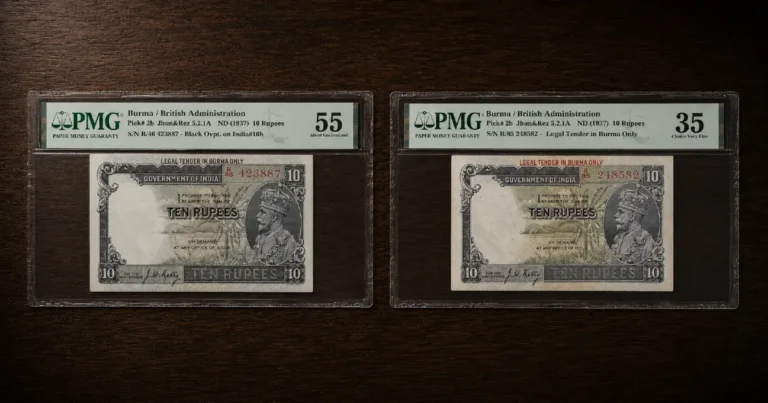
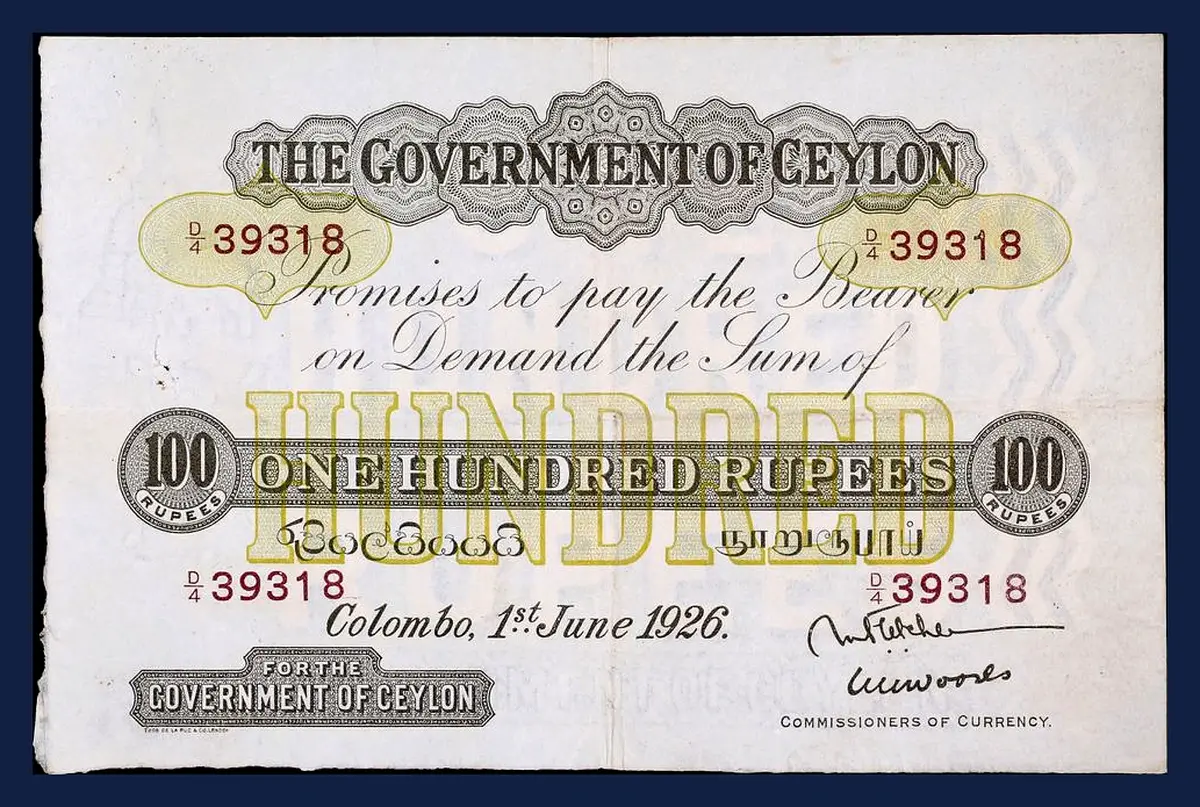
Knowing how to identify rare banknotes is one of the most important skills a paper money collector can develop. While many collectors assume that age alone determines banknote rarity, the reality is far more complex. Some banknotes printed in small quantities remain surprisingly common today, while others issued in large numbers have become extremely difficult to find due to low survival rates, collector demand, or unique varieties.
Rare paper money can emerge for many different reasons. A banknote may be scarce because few examples were originally printed, because most surviving notes were destroyed or redeemed, or because collectors actively seek a particular variety, prefix, signature combination, or printing error. In other cases, historical events such as wars, political transitions, demonetization programs, or economic crises may dramatically reduce the number of surviving examples.
Understanding banknote rarity is also different from understanding value. While rare banknotes often attract strong collector interest, rarity alone does not guarantee high prices. Condition, demand, historical significance, and market trends all influence how collectors and dealers evaluate a note. As a result, identifying genuinely scarce banknotes requires more than simply checking a catalogue value or looking at the age of a note.
This guide explores the key factors that contribute to banknote rarity, from low print runs and survival rates to varieties, specimens, historical significance, and collector demand. By understanding these factors, collectors can make more informed decisions, recognize overlooked opportunities, and better appreciate what separates an ordinary banknote from a genuinely rare one.
Table of Contents
What Makes a Banknote Rare?
For collectors who want to identify rare banknotes, understanding the difference between “rare” and “valuable” is the essential first step — the two terms are not the same thing. A banknote can be genuinely rare yet attract limited collector interest, while a relatively common note can command strong prices due to exceptional demand. Understanding rarity requires looking beyond age, catalogue values, or asking prices and examining the factors that influence how many examples exist and how many collectors want them.
In numismatics, rarity is best viewed as a combination of supply and demand. Supply is influenced by factors such as print runs, survival rates, varieties, and historical circumstances, while demand is driven by collector interest, market trends, and the significance of a particular issue. The interaction between these factors determines whether a banknote becomes highly sought after or remains relatively overlooked.
Rarity vs. Market Value
A common misconception among collectors is that banknote rarity automatically translates into high value. While rarity often contributes to desirability, value is influenced by several additional factors including condition, collector demand, historical importance, and market activity.
For example, a scarce local issue may have very few surviving examples but attract limited collector interest, resulting in modest prices. Conversely, a more common banknote from a popular collecting area may command substantial premiums because many collectors compete to acquire it.
As a result, rarity should be viewed as one component of value rather than the sole determinant.
Rarity vs. Scarcity
Although frequently confused, banknote rarity and scarcity are not always identical concepts.
Scarcity generally refers to limited availability in the marketplace. A banknote may be difficult to obtain simply because few examples are currently being offered for sale. Rarity, by contrast, relates to the actual number of surviving examples believed to exist.
A note can be scarce in the short term because collectors are holding onto their examples, even if a substantial number survive. Likewise, a genuinely rare banknote may occasionally appear more available if several examples enter the market at the same time.
Understanding this distinction helps collectors avoid making assumptions based solely on current market availability.
Why Some Common Notes Sell for More Than Rare Notes
Collector demand often has a greater influence on prices than rarity alone. Popular collecting themes, iconic designs, famous historical issues, and notes from widely collected countries frequently attract strong demand regardless of how many examples survive.
Modern commemorative issues provide a good example. Some are produced in limited quantities and remain relatively inexpensive because collector demand is modest. Meanwhile, certain widely available banknotes can command significant premiums because they are actively pursued by large numbers of collectors.
For this reason, experienced collectors evaluate rarity alongside demand, condition, and historical significance rather than focusing on any single factor in isolation.
The following sections examine the most important factors that contribute to banknote rarity and explain how collectors can use them to identify genuinely scarce and desirable notes.
Factor 1: Low Print Runs
One of the most obvious starting points when trying to identify rare banknotes is examining the print run. In simple terms, the fewer banknotes that were originally produced, the fewer examples are available to survive into the future. For this reason, collectors often begin their rarity research by examining official printing figures and issue quantities.
However, low print runs alone do not guarantee rarity. Some banknotes printed in relatively small quantities survive in large numbers because they were carefully preserved, while others produced in much larger quantities may become scarce due to heavy circulation, redemption, or destruction. As a result, print run data should be viewed as a starting point rather than a definitive measure of rarity.
Understanding Official Print Quantities
Many issuing authorities publish information regarding the number of banknotes printed for a particular series, denomination, or signature combination. These figures can provide valuable clues regarding potential rarity.
In general, a banknote printed in a quantity of 100,000 pieces is likely to be more difficult to obtain than one printed in a quantity of 100 million pieces. Collectors often pay close attention to low-print-run issues because the limited supply creates the potential for long-term scarcity.
However, printing figures should always be considered alongside other rarity factors discussed later in this guide.
Issued vs. Printed Numbers
An important distinction exists between the number of notes printed and the number actually issued into circulation.
In some cases, banknotes may be printed but never released due to policy changes, design revisions, political events, or replacement by a newer series. Other notes may be withdrawn shortly after issuance or held in reserve for future use.
As a result, the number of notes that collectors can realistically obtain may differ significantly from the original printing quantity. Understanding this distinction can help explain why some seemingly common issues become unexpectedly scarce.
Why Low Print Runs Matter
Low print runs create the foundation for rarity because they establish an upper limit on the number of notes that can potentially survive. Even if every example were preserved, the total population would remain constrained by the original quantity produced.
For collectors, low print runs become particularly significant when combined with other rarity factors such as low survival rates, historical events, unusual varieties, or strong collector demand. These factors can dramatically reduce the number of obtainable examples and transform a modestly scarce note into a genuinely rare one.
Ultimately, low print runs are an important indicator of potential rarity, but they should never be viewed in isolation. The most desirable banknotes are often those where limited production is reinforced by additional factors that further reduce the surviving population.
Factor 2: Survival Rates
While print runs indicate the number of banknotes originally produced, survival rates are often the more important factor in determining banknote rarity. In many cases, survival rates have a greater influence on rarity than the original quantity printed.
Throughout history, vast numbers of banknotes have been redeemed, destroyed, lost, damaged, or simply worn out through circulation. As a result, only a small fraction of the original printing may survive. This helps explain why some banknotes with relatively large print runs are now considered scarce or even rare.
For collectors seeking to identify genuinely rare banknotes, understanding survival rates is often more important than knowing how many notes were originally printed.
The Difference Between Printed and Surviving Notes
A banknote’s print run represents the maximum number that could potentially survive. However, the number of surviving examples is usually much lower.
For example, a banknote printed in a quantity of ten million pieces may appear common based on production figures alone. Yet if most examples were heavily circulated, redeemed, or destroyed, only a small number may remain available to collectors decades later.
This distinction is one of the most important concepts in rarity research. Collectors who focus solely on print runs may overlook genuinely scarce notes with surprisingly low surviving populations.
Destruction, Redemption, and Circulation
Banknotes are designed to circulate, not to be preserved as collectibles. Over time, worn notes are routinely withdrawn and destroyed by central banks and issuing authorities.
Historical events can further reduce survival rates. Currency reforms, demonetization programs, inflationary periods, wars, political transitions, and changes in monetary policy have resulted in the destruction of countless banknotes throughout history.
In many countries, entire series disappeared from circulation long before collectors recognized their future significance. Consequently, some notes survive today only in very small numbers despite originally being printed in large quantities. Understanding how to protect surviving examples is equally important — see our guide to Banknote Preservation for practical advice.
Why Survival Matters More Than Print Runs
For banknote rarity purposes, collectors are generally more interested in how many examples survive than how many were originally printed.
A low-print-run note that was widely saved may be easier to obtain than a high-print-run note that experienced decades of heavy circulation and destruction. This is why experienced collectors often place greater emphasis on surviving populations, market availability, and long-term preservation patterns than on production figures alone.
When evaluating banknote rarity, the most informative question is not simply “How many were printed?” but rather “How many can collectors realistically acquire today?” The answer often provides a far more accurate picture of true rarity.
Understanding survival rates allows collectors to move beyond production statistics and develop a deeper appreciation for how rarity is created over time. In many cases, survival—not production—is what ultimately determines whether a banknote becomes genuinely rare.
Factor 3: Condition Rarity
Collectors who want to identify rare banknotes should understand that not all rarity is created by limited production or low survival rates. In many cases, a banknote may be relatively available in circulated condition but exceptionally difficult to find in high grades. This concept is known as condition rarity.
Condition rarity occurs when a significant number of examples survive, but very few remain in the state of preservation preferred by collectors. As a result, banknotes that are common in lower grades can become highly sought after when found in exceptional condition.
For many modern and historical issues, condition rarity plays a major role in determining collector demand and market value.
Rare in Any Grade vs. Rare in High Grade
Some banknotes are genuinely rare regardless of condition because very few examples survive. Others are relatively obtainable in circulated grades but become increasingly difficult to locate as condition improves.
For example, a note that circulated extensively for decades may still appear regularly in heavily worn condition. However, examples that escaped circulation and remained carefully preserved may be extremely scarce.
Understanding this distinction helps collectors recognize that banknote rarity can exist at multiple levels. A banknote may not be rare in absolute terms, yet still be highly desirable because very few examples survive in premium condition.
The Importance of Uncirculated Examples
Uncirculated banknotes often command substantial premiums because they represent the closest condition to how the note appeared when originally issued.
For older banknotes, finding examples that escaped circulation entirely can be extremely challenging. Even when large numbers of notes survive, most may exhibit folds, handling, staining, or other signs of use accumulated over decades.
As a result, collectors frequently compete for the finest-preserved examples available. The combination of scarcity and exceptional condition can significantly increase collector interest and market demand.
How Population Reports Reflect Condition Rarity
Professional grading services maintain population reports that record the number of banknotes certified at different grade levels. These reports can help collectors understand how frequently a particular note appears in high grades compared with lower grades.
A banknote may have hundreds or even thousands of surviving examples, yet only a handful may be known in premium uncirculated condition. In such cases, the rarity lies not in the note itself but in the scarcity of top-quality examples.
Population data should never be used as the sole measure of banknote rarity, but it can provide useful insights into condition rarity when combined with other research. Collectors interested in learning more about grading, certification, and population reports can refer to our guide on Banknote Grading & Authentication.
Condition rarity demonstrates that banknote rarity is not simply about how many notes exist. It is also about how many survive in a condition that collectors actively seek, making preservation and grade important factors in the overall rarity equation.
Factor 4: Varieties and Sub-Types
Not all banknote rarity is created by low print runs or low survival rates. In many cases, a banknote becomes desirable because of a specific variety or sub-type that distinguishes it from otherwise common examples.
Collectors often discover that two banknotes with identical designs and denominations can have vastly different rarity levels due to subtle manufacturing variations. While these distinctions may appear minor to casual observers, they significantly shape collector demand and overall market value.
When inspecting a series for hidden scarcity, look closely for these five critical sub-type variables:
- Authorized Signatures
- Prefixes and Inset Letters
- Serial Number Characteristics
- Replacement Status
- Printing Errors and Production Anomalies
For this reason, experienced collectors pay close attention to varieties and sub-types when researching potential rarities.
Signature Varieties
Changes in central bank governors, finance ministers, treasurers, or other authorized signatories often create distinct varieties within the same banknote series.
Although the design may remain unchanged, some signature combinations were issued for only a short period or in relatively small quantities. Over time, these varieties can become considerably more difficult to obtain than other notes from the same series.
Rare Prefixes and Inset Letters
Certain prefixes, serial number blocks, and inset letters may be considerably scarcer than others within the same issue. Examples include first prefixes, last prefixes, overlap prefixes, and limited production blocks.
In some countries, such as India, collectors closely study inset letters because certain combinations were printed in much smaller quantities than others. These subtle distinctions can create rarity even when the underlying banknote is otherwise common.
Replacement Notes
Replacement notes are issued to replace defective notes removed during the production process. Because they are produced for a specialized purpose, they are often issued in smaller quantities than regular notes.
Many countries identify replacement notes through a star symbol, special prefixes, suffixes, or numbering systems. As a result, certain replacement issues can become significantly scarcer than their standard counterparts and are actively collected as separate varieties.
Collectible Serial Numbers
Some banknotes derive their desirability from unusual serial number characteristics rather than from the note itself. Collectors actively seek distinctive serial number patterns, including solid numbers (111111), radar numbers (123321), low numbers, ladder numbers (123456), and other unusual combinations.
While the underlying banknote may be common, an unusual serial number can significantly increase collector interest and create a specialized collecting market of its own.
Printing Errors
Printing errors occur when a banknote leaves the production process with an unintended defect. Because genuine errors are typically identified and removed during quality control, relatively few reach circulation.
As a result, certain error notes can become highly collectible and may attract strong demand from specialists. However, rarity varies considerably between different types of errors, and careful research is often required before conclusions can be drawn regarding their scarcity.
Varieties and sub-types demonstrate that rarity is not always visible at first glance. Sometimes the difference between a common note and a highly sought-after collectible lies in a small detail that many collectors overlook. Understanding these distinctions can help collectors identify opportunities that might otherwise go unnoticed.
Factor 5: Special Issues and Production Variants
Not every collectible banknote was intended for normal circulation. Throughout the history of paper money, issuing authorities, security printers, and central banks have produced a variety of special issues for administrative, developmental, presentation, and commemorative purposes.
Because these notes were often created in limited quantities and distributed to a restricted audience, they can be significantly scarcer than regular circulation issues. As a result, many special issues occupy an important place within the broader study of banknote rarity.
Specimen Banknotes
Specimen banknotes are examples produced for reference, training, archival, or distribution purposes rather than for circulation. To explore how these tracking marks, cancellations, and overprints are classified by major grading services, consult our specialized specimen banknote guide. These unique issues are typically marked, perforated, or stamped to prevent their use as currency.
Specimen banknotes are examples produced for reference, training, archival, or distribution purposes rather than for circulation. They are typically marked, perforated, stamped, or otherwise identified to prevent their use as currency.
Because specimens were often produced in relatively small quantities, many have become highly collectible. Their rarity varies significantly depending on the issuing authority, distribution method, and number originally produced.
Proofs, Essays, and Developmental Material
Before a banknote enters production, multiple design and testing stages may occur. These can include essays, proofs, progressive proofs, colour trials, and other developmental material used to evaluate designs, colours, security features, and printing techniques.
Many of these items were produced in very limited quantities and never intended for public circulation. As a result, surviving examples can be considerably rarer than the finished banknotes eventually released to the public.
Commemorative and Limited Issues
Some issuing authorities produce commemorative banknotes to mark important anniversaries, national events, historical milestones, or cultural achievements. Others release limited editions specifically intended for collectors.
While not all commemorative issues become rare, some are produced in restricted quantities or experience strong collector demand that reduces market availability over time. When combined with limited distribution and long-term collector interest, these factors can contribute to scarcity.
Special issues and production variants demonstrate that rarity is not limited to circulation banknotes. In many cases, some of the scarcest and most desirable items in numismatics were never intended for everyday use at all.
Factor 6: War, Occupation, and Emergency Issues
Periods of conflict and instability have produced some of the most fascinating banknotes in numismatics. Military authorities, occupation governments, emergency administrations, and local issuing bodies have often released temporary currencies under extraordinary circumstances.
While some of these issues were produced in very large quantities, rarity can still emerge at the variety level. Japanese Invasion Money provides a good example. Although many occupation notes were printed in substantial numbers, certain prefixes, blocks, signature varieties, or denominations may be considerably scarcer than others.
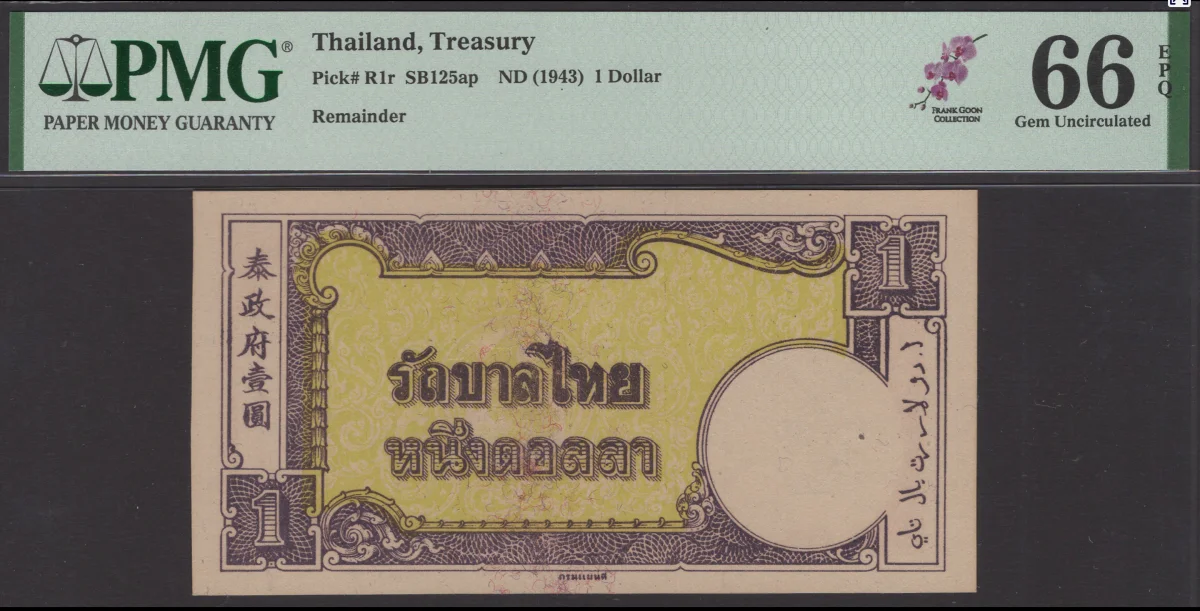
In other cases, rarity arises because a note was never issued at all. The Thailand Occupation of Malaya 1 Baht note (Pick R1) is an excellent example. Produced for use in the four northern Malayan states of Kedah, Perlis, Kelantan, and Terengganu — annexed by the Axis-aligned Thai government following the Japanese invasion of Malaya — these notes were never released into general circulation. As a result, surviving unissued remainder examples are extremely rare today and are actively sought by collectors of wartime and occupation currency.
For this reason, collectors should avoid assuming that an entire series is either common or rare. Often, the true rarity lies within specific varieties, denominations, or historical circumstances that require closer study.
Factor 7: Collector Demand
Rarity alone does not determine desirability. A banknote may be genuinely scarce, but if few collectors are interested in acquiring it, prices and market activity may remain relatively modest. Conversely, a note with a larger surviving population can command significant premiums if demand is strong.
For this reason, experienced collectors evaluate rarity and demand together. Understanding how collector interest influences the marketplace is essential when assessing the significance of a banknote.
Popularity Can Create Scarcity
In some cases, collector demand can make a banknote appear scarcer than its actual surviving population would suggest.
When large numbers of collectors actively pursue the same note, available examples may be absorbed into long-term collections and rarely return to the market. As a result, obtaining an example can become surprisingly difficult despite the existence of a substantial surviving population.
Popular themes such as animals, occupation currency, replacement notes, low serial numbers, and iconic historical issues often attract strong collector interest that influences market availability.
International Collector Interest
Some banknotes appeal primarily to collectors within their country of origin, while others attract interest from collectors around the world.
Banknotes associated with major historical events, distinctive designs, wartime occupations, colonial administrations, or internationally recognized issuing authorities often enjoy broader demand. This wider collector base can significantly increase competition for available examples.
For example, Japanese Invasion Money is collected not only in Southeast Asia but also by collectors interested in wartime currency, military history, and occupation issues. This international appeal contributes to sustained collector demand across multiple collecting communities.
The Influence of Registry and Competitive Collecting
Competitive collecting can also influence demand for certain banknotes.
Some collectors pursue complete series, signature sets, replacement note sets, or high-grade collections. Others participate in registry programs that encourage collectors to seek the finest available examples of specific notes.
As a result, demand may become concentrated on particular varieties, dates, signatures, or grades, creating additional competition even when the overall issue is not especially rare.
Understanding these collecting dynamics helps explain why two banknotes with similar rarity levels may experience very different market outcomes.
Ultimately, rarity creates opportunity, but demand determines how collectors respond to that opportunity. Collectors who are new to the hobby may find our guide to Banknote Collecting a useful starting point for understanding how collector interest shapes the market. The most sought-after banknotes are often those that combine genuine scarcity with strong and sustained collector interest.
How to Identify Rare Banknotes Through Research
Learning to identify rare banknotes requires more than examining a note’s age, appearance, or asking price. Experienced collectors rely on multiple sources of information to evaluate rarity, verify varieties, and understand how a particular issue fits within the broader collecting landscape.
No single source provides a complete answer. Instead, rarity research is most effective when several references are used together.
Reference Catalogues
Reference catalogues are often the starting point for rarity research. They provide standardized numbering systems, issue information, signature varieties, denomination details, and basic market data that help collectors identify exactly what they own.
Catalogues are particularly useful when distinguishing between similar banknotes that may appear identical at first glance but differ in signatures, prefixes, issuing authorities, or other collectible characteristics.
Collectors unfamiliar with numismatic terminology may also find our Banknote Glossary useful when researching specialized terms and descriptions.
Auction Records
Auction records provide valuable insight into real-world collector demand and market activity.
Unlike catalogue values, which are often general estimates, auction results show what collectors have actually been willing to pay for specific notes under competitive market conditions. Reviewing multiple auction records can help collectors identify which varieties consistently attract interest and which notes appear only infrequently.
Auction archives are especially useful when researching scarce varieties, replacement notes, specimens, and other specialized material.
Population Reports
Population reports published by professional grading services such as the PMG Population Report can help collectors understand how many examples of a banknote have been certified within particular grade ranges.
These reports are particularly useful when evaluating condition rarity and identifying notes that are difficult to obtain in premium grades. However, collectors should remember that population reports reflect only certified examples and do not measure the total number of surviving notes.
When used alongside catalogue data, auction records, and historical research, population reports can provide valuable context regarding paper money rarity and market availability.
Collector Communities and Specialist Literature
Many rarity discoveries originate from dedicated collectors rather than official publications.
Specialist books, society journals, research articles, and organizations such as the International Bank Note Society (IBNS) often contain information that may not yet appear in standard catalogues. These sources can be particularly valuable when researching obscure varieties, occupation currency, emergency issues, and regional banknote series.
Engaging with knowledgeable collectors and consulting specialized literature can often reveal insights that are difficult to obtain through any single reference source.
Ultimately, the most reliable banknote rarity assessments come from combining multiple sources of information. Collectors who verify their conclusions through catalogues, auction records, population reports, and specialist research are far more likely to identify genuine rarities and avoid costly mistakes.
Common Mistakes When Identifying Rare Banknotes
Even experienced collectors occasionally misjudge rarity when trying to identify rare banknotes. Many assumptions that seem logical at first glance can lead to inaccurate conclusions about a banknote’s scarcity, desirability, or market significance.
By understanding these common mistakes, collectors can make better-informed decisions and avoid relying on misleading indicators.
Assuming Old Means Rare
Age alone does not determine banknote rarity.
Many nineteenth-century and early twentieth-century banknotes survive in large quantities because collectors, institutions, and archives preserved them. Conversely, some relatively modern banknotes can be genuinely scarce because they circulated heavily, were withdrawn quickly, or were produced in limited quantities.
When evaluating rarity, collectors should focus on surviving populations rather than age alone.
Misinterpreting Low Population Reports
Population reports can be valuable research tools, but they are often misunderstood.
A low population count does not necessarily mean a banknote is rare. In some cases, few examples have been certified simply because collectors have not submitted them for grading. In other cases, large numbers of uncertified examples may exist in private collections.
Population data should always be considered alongside print runs, survival rates, auction records, and market availability.
Confusing Condition with Rarity
A banknote may be difficult to find in high grade without being rare overall.
For example, a note may be readily available in circulated condition but scarce in uncirculated grades. This is known as condition rarity and differs from absolute rarity, which relates to the total number of surviving examples.
Collectors who understand this distinction are less likely to mistake a difficult-to-find grade for a genuinely rare issue.
Ignoring Collector Demand
Rarity and demand are closely related, but they are not the same thing.
A genuinely scarce banknote may attract limited interest if few collectors pursue it, while a more available note can command strong prices because demand is exceptionally high. Focusing solely on rarity without considering collector demand can lead to unrealistic expectations regarding market value.
Successful collectors evaluate banknote rarity, demand, condition, and historical significance together rather than relying on any single factor.
Ultimately, identifying rare banknotes requires careful research and a willingness to look beyond simple assumptions. Collectors who verify information using multiple sources are far more likely to recognize genuine rarities and avoid costly mistakes.
How to Identify Rare Banknotes: Frequently Asked Questions
Final Thoughts on Identifying Rare Banknotes
Learning how to identify rare banknotes is one of the most valuable skills a collector can develop. While many people focus on age or catalogue prices, true rarity is often shaped by a combination of factors including print runs, survival rates, condition, varieties, historical significance, and collector demand.
As this guide has shown, banknote rarity is rarely determined by a single characteristic. A banknote may be scarce because few were printed, because most examples were destroyed, because a particular variety was issued in limited numbers, or because collectors actively compete for the surviving population. In many cases, understanding why a note is rare is just as important as knowing that it is rare.
The most successful collectors approach rarity with curiosity and research rather than assumptions. They compare catalogue information, review auction records, study varieties, examine population data, and learn the historical context behind the notes they collect. Over time, this knowledge helps them recognize opportunities that casual collectors may overlook.
It is also important to remember that rarity and value are not always the same thing. Some genuinely rare banknotes remain relatively affordable because collector demand is limited, while other notes command strong prices because they combine rarity with historical significance, exceptional condition, or broad collector appeal.
Ultimately, identifying rare banknotes is not about memorizing a list of scarce issues. It is about understanding the factors that create rarity and applying that knowledge consistently. By studying print runs, survival rates, varieties, special issues, historical events, and market demand, collectors can make more informed decisions and gain a deeper appreciation for the stories behind the world’s most fascinating banknotes.
The more you research, the easier it becomes to distinguish between notes that are simply old and notes that are genuinely rare.