PMG Population Report Explained: How Rare is Your Banknote?
Learn how to read a PMG population report and understand how rare your paper money is. Discover Top Pop banknotes, grade rarity, and collecting insights today.
5/7/20268 min read
In today’s numismatic world, collectors have more tools than ever to understand what makes a banknote truly special. Beyond historical significance and visual appeal, one of the most important factors influencing desirability is rarity—not simply how old a note is, but how often it appears in the market and in what condition.
Modern collecting has evolved from relying purely on experience to using data-driven insights. Among the most valuable of these tools are population reports published by Paper Money Guaranty. These reports provide a clear and structured view of how many examples of a banknote have been graded and how they are distributed across different grades.
For collectors who are already familiar with grading concepts, such as those explained in banknote grading fundamentals, population data adds an additional layer of clarity. It allows collectors to move beyond condition alone and understand how a note compares within the wider certified market.
Whether you are starting your collection or refining a high-quality portfolio, understanding population data brings confidence and direction. It highlights not only how available a banknote is, but also which examples stand out in superior condition—often the key factor behind long-term collectibility.
What Is a PMG Population Report?
A PMG population report is a detailed database published by Paper Money Guaranty showing how many banknotes of a specific type have been graded and certified.
Each banknote is categorized by country, denomination, and catalog reference, and then grouped according to grade. As more notes are submitted for grading, the report grows into a comprehensive reference that reflects how frequently particular issues appear in certified form.
In simple terms, a PMG population report answers a key collector question:
How many graded examples of this banknote exist, and in what condition?
Because PMG applies consistent grading standards, these reports allow collectors to compare notes objectively across different countries and series. When used alongside guides such as What is PMG Grading and PMG Grading Scale, population reports provide a complete framework for understanding both condition and rarity.
Why Population Reports Matter to Collectors
Population reports matter because they transform collecting into a more informed and structured experience.
Instead of relying on observation alone, collectors can see how often a banknote appears in certified form and how those examples are distributed across grades. This makes it easier to understand why certain notes, particularly in higher grades, are more desirable.
For collectors comparing different notes, population data provides valuable context. A banknote that appears similar at first glance may differ significantly when viewed through its population distribution. This deeper insight supports more confident decisions and enhances the overall collecting experience.
When combined with structured approaches such as grading banknotes the IBNS way, population data helps collectors build collections with both clarity and purpose.
How to Read a PMG Population Report
A PMG population report follows a clear structure that becomes easy to interpret once understood.
Each entry identifies a banknote by catalog reference, denomination, and series, followed by the total number of graded examples. This total population provides an overview of how frequently the note appears in certified form.
The most important information lies in the grade distribution. This shows how many notes exist at each grade level, from circulated examples to high-grade uncirculated pieces.
In simple terms, reading a population report involves two key steps:
First, look at the total number of graded examples to understand overall availability. Second, examine how those examples are distributed across grades to understand quality.
This approach allows collectors to quickly assess both the presence and the strength of a banknote within the market.
Understanding Rarity: Total Population vs Grade Rarity
Rarity in banknote collecting is best understood by looking at both total population and grade rarity together.
The total population reflects how many certified examples exist overall. However, this alone does not indicate how many examples are preserved in superior condition.
Grade rarity focuses on how many notes exist at higher grades. A banknote may be widely available in circulated condition, yet significantly less common in About Uncirculated or Gem Uncirculated grades.
This distinction is essential because collectors often place greater emphasis on quality. A note that is common in lower grades can still be highly desirable when found in exceptional condition.
Understanding both aspects of rarity allows collectors to appreciate not just how often a note appears, but how it stands out at its finest level.
What Does “Top Pop” Mean in Banknote Collecting?
“Top Pop” refers to the highest graded examples of a particular banknote recorded in PMG population reports.
In simple terms, a Top Pop note is the finest known certified example currently available. These notes represent the highest level of preservation within the population and are often recognized for their exceptional paper quality and visual appeal.
Collectors who focus on high-grade material often seek Top Pop examples because they represent the best available version of a note. Within a collection, these pieces frequently stand out as highlights due to their superior condition.
Understanding the concept of Top Pop helps collectors identify which notes sit at the very top of their category in terms of quality.
Real Example: Reading a PMG Population Report
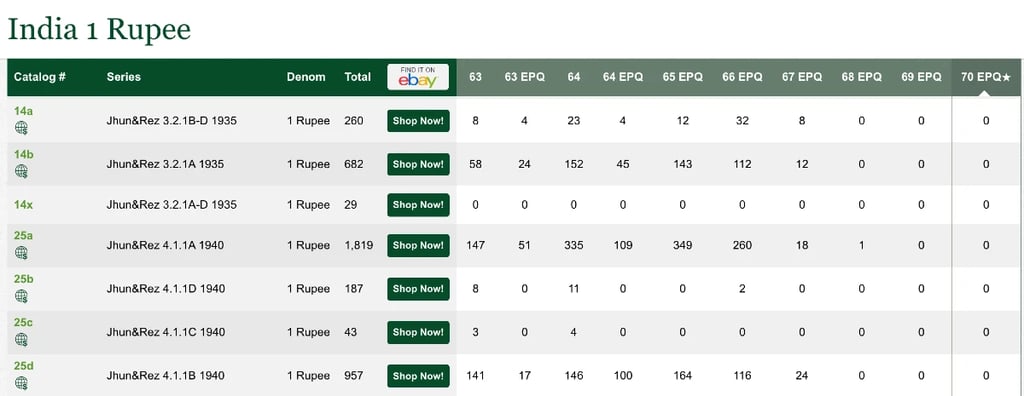
The example above shows a PMG population report for India 1 Rupee banknotes. To explore the full dataset, you can also view the official India 1 Rupee population report on PMG.
To understand how to read and compare this data, let’s walk through a practical example using the 1940 issue (Pick 25 series).
Start by looking at the total population for each variety. You will notice that Pick 25a has a total of 1,819 graded notes and Pick 25d has 957. In comparison, Pick 25b has 187 and Pick 25c has only 43. This immediately tells us that 25b and especially 25c are comparatively rarer varieties within the same series.
Next, move to the grade distribution. Even though Pick 25b has 187 graded examples overall, only 11 notes are graded at 64. This shows that while the note is available, higher-grade examples are much less common, which adds to its appeal among collectors seeking quality.
Now look at the highest grades achieved, often referred to as “Top Pop.” For Pick 25d, the highest recorded grade is 67 EPQ, with 24 notes at this level. This indicates that while the note has a relatively high total population, it is also well represented in top condition, making high-grade examples more accessible compared to other varieties.
By comparing total population, grade distribution, and highest grades together, collectors can develop a clearer understanding of both rarity and quality. This approach allows you to move beyond simply looking at numbers and begin identifying which banknotes stand out within a series.
Using Population Reports to Identify Desirable Banknotes
Population reports provide a practical way to identify banknotes that stand out within a series.
By examining how notes are distributed across grades, collectors can recognize which examples represent stronger quality. Differences between denominations, signature varieties, or printings often become clearer when viewed through population data.
This approach allows collectors to refine their focus and build collections that emphasize both visual appeal and quality. It also works alongside advanced collecting topics such as identifying rare banknotes, where subtle differences can significantly enhance desirability.
Over time, using population data in this way helps create collections that are both structured and personally meaningful.
Population Reports and Market Demand
Population data becomes even more useful when considered alongside collector demand.
Certain banknotes remain consistently popular due to their historical significance, design, or collecting interest. When these notes are available in higher grades, they often attract greater attention within the market.
Understanding how population data interacts with demand allows collectors to see the full picture. It highlights not only how many notes exist, but also how strongly they are sought after.
This combined perspective helps collectors appreciate why certain notes continue to hold strong appeal across different grades and collecting themes.
How Population Data Supports Confident and Long-Term Collecting
Population reports support a more confident and structured approach to collecting.
They allow collectors to identify stronger examples, compare grades more effectively, and build collections with consistency. Over time, collectors may refine their collections by selecting higher-grade examples or improving overall quality within a series.
This process creates a sense of progression, turning collecting into a journey rather than a series of individual purchases.
When used alongside practical decision-making guides such as when to buy raw vs graded banknotes and which notes should you submit for grading, population data becomes part of a broader framework that supports confident and long-term collecting.
Tips for Using PMG Population Data Effectively
Using population data effectively involves combining clear insights with personal collecting preferences.
Comparing grades within a series provides a better understanding of where the strongest examples are concentrated. Exploring variations such as signatures or prefixes can reveal additional depth within a collection.
Aligning population insights with collecting goals ensures that each acquisition contributes meaningfully to a collection. This is especially useful for those following structured approaches such as banknote collecting for beginners or refining strategies through tips for banknote collectors.
Building a Strong Collection with PMG-Certified Banknotes
Building a strong collection often begins with selecting banknotes that offer both quality and consistency. PMG-certified notes provide this foundation by ensuring authenticity and standardized grading. This allows collectors to compare notes with confidence across different countries and series.
When combined with population data, certification helps highlight notes that stand out within the market. Collectors can identify examples that not only meet their preferences, but also represent strong quality within their category. Over time, this approach leads to collections that are well-structured, visually appealing, and aligned with long-term collecting goals.
Collectors looking to strengthen their collections often focus on certified notes that combine quality, rarity, and strong population characteristics, especially when selecting from established and trusted sources.
Final Thoughts: Rarity, Quality, and Confidence in Collecting
PMG population reports provide collectors with a clear and reliable way to understand rarity.
By combining transparent data with standardized grading, they bring structure and confidence to the collecting process. Collectors can better appreciate how a banknote fits within the broader market, both in terms of availability and quality.
With this understanding, collecting becomes more than acquiring notes. It becomes a thoughtful and rewarding process guided by knowledge, clarity, and a deeper appreciation of quality.
Frequently Asked Questions
What is a PMG population report?
A PMG population report is a database published by Paper Money Guaranty that shows how many banknotes of a specific type have been graded and certified. It provides a breakdown of notes by grade, allowing collectors to understand both availability and quality within the certified market.
How do you read a PMG population report?
To read a PMG population report, start by looking at the total number of graded examples to understand overall availability. Then examine how those notes are distributed across grades. This shows where most examples fall and how many exist in higher grades, helping collectors evaluate both rarity and quality.
What does “Top Pop” mean in banknotes?
“Top Pop” refers to the highest graded examples of a particular banknote recorded in PMG population reports. These notes represent the finest certified examples currently available and are often sought after for their exceptional condition and visual appeal.
Are low population banknotes more valuable?
Banknotes with lower population numbers can be more desirable, especially when they also have strong collector demand. Value is influenced by a combination of rarity, grade, and popularity, with high-grade examples often attracting greater interest.
Why do collectors use PMG population reports?
Collectors use PMG population reports to gain a clearer understanding of how often a banknote appears and how it is distributed across grades. This helps them make more informed decisions, compare notes more effectively, and build collections with greater confidence.
Do PMG population reports show all existing banknotes?
PMG population reports show only the banknotes that have been submitted and graded by PMG. While they provide a reliable view of the certified market, they represent graded examples rather than the total number of notes in existence.
How often are PMG population reports updated?
PMG population reports are updated regularly as new banknotes are submitted and graded. This ensures that the data remains current and continues to reflect the latest information available in the certified market.