When to Buy Raw vs Graded Banknotes
Learn when to buy raw vs graded banknotes, how grading works, and how paper money collectors choose between hands-on study and certified protection wisely now
3/5/202611 min read
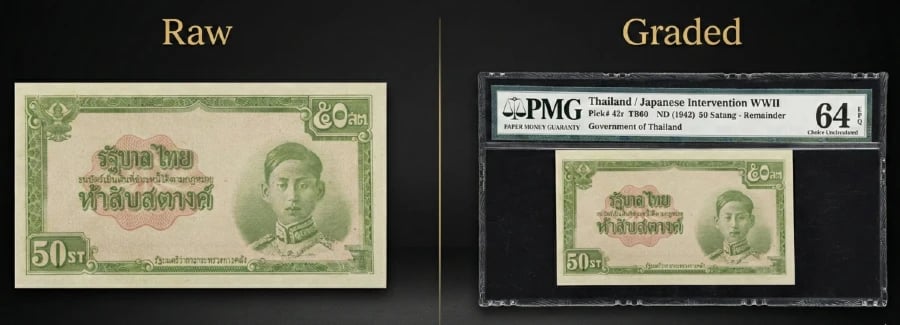
One of the most common decisions faced by paper money collectors is whether to acquire banknotes in raw form or as third-party graded examples. This choice influences not only how a collection is built, but also how collectors evaluate condition, authenticity, preservation, and long-term collecting strategy. In modern numismatics, both raw and graded banknotes play established and legitimate roles within the paper money market.
Raw banknotes allow direct examination and personal evaluation, reflecting traditional collecting practices that emphasize hands-on study and independent judgment. Graded banknotes, by contrast, provide standardized authentication and condition assessment, supporting consistency and confidence in global and online transactions. Neither format is inherently superior, and each serves different purposes depending on a collector’s objectives, experience, and collecting environment.
This article examines the practical and conceptual differences between raw and graded banknotes. By exploring their advantages, limitations, and appropriate use cases, it aims to help collectors make informed decisions grounded in knowledge rather than assumption. Understanding both formats—and learning how to evaluate banknotes effectively—remains essential for serious paper money collectors at every stage.
What Are Raw Banknotes?
Raw banknotes are banknotes that have not been authenticated, graded, or encapsulated by a third-party grading service. They may be stored in protective sleeves, albums, archival holders, or simple envelopes, but their evaluation remains the responsibility of the collector, dealer, or researcher handling them. Historically, all banknotes were collected in this form, and raw examples continue to represent a substantial portion of the global paper money market.
A raw banknote allows direct examination of the paper, printing, and physical characteristics without the visual or tactile barrier of encapsulation. Collectors can assess folds, creases, pinholes, stains, edge wear, paper quality, ink saturation, embossing, and signs of handling firsthand. This direct interaction is particularly valuable when studying circulation patterns, production methods, and subtle condition nuances that may not be immediately apparent through a plastic holder.
Raw banknotes are commonly encountered in older collections, regional markets, estate holdings, and historical archives. Many early or regionally issued banknotes, especially from Asia and former colonial territories, circulate primarily in raw form due to collecting traditions, market preferences, or the nature of their survival. As a result, raw banknotes often provide access to material that may be scarce or unavailable in graded holders.
However, purchasing raw banknotes requires a higher level of personal expertise. Without third-party authentication, collectors must independently evaluate originality, detect repairs or alterations, and determine condition accurately. This places greater emphasis on learning how to assess paper money properly, rather than relying solely on external certification.
For many collectors, raw banknotes represent not only a collecting format but also a learning pathway. Developing the ability to evaluate raw notes builds foundational skills that remain essential even when acquiring graded examples later in a collecting career.
What Are Graded Banknotes?
Graded banknotes are banknotes that have been examined, authenticated, and assigned a condition grade by an independent third-party grading service before being encapsulated in a tamper-evident holder. The grading process is designed to provide a standardized assessment of authenticity and condition at a specific point in time, offering collectors a consistent reference when evaluating banknotes in the marketplace.
The grading workflow typically involves multiple stages. Banknotes are first authenticated to confirm that they are genuine and unaltered. They are then evaluated for condition, with attention given to folds, creases, paper quality, edge wear, pinholes, stains, repairs, and overall eye appeal. Based on these observations, a numerical grade is assigned according to established grading criteria.
Once graded, the banknote is encapsulated in a sealed holder that protects it from physical handling and environmental exposure. The holder also displays essential information, including the grade, issuing authority, denomination, and serial number, creating a permanent record of the grading assessment. This encapsulation facilitates storage, transportation, and display while reducing the risk of accidental damage.
Graded banknotes play a significant role in international and online markets, where buyers may not have the opportunity to examine notes in person. Standardized grading allows collectors and dealers to communicate expectations more clearly across geographic boundaries. For this reason, graded banknotes are often favored for higher-value material, cross-border transactions, and collections where consistency and documentation are priorities.
It is important to recognize that grading does not change the physical attributes of a banknote. Rather, it records an informed opinion based on accepted standards. Understanding how grading decisions are made remains essential for collectors, regardless of whether they primarily acquire raw or graded banknotes.
The Importance of Learning to Grade Banknotes
Learning how to grade banknotes is one of the most important skills a collector can develop, regardless of whether they primarily collect raw or graded material. Grading is not merely a matter of assigning a numerical value; it is a systematic process of evaluating paper quality, originality, handling, and overall condition. These skills form the foundation of informed decision-making in banknote collecting.
Collectors who understand grading principles are better equipped to interpret third-party grades critically rather than accepting them at face value. Encapsulation provides protection and standardization, but it does not replace the need for knowledge. A well-informed collector can assess whether a graded note aligns with personal expectations, identify subtle condition factors, and recognize the impact of folds, pinholes, repairs, or pressing on long-term desirability.
For collectors of raw banknotes, grading knowledge is essential. Without third-party certification, the ability to evaluate condition accurately determines whether a purchase represents fair value or unnecessary risk. Even experienced collectors continue refining their grading skills as they encounter new series, paper types, and printing methods.
Grading literacy also supports better collection management. It allows collectors to track condition consistency, plan upgrades, and decide when professional grading may be appropriate. Over time, this knowledge reduces reliance on external opinions and increases confidence across different market environments.
Resources such as Grading Banknotes and Grading Banknotes the IBNS Way, published in line with standards recognized by the International Banknote Society (IBNS), provide structuredframeworks for understanding grading standards and terminology. Developing these skills transforms collecting from passive acquisition into informed stewardship, ensuring that decisions are guided by knowledge rather than assumption.
Advantages of Buying Raw Banknotes
Buying raw banknotes offers advantages that are closely tied to collector autonomy, direct engagement, and long-term skill development. One of the most significant benefits is unrestricted access to the physical characteristics of the note. Without encapsulation, collectors can examine paper texture, ink application, embossing, folds, edge wear, and handling marks directly, gaining a clearer understanding of how condition manifests in real terms.
Raw banknotes also encourage active learning. Collectors who evaluate condition themselves develop a stronger grasp of grading principles, which improves decision-making across all areas of collecting. This hands-on experience builds confidence and reduces dependence on external assessments, particularly when comparing multiple examples or studying subtle condition differences.
Another advantage lies in historical breadth. Many older issues, regional series, and locally preserved collections remain predominantly available in raw form. For collectors interested in research, provenance, or production characteristics, raw notes often provide broader access to material that may be scarce or unavailable in graded holders.
Flexibility is also a key consideration. Raw banknotes allow collectors to manage collections dynamically, upgrading examples, reassessing condition over time, or deciding later whether professional grading is appropriate. This approach supports thoughtful collection building rather than immediate commitment to encapsulation.
For collectors who value education, research, and personal evaluation, raw banknotes offer a format that prioritizes understanding over standardization.
Risks and Responsibilities When Buying Raw Banknotes
While raw banknotes offer flexibility and learning opportunities, they also place greater responsibility on the collector. Without third-party authentication, the burden of evaluating authenticity, originality, and condition rests entirely with the buyer. This requires careful examination and a solid understanding of banknote characteristics.
One risk involves undisclosed alterations. Repairs, pressing, trimming, or chemical treatment may not be immediately obvious without experience or magnification. Even subtle interventions can affect long-term desirability and historical integrity. Collectors must therefore learn to recognize signs of manipulation and understand how such factors influence condition assessment.
Authenticity is another critical concern. Counterfeit and altered banknotes, particularly those targeting rare or high-demand issues, can appear convincing at first glance. Familiarity with security features, paper structure, printing methods, and serial numbering practices is essential when evaluating raw material. Knowledge in these areas significantly reduces exposure to misrepresentation.
Condition assessment also requires discipline. Without standardized grades, sellers may describe condition inconsistently or optimistically. Collectors must develop their own internal benchmarks to evaluate whether a note aligns with expectations and value.
These risks are not arguments against buying raw banknotes; rather, they define the responsibilities that accompany this approach. Collectors who invest time in learning evaluation techniques gain greater control over their acquisitions and reduce reliance on assumptions or seller descriptions.
Advantages of Buying Graded Banknotes
Buying graded banknotes offers advantages that center on authentication, consistency, and structural clarity within the paper money market. One of the most significant benefits is independent verification. Before encapsulation, a banknote is examined to confirm authenticity and assess condition according to established standards. This process reduces uncertainty, particularly when acquiring unfamiliar material or purchasing banknotes without the opportunity for in-person inspection.
Standardized grading provides a common framework for describing condition. Numerical grades and accompanying designations allow collectors and dealers to communicate expectations more clearly across different markets and collecting traditions. For collectors seeking a deeper understanding of how grading decisions are made, references such as PMG Overview and PMG Grading Guidelines explain how professional paper money grading services, including PMG and PCGS Banknote, assess authenticity and condition.
Encapsulation also serves a protective function. Sealed holders help shield banknotes from handling damage, environmental exposure, and accidental deterioration. This is particularly relevant for higher-grade notes or material intended for long-term preservation. The holder additionally integrates essential identifying information, including issue details and serial numbers, creating a stable and durable reference record.
Graded banknotes are often preferred in structured or internationally oriented collections. Certification can simplify transactions by reducing the need for repeated condition verification, especially when notes change hands across borders or through online platforms. In such contexts, grading supports consistency and documentation rather than replacing personal judgment.
When used appropriately, graded banknotes function as a practical tool that enhances confidence, organization, and preservation within certain collecting strategies.
Limitations of Graded Banknotes
Despite their benefits, graded banknotes also present limitations that collectors should consider carefully. One such limitation is the interpretive nature of grading itself. A numerical grade represents an informed assessment based on defined criteria, but it does not capture every nuance of appearance, paper quality, or visual balance. Two banknotes with identical grades may differ noticeably in eye appeal or historical character, making personal evaluation still essential.
Encapsulation, while protective, introduces physical separation between the collector and the banknote. Direct tactile examination of paper texture, embossing, and ink relief is no longer possible once a note is sealed. Over time, exclusive reliance on graded material may reduce familiarity with how unencapsulated banknotes behave and age, potentially slowing the development of hands-on evaluation skills.
Grading also involves practical considerations. Submission requires time, logistical planning, and associated fees. These factors influence whether grading is appropriate for a particular banknote and may not align with all collecting strategies, especially for material where historical interest outweighs condition sensitivity.
Another limitation is the tendency for numerical grades to shape perception. Collectors must remain mindful that grading is a tool for description rather than a substitute for understanding. Without grading literacy, there is a risk of focusing too narrowly on labels rather than broader numismatic context.
Recognizing these limitations allows collectors to use grading selectively and effectively, ensuring that certification complements rather than replaces informed judgment.
When Buying Raw Banknotes Makes Sense
Buying raw banknotes is often the better choice when a collector’s primary objective is learning, research, or direct engagement with paper money. Collectors who wish to deepen their understanding of grading, paper quality, and circulation characteristics benefit from handling raw notes, as direct examination allows observation of folds, paper texture, ink saturation, embossing, and edge wear without the barrier of encapsulation.
Raw banknotes are particularly appropriate in research-driven collecting. When studying production methods, signature varieties, paper types, or historical circulation patterns, raw examples offer greater flexibility for side-by-side comparison and close inspection. Many early series, regional issues, and locally preserved collections remain available mainly in raw form, making raw acquisition necessary for collectors working in these areas.
Raw collecting also suits collectors who plan to curate collections dynamically. Evaluating multiple examples, upgrading condition gradually, or reassessing notes over time is often easier without the permanence of encapsulation. In such cases, grading may be deferred until a collector determines that a specific note warrants long-term certification.
Additionally, collectors developing grading literacy often choose raw notes intentionally. Practicing independent condition assessment strengthens judgment and improves confidence across all collecting formats. Over time, this knowledge benefits even those who later acquire graded material.
In these scenarios, raw banknotes serve not only as collectible objects but also as educational tools, supporting deeper numismatic understanding and informed long-term decision-making.
When Buying Graded Banknotes Is Preferable
Buying graded banknotes is often preferable when certainty, documentation, and consistency are priorities. Collectors acquiring unfamiliar issues, rare material, or notes from outside their primary area of expertise may benefit from third-party authentication, which confirms originality and provides an independent assessment of condition.
Graded banknotes are particularly useful in remote or international transactions. When in-person inspection is not possible, standardized grading allows buyers and sellers to communicate expectations more clearly, reducing ambiguity. Certification also supports smoother transactions when banknotes change hands across borders or through online platforms.
Collectors building structured collections may also favor graded notes. Encapsulation provides uniform presentation and integrates identifying information into a durable record. This consistency can be valuable for collections intended for long-term preservation, institutional reference, or eventual transfer.
Graded banknotes are also well suited for condition-sensitive material. When precise documentation of condition is important, certification helps maintain stability and clarity over time. In such cases, encapsulation functions as a protective and organizational tool rather than a replacement for knowledge.
In these scenarios, graded banknotes support clarity, preservation, and confidence. When selected thoughtfully and interpreted with understanding, they complement broader collecting strategies and serve specific practical and documentary purposes within the paper money market.
Market Coexistence of Raw and Graded Banknotes
In the modern numismatic landscape, raw and graded banknotes coexist as established and complementary formats rather than competing alternatives. Each serves different collecting purposes, shaped by factors such as historical tradition, market structure, geographic practice, and individual collector preference. Understanding this coexistence is essential for navigating the paper money market without imposing artificial hierarchies.
Raw banknotes remain deeply embedded in traditional collecting practices, particularly in regions where long-standing collections, archives, and local markets emphasize direct evaluation and study. Many historically significant banknotes continue to circulate primarily in raw form, reflecting collecting norms that prioritize research, provenance, and physical examination.
Graded banknotes, by contrast, have become increasingly prominent in global and online markets where standardization, documentation, and authentication support broader participation. Certification facilitates cross-border transactions and allows collectors from different backgrounds to communicate condition expectations more efficiently. In this context, grading functions as an organizational and reference tool rather than a replacement for expertise.
Most experienced collectors engage with both formats over time. Raw notes support learning, research, and flexibility, while graded notes offer structure, preservation, and consistency when appropriate. Recognizing that both formats fulfill legitimate roles allows collectors to make decisions based on purpose rather than perceived superiority, fostering a more nuanced and informed approach to banknote collecting.
Common Myths About Raw vs Graded Notes
Discussions comparing raw and graded banknotes are often influenced by oversimplified assumptions that obscure the complexity of collecting practices. One common misconception is that graded banknotes are inherently superior to raw examples. In practice, grading serves specific purposes but does not determine historical importance, research value, or personal relevance.
Another frequent assumption is that raw banknotes are inherently unsafe to collect. While raw material requires greater expertise, informed collectors routinely evaluate and manage raw notes successfully through knowledge and careful examination.
It is also sometimes assumed that grading removes the need to learn how to evaluate banknotes. In reality, understanding grading principles remains essential for interpreting certified material meaningfully.
Finally, there is a tendency to equate numerical grades with overall significance. Condition is one factor among many, and historical context, rarity, and originality remain central to serious collecting. Recognizing these nuances leads to more informed and balanced collecting decisions.
Conclusion
The choice between raw and graded banknotes is not a binary judgment, but a strategic decision shaped by collecting purpose, experience, and context. Raw banknotes offer direct engagement, flexibility, and valuable learning opportunities, while graded banknotes provide authentication, standardization, and structural clarity in certain market settings. Both formats remain integral to modern paper money collecting.
Developing strong identification and grading skills is the foundation that connects these approaches. Collectors who understand how banknotes are evaluated are better equipped to interpret graded material meaningfully and assess raw notes with confidence. In this sense, mastering grading principles is not optional; it is essential to informed collecting, regardless of format.
As the paper money market continues to evolve, educated collectors increasingly move between raw and graded banknotes based on suitability rather than preference alone. Recognizing the strengths and limitations of each allows collectors to build coherent, historically informed collections while avoiding oversimplified assumptions. Ultimately, informed judgment—rather than format—remains the most valuable asset in serious banknote collecting.
Frequently Asked Questions About Raw and Graded Banknotes
What is the difference between raw and graded banknotes?
Raw banknotes are unencapsulated and evaluated directly by collectors, while graded banknotes have been authenticated and assigned a condition grade by a third-party grading service.
Are graded banknotes safer than raw banknotes?
Graded banknotes provide authentication and standardized condition assessment, but safety ultimately depends on collector knowledge and proper evaluation.
Should beginners only buy graded paper money?
Not necessarily. While graded notes can reduce uncertainty, beginners benefit from learning how to evaluate raw banknotes to develop essential grading skills.
When does grading a banknote make sense?
Grading is most appropriate for high-value notes, international transactions, unfamiliar material, or situations where documentation and consistency are priorities.
Can experienced collectors use both raw and graded banknotes?
Yes. Many advanced collectors strategically use both formats depending on research goals, preservation needs, and market context.