Thailand Series 5 Banknotes: WWII Japanese Print Series
History, design and varieties of Thailand Series 5 banknotes, the only Thai paper money printed under Japanese wartime arrangements during World War II period
4/2/202613 min read
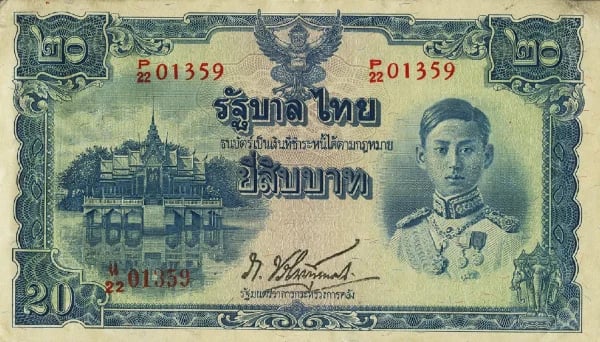
Thailand Series 5 banknotes—widely known among collectors as the “Japanese Print Series”—represent one of the most distinctive wartime Thai paper money issues and a defining chapter in Thailand’s World War II monetary history. Introduced between 1942 and 1945, they remain the only Thai banknote series produced under Japanese wartime printing arrangements, created after Thailand’s normal banknote supply channels were disrupted during World War II.
This series followed directly from the developments seen in Thailand Series 4 Banknotes, which themselves were produced under mixed circumstances—initially printed by Thomas De La Rue & Co. Ltd. in Britain and later supplemented by emergency issues printed locally by the Royal Thai Survey Department. With access to British printing services severed entirely, the Thai government was compelled to seek external assistance elsewhere, resulting in the transition to Japanese state-supported banknote production.
Series 5 was produced without a printer’s imprint under Japan’s Cabinet Printing Bureau, with Mitsui Bussan Kaisha acting as the coordinating intermediary. Wartime realities further shaped production geography, with banknotes printed through Japanese-controlled facilities in Java (Indonesia) and later Saigon (Vietnam)—a regional footprint that firmly situates the series within the wider monetary history of wartime Asia.
From a design and structural perspective, Series 5 is immediately recognizable. It is the only Thai series to place King Ananda Mahidol (Rama VIII) in a forward-facing portrait on the right side of the obverse. It also expands Thailand’s circulating denominations to seven values, from 50 satang to 1000 baht, introducing the lowest denomination banknote ever issued by Thailand. Collectors further distinguish the series by its two principal format types—notes with matching obverse and reverse colors, and those with contrasting reverse colors—marking the only deliberate use of different reverse coloration in Thai banknote design.
Historical Context — Thailand, Japan, and World War II
Thailand–Japan Alliance and Wartime Realignment
On 21 December 1941, Thailand signed a formal alliance pact with Japan following the entry of Japanese troops into Thai territory earlier that month. Soon afterward, the government of Plaek Phibunsongkhram declared war on Great Britain, aligning Thailand politically with Japan during World War II, known in Japanese historiography as the Greater East Asia War. This realignment had immediate economic consequences. Cooperation with Western powers ceased, foreign assets were frozen, and established supply chains for currency production were abruptly disrupted.
At the time, Thailand depended almost exclusively on the British banknote printer Thomas De La Rue & Co. Ltd. for the production of its paper currency. From Series 1 through Series 3, and into Series 4 (Type 1), Thomas De La Rue served as Thailand’s sole overseas banknote printer. With Britain now an enemy power, this relationship became untenable. Although emergency local printing had already begun during the latter part of Series 4, Thailand still lacked the capacity to meet growing wartime demand for currency amid inflation, military expenditure, and expanding monetary circulation.
Wartime Currency Disruptions in Southeast Asia
Across Southeast Asia, the Pacific War severely disrupted monetary systems, but the form of disruption varied by territory. In Burma (Myanmar), Malaya (Malaysia and Singapore), and the Dutch East Indies (Indonesia), Japanese occupation authorities replaced pre-war currencies with Japanese Invasion Money, imposing military-issued notes designed primarily for administrative control rather than long-term monetary stability.
Thailand’s experience was fundamentally different. Although allied with Japan, Thailand was not subject to an occupation currency. Instead, it continued issuing official national paper money, produced under Japanese logistical and technical support. Series 5 banknotes were printed by Japan’s Ministry of Finance Printing Office, and manufactured at Japanese-controlled facilities in Java and later Saigon. Within the broader crisis of wartime currency disruption during the Greater East Asia War, Series 5 thus represents an effort to maintain monetary continuity and sovereignty under exceptional conditions.
Shift in Thai Banknote Production
Collapse of European Printing Supply
By late 1941, Thailand no longer had practical access to European banknote printers. Britain—Thailand’s sole overseas banknote supplier through Thomas De La Rue & Co. Ltd.—had become an enemy power, while continental Europe was either occupied or inaccessible due to the widening conflict of World War II. Although emergency local printing by the Royal Thai Survey Department had begun during the latter phase of Series 4, domestic capacity remained insufficient to meet the rapidly expanding demand for currency.
Rising wartime expenditure, inflationary pressure, and the need for small denominations in daily commerce created an urgent monetary shortage. Maintaining circulation continuity required an immediate external solution.
Request to Japan’s Printing Bureau
To address this crisis, the Thai government formally requested assistance from Japan. Acting as intermediary, Mitsui Bussan Kaisha coordinated between Thai authorities and Japan’s Cabinet Printing Bureau under the Ministry of Finance. The Japanese government agreed to undertake emergency production of official Thai banknotes—marking the first time Thailand entrusted its national currency to a non-Western state printer.
The paper selected for Series 5 was manufactured from mitsumata (hemp) fiber, a traditional Japanese papermaking plant valued for strength and durability. These characteristics made it particularly suitable for wartime circulation under harsh conditions.
Japanese Engraving and Wartime Printing Operations
Kurakichi Kato and the Engraving of Series 5 Plates
The engraving of Thailand’s Series 5 banknotes was entrusted to Kurakichi Kato, Chief Engraver of Japan’s Cabinet Printing Bureau and one of the most accomplished portrait engravers of the Shōwa period. From 1932 onward, Kato had engraved designs for more than fifty foreign banknote issues, making him exceptionally qualified to undertake Thailand’s emergency wartime commission.
Working under severe time constraints, Kato completed the unified portrait plate of King Ananda Mahidol (Rama VIII) in just 26 working days between June and August 1942. The engraving was based on an official photograph taken when the king was still a child, yet the final result conveyed both youthful features and regal authority. This portrait marked two significant departures in Thai banknote design: it was placed on the right side of the obverse, and it was rendered as a forward-facing image, the first such portrait in Thai currency history.
In addition to the royal portrait, Kato engraved the architectural and landscape plates used across the series. Each intaglio plate—depicting major Thai temples and royal buildings—was completed in slightly over ten days. Together, these engravings established a visually unified and artistically coherent series, despite the extraordinary wartime conditions under which Series 5 was produced.
Wartime Printing Facilities: Java and Saigon
As wartime conditions worsened, large-scale printing increasingly shifted away from Japan to Southeast Asia. The Imperial Japanese Navy seized Dutch printing facilities in Java, including the Kolff General Printing Plant, the largest and most advanced printing complex in the region. Operations at Kolff were entrusted to Toppan Printing Co., Ltd., which dispatched specialist teams to manage platemaking, ink production, and banknote printing.
The early issues of Series 5, introduced from 1942 through early 1945, were printed on high-quality banknote paper made from mitsumata fiber, a tough and durable plant traditionally used in Japanese papermaking. These early printings are generally associated with better paper quality and uniform coloration. As the war progressed, however, shortages of raw materials increasingly affected production capacity.
In 1945, printing operations expanded to Saigon, where Yanagawa worked with technicians from Nakata Printing to produce Thai small-denomination notes. This final phase coincided with severe wartime scarcity and continued only until Japan’s surrender in August 1945, when production ceased abruptly. It was during this late period that Series 5 notes with contrasting obverse and reverse colors were introduced—making Series 5 the first Thai banknote issue to deliberately employ different reverse coloration.
Design Elements of Series 5 Banknotes
Thailand’s Series 5 banknotes, issued between 1942 and 1945, display a remarkably unified design language across denominations, shaped by wartime urgency, Japanese engraving standards, and Thai national symbolism. With the exception of the 50 satang note, which differs only in a limited number of technical and format details, the series otherwise follows a highly consistent visual and structural framework. This consistency allows collectors to identify denominations, varieties, and production phases through careful examination.
King Portrait and Obverse Layout
All Series 5 denominations feature a forward-facing portrait of King Ananda Mahidol (Rama VIII) positioned on the right side of the obverse. This represents a decisive break from earlier Thai portrait conventions, where royal portraits were typically rendered in profile and placed on the left. The unified portrait plate was used across all denominations, reinforcing visual continuity throughout the series.
The national title “Government of Thailand” appears prominently on each note, accompanied by a legal tender declaration confirming the note’s lawful status. Denominations are expressed in Thai script and reinforced through both Thai numerals and Western numerals, with placement varying by denomination and sub-type.
National Emblems and Symbolism
Two key national emblems anchor the obverse design of Thailand’s Series 5 banknotes. The Garuda emblem, symbol of state authority, appears prominently above the national title. Complementing this is the Airapote (three-headed elephant), a long-standing royal and mythological symbol traditionally associated with sovereignty and protection. On all Baht denominations, the Airapote appears in the lower right corner of the obverse.
The principal exception is the 50 satang note. Unlike the higher denominations, the Garuda emblem is positioned at the upper left corner, while the lower right corner is occupied by the Constitution-on-pedestal tray motif. Notably, the Airapote (three-headed elephant) is entirely absent from this denomination—a rare and unusual departure in vintage Thai banknote design, where the Airapote had long served as a recurring royal and state symbol.
Watermark
Watermark usage in Series 5 reflects both continuity with earlier Thai banknote design and adaptation to wartime material constraints. Most Series 5 denominations incorporate the familiar Constitution-on-pedestal tray motif, a powerful symbol introduced after the 1932 constitutional transition and carried forward from Series 4. The 50 satang denomination is unique within the series, as it always carries no watermark. For 5 Baht and 10 Baht, in later issues with different obverse and reverse colors introduced toward the end of the war, the paper watermark is absent.
Reverse Design and Layout
The reverse design of Series 5 banknotes is unified by a shared central motif: Padej Dusakorn Fort and the Grand Palace in Bangkok, engraved in fine detail.
Denominations are repeated on the reverse using both Thai and Western numerals, with placement adjusted according to format and type. A standardized forgery-penalty inscription appears beneath the main vignette, completing the reverse layout. While color schemes and technical features may differ between types, the core reverse composition remains stable across the series.
Major Types: Color Usage in Series 5
Major international catalogs such as The Banknote Book and the Standard Catalog of World Paper Money (Pick catalog) generally distinguish Thailand Series 5 banknotes by assigning separate catalog numbers to the two principal format types, defined by whether the obverse and reverse share the same color or display contrasting colors. This high-level classification reflects a fundamental production distinction that is immediately visible and consistent across denominations.
By contrast, many Thai catalogs assign separate numbers to individual sub-types based on serial-number configuration or numeral systems. While both approaches are valid and widely used, this article adopts obverse–reverse color treatment as the primary type-level differentiator, treating serial and signature variations as sub-types within each major format. This framework preserves clarity while accommodating the full technical complexity of Series 5 production.
Type I: Same-Color Obverse and Reverse
The earlier and more common format consists of notes where the obverse and reverse share the same dominant color family. This format applies to all denominations at initial issue, and exclusively to the 50 satang, 1 baht, and 1000 baht denominations throughout the entire series. Within this format, collectors encounter numerous sub-types defined not by design changes but by serial-number configuration.
Type II: Different-Color Obverse and Reverse
The second major format, introduced toward the end of the war in 1945, features a deliberate contrast between obverse and reverse colors. This marks the first time in Thai banknote history that reverse coloration was intentionally differentiated from the obverse. This format appears only on the 5 baht, 10 baht, 20 baht, and 100 baht denominations.
Serial Numbering as the Basis of Sub-Types
Rather than reflecting discrete redesigns, most Series 5 varieties arise from changes in serial-number structure, character format, and placement. Across denominations, collectors will encounter notes bearing three serial positions or two serial positions, with prefixes and numerals rendered in either Thai or Western characters depending on the production phase.
These serial configurations are systematic rather than arbitrary. When studied alongside prefix ranges, they allow collectors to identify sub-types and production sequences with a high degree of confidence. As a result, Series 5 rewards careful comparative study, making it one of the most intellectually engaging Thai banknote series for advanced collectors.
Individual Denomination Designs
Each denomination of the Series 5 banknotes is distinguished by a stable color identity, a specific architectural vignette on the obverse (with the exception of the 50 satang), and progressively increasing dimensions. These visual and physical characteristics allow denominations to be identified independently of serial formats or variety classification.
50 Satang Banknote
Obverse color: Green and pink
Obverse image: No landmark vignette
Dimensions: 117 × 63 mm
1 Baht Banknote
Obverse color: Brown
Obverse image: Mythical naga serpents flanking the entrance to Wat Phumin, Nan
Dimensions: 125 × 65 mm
5 Baht Banknote
Obverse color: Green
Obverse image: Wat Benchamabophit Dusitvanaram (Marble Temple), Bangkok
Dimensions: 135 × 75 mm
10 Baht Banknote
Obverse color: Purple
Obverse image: Wat Phra Chetuphon Vimolmangklararm (Wat Pho), Bangkok
Dimensions: 145 × 85 mm
20 Baht Banknote
Obverse color: Blue
Obverse image: Aisawan Thiphya-Art pavilion, Bang Pa-In Royal Palace, Ayutthaya
Dimensions: 155 × 90 mm
100 Baht Banknote
Obverse color: Red
Obverse image: Wat Arun (Temple of the Dawn), Bangkok
Dimensions: 165 × 95 mm
1000 Baht Banknote
Obverse color: Olive green
Obverse image: Chakri Mahaprasat and Dusit Mahaprasat Throne Hall, Bangkok
Dimensions: 175 × 100 mm
A Collector’s Guide to Series 5 Banknotes
From a collecting perspective, Thailand’s Series 5 banknotes form one of the most intricate and rewarding wartime series to study. Unlike earlier Thai issues, where varieties are often separated by legal tender text, king’s portrait, name of country, or printer, Series 5 varieties arise primarily from production mechanics. Differences in obverse and reverse color treatment, serial-number structure, digit systems, and ministerial signatures collectively define the collecting framework of the series.
For clarity and consistency, Series 5 is best approached through two principal format types: notes with the same color on both obverse and reverse, and notes with different colors on the obverse and reverse. Within these two major types, further sub-types emerge through serial-number placement, and numeral systems, with signature varieties. This layered structure makes Series 5 particularly appealing to collectors who value analytical classification over simple visual differentiation.
Type I: Same-Color Obverse and Reverse
Type I notes form the initial production format of Series 5 and account for the majority of varieties across denominations. In these issues, the reverse is printed in the same color family as the obverse, maintaining a visually unified appearance consistent with earlier Thai banknote traditions.
50 Satang - 2 Varieties
Banknote Book B109 Pick P43
Only one sub-type with alphanumeric prefix and no serial number
a. Signature: Pao Boripanyuthakit. Prefix range: 1V to 100Z, with 1Z recognised as the first issued prefix
b. Signature: Leng Srisomwong. Prefix range: 1U to 55U
Remainders with no serial number and no signature are known.
1 Baht - 5 Varieties
Banknote Book B110 Pick P44
1st sub-type: three serial-number positions, with the lower-left serial rendered in Thai digits
a. Signature: Pao Boripanyuthakit. Prefix range: A/1 to A/40
2nd sub-type: three serial-number positions, with the lower-left serial rendered in Western numerals
a. Signature: Pao Boripanyuthakit. Prefix range: A/41 to B/100
3rd sub-type: two serial positions (on top only)
a. Signature: Pao Boripanyuthakit. Prefix range: C/1 to D/79
b. Signature: Kuang Apaiwong. Prefix range: D/80 (00001 to 20000) and E/1 to E/5
c. Signature: Leng Srisomwong. Known prefix range: D/80 20001 to D/100 and E/6 to E/56
Remainders with no serial number and no signature are known.
5 Baht - 5 Varieties
Banknote Book B111 Pick P45
1st sub-type: three serial-number positions, with the lower-left serial rendered in Thai digits
a. Signature: Pao Boripanyuthakit. Prefix range: K/1 to K/20
2nd sub-type: three serial-number positions, with the lower-left serial rendered in Western numerals
a. Signature: Pao Boripanyuthakit. Prefix range: K/21 to K/40
3rd sub-type: two serial positions (on top only)
a. Signature: Pao Boripanyuthakit. Prefix range: K/41 to K/60
b. Signature: Kuang Apaiwong. Prefix range: K/61 to K/84
c. Signature: Leng Srisomwong. Prefix range: K/84 to K/87
10 Baht - 4 Varieties
Banknote Book B113 Pick P47
1st sub-type: three serial-number positions, with the lower-left serial rendered in Thai digits
a. Signature: Pao Boripanyuthakit. Prefix range: N/1 to N/20
2nd sub-type: three serial-number positions, with the lower-left serial rendered in Western numerals
a. Signature: Pao Boripanyuthakit. Prefix range: N/21 to N/40
3rd sub-type: two serial positions (on top only)
a. Signature: Pao Boripanyuthakit. Known prefix range: N/41 to N/65
b. Signature: Leng Srisomwong. Known prefix range: N/81 to N/91
20 Baht - 6 Varieties
Banknote Book B115 Pick P49
1st sub-type: three serial-number positions, with the lower-left serial rendered in Thai digits
a. Signature: Pao Boripanyuthakit. Prefix range: P/1 to P/20
2nd sub-type: three serial-number positions, with the lower-left serial rendered in Western numerals - Top right prefix in English character
a. Signature: Pao Boripanyuthakit. Prefix range: P/21 to P/30
3rd sub-type: three serial-number positions, with the lower-left serial rendered in Western numerals - Top right prefix in English character
a. Signature: Pao Boripanyuthakit. Prefix range: P/31 to P/33
4th sub-type: two serial positions (on top only)
a. Signature: Pao Boripanyuthakit. Prefix range: P/34 to P/70
b. Signature: Kuang Apaiwong. Prefix range: P/70 to P/93
c. Signature: Leng Srisomwong. Prefix range: P/94 to P/96
100 Baht - 1 Variety
Banknote Book B117 Pick P51
Only one sub-type with two serial positions on top only
a. Signature: Pao Boripanyuthakit. Prefix range: S/1 to S/5
Remainders with no serial number and no signature are known.
1000 Baht - 1 Variety
Banknote Book B119 Pick P53
Only one sub-type with two serial positions on top only
a. Signature: Pao Boripanyuthakit. Prefix range: T/1 to T/2
Remainders with no serial number and no signature are known.
Type II: Different-Color Obverse and Reverse
Type II notes represent a distinct late-series development, characterised by the deliberate use of a reverse color that differs from the obverse. Except for the 100 Baht, these issues also introduce seven-digit serial numbers printed prominently on the face, making them immediately recognisable.
5 Baht - 1 Variety
Banknote Book B112 Pick P46
Purple color on reserve
a. Signature: Leng Srisomwong. Prefix range: K/88 to K/90
10 Baht - 1 Variety
Banknote Book B114 Pick P48
Green color on reserve
a. Signature: Leng Srisomwong. Prefix range: N/92 to N/99
20 Baht - 1 Variety
Banknote Book B116 Pick P50
Brown color on reserve
a. Signature: Leng Srisomwong. Prefix range: P/97 to P/101
100 Baht - 1 Variety
Banknote Book B118 Pick P52
Blue color on reserve
a. Signature: Leng Srisomwong. Prefix range: S/7 to S/21
Conclusion
Thailand’s Series 5 banknotes occupy a unique position in the nation’s monetary history. Issued under extraordinary wartime conditions, they represent the only Thai banknote series produced entirely through Japanese state-supported printing arrangements. Despite material shortages, logistical disruption, and political realignment during World War II, the series maintained a coherent national design identity while introducing several unprecedented features in Thai currency.
From a collector’s perspective, Series 5 stands out for its analytical depth rather than overt visual redesign. Differences in color usage, serial-number structure, numeral systems, and ministerial signatures form a layered classification framework that rewards careful study. This makes Series 5 particularly appealing to collectors interested in production mechanics, wartime administration, and systematic variety attribution.
Beyond their technical and artistic qualities, Series 5 banknotes also reflect the broader challenges of maintaining monetary continuity during conflict. Certain wartime incidents associated with their transport and circulation further illustrate the complexities faced by Thai authorities during this period. These aspects are examined in greater detail in a separate study dedicated to the irregular circulation and official prefix declarations associated with specific Series 5 issues. Taken as a whole, Series 5 remains one of the most intellectually engaging and historically significant banknote series in Thailand’s numismatic canon.
Frequently Asked Questions About Thailand Series 5 Banknotes
Why are Series 5 notes called the “Japanese Print Series”?
They were printed under Japanese wartime arrangements by Japan’s Cabinet Printing Bureau, coordinated through Mitsui Bussan Kaisha, making them the only Thai banknotes produced entirely through Japanese state printing.
Were Thailand Series 5 banknotes Japanese invasion money?
No. Series 5 notes are official Thai government banknotes, not Japanese invasion money. Thailand was not placed under a Japanese military occupation currency regime and continued issuing national currency.
Why is the 50 satang note unique within Series 5?
It is Thailand’s first sub-baht banknote and has no serial number, no watermark, and no landmark vignette, making it structurally distinct from all other Series 5 denominations.
What is the difference between Type I and Type II Series 5 banknotes?
Type I notes have the same colour on both obverse and reverse, while Type II notes use deliberately different reverse colours, a feature introduced late in the series.
Which Series 5 denominations have different obverse and reverse colours?
Only the 5 baht, 10 baht, 20 baht, and 100 baht denominations appear in Type II (different-colour reverse) format.